Skip to content
DevMeme
2728 of 7435
The Tech Professional's Vicious Cycle of Screens
MentalHealth Post #3013, on Apr 25, 2021 in TG

The Tech Professional's Vicious Cycle of Screens

Why is this MentalHealth meme funny?

Level 1: No Break from Screens

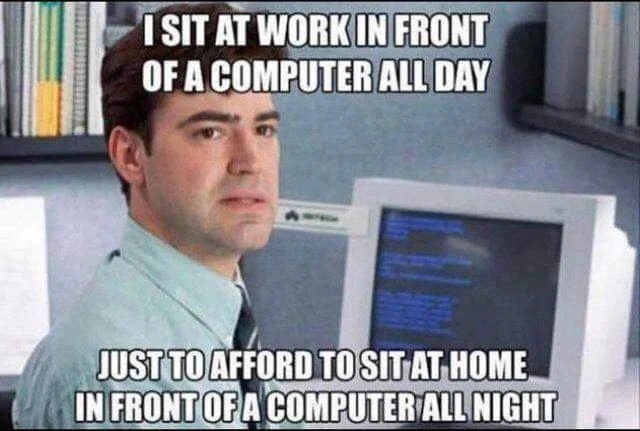
Imagine someone who spends all day doing one thing, then goes home and keeps doing the exact same thing all night. That’s what this funny picture is about. In the picture, a man is at his office job sitting in front of a computer. The joke is that he says he does this all day at work, and then he goes home and sits in front of his computer for the rest of the night. It’s like if you went to school and read books or did math problems all day, and then came home and for fun you just kept on reading more books or doing more math until bedtime! You’d never take a break from the same activity. Here, the activity is using the computer. So the man basically lives his life in front of a screen: daytime working on the computer, nighttime relaxing (also on the computer).

This is funny because usually people do something different to relax after work or school. For example, a bus driver might drive a bus all day, but at night he might watch TV or play with his kids – not keep driving a bus. If he did drive a bus for fun at night, we’d think that’s pretty silly, right? That’s essentially what this meme is saying about a programmer (a person who writes computer software). He works with computers all day to make money, and then when he’s free, what does he do? He goes right back to his computer because that’s what he enjoys. It’s a bit absurd and ironic (ironic means it’s the opposite of what you’d expect). You’d expect him to do something else at night since he’s tired from work, but nope – he’s back at the computer again. Maybe he really loves coding or playing computer games so much that it doesn’t feel like work to him. Or maybe it’s the only way he knows to spend his time. Either way, the poor guy is stuck in an endless loop of computer time! The meme makes us laugh because we feel a little sorry for him but also find it relatable if we also spend too much time on our devices. It’s basically saying: some people work with a computer all day, just so they can go home and play with a computer all night. That’s the funny (and a little bit sad) truth captured in this joke.

Level 2: Day Job, Night Code

This meme highlights a very familiar scenario for many programmers: spending the whole day coding at work, then coming home and continuing to stare at a computer for the rest of the night. The top text says he sits in front of a computer all day at work. The bottom text says he does the same all night at home. In other words, whether it’s daytime or nighttime, work hours or free time, he’s always on the computer. The humor is that his hobby is basically the same activity as his job. Normally people might work at one thing and relax with something different, but here the “relaxation” looks almost identical to work! It’s a funny, slightly absurd twist on work-life balance, because in this case work life and personal life look exactly the same (just in two different locations). The meme format is the classic two-line white Impact font often used for jokes, so it’s meant to be read in that exaggerated, slightly complaining tone. And indeed, the statement reads like a bemused complaint: “I slave away at the computer for my boss all day… just so I can go sit at my computer at home all night.” It’s tongue-in-cheek about how a developer’s idea of fun (more computer time) might look indistinguishable from their actual work.

Let’s break down the picture itself. It shows an office worker sitting in a typical cubicle (those small, semi-enclosed office workspaces divided by grey partition walls). The decor and technology firmly place it in a classic corporate office setting. On his desk is a beige CRT monitor – one of those old bulky computer screens from the pre-flat screen era. (For context, CRT stands for Cathode Ray Tube, the technology used in monitors and TVs before LCDs; they’re deep, heavy, and have a bit of a flicker.) The monitor’s display has bright blue text on a dark background, resembling an old terminal or DOS-based interface from the late 90s. These details give off a strong 90s nostalgia vibe – back then, many programmers worked in cubicles with exactly this kind of setup, and movies like Office Space famously mocked that environment. Even the worker’s fashion (light grey shirt, generic office attire) and the filing binders on the shelf scream “1990s office drone.” By using this image, the meme taps into that recognizable stereotype: the bored guy in the cubicle staring at code or data. It’s a visual shorthand for “tech worker at his day job.”

Now, the twist is in the text: after doing this all day professionally, he then goes home and does it all night as well. This is a nod to how many developers have side projects or continue coding off the clock. For example, a developer might write database code for an insurance company from 9 to 5, then go home and work on a cool video game app or contribute to an open-source project until midnight. Or they might be a QA engineer filing bug reports all day, then spend the evening learning a new programming language for fun. It’s all computer time, just different projects. The meme humorously implies that the only reason he works is “to afford” his home coding setup. In reality, of course, most people work to pay for all their living expenses, not just for more computer gear or software. But it exaggerates the idea that this person’s primary expense or luxury in life is more computer usage! It’s like saying, “My job pays me money, which I immediately invest in more time to sit and code.” This tongue-in-cheek statement makes us laugh because it feels so true for tech enthusiasts: many developers truly do spend a chunk of their salary on better home computer equipment, faster internet, online courses, or that fancy mechanical keyboard – all to enhance their after-work coding experience.

For a junior developer or someone new to this culture, let’s explain a few terms and concepts here. Work-life balance is the idea of having a healthy separation between your job (work) and your personal time (life), so you don’t burn out or lose sight of other important things like rest, hobbies, family, and health. In this meme, the work-life balance is clearly off-kilter: “life” time is being filled with essentially more work (just unpaid and self-directed). Burnout is something developers worry about – it’s a state of physical and emotional exhaustion often caused by long-term stress and overwork, where you lose motivation and energy. If someone is coding all day and all night frequently, that’s a fast track to burnout territory. The meme is funny because it recognizes that risk in a joking way. The guy’s face even looks kind of drained, as if hinting that this routine is not sustainable forever. The tags like MentalHealth and DeveloperBurnout in the context of the meme are pointing out that, humor aside, constantly staring at screens can affect one’s well-being.

The meme also touches on developer culture. It’s quite common in the tech world for people to be very passionate about programming – so much so that they’ll code outside of work hours just for enjoyment or personal growth. For instance, you might hear a young programmer say, “I’m working on a cool VR game engine in my free time,” or “I stay up late tinkering with a Raspberry Pi project after work.” Many developers do this to learn new skills, contribute to open source, or build something of their own. Sometimes it’s even encouraged: having side projects can make you a better programmer and can be useful for your career (it’s something you might show in an interview to demonstrate your skills). However, it also means a lot of late-night coding sessions. The meme captures the overlap of work and hobby: the very tool you use at work – the computer – is also your gateway to leisure, creativity, and socializing (through gaming or chatting or coding with friends). Especially in modern times, many recreational activities (like gaming, watching movies, or coding a passion project) involve sitting in front of a screen as well. So for tech workers, it’s not unusual that after an 8-hour workday at the computer, they go home and end up again in front of a computer, just for different reasons.

We should also note the tone: this meme is relatable humor. People tag it as DeveloperHumor or WorkplaceHumor because it pokes fun at a common situation in a lighthearted way. Even if you haven’t literally done this every single night, if you’re a developer you probably chuckle and think, “Haha, some days it really does feel like I live at my screen.” It’s funny and a little self-deprecating – basically saying we’re a bunch of computer nerds and we know it. There’s also a hint of frustration mixed in the humor: a feeling of “I can’t escape these screens!” Many of us love coding, but we also recognize it’s a bit absurd to spend all our waking hours looking at code or computer output. The corporate culture angle (sitting in a cubicle) contrasts with the freedom of coding at home (maybe he can sit in pajamas or play music while coding at night). Yet, ironically, he’s still sitting in the same position, doing a similar thing. The meme exaggerates to make a point: if you do too much of the same thing, life can feel like an endless loop. It’s using humor to highlight a real issue: developers (and many in modern jobs) have to consciously find variety and breaks, or else you end up like this guy – literally changing locations but not activities.

Overall, for a newcomer, the meme is showing the irony of a developer’s life: “I use a computer at work to make money, so I can use a computer at home for fun.” It’s witty because usually you’d expect someone to say, “I work all day so I can enjoy my hobbies at night,” but here the hobby is basically the same as the work. It’s both praising the passion (hey, we love coding so much we do it in our free time!) and lightly mocking the obsession (maybe we should touch grass or see the outside world once in a while?). The context tags like day_job_night_hobby and personal_free_time_spent_coding summarize it well: working to code, then coding for fun – a cycle many find amusing and all too true.

Level 3: Work-Life Recursion

At first glance, this meme sets up a while-true loop of a developer’s life. The top caption is the setup:

“I sit at work in front of a computer all day…”
The bottom delivers the punchline:
“…just to afford to sit at home in front of a computer all night.”
It’s a sardonic commentary on the work-to-code cycle that many in tech know all too well. Essentially, the meme describes a developer trapped in an infinite loop of screen time – coding by day to earn a paycheck, then coding by night for personal projects or fun. In code, it might look something like:

while (true) {
  codeAtWork(8 /* hours */);
  goHome();
  codeForFun(6 /* hours */);
  // break; // ← maybe insert break here if burnout triggers
}

This endless loop humorously echoes a recursive routine: the function of “being in front of a computer” calls itself again as soon as one cycle ends. The relatable humor comes from how perpetual screen time has become the norm for developers whose hobby is the same as their job. The meme’s image choice is telling: a weary office worker in a drab grey cubicle, chained to a beige CRT monitor with blocky blue text on a dark screen. This retro setting evokes late-1990s tech culture – a nod to the movie Office Space (1999), which famously satirized soul-crushing corporate culture in exactly such cubicles. The blurred, apathetic face screams “burned-out developer in a Dilbert comic,” giving a visual setup for the punchline. Seasoned engineers chuckle (perhaps a bit darkly) because they’ve lived this loop, especially those who started back when IDEs had black backgrounds and Cathode Ray Tube (CRT) screens flickered. The nostalgia of that old terminal font is a wink at veterans: technology has evolved from CRTs to sleek laptops, but the developer lifestyle – long hours in front of glowing screens – persists across generations.

Digging deeper, this meme highlights the blurred line between work and personal life in tech. By day, our protagonist likely wrestles with legacy code or JIRA tickets under fluorescent office lights. By night, he eagerly tackles his passion project (or perhaps grinds through leetcode, or raids in a MMORPG) in the cozy glow of his home setup. It’s the classic day job vs. night hobby dichotomy. The irony is that both phases look identical to an outside observer: he’s just sitting in front of a computer, again, typing away. The only noticeable difference might be the context – at work he’s coding for a boss and a paycheck, at home he’s coding for himself. The meme text “just to afford to” hints at a slightly bitter truth: the day job funds the night coding habit. In other words, he endures meetings, deadlines, and maybe boring tech at work so he can, quite literally, afford the equipment, electricity, and time to indulge in more coding off the clock. This creates a loop of developer work-hobby overlap: the skill and tool that earns his living is the same thing he uses for personal fulfillment. It’s funny because it’s so literal – imagine a chef cooking in a restaurant all day just to go home and cook for fun all night. For a lot of developers, that’s reality. They love coding enough (or feel compelled enough) that their personal free time is spent coding too.

From a senior developer’s perspective, there’s a mix of amusement and concern in this meme. On one hand, it lampoons the passion culture in tech: that unwritten expectation that “real” devs eat, sleep, and breathe code. The joke exposes how this passion can turn into an absurd endless loop where there’s no distinction between labor and leisure – it’s all staring at text editors and terminals. Many experienced engineers will nod knowingly because they remember grinding on an open-source project or freelance gig at night after a full day's work. It’s practically a rite of passage in tech to have a “side hustle” or hobby app on GitHub that you hack on after hours. In fact, a lot of innovation and learning in our field happens during these after-work coding marathons (new frameworks to try, personal apps to build, etc.). The meme is relatable because countless developers have justified to themselves: “I’ll put in the 9-to-5 to pay rent, then use my 5-to-9 to work on my ideas.” There’s a certain pride and humor in that self-imposed “double shift.” It implies a strong intrinsic motivation – you know you truly love (or are obsessed with) programming when you willingly do more of it unpaid. As a result, the meme resonates as a badge of the developer lifestyle: half complaint, half humblebrag that we’re the kind of people who code all night by choice.

On the other hand, the meme also carries an undercurrent of developer frustration and burnout. The man’s exhausted expression isn’t exactly joyous. There’s a subtle critique: if you spend all day in an office coding for a corporation and all night coding for yourself, when do you actually rest or see sunlight? The work-life balance here is comically nonexistent – it’s all work, just some of it is “for fun.” Seasoned devs have learned (often the hard way) that this can be a slippery slope. Continuous late-night coding after a full workday can lead to bleary-eyed mornings, sloppy code commits, and eventually serious burnout. The meme’s humor comes tinged with truth: many of us have felt that eye-strained, caffeine-fueled delirium of coding past midnight, then dragging ourselves to stand-up meeting at 9 AM. The caption “just to afford to sit at home…” hints that the cycle is somewhat unsustainable – it’s like an engine running 24/7 with no cooldown. The veteran perspective might add: “Kid, at some point you’ve gotta hit Ctrl+C on that loop, or life will do it for you.” In other words, eventually your body or mind might force a break (the commented-out break; in the code snippet above). The real laugh here is a knowing one: a recognition that mental health in tech is often challenged by exactly this pattern of overwork. Even as we chuckle, we’re aware that too many all-nighters can transform a passionate coder into a burnt-out husk.

In summary, at the most detailed level, this meme cleverly satirizes the endless loop many developers find themselves in. It combines the nostalgic imagery of the 90s office drone with a timeless inside joke about programming culture: the idea that coding is both our day job and our night-time “play.” It’s funny because it’s true – a bit of self-deprecating humor about how we might complain about sitting at a computer for work, yet voluntarily sit at the same computer at home by choice. The meme lands its punch by highlighting this absurd work–to–code pipeline in a single sentence. Experienced devs appreciate the layers: the reference to classic office ennui (Office Space vibes), the implicit comparison to an infinite loop bug that never exits, and the commentary on how tech workers often blur the line between professional productivity and personal passion. It’s a laugh tinged with “yep, that’s me” recognition and maybe a resolve to at least stand up and stretch once in a while during that never-ending compile-run cycle we call our daily life.

Description

This meme features a still image of the character Peter Gibbons from the 1999 cult classic film 'Office Space.' He is depicted in a dreary office cubicle, wearing a light-colored, collared shirt and a tie, with a look of existential dread or weary resignation on his face. In front of him is an old, boxy CRT computer monitor. The image is overlaid with a two-part caption in a bold, white, all-caps font. The top text reads: 'I SIT AT WORK IN FRONT OF A COMPUTER ALL DAY,' and the bottom text continues the thought: 'JUST TO AFFORD TO SIT AT HOME IN FRONT OF A COMPUTER ALL NIGHT.' The meme humorously captures the ironic reality for many software developers and IT professionals, where their work and leisure activities are often indistinguishable, both revolving around computer screens. It speaks to the blurred lines between a passion for technology and a career in it, resonating with experienced developers who might find their hobbies and their job competing for the same digital real estate

Comments

10
Anonymous ★ Top Pick My home computer has a better GPU, but my work computer has direct access to the production servers. It's a classic trade-off between render latency and deployment latency
  1. Anonymous ★ Top Pick

    My home computer has a better GPU, but my work computer has direct access to the production servers. It's a classic trade-off between render latency and deployment latency

  2. Anonymous

    Day: squeeze 10 ms off the company’s JVM to save them pennies; Night: burn $50 on my idle Kubernetes cluster so two friends can hit /health. Perfectly balanced - except the sleep scheduler

  3. Anonymous

    After 20 years in tech, I've finally achieved the dream: two separate git configs, three mechanical keyboards, and a home setup that costs more than my car - all to maintain the same posture problems in two different locations while arguing about the same architectural decisions on different Slack workspaces

  4. Anonymous

    The ultimate ROI calculation: 8 hours of production code to fund 6 hours of personal projects, 2 hours of Stack Overflow rabbit holes, and the remaining time convincing yourself that rewriting your dotfiles in a new language counts as 'relaxation.' At least the ergonomic chair investment amortizes across both environments

  5. Anonymous

    Day: paid commits to prod. Night: voluntary deploys to Steam

  6. Anonymous

    At work I switch Git branches; at home I just switch kubectl contexts - either way the same chair gets 100% uptime

  7. Anonymous

    I keep prod alive 9 - 5 to pay the power bill for my homelab 5 - 9 - same containers, fewer meetings, finally with root

  8. Deleted Account 5y

    Im working remotely. So... Im sitting in front of a computer all day. And all night. In front of same computer.

    1. @Buckyass 5y

      I feel u. I leave my table only for sleeping :/ This pandemic made everything worse

  9. @asoteric 5y

    I dream of working from home. I may have to find a new job to do that though. You get actual windows that you can open and see sunlight through, control of the thermostat temperature and a relative humidity above 32% so your skin doesn't just start cracking for no reason.

Use J and K for navigation