A Fibonacci Poem about Running Out of Space in a Tweet
Why is this CS Fundamentals meme funny?
Level 1: It Escalated Quickly
Imagine you have a little notebook and you’re writing a poem. You start with a really simple first line – just one word: “I”. For the second line, you also write one word, say “wrote”. Now, you decide on a funny rule for adding more lines: to figure out how many words to put in the next line of the poem, you must add together the number of words from the two lines before it. So since the first line had 1 word and the second line had 1 word, your third line should have 1 + 1 = 2 words. Okay, neat – the third line might be “a poem” (that’s 2 words). Now for the fourth line, you look at the two lines before it (which had 1 and 2 words), and you add those: 1 + 2 = 3 words for line four. Maybe you write “in a tweet” (3 words) on line four.
As you keep following this rule, the number of words per line starts growing pretty fast. The fifth line needs to have 2 + 3 = 5 words. The sixth line should have 3 + 5 = 8 words. Then 5 + 8 = 13 words for the seventh line. By now, each new line is a lot longer than the last! For the eighth line, the rule says 8 + 13 = 21 words. Try to picture a sentence that has 21 words in it – it’s a mouthful 🥵. Now, here’s the catch: Twitter (the platform where you’d post a tweet) has a limit on how much you can write in one post. You can only use up to 280 characters in a single tweet (that includes letters, spaces, punctuation – everything). Think of it like the tweet is a little sticky note; you can’t write more characters on it after it’s full.
So, our poem started very small, but because of the “add the last two lines” rule, each line got longer and longer. By the time the poem reached that eighth line with 21 words, it was using up almost all the space on that Twitter “sticky note.” It nearly ran out of room completely. The tweet even jokes about this: the last line basically says “as you can see, it’s easy to run out of space when a poem goes all Fibonacci-sequence-y.” In simpler words, if you keep making each line longer and longer like this, you’ll run out of space to write! The word “Fibonacci” is referencing the special sequence of numbers we were using (1,1,2,3,5,8,13,21… those are Fibonacci numbers). And “sequency” is just a playful way to say “sequence-like.”
The humor here is that something that began so small escalated really quickly because of that add-the-last-two rule. It’s like a snowball rolling downhill, getting bigger and bigger each turn. By the end, the poem almost couldn’t fit in a single tweet – it almost needed another tweet to continue (like when you have so much to say that you make a second tweet, called a thread). It’s funny and clever because the person writing the tweet followed a strict math pattern to make the poem grow, and in doing so, they demonstrated why that kind of growth can get out of hand. It’s a bit like starting with a tiny seed that grows into a huge vine wrapping around everything.
Anyone reading it realizes by the last lines, “Wow, this got really long, really fast!” – and that surprise is the joke. The tweet basically turned into a mini math puzzle. Even if you didn’t know the Fibonacci name, you could appreciate that each line was getting longer by a fixed rule, and that it ended humorously by bumping into Twitter’s character limit. It’s the same kind of chuckle you’d get from someone intentionally writing a ridiculously long run-on sentence on a small sticky note: the constraint makes it absurd. Here the constraint was the tweet size, and the cause was the ever-growing Fibonacci word count. In the end, the poem is poking fun at itself for becoming so large: it’s saying “see, with this pattern, we ran out of space just like that!”
So, in everyday terms: the meme is funny because it’s showing how a simple rule can make something grow way too big, way too fast. It started as a tiny poem and turned into a monster paragraph that barely fits where it’s supposed to. It’s a playful reminder that sometimes things that grow step by step can suddenly become overwhelming if you’re not careful – whether that’s words in a tweet, toys on your floor, or scoops of ice cream on a cone! Here, it just so happens the growth followed a famous number pattern, and the poor tweet almost burst at the seams because of it. In short, a one-word poem blew up into a novel within a single tweet, all due to a clever little rule – and that unexpected bigness is what makes us laugh.
Level 2: Poem by Numbers
Let’s break down what’s happening in simpler terms. This tweet is essentially a poem with a rule: each new line has more words, following a very specific pattern – the Fibonacci sequence. The Fibonacci sequence is a famous sequence of numbers in math and computer science where every number after the first two is the sum of the two previous numbers. If we start with 1, 1, it goes: 1, 1, 2, 3, 5, 8, 13, 21, 34, 55, and so on. Notice how it grows: after 1 and 1, you get 2 (since 1+1=2), then 3 (1+2=3), then 5 (2+3=5), then 8 (3+5=8)... each time you add the last two to get the next. It’s a gentle start, but the numbers get bigger surprisingly fast. This sequence is a staple of CS_fundamentals; beginners often first encounter it when learning about loops or recursion (a function calling itself).
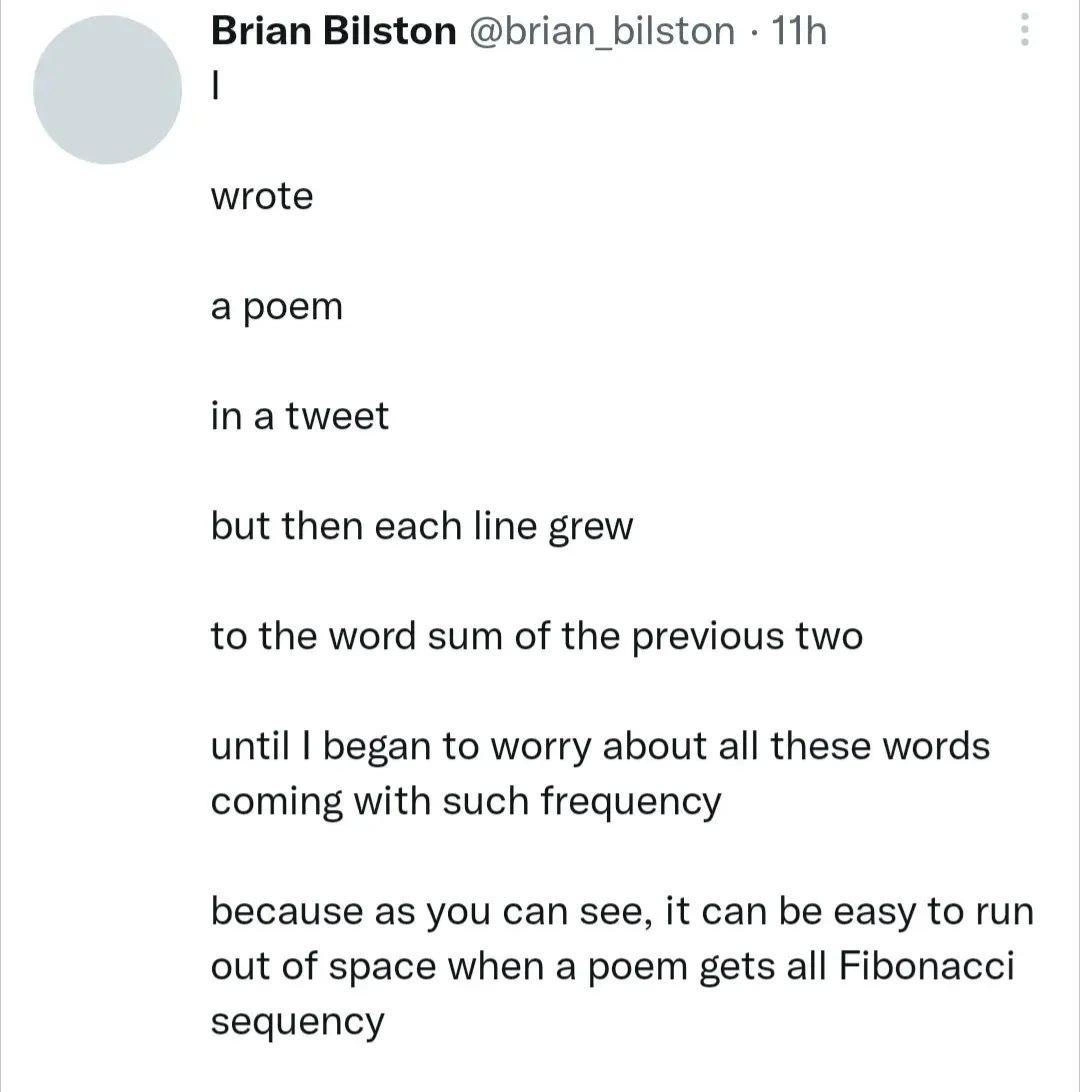
In the tweet, instead of just numbers, we have a poem where the count of words per line follows that Fibonacci pattern. Let’s enumerate the lines to see it clearly:
- Line 1: "I" — 1 word.
- Line 2: "wrote" — 1 word.
- Line 3: "a poem" — 2 words (because 1 + 1 from the previous two lines = 2).
- Line 4: "in a tweet" — 3 words (since 1 + 2 = 3).
- Line 5: "but then each line grew" — 5 words (2 + 3 = 5).
- Line 6: "to the word sum of the previous two" — 8 words (3 + 5 = 8).
- Line 7: "until I began to worry about all these words coming with such frequency" — 13 words (5 + 8 = 13).
- Line 8: "because as you can see, it can be easy to run out of space when a poem gets all Fibonacci sequency" — 21 words (8 + 13 = 21).
As you can see, each line’s word count is literally the sum of the word counts of the two lines before it. The tweet even says this outright in lines 5-6 (“each line grew to the word sum of the previous two”) to confirm the pattern. This is the very definition of the Fibonacci_sequence in action, but applied to word counts instead of plain numbers. It’s like the author turned the concept of a Fibonacci number sequence into a fun linguistic puzzle. In developer terms, it’s an algorithm being expressed in English: take two previous outputs, combine them to form the next output. Pretty neat, right?
Now, the second part of the joke is the Twitter context. Twitter has a strict tweet_character_limit – currently 280 characters per tweet (up from the old 140-character limit a few years back). Think of that like a single tweet’s storage box for text; you can’t put more characters into the tweet than that box can hold. In the meme, they call it a “character budget”, which means you have a fixed amount of characters to ‘spend’ on your message. Once you’ve “spent” (typed) 280 characters, you’re out of allowed space.
So, our poet has this growing poem that’s quickly using up more and more characters with each line. The word_count_growth is not linear (adding a fixed amount each time), but accelerating, because each line is longer than the last two combined. By the time we hit line 8 with 21 words, the tweet is almost out of characters. The phrase "exhausts the character budget" in the title is a humorous way to say "uses up all the characters Twitter allows." Essentially, the poem almost didn’t fit in one tweet! If the author had tried to add a 9th line following the same rule, they would have needed 34 words on that next line 😮. That definitely would have overflowed the single tweet’s limits (34 words alone could be well over 150-200 characters, and adding that to what was already there would shoot past 280). In Twitter, if you go past the limit, you simply can’t type any more— the text box stops you. In coding terms, it’s like hitting the maximum size of an array or string; you can’t append further. The author was conscious of this and ended the poem right when it was about to run out of space, which is part of the joke. They intentionally pushed the limit to demonstrate the effect.
For a newer developer or someone not deeply familiar with Big O notation: this is a playful example of exponential growth vs a fixed limit. Exponential growth means something grows faster and faster, in a compounding way. In contrast, something like linear growth adds the same amount each step. Here, the number of words isn’t doubling exactly, but it’s growing in a compounding way given by the Fibonacci rule (roughly each line has ~1.6 times more words than the previous, on average). Developers often talk about growth using Big O notation: for example, we say linear growth is $O(n)$ and exponential growth might be $O(2^n)$. The Fibonacci sequence growth is about $O(φ^n)$ (where $φ \approx 1.618$ as mentioned), which is still exponential in nature. What you need to know is just that exponential growth gets big really fast. So if you have an exponential process inside a system with a fixed capacity, you’re going to hit the ceiling quickly. That’s exactly the lesson this meme conveys in a funny way. The poem’s length started small but then skyrocketed, bumping into the tweet’s character ceiling by design.
To put it in everyday perspective: imagine you’re writing on a small whiteboard. You write one short word on the first line, one on the second line. Now you decide that for every new line, you’ll write as many words as there were in the last two lines combined. Initially it’s easy: 1 word, then 1 word, then 2 words, then 3 words... not too bad. But soon you’re writing 5 words on one line, then 8 on the next, then 13, then 21, and your lines are getting longer and longer. Eventually, you’re squishing in 21 words on a single line – your whiteboard is almost full, and you realize the next line (34 words!) definitely won’t fit. You’ve basically run out of space. That’s what happened here, except the “whiteboard” is a tweet on Twitter, and the space is measured in characters (letters, spaces, punctuation). The poet had to stop because the character limit was about to be exceeded.
This concept is also a nifty cross between mathematics and everyday tech. The Fibonacci sequence isn’t just a random choice – it’s a famous series in math that shows up in nature (like the number of petals in flowers or the spiral patterns of sunflowers). It’s also one of the first examples many of us see in programming: printing Fibonacci numbers, computing them with recursion, etc. By using it in a tweet, the author made a math puzzle out of a social media post. It’s educational and humorous at the same time. You get the satisfying “aha!” moment when you realize each line’s length is following a pattern you recognize from math class or programming 101. In fact, there’s a term Fibonacci poem (or “Fib”) for poems structured by this sequence — so this tweet is literally one of those. It’s like a little nerdy challenge the author took on: Can I fit a Fibonacci-sequence poem into a single tweet? The outcome was a success (we see it just fits) and a joke: the poem itself starts commenting on how it’s growing too fast to fit.
Let’s touch on the wording of the last line: “gets all Fibonacci sequency.” That’s not an official term; it’s the poet being playful with language. They stuck a “-y” on “sequence” to make it rhyme with “frequency” in the previous line, implying “it’s getting all Fibonacci sequence-like.” It’s a pun – a little wink that says, “yep, I’m doing a Fibonacci thing here.” It ensures even readers who aren’t counting every word can catch the joke by the end. By explicitly dropping the word “Fibonacci” in the final line, the pattern is spelled out for everyone. And describing the poem as getting sequency (sequence-y) is just a fun, quirky way to tie it up. You might say the tweet self-identifies as a Fibonacci sequence at the finish line.
In summary, from a learning point of view: this meme highlights how a simple mathematical rule (add the last two to get the next) can make something grow very quickly, and how that can conflict with a real-world limit (Twitter’s character cap). It’s a humorous demonstration of algorithmic thinking in a creative format. The author implemented an increasing word count algorithm in plain English! And if you’ve just started coding or studying algorithms, it’s a cool reminder: always consider how your output or running time grows, and if there’s any limit it might hit. Here it was just for fun, but in programming, that’s an important consideration. Plus, it shows that even something as dry-sounding as the Fibonacci sequence can be used for a bit of CodingHumor and clever wordplay. Not every day you see a tweet that doubles as a mini computer science lesson!
Level 3: Complexity vs Capacity
To a seasoned developer or computer scientist, this tweet immediately reads like an inside joke about algorithmic complexity running into system limits. The structure of the poem is instantly recognizable: those line-by-line word counts (1, 1, 2, 3, 5, 8, 13, 21…) scream Fibonacci sequence. By line 5 or 6, the pattern is undeniable. An experienced engineer might chuckle because they foresee exactly what’s coming: this clever poem is about to blow past its allotted space, much like an unoptimized program chewing through memory or a recursive function without a termination check. It’s the classic tale of complexity vs. capacity.
Think of the tweet as a little program running on Twitter’s infrastructure. It starts with tiny outputs ("I", "wrote") but then each iteration (each new line) increases the output length by combining the sizes of the last two outputs. This is literally what line 5-6 of the poem spells out:
but then each line grew
to the word sum of the previous two
In plain terms, the tweet itself is documenting the algorithm: each line’s word count = sum of the previous two lines’ word counts. Any senior developer recognizes this as the Fibonacci pattern, and they also know something else: Fibonacci growth accelerates fast. By the time you’re a few iterations in, the numbers become unwieldy. It’s a bit like those infamous scenarios where a seemingly small piece of code unexpectedly generates a huge output or an explosion of computations. In practice, this is often related to exponential time or space complexity – for example, the naive recursive calculation of Fibonacci numbers where the number of function calls doubles with each increment of n. Here, the output (the poem’s text) is what’s expanding rapidly.
Why is that funny in a dev context? Because it’s relatable. We’ve all seen cases where a process grows out of hand: maybe a log file that grows without bound, or an algorithm that works fine for small inputs but suddenly tanks with slightly larger ones. The tweet’s author begins to worry (as they write in line 7) when the words start coming "with such frequency." That line perfectly captures the moment a developer realizes their code’s growth rate is unsustainable. It’s the "uh-oh" of noticing your simple script is now consuming 100% CPU or that your data structure is ballooning. The poem humorously self-documents this growing concern as the lines lengthen. A senior dev reading it nods knowingly—yep, we’ve been there. The poet is essentially performing a live demonstration of a resource limit being hit. In this case, the resource is Twitter’s 280-character allowance (often jokingly called a character budget, as in the meme title). In developer terms, that’s akin to a fixed-size buffer. And what happens when you keep writing into a buffer without checking its size? You risk an overflow. 🚨
Now, Twitter won’t crash if you go over 280 characters – it will just stop you from typing further. But the concept maps perfectly to a software bug where output exceeds the allocated space. An experienced programmer might facetiously think: “If he kept going to a 9th line (34 words), would we get a BufferOverflowException or need to start a new thread (pun intended)?” 😄 In fact, on Twitter, continuing the sequence would require starting a new tweet in a thread, which is a hilarious parallel to how developers have to architect beyond single-limit systems by chaining resources. The poet essentially stopped right at the brink, delivering the punchline that acknowledges the limit: “easy to run out of space when a poem gets all Fibonacci sequency.” This final line is both a wink and a sigh of relief — they didn’t actually overflow, but only because they knew when to stop. That’s a very developer mindset: manage your resources and exit gracefully before disaster.
The humor also lies in the context switch: we expect tweets to be free-form, not following strict numeric patterns. Here we have a programmatic structure masquerading as a casual tweet. It’s like an Easter egg for those in the know. Devs often find it amusing when people apply computing concepts in everyday settings (“haha, that’s algorithm humor in the wild”). And Fibonacci is a classic: it’s taught in every introductory CS course, both as a math concept and through coding exercises (anyone who’s done recursion or dynamic programming has implemented fib(n)). Seeing it applied to a Twitter poem is delightful because it bridges a CS fundamental with a real-world creative constraint.
Moreover, consider the term “character budget.” In tech we often speak of budgets — memory budgets, CPU time budgets, etc., to mean limited resources we must allocate carefully. Calling the tweet’s character limit a budget is tongue-in-cheek language a senior developer finds humorous and apt. It casts tweeting in terms of resource management. The poem exhausting the character budget is analogous to an application exhausting its memory allotment. And indeed, if you tally up the characters, by line 8 the tweet is nearly at the 280 char boundary (just like an app filling up all available RAM). It’s a scenario of diminishing headroom that experienced folks recognize.
One more layer of fun for the seasoned reader: Fibonacci numbers are connected to the golden spiral (a geometric representation of the sequence). So the phrase “spiral out of control” truly fits — the poem’s word count is spiraling upward like a Fibonacci spiral until control (the limit) is reached. It’s a perfect storm of math, coding, and social media limitations all rolled into one joke.
Finally, the poet’s use of the word “sequency” to rhyme with “frequency” in the last line is itself a playful twist. A senior dev or mathematician will recognize that it’s poking fun at itself: sequency isn’t a real term, but clearly nods to “sequence” (as in Fibonacci sequence). It’s the kind of cheeky wordplay that garners an appreciating groan — akin to a coder slipping in a punny variable name in code. It caps off the meme with a linguistic joke on top of the algorithmic one.
All in all, the senior perspective revels in how many layers this seemingly simple tweet has. It’s a textbook example of ComputerScienceHumor: a fundamental concept like Fibonacci is implemented in a novel setting, it triggers a resource limit (evoking real engineering problems), and it even documents its own complexity as it goes. The result is both clever and hilariously true-to-life — a “works in theory, but hitting production limits” moment captured in 280 characters or less.
Level 4: Spiraling Out of Control
At its core, this meme is a brilliant fusion of mathematics and code-like logic hidden within a tweet. Each line of the poem follows the Fibonacci sequence, a famous numerical sequence where each term is the sum of the two preceding terms. In formula form, the recurrence is usually written as:
$$ F(n) = F(n-1) + F(n-2), $$
with starting values $F(1) = 1$ and $F(2) = 1$. Here the word count of each line adheres to that rule – 1, 1, 2, 3, 5, 8, 13, 21… and so on. This sequence grows almost exponentially, at a rate governed by the golden ratio $\varphi \approx 1.618$. In fact, there’s a closed-form known as Binet’s formula:
$$ F(n) = \frac{\varphi^n - \psi^n}{\sqrt{5}}, $$
where $\varphi = \frac{1+\sqrt{5}}{2} \approx 1.618$ and $\psi = \frac{1-\sqrt{5}}{2} \approx -0.618$. For large $n$, $\psi^n$ becomes negligible, so $F(n) \approx \frac{\varphi^n}{\sqrt{5}}$. This tells us that $F(n)$ grows on the order of $\varphi^n$ – effectively an exponential growth pattern (since $\varphi^n$ increases multiplicatively as $n$ rises).
In computer science terms, if you were to naively generate Fibonacci numbers via recursion, it would take on the order of ~$O(\varphi^n)$ time, which is exponential complexity. Similarly, the character count of this tweet’s poem exploded with each new line. By the 8th line, the poem had grown to 21 words, pushing the tweet’s 280-character limit to its brink. The phrase "exhausts the character budget" isn’t just poetic; it underscores a fundamental constraint – a fixed-size buffer (the tweet) being overwhelmed by an exponentially growing output. It’s a playful nod to Big O notation and algorithmic growth: what started as a tiny O(1)-sized snippet turned into an O(φ^n) monster. We’re essentially witnessing a resource consumption curve that spirals out of control in the mathematical sense (Fibonacci numbers famously create the Fibonacci spiral), and indeed the situation quickly becomes untenable.
This elegant Fibonacci construction inside a tweet is more than just number crunching – it’s a subtle algorithmic insider joke. It highlights a classic CS_fundamentals scenario: an unbounded recursion or growth sequence running up against a hard limit. The tweet cleverly demonstrates how something that grows according to a recurrence relation (especially one with a growth ratio > 1) will inevitably collide with any fixed bound. In other words, an algorithm (here, a rule for the poem) that produces output of size $F(n)$ will exceed a fixed-size container when $n$ gets large enough – a scenario theoretical computer science warns us about with concepts like space complexity. The fact that this all happens within a single tweet is delightful to anyone who appreciates the intersection of mathematics and computing. It’s like seeing a tiny self-contained program execute a loop until it nearly causes an overflow, all in plain English.
Historically, it’s also amusing because the Fibonacci sequence has been enchanting mathematicians since at least the 13th century (Leonardo of Pisa used it to model rabbit populations!). Now, centuries later, that same sequence is cheekily used to push the limits of a modern communication platform. This is algorithm design as art: the poet crafted a self-referential, scaling pattern that obeys a strict mathematical rule. The result is a tweet that’s not just ComputerScienceHumor but also a demonstration of how quickly word_count_growth takes off when following a recursive formula. The final poetic twist – calling the runaway pattern “all Fibonacci sequency” – is a playful wink at the mathematically literate. It’s a made-up term to rhyme with "frequency," but it echoes the word sequence, emphasizing that the joke is fundamentally about the Fibonacci sequence. In sum, this level dives into why the tweet’s content grows so explosively: the inexorable math of a recurrence relation meeting the finite world of Twitter. The humor emerges from that collision between infinite theoretical growth and real-world limits, a scenario that’s equal parts academic and absurd.
Description
A screenshot of a tweet by Brian Bilston (@brian_bilston). The image displays a poem where the number of words in each line follows the Fibonacci sequence, starting with one word, then another one, then two, then three, and so on. The poem's text is a meta-commentary on its own structure. The lines are: 'I', 'wrote', 'a poem', 'in a tweet', 'but then each line grew', 'to the word sum of the previous two', 'until I began to worry about all these words coming with such frequency', and 'because as you can see, it can be easy to run out of space when a poem gets all Fibonacci sequency'. The humor lies in the clever, self-referential construction that perfectly demonstrates the mathematical sequence it describes, and the final playful, slightly forced rhyme to complete the concept
Comments
60Comment deleted
This poem is the perfect interview question. It starts simple, demonstrates recursion, and accurately simulates hitting platform limits due to exponential growth. The only thing missing is a stakeholder asking to add one more feature
That Fibonacci poem hitting Twitter’s 280-char wall is every “quick recursive helper” in code review - elegant until n≈8, then it’s O(φⁿ) and PagerDuty starts writing its own elegy
Finally, a Fibonacci implementation that actually ships to production before hitting the heap limit - though the code review comments are growing exponentially too
Every senior engineer knows that moment when your elegant solution reveals its O(n²) nature in production - this poet discovered that Fibonacci sequences in constrained environments have the same problem as unbounded recursion without memoization: they consume resources faster than your stakeholders can say 'why is the server down?' At least when your poem stack overflows, you only lose literary credibility, not uptime SLAs
Like a naive recursive fib(), it looks elegant until it obliterates your 280‑char budget; capacity planning beats poetic asymptotics every time
Naive recursive Fibonacci in verse: starts with two 1s, ends in stack overflow - memoization not included
Fibonacci poem in a tweet: elegant right up until the character count grows ~phi^n - exactly why story points cap at 13
is that a bot? Comment deleted
Yep Comment deleted
incredible Comment deleted
I think this is a discord bot, right? Comment deleted
Nope https://beta.character.ai/ Comment deleted
very interesting AI Comment deleted
Yeah, you can check up this bot. It can answer developer questions and generate simple code https://beta.character.ai/chat?char=iexec0El0VQdiYLhZ5kaD1yX4N16AYFq6_7nIEHwzeE Comment deleted
thanks Comment deleted
Imma ask it questions that I cant find answers in stackoverflow or I cant fit them in a suitable question Comment deleted
Oh thanks Comment deleted
Well, you can swipe left/right, and it will sugest other answers Comment deleted
oh really? Comment deleted
AI become smarter with each day that pass It's kinda scary... I see someday that we can't tell them from ourselves apart... Comment deleted
another russian supporting the war Comment deleted
whats the translation? Comment deleted
translation: LIKE A DICK COVERED IM CUM INTO A FAGGOT'S ASS this part isn't entirely visible but INTO UKRAINE THE RUSSIAN *unintelligible* HAS ENTERED Comment deleted
@dev_void Comment deleted
wtf Comment deleted
yes yes Comment deleted
this is it but i have drawn the continuations of letters Comment deleted
РАТЬ Comment deleted
i suspected that but i thought that wasn't a real word Comment deleted
does that mean something simmilar to рота? Comment deleted
https://ru.wikipedia.org/wiki/%D0%A0%D0%B0%D1%82%D1%8C Comment deleted
Yeah, that's is Comment deleted
No Comment deleted
rly? Comment deleted
truly a literary masterpiece Comment deleted
Well, you didn't get it. The point of the joke is that patriots think about assholes and faggots Comment deleted
oh lol Comment deleted
the start sounds like supporting the war and the rest doesn't Comment deleted
Didn't mean to hurt you. I thought everyone knew the context of this expression because it became a meme on anonymous boards https://arhivach.ng/thread/791161/ Comment deleted
you didn't hurt me Comment deleted
what is this Comment deleted
Satirical channel Comment deleted
. Comment deleted
No Russians that support war here. Comment deleted
I already eliminated most of them via my NATO propaganda 😈 Comment deleted
WTF, Instructor from NATO??? Comment deleted
didn't you know? Every western european is a NATO agent and wants to brainwash the slavic nations Comment deleted
I can confirm As a Hungarian I can confirm Comment deleted
now the question is hungary western europe or eastern europe Comment deleted
😈 Comment deleted
There is a very funny satirical song on this topic, it's a pity it's in Russian ;) Comment deleted
please send it anyway, maybe it's a banger Comment deleted
https://www.youtube.com/watch?v=eczt_SoD0Jg Comment deleted
hey, that sounds pretty good Comment deleted
Yes, but just try to translate it) Comment deleted
blyat blyat suka privet Comment deleted
Better to learn Ukrainian :) Comment deleted
Oh, I know this song too Comment deleted
Hey hey, Austria is not in NATO Comment deleted
not officially 😏 Comment deleted