Skip to content
DevMeme
6302 of 7435
The Cultural Aesthetics of Systems Programming Languages
Languages Post #6908, on Jun 20, 2025 in TG

The Cultural Aesthetics of Systems Programming Languages

Why is this Languages meme funny?

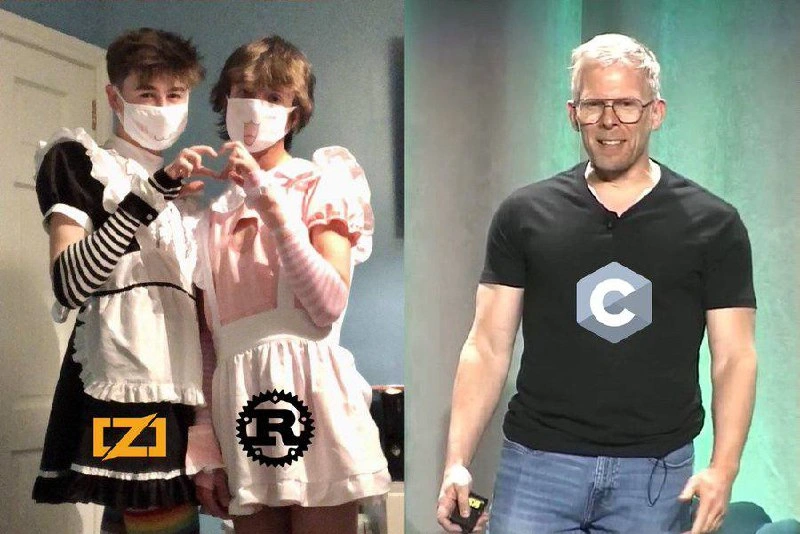
Level 1: Costumes vs Uniform

Imagine you have two excited young inventors who show up to a workshop wearing flashy safety suits and smiling big, saying, “Look, we have these new super-safe tools, we’ll never get hurt using them!” They even do a little heart-hand gesture to show how proud and happy they are with their new gear. Now, on the other side of the workshop, there’s an old master craftsman who’s built most of the furniture and machines in that shop over the years. He walks in wearing just his plain old work clothes – no fancy gear, just a regular shirt – carrying a toolbox that’s a bit worn out. The two youngsters in their colorful protective costumes might represent new fancy tools that promise no accidents, while the old master in his regular uniform represents the traditional tools that, despite being old, have been used forever. The funny part is seeing them side by side: the kids are all dressed up to impress and stay safe, but the grandpa-like craftsman is confident with what he’s always used. He basically says, “Those outfits are cute, and safety is great, but I’ve been doing this work since before you were born, and this old toolkit of mine has built everything here. You can’t just throw it away.” In real life terms, it’s like the new kids have cool new gadgetry, but the old guy’s basic hammer and wrench are still needed because the whole workshop was made with them. We laugh because the youngsters are so enthusiastic and decked out as if it’s a party, and the old guy is like, “Alright, back to real work.” It’s a friendly poke at how each generation or new idea might look fancy, but the experienced old-timer calmly reminds everyone that his way is still holding everything together.

Level 2: New Languages, Old Guard

Let’s break down the scene and the tech references for someone newer to programming: On the left, we have Rust and Zig, two modern programming languages known for systems programming (writing low-level software like operating systems, game engines, or other performance-critical code). They’re depicted as young people in cosplay (costume play) – specifically wearing maid outfits and making a heart with their hands. On the right, we have the C language personified as an older, muscular guy on a stage, wearing a plain black t-shirt with C’s logo (a gray hexagon with a “C”). The contrast is striking and intentional, and here’s why it’s funny to developers:

  • Rust (the one with the pastel pink outfit and the gear-shaped logo 🦀) is a relatively new language (first appeared around 2010, and really popular by the late 2010s). Rust was created to offer the same kind of speed and low-level control as C, but with a big emphasis on memory safety. Memory safety means preventing common bugs like accessing memory that doesn’t belong to you (which can cause crashes or security issues). Rust has a compiler that is strict and checks how you use memory at compile time (before the program runs). For example, it won’t let you have two parts of your program messing with the same piece of data in conflicting ways at the same time – which prevents a lot of bugs in concurrent (multi-threaded) programs. This feature is often called Rust’s borrow checker or ownership system. Rust is also known for a very enthusiastic community (the Rust logo is often shown with a cute crab named Ferris, and Rust developers love to say things like “fearless concurrency” to describe that you can handle multiple threads without fear of data races). The maid outfit and heart likely exaggerate Rust’s community as very friendly, a bit whimsical, and “cutesy” in how they market the language’s benefits (you might see silly memes, Rust-themed plush toys, etc., in real life tech circles). It’s a way to say Rust is the darling “sweetheart” of systems programming right now – loved and adored by many programmers who advocate for safer code.

  • Zig (the one in the black-and-white goth-style maid outfit with the orange Zig logo on the skirt) is another new systems programming language (started around mid-2010s). Zig’s goal is somewhat like Rust’s – to give programmers a way to write very efficient, low-level code more reliably than C – but Zig takes a different path. Zig doesn’t have a borrow checker like Rust; instead, it simplifies things and gives you tools to avoid mistakes. For example, Zig has a feature called defer to ensure resources are freed (kind of like how you’d remember to clean up in any circumstance), and it forces you to handle errors from functions (so you don’t accidentally ignore an error code). Zig emphasizes being small, consistent, and easy to understand (the Zig compiler is known for giving clear error messages, and the language avoids having too much magic). In the meme, Zig is paired up with Rust, making a heart together – this suggests that Rust and Zig, while different, are both part of the new wave. They’re like two new friends in the programming world who share similar values (they both care about things like not crashing, and not needing a big runtime or garbage collector, etc.). The Zig community, like Rust’s, also has youthful enthusiasm (some Zig fans joke about how Zig keeps things simple and might lovingly tease Rust for being more complex). Seeing Zig in a maid outfit next to Rust implies they’re both in this playful, idealistic camp of modern languages that promise to make coding safer and maybe more fun. Cosplay in the context of the meme means they’re literally dressed up in costumes – it’s a popular internet meme format to show something as cute or over-the-top enthusiastic. It’s hinting that Rust and Zig are sort of “dressing up” the idea of system-level coding with new styles and safety features, trying to charm developers.

  • C (the guy on the right, labeled with a big “C” logo) is one of the oldest and most widely used programming languages in the world for system-level programming. It was created in the early 1970s and has been the backbone of a tremendous amount of software – operating systems (like Unix/Linux, Windows parts, Mac OS foundations), hardware drivers, embedded systems (the small computers in appliances and gadgets), and so on. C is known for being low-level and extremely efficient: code written in C can run very fast and can directly manipulate memory and hardware with minimal overhead. However, C does not have built-in safeguards for memory safety. The programmer has to be very careful when using C, because if you make a mistake (like writing past the end of an array, or forgetting to free memory you allocated, or freeing it twice), the language itself won’t stop you – those are called undefined behaviors and they often lead to program crashes or even security vulnerabilities. That being said, C’s power and simplicity made it hugely successful. By “simplicity,” we mean the language core is small – there’s not a lot of abstraction or complexity in the syntax – it’s straightforward once you learn it, but it’s also “simple” in the sense of “no help if you mess up.” Now, in the meme, C is personified as this confident older gentleman in just a plain shirt. This represents how C, despite lacking the fancy new features, is very established and confident in its role. He’s on a stage, suggesting he’s giving a talk or is the center of attention – which is true historically: C has been the star of system programming for many, many years. The caption says he “walks in like legacy isn’t optional.” Legacy here refers to old software or technology that is still in use. When we say something is “legacy,” we mean it might be old or outdated in some ways, but you still have to use or support it because it’s important to a lot of existing systems. So C is basically acting like “I know I’m old-school, but you can’t just ignore me or replace me completely.”

All together, the meme is showing a scenario that’s like a programming language popularity contest or meetup. Rust and Zig are teaming up, full of energy, saying “look at us, we have memory safety, modern features, we’re the future!” (hence the heart sign, like they’re proudly presenting their unity or shared cause). Then C barges in, very sure of itself, basically saying “I’m still here, and I run so much of the world’s software that you must deal with me.” It’s funny because each character’s outfit and posture exaggerates their reputation:

  • Rust & Zig: dressed as maid cafe characters – which is a very playful, somewhat niche/nerdy cultural reference – implying they cater to developers’ desires (for safer code, better tools) in a somewhat fanservice way. “Fanservice” means doing things to please fans; Rust and Zig often get a lot of positive buzz from their fans who are really into them (some might say almost to the point of fandom, where people identify with their favorite language like they’d identify with a sports team or a comic book hero).
  • C: dressed plainly, strong stance – implying it’s the serious, no-nonsense veteran. It doesn’t need to please fans; it’s already proven. In fact, many new languages (like Rust and Zig) still rely on C for a lot of things under the hood (for example, Rust’s standard library uses some C code for low-level parts, and Zig can directly import C code easily as a selling point). So C knows it’s not going away anytime soon.

For a junior developer or someone not deeply familiar with these language communities, it helps to know:

  • Systems Programming: This is a kind of programming where you’re working with code that interacts closely with the computer’s hardware or core system software. It’s different from, say, writing a web app or a game in a high-level engine. Systems programming languages need to be efficient and give a lot of control. C has been the classic choice for this, but it’s tricky to manage safely. Rust and Zig are newer choices that try to make systems programming less error-prone while staying efficient.
  • Memory Safety: A major theme here. Rust and Zig address memory safety in different ways (Rust via strict compile-time rules, Zig via simpler language design and some runtime checks especially in debug builds). Why is this important? Because a huge proportion of bugs and security issues in low-level code come from memory mismanagement (like forgetting to free memory = memory leak, or freeing twice = crash, or writing out of bounds = can crash or let hackers exploit the program). Rust basically forces the programmer to handle memory correctly — if you don’t, your code just won’t compile. Zig tries to make it easier to avoid mistakes, but ultimately still trusts the programmer more than Rust does (Zig will compile code that might be unsafe if you’re not careful, but it gives you tools to be careful).
  • Legacy Code: This term means old code that’s still in use. For example, a bank might have legacy code in COBOL from the 1970s, or an operating system (like some parts of Windows or Unix) has legacy C from decades ago. It’s not easy to just rewrite “legacy” code because it’s often huge, complex, and mission-critical (it’s running important things already). So new languages often have to find ways to work with legacy code rather than replace it all immediately. Rust, for instance, allows you to call C functions and use C libraries through a mechanism called FFI (Foreign Function Interface). Zig can even incorporate C code directly or use C headers seamlessly. These are pragmatic nods to the reality that C is everywhere.
  • Language Rivalry: The meme also references the light-hearted “wars” or debates in programming: people love comparing languages. There’s a bit of a running joke in developer communities whenever a new language gets popular: its fans will say it’s the best and older devs will push back or share cautionary tales. Rust and C debates are common: Rust folks say “No more segfaults (crashes)!” and C folks might reply “Rust has a steep learning curve and slows down our builds,” etc. Zig is newer on the scene, and sometimes Zig fans say “Rust is too complicated with its rules, Zig is simpler and just as good!” So it’s like each language has its cheerleaders.
  • Cosplay meme: Why maid outfits? There’s a bit of absurdist humor here. Maid outfits are kind of random and comical – it’s not what you expect programmers (or programming languages) to be associated with. This comes from an internet meme trend where people ironically celebrate things by wearing maid costumes (for laughs, often on Twitter or forums, like “if my code gets 1000 stars on GitHub, I’ll wear a maid outfit” kind of jokes). So putting Rust and Zig in these outfits is a way to visually say “these are the starlets of the show right now, doing something silly to get your attention and affection.” It’s all in good fun, demonstrating the fan culture around them.

So, in simpler terms: Rust and Zig are portrayed as the cool new kids with fancy tricks (and a flair for dramatic, meme-worthy presentation), and C is the old, muscular mentor who walks in unamused, reminding everyone that the old way is still very much around and in fact forms the foundation of most computing environments. The humor comes from how exaggerated the contrast is – which helps underline real differences. It’s like a cartoon: Rust and Zig literally dressed as maid café characters (friendly, maybe even a bit chibi-cute in spirit), whereas C is like a no-nonsense engineer. For a newcomer, you can take away that Rust and Zig want to make programming safer and have passionate communities, while C is super important historically and practically, but can be dangerous if you’re not extremely careful. And importantly, even if new languages are great, you can’t ignore the old ones that so much existing technology relies on.

Level 3: The Legacy Strikes Back

The meme humorously stages a culture clash that any seasoned programmer will recognize: the new kids on the block (Rust and Zig) enthusiastically flaunting their modern features and safety-first attitudes, while the grizzled veteran (C) walks in with unshakeable confidence, treating legacy systems less as a burden and more as an inevitability that everyone must respect. It’s funny because it rings true – we’ve all seen the narrative where a shiny new language is hyped up to “rewrite everything in a safer/better way,” and then reality walks in, flexing like, “That’s cute, but this mission-critical system is still in C, and you’re going to have to deal with it.” In other words, legacy isn’t optional. C is unapologetically everywhere: in OS kernels (Linux, Windows drivers), in low-level libraries, in embedded devices, and its influence looms large. The presenter with the C logo boldly reminds us of a typical senior engineer or tech lead who’s been around long enough to see languages come and go. 🚧 They know that no matter how many Rustaceans (Rust fans) and Zig aficionados declare C “outdated” or “unsafe,” the industry simply cannot drop everything and move on overnight. There are millions of lines of battle-tested C code out there – some of it legacy code so fragile or specialized that even trying to replace it is a risky venture. That grey hexagon ‘C’ on the muscular presenter’s shirt and his confident stance communicate: “I’ve been doing low-level systems programming for decades without a fancy costume, and guess what? The world runs on my code.” It’s a dose of reality to temper the hype.

For a senior developer, the juxtaposition of the maid outfits on Rust and Zig (with their logos on the frills) against the plain black t-shirt of C is loaded with subtext. Maid outfits are a tongue-in-cheek symbol here – they represent the almost fanatical enthusiasm and over-the-top community culture that has grown around these new languages. Rust’s community, for instance, is known for being friendly, safe-by-default, and sometimes a little extra in how they celebrate (if you’ve been on programming forums or Twitter, you might even have seen real devs jokingly wearing cosplay or doing quirky stunts to show their love for Rust or to celebrate a release). Zig’s community, while smaller, has a similar fervor: they pride themselves on being an up-and-coming challenger to C, often talking up Zig’s clean design and cross-compilation party tricks. The heart shape that the two costumed characters form with their hands shows how Rust and Zig fans often collaborate in spirit — both languages share the common enemy (or beloved frenemy) that is C. They’re like two newer team members at a company who bond over wanting to modernize the tech stack. You can imagine them saying: “We just want safer, more robust code! 💖 Isn’t that great?” And indeed, those are great goals – memory safety, fewer crashes, built-in package managers, etc. – which is why they’re shown as wholesome and appealing.

Then in walks C, the old guard, not even slightly ashamed of being “unsafe” by the new standards. The caption “like legacy isn’t optional” nails it: C carries the weight of inevitability. The muscular presenter’s vibe is “I don’t need frills or crowd-pleasing gimmicks – I am the standard.” He’s confidently giving a talk, which is symbolic: C has been teaching us how computers work since the epoch of Unix. He’s not dressed up because he doesn’t have to win popularity contests; he’s already essential. This is the language that survived format wars, shifts from 16-bit to 32-bit to 64-bit computing, the rise of object-oriented everything, and more. Heck, most modern languages (including Rust and Zig themselves) have written parts of their compilers in C or C++ at some point, or rely on C-written LLVM under the hood. It’s the ultimate “I’m in the foundations of your house” flex.

Senior engineers find this hilarious and relatable because it mirrors discussions we have in real life. We’ve heard junior colleagues gush, “Let’s rewrite this C module in Rust to eliminate all those pesky bugs!” — and sure, that’s enticing (who doesn’t want fewer segfaults?). But then reality: deadlines, testing, the risk of introducing new bugs, lacking Rust experts on the team, or the simple fact that the C code, while ugly, has worked fine for 20 years except that one time it crashed... These practical concerns often win. It’s not that Rust or Zig aren’t objectively better in many ways (they are safer, and Rust especially can prevent entire classes of errors). It’s that legacy code has a gravity that’s hard to escape. We have to integrate new languages gradually, often wrapping or FFI-calling into C libraries because there’s no equivalent library in Rust/Zig yet. Some of us have war stories of porting just a small part of a codebase to a new language and spending weeks on build system issues, performance tuning, or interoperability bugs. It can feel like trying to get the new kids’ flashy ideas through the door of a very established, conservative club.

The meme also touches on language rivalry and “language fandom”. Rust in particular has some meme-worthy stereotypes: for example, the joke that Rust developers will mention Rust’s borrow checker or safety guarantees at every opportunity (similar energy to someone in a fun costume demanding attention 😅). Zig’s fans are fewer but often tout how Zig is simpler than Rust and not weighed down by a complex compiler or long compile times (Rust’s compile times can be famously slow, a point of contention for seasoned devs who value fast edit-compile-run cycles, something C excels at). So, in the image, Rust and Zig literally dressed up might imply they’re trying a bit hard to win hearts and minds. And indeed, in tech conferences or online communities, advocates of new languages do tend to put on a show – presentations, YouTube channels, blogs all evangelizing “we have to modernize and use this cool new tool.” Meanwhile a C veteran might roll their eyes and say “I’ve heard this before – remember when Java or Go or insert-new-language was supposed to replace C? Yet here I am.” The systems programming world has seen many would-be heirs to C’s throne. C++ extended C (but also carried forward much of C’s unsafe pitfalls unless you’re disciplined). D language tried to be a better C++ but never gained mass adoption. Go chose garbage collection for simplicity, which is great for some areas but not suitable for tiny embedded systems or OS kernels – so it didn’t directly displace C in the lowest-level realms. Rust is the first in a long time to actually make headway in traditionally C domains (like portions of Linux kernel being written in Rust now, drivers in Windows started using Rust, etc.), which is exactly why it has such passionate support (and backlash from some old-timers). Zig is another attempt, acknowledging Rust’s success but taking a different stance (trade some safety for simplicity and C-like feel). The interplay between Rust and Zig is kind of friendly (they often see each other as co-belligerents in the fight against C/C++ dominance), hence the heart hands 💕 – they’re different, but in this meme they’re united in being “modern safe languages” challenging the old ways.

We also find humor in how each “character” would speak if this panel came to life. Imagine the dialogue:

Rust (🤍, in pink frills): “We just want you to be safe and fearless when coding concurrency! Look, no more null pointers or data races, isn’t that wonderful?~”
Zig (🖤, in gothic maid attire): “Yeah, and I can give you manual control and sane defaults. No hidden surprises, I promise. We even come with built-in package management – fun, right?”
C (💪, plain tee): “That’s... cute. But I’ve shipped your OS, your databases, heck, probably parts of your language runtimes. I don’t need a costume to get the job done. Legacy isn’t optional, kiddos.”

It’s funny because it’s true on multiple levels: Rust does obsess about safety (to an almost mother-hen degree, preventing you from doing things until you do them the right way), Zig does pride itself on being straightforward and efficient (like a cool alternative friend who also thinks Rust can be a bit much sometimes), and C does not care about your new ideals – it’s running the show in so many places and is brutally efficient and established. The “unapologetically low-level” stance of C in the image (plain black V-neck, maybe even the guy’s slight smirk) embodies that sentiment perfectly. He’s like a veteran engineer strolling into a room of interns who are excited about some new gadget; he respects their energy but also knows they might be underestimating the constraints of the real world.

From an experienced developer’s perspective, the meme is a nod to the cyclical nature of our industry’s language wars. We need that enthusiasm of the Rusts and Zigs to push things forward (better safety, better tooling – who wouldn’t want fewer midnight segfault emergencies?). But we also need the grounded knowledge that certain old problems (and solutions) don’t vanish just because a new language appears. There’s always a transition period, compatibility layers, and new problems that arise (e.g., Rust’s steep learning curve and sometimes cryptic compiler errors might slow down development; Zig’s relatively young ecosystem might force you to write more from scratch). The meme captures that balance with humor: two eager-to-please newcomers vs one battle-tested veteran saying “I’m not going anywhere.” Every senior dev has witnessed this when proposing a new technology at work or watching others do so. It often ends with a compromise: “Okay, we’ll use Rust for the new component, but we’ll wrap the old C library rather than rewrite it,” which is essentially C and Rust/Zig having to cooperate after this meme scene.

In summary, this panel perfectly dramatizes an inside joke among programmers: modern vs legacy in the systems programming arena. We laugh because we see ourselves in it – the part of us that’s giddy about new languages that fix old problems (maybe even goofy enough to evangelize with meme-y flair), and the part of us that’s the gruff pragmatist, knowing that old code and old languages have immense staying power. It’s a playful reminder that in tech, progress happens, but you always tip your hat to what came before (even if it’s a plain old C in a plain old tee, quietly powering the world). After all, legacy isn’t optional – it’s the stage on which new innovations must perform.

// C code: powerful but with no safety net.
#include <stdio.h>
#include <stdlib.h>
#include <string.h>

int main() {
    char *buffer = malloc(10);
    if (!buffer) return 1;
    // Danger: writing beyond allocated memory -> undefined behavior (buffer overflow)
    strcpy(buffer, "Hello, world!"); // "Hello, world!" is 13 bytes, buffer is 10 bytes
    printf("%s\n", buffer);  // This might crash or print random characters
    free(buffer);
    
    // Another danger: use-after-free
    // buffer is freed, but let's say someone mistakenly uses it again:
    // printf("%c\n", buffer[0]);  // Using memory after free - bug! Could crash or worse.
    
    // And double free:
    // free(buffer); // freeing twice - undefined behavior.
    return 0;
}
// Rust code: compiler stops you from those mistakes.
fn main() {
    // Allocate a buffer with 10 bytes capacity using a vector (Vec) in Rust
    let mut buffer = Vec::with_capacity(10);
    buffer.extend_from_slice(b"Hello, ");      // add 7 bytes
    // buffer.extend_from_slice(b"world!");    // If we tried to add 6 more bytes, we'd exceed capacity.
    // Rust will panic at runtime rather than silently corrupt memory.
    println!("{}", std::str::from_utf8(&buffer).unwrap_or("<invalid utf8>"));
    
    // Rust prevents use-after-free by scope:
    let s = String::from("memory safe");
    drop(s); 
    // println!("{}", s); // error: use of moved value `s` (Rust won’t compile this line)
    
    // Rust also prevents double free automatically:
    let x = Box::new(42);
    // When x goes out of scope here, it frees the memory once.
    // There's no way to free it twice because `drop(x)` moves ownership and then x is unusable.
}

In the C code above, we see dangerous flexibility: writing past buffer causes undefined behavior, which could corrupt data or crash – C won’t stop you. In Rust, the equivalent operation would either be checked (with a panic if you overflow a Vec) or simply not allowed by the type rules. Rust’s drop(s) consumes the value s, and any further use is a compile-time error (so no use-after-free at runtime). C would let you free and continue using memory erroneously or free twice, potentially causing a segfault or worse; Rust’s design makes that impossible in safe code. Zig, for its part, would encourage handling these cases explicitly: e.g., if you allocate, you’d use defer to ensure free happens exactly once at the end of a scope, and many risky operations can be caught with Zig’s optional safety checks in debug mode. These examples underscore why Rust and Zig are heralded as “safer C” – they retain the power (pointer arithmetic, manual control if you want it) but try to eliminate the nastiest pitfalls through compile-time checks or simple language design choices. And yet, as the meme implies, even with those improvements, C’s legacy looms – there’s a lot of existing C code that isn’t magically going away, so real-world systems often involve mixing these languages, not just choosing one over the other outright.

Level 4: Type-Safe Catwalk

At the cutting edge of systems programming, languages like Rust and Zig strut their stuff with rigorous memory safety guarantees and modern compiler features, all while aiming to match C’s bare-metal performance. Under Rust’s elegant borrow-checker model (a type-system embodiment of formal lifetime and ownership rules), pointers are tamed by compile-time proofs. This is essentially a form of lightweight formal verification: the Rust compiler acts like a strict fashion police ensuring no dangling pointers or data races walk the runway of your code. In academic terms, Rust’s type system leverages concepts from linear/affine type theory (you can only “use” or own a piece of data once unless you explicitly clone or share it safely). The result? Use-after-free errors and double frees are prevented before the program ever runs. This approach has roots in research languages and concepts (like the region-based memory management of ML’s progeny and Cyclone’s borrowed ideas) but Rust is the breakout star bringing it mainstream without a garbage collector.

Meanwhile, Zig takes a different yet intriguing approach. It foregoes a formal borrow checker and instead relies on simplicity, clarity, and tooling to avoid footguns. Zig’s philosophy is that by removing hidden control flow (no implicit heap allocations, no hidden exceptions) and providing features like defer (for automatic cleanup) and comptime (for executing code at compile-time), developers can write safer code without a nanny compiler holding their hand at every step. It’s as if Zig opts for a minimalist haute couture: fewer pieces, clean lines, nothing extraneous – reducing mistakes by design simplicity. There’s still potential for mistakes (Zig will let you do manual memory management much like C), but it’s designed so that what you write is exactly what runs, making it easier to reason about. It’s closer to C’s low-level model but with modern conveniences and strictness about explicitness (for instance, you must handle errors explicitly, akin to wearing a safety harness you chose rather than one bolted onto you).

C, the seasoned model on this catwalk, operates with a very permissive memory model – practically no safety rails in the language spec. C relies on the programmer (or external tools) to avoid undefined behavior like buffer overflows or invalid frees. The absence of enforced checks was by design in the 1970s to keep overhead near zero. This “freedom” is powerful; you can do pointer arithmetic as boldly as walking the edge of a cliff in high heels – thrilling and dangerous. Over decades, this led to incredible performance (and a rich ecosystem of optimized compilers) but also innumerable security vulnerabilities: out-of-bounds writes, null pointer dereferences, and other memory misadventures that became famous (or infamous) vulnerabilities in systems. In theoretical terms, C leaves memory safety as a runtime concern, meaning the problem of ensuring safety is undecidable in general (thanks, halting problem), so it doesn’t try beyond simple compile-time warnings. Rust’s and Zig’s existence is essentially a response to this classical dilemma: can we have the low-level control of C while reducing the scope of catastrophic mistakes? Rust answers with a resounding “yes, via compile-time theorem-like guarantees and checked rules,” whereas Zig says “maybe, by simplifying the language and making safety a conscious, explicit choice at every step.” It’s a difference in philosophy akin to formal gowns vs. minimalist design on the runway — both aiming to impress, one with elaborate guarantees, the other with simplicity and pragmatism.

Deeper still, there’s an interplay with actual hardware and OS interfaces. C remains the lingua franca of system calls, hardware APIs, and embedded systems. The Application Binary Interface (ABI) of most operating systems is designed around C calling conventions; even Rust and Zig, when they need to talk to the OS or call existing libraries, often use an extern "C" interface. This is like an established standard dance routine at the show: no matter how innovative your new choreography is, you still need to know the classic steps to perform on the main stage. It highlights an underlying truth from computer science and engineering: legacy standards and code create a form of technical inertia. The entire ecosystem (tools, libraries, OS kernels, etc.) has been optimized around C for ages, so newer languages must interoperate with or gradually replace pieces of that giant foundation — they can’t just ignore it. This is reminiscent of the field’s recognition that backward compatibility and decades of optimizations are formidable factors; even the most groundbreaking type-safety proofs or fancy compiler optimizations in Rust/Zig ultimately must produce machine code that plays nice with C’s world. It’s as if Rust and Zig came dressed in modern safety armor to a battlefield long dominated by C’s unarmored agility – they have to prove they can maneuver just as well without tripping over their protective gear. And incredibly, they often do, thanks to techniques like zero-cost abstractions (abstractions that compile away without runtime cost) and advanced optimizations from backends like LLVM. The humor underlying this meme is rooted in these deep technical realities: we’re watching programming language theory and decades of computing legacy literally personified and costumed for dramatic effect.

Description

A two-panel comparison meme contrasting the perceived cultural aesthetics of different programming language communities. The left panel features two young individuals dressed in 'femboy' aesthetic clothing, one in a black and white maid outfit and the other in a pink dress, making a heart shape with their hands. The logo for the Zig programming language is on the maid dress, and the logo for the Rust programming language is on the pink dress. This image represents a modern, online, and somewhat niche subculture. The right panel shows a muscular, middle-aged man with glasses, likely programmer John Carmack, wearing a black t-shirt with the C programming language logo, looking serious while seemingly giving a presentation. This image embodies a more traditional, established, and 'old-school' developer persona. The humor arises from the stark juxtaposition of these cultural stereotypes, humorously assigning them to the user bases of these powerful systems programming languages
Comments

48
Anonymous ★ Top Pick Rust's borrow checker exists to protect its precious users from dangling pointers. C has no such protections because it assumes you're a grown adult who can manage their own memory, and if you mess up, you deserve the segfault
  1. Anonymous ★ Top Pick

    Rust's borrow checker exists to protect its precious users from dangling pointers. C has no such protections because it assumes you're a grown adult who can manage their own memory, and if you mess up, you deserve the segfault

  2. Anonymous

    Rust and Zig showed up in full borrow-checking couture; C skipped the dress code, bench-pressed a segfault, and still got production access

  3. Anonymous

    After 30 years of undefined behavior and manual memory management, C++ finally discovers what its younger siblings have been doing at conferences - turns out Rust and Zig's borrow checker and compile-time safety weren't the only things they were strict about enforcing

  4. Anonymous

    When your shiny new systems languages show up to the party dressed to impress, but C just stands there in jeans knowing it's still running 90% of the world's critical infrastructure - and both Zig and Rust are still trying to figure out how to completely replace it without breaking everything

  5. Anonymous

    Zig and Rust dress as maids promising borrow-checked bliss, but Carbon just drops full C++ interop and owns the room

  6. Anonymous

    Rust and Zig are busy proving lifetimes and comptime invariants; C just reminds you your bootloader, drivers, and half your ‘portable’ libs still FFI to him - payment occasionally due in segfaults

  7. Anonymous

    Rust brings a borrow checker, Zig brings comptime; C brings undefined behavior and a pager - guess which one still boots your router

  8. @H3R3T1C 1y

    Only a fact.... C has leaks..... so allow inputs from every place as unkown behaviors....

    1. @deadgnom32 1y

      like input in every other language?

  9. @RiedleroD 1y

    not true. I'm on the left and know C a lot better than Rust or Zig

    1. @chupasaurus 1y

      Continue the observation

      1. @RiedleroD 1y

        ?

        1. @chupasaurus 1y

          it's a not-so-funny meme

          1. @RiedleroD 1y

            I don't understand your point

            1. @chupasaurus 1y

              There is none, that's what the original meme is about

              1. @RiedleroD 1y

                alright

    2. @purplesyringa 1y

      fun fact: when I started learning Rust I told everyone I'm living proof not everyone who uses it is queer

      1. @purplesyringa 1y

        (I transitioned like half a year later)

        1. @deadgnom32 1y

          trans-rust-dev

      2. @deadgnom32 1y

        but after you learned rust you turned queer?

        1. @purplesyringa 1y

          basically, yes

          1. @Johnny_bit 1y

            note to self: do not try rust or that other thingie. C was, is and will be fine tho :

            1. @deadgnom32 1y

              maybe you might like it.

            2. @deadgnom32 1y

              give it a try

            3. @nightingazer 1y

              no, you should try it. don't believe propaganda, rust is fine. it's quite enjoyable really. speaking as a person who was coding a lot of c then c++ and returned to c before the rust. in the worst case you would just return to c, but with some new perspective that maybe make you a better c programmer (or not). just try new stuff and then see what sticks

              1. @deadgnom32 1y

                I have never tried rust before, only had some code explained, but it felt like C++🤝Haskell and I know both of them, and yes, I can tell that knowing haskell's approaches helps in other languages and paradigmas too.

                1. @nightingazer 1y

                  yeah, rust has some functional influence, particularly from ocaml afaik, and it somewhat tries to be a better c++, so your impression definitely is not so far off. also, tried haskell a couple of times, I'm too stupid for that. or too unmotivated, lol. either way would try again, and even with that limited knowledge of haskell I from time to time apply it in other languages (also, it would be lovely if partial application was not locked to hardcore fp languages)

                  1. @deadgnom32 1y

                    basically I can tell. both languages: C++ and Haskell are no languages you can learn completely, you can only continue to comprehend. and while haskell is rarely used in production — it's approaches are widely used across many languages natively, but also another part of approaches can be used in basically any production-ready language. I learn haskell casually for about 6-8 years, and still when I talk to people talking about it in a Haskell group, I feel I know nothing compared to them, but still, I was able to help other even lesser experienced people in this group. so I do understand something. something enough to solve tasks in a more concise way than a regular programmer, but I still feel dumb compared to those haskell geeks

                  2. _ 1y

                    Isn't that call or apply in javascript ? (I never remember which one is which)

                    1. @deadgnom32 1y

                      same. even though I can easily understand those two when I read about them — I could never remember which one is which — but afterwards I just refused to — I have simply learned common functional patterns which completely make them useless

                    2. @purplesyringa 1y

                      nope, that would be bind

    3. @ZgGPuo8dZef58K6hxxGVj3Z2 1y

      Idk if you intended to sound sarcastic or not💀 👁️👄👁️

      1. @RiedleroD 1y

        …not sarcastic, no.

        1. @ZgGPuo8dZef58K6hxxGVj3Z2 1y

          Damn

        2. @ZgGPuo8dZef58K6hxxGVj3Z2 1y

          Ah fuck I am tired I imagined an "is" word in between "I know C is a lot better"

          1. @ZgGPuo8dZef58K6hxxGVj3Z2 1y

            F

          2. @RiedleroD 1y

            bruh

            1. @ZgGPuo8dZef58K6hxxGVj3Z2 1y

              Its late 😂

  10. @mvolfik 1y

    fake, as a rust user, i would never act like this with my zig friend

    1. @purplesyringa 1y

      yup, name and shame /hj

  11. @Johnny_bit 1y

    Where PHP?

    1. @purplesyringa 1y

      smoking probably

  12. @nightingazer 1y

    guys, you really should try new things to widen your horizon. if you care about your craft, just do it

  13. @alexmishin99 1y

    Zov

    1. @nightingazer 1y

      fuck off

  14. @Algoinde 1y

    Rust provides the answer to the feminine desire of being protected and safe, Zig provides aesthetics and elegancy, while C allows for high-testosterone environment of danger and memory recklessness you have to keep in control over. This even transfers to C#, because men like sharp things like swords and knives. All that and more in my programming gender studies book; purchase it for the low price of $344.99! (not licensed, terms and conditions may apply)

    1. @Algoinde 1y

      As for C++, men treat everyone as objects something something you get the point

      1. dev_meme 1y

        *pointer

Use J and K for navigation