I Told You So: When Ignored Warnings Become Production Fires
Why is this Management PMs meme funny?
Level 1: I Told You So
Imagine your friend is about to do something you know is a bad idea. Let’s say their shoe is untied. You tell them, “Hey, you should tie your shoelace or you might trip.” Your friend brushes it off, like “Nah, I’ll be fine.” So you shrug and carry on. A little while later, boom – your friend steps on that loose lace, stumbles, and falls flat on the ground. They’re not seriously hurt, maybe just embarrassed. You look at them and can’t help but give a little smile because… well, you did warn them. You don’t even have to say “I told you so” out loud – the look on your face says it all.
That’s exactly what’s happening in this meme. The developer (like you in the story) warned the manager (like your friend) about a problem months ago. The manager ignored the warning, just like your friend ignored tying the shoelace. Now the problem has actually happened (equivalent to your friend tripping), and the developer is sitting there with a face that says “I saw this coming.” It’s a bit funny because the developer was right, but it’s also a little sad because if the manager had listened, the whole fall (or problem) could have been avoided.
It’s like when a parent says, “Don’t touch the stove, it’s hot,” but the kid touches it anyway and burns their finger. The parent isn’t happy the kid got hurt, but they did raise an eyebrow with that see, I warned you expression. The meme’s humor comes from that very human situation: someone didn’t listen to good advice and then the exact thing that was predicted happened. The developer isn’t jumping for joy that there’s trouble – they’re just quietly satisfied that their warning was valid.
So in simple terms: the picture is funny because it shows a “I told you so” moment. We’ve all been there, either as the one who gave the warning or the one who ignored it. It’s a little story about why listening is important, told in a joking way. The guy in the picture has the same calm face before and after the disaster, which is a silly way to show that he wasn’t surprised at all. It’s the kind of quiet laugh you get when you’re right about something going wrong.
Level 2: Tech Debt Timebomb
Let’s break down the scenario in simpler terms. In software teams, technical debt refers to the idea that if you take shortcuts or postpone necessary fixes, you accumulate a sort of “debt” that must be paid later, often with interest (the interest being the increased difficulty or risk of a bigger problem). Imagine you write some quick, messy code to meet a deadline, and you tell your boss, “We should really clean this up or it might cause issues.” If the boss (or manager) replies, “We’ll handle it later, it’s not urgent,” that messy bit of code becomes a timebomb quietly ticking away in your project. The meme is about what happens when that timebomb finally ticks down to zero and explodes in production (meaning the real-world system that customers or users rely on). In this story, the developer saw the explosion coming well in advance.
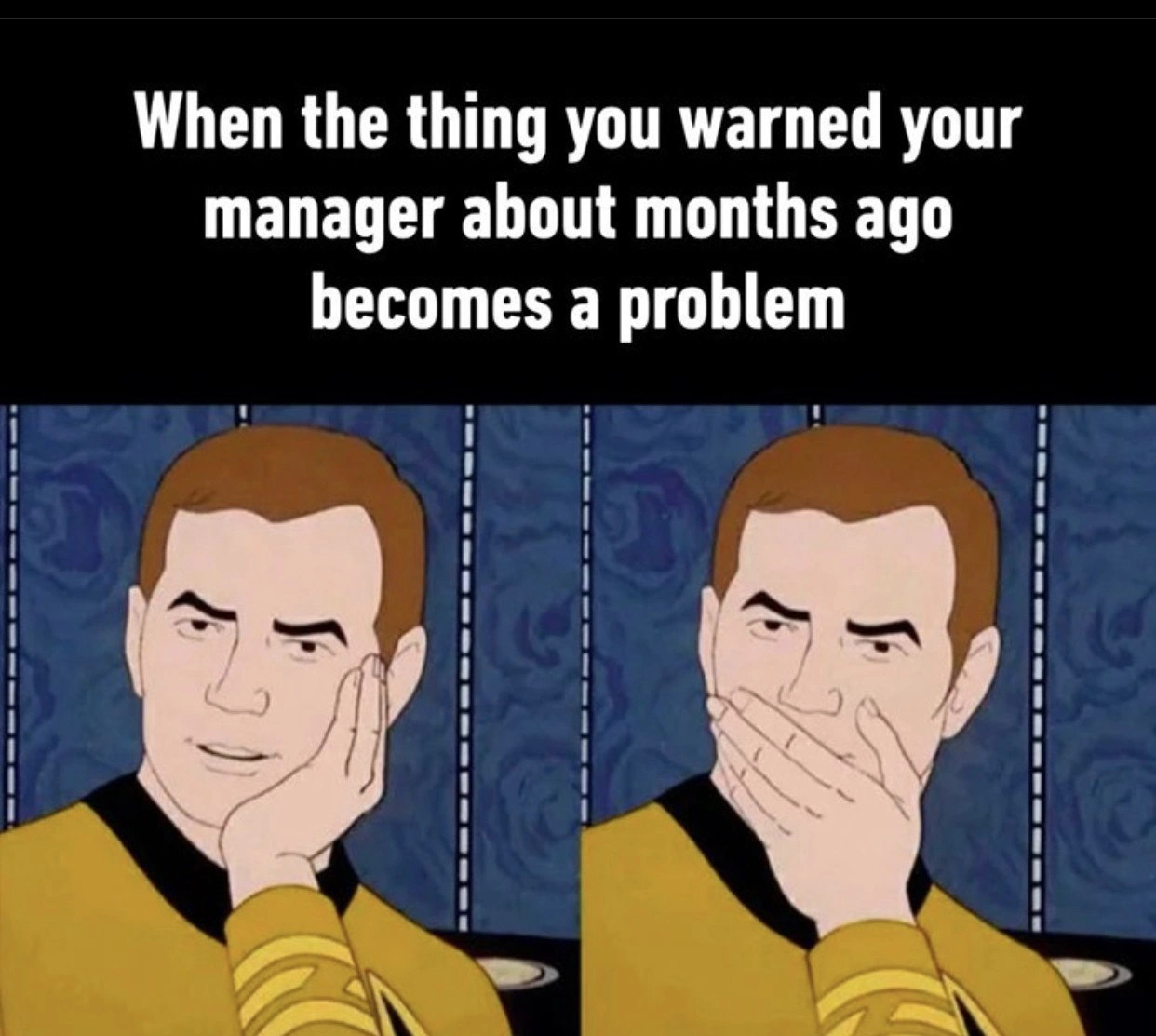
The top text of the meme reads: “When the thing you warned your manager about months ago becomes a problem.” This immediately sets the scene: you – the engineer – had informed your manager months earlier about a potential problem (maybe a bug, an outdated component, a scaling issue, etc.). Ignored_risk is the key theme: the warning was not heeded. Perhaps the manager didn’t fully understand the technical jargon, or they thought the engineer was being overly cautious. This is the CommunicationGap at work: a difference in understanding or priorities between the technical team and management. MisalignedExpectations can also play a role – the engineer expects that any serious risk will be addressed promptly, but the manager expects that everything is fine unless it’s an active fire. They might have said something like, “If it becomes a real issue, we’ll deal with it then,” effectively kicking the can down the road.
Now, months later, that issue has become very real – maybe the site went down during a crucial sale, or a bug started corrupting data, or a security hole got exploited. In other words, the preventable issue materializes in the worst way. This leads to a production incident, which is a fancy term for “something went wrong in the live system we deliver to customers, and we have to fix it right now.” Production incidents often cause panic: managers, engineers, everyone jumps on a call trying to patch the problem ASAP. It’s stressful and usually expensive in terms of lost revenue or reputation.
So where’s the humor? It’s in the developer’s reaction shown in the images. The meme uses two side-by-side cartoon panels of a Star Trek character in a gold uniform (likely Captain Kirk from the classic animated series). In the first panel, he’s resting his chin on his hand, looking contemplative, as if he’s patiently waiting. In the second (which looks almost the same), he has his hand over his mouth, eyes looking slightly upward. The images are basically identical, emphasizing that his expression hasn’t really changed. He’s not shocked or panicking – he’s unfazed. Why? Because he expected this to happen. It’s a told you so moment. The developer is basically doing an internal “I knew this was coming” smug face. But he’s covering his mouth to hide it – in reality, when an incident happens, you don’t actually want to start saying “I told you so” out loud; that wouldn’t help fix the issue and would just create tension. Yet inside, that engineer is definitely remembering how their warning months ago went unheeded.
For someone early in their career, this scenario is a rite of passage on a dev team. Perhaps as a junior developer, you spot something worrisome – say, a function that might fail if a user uploads too large a file. You mention it to a senior or a project manager. They acknowledge it but decide not to prioritize fixing it right now. Sure enough, later on when the product is live, an important client accidentally uploads a huge file and the whole app crashes. Everyone scrambles to fix it. You’re sitting there thinking, “This could have been avoided if we had just listened earlier.” It’s frustrating! This meme speaks to that exact frustration. DeveloperFrustration builds up when you feel you weren’t heard by those in charge. There’s also a bit of DeveloperHumor in how engineers cope: instead of crying, you make a joke of it (like this meme) to share the pain with fellow engineers who’ve been in the same boat.
Let’s clarify a few terms in context:
- TechnicalDebt: This is like when you borrow time by doing something quickly in coding instead of doing it the right way. It’s similar to borrowing money – eventually, you have to pay it back. If you don’t “pay back” technical debt by refactoring or fixing things, it accumulates problems. In our scenario, the developer’s warning was likely about a piece of technical debt that needed addressing.
- ManagerExpectations: Managers often have to juggle many concerns – deadlines, budgets, stakeholder demands. A manager might expect that the team can just get features done and that anything not immediately on fire can wait. Their expectation might be that “if it hasn’t broken yet, maybe it never will.” This can conflict with the engineer’s knowledge of the system’s limits.
- MisalignedExpectations: This refers to when the team and the manager are not on the same page. For example, the engineer expects time will be set aside to fix critical issues; the manager expects engineers will magically keep the product stable while only working on new features. In the meme’s story, the expectations were misaligned about how important that old warning actually was.
- CommunicationGap: This is a big one. Engineers sometimes explain a risk in technical terms (“Our memory usage will spike O(n^2) if we reach X users, leading to thrashing on the server”). A non-technical manager might not grasp the severity, or they might just hear “not an immediate problem.” Conversely, an engineer might not understand why a manager is reluctant to halt feature development for an invisible problem. This gap can lead to warnings getting ignored not out of malice, but misunderstanding.
The combination of all these factors can lead to a preventable disaster. The image of the Star Trek officer with a calm face is a bit tongue-in-cheek: in Star Trek, the crew usually tries to prevent disasters before they happen (listening to Spock’s or Scotty’s warnings!). In our tech world, the “crew” gave a warning but the “captain” didn’t listen, so at the moment of truth, the crew member is just sitting there internally saying, “Well, captain, I did alert you to the asteroid ahead, but you kept going.”
For a junior engineer, it’s important to learn why such things happen and how to handle them. It’s rarely because managers are dumb – it’s often because they have different pressures. Maybe the manager genuinely believed the risk was low, or maybe there was pressure from upper management or clients to deliver something else first. Sometimes there’s even optimism bias – thinking “surely that problem won’t happen to us (at least not soon).” And to be fair, not every warning turns into a real issue; it’s a game of probabilities. But engineers are trained to think in terms of worst-case scenarios to make systems robust, whereas managers might think more in terms of best-case to keep things moving. That difference can cause frustration and the occasional “I told you so” situation.
The DeveloperSkepticism and dry humor in the meme come from lived experience. After you’ve been through a couple of ignored warnings that blew up, you start to become a bit skeptical of any manager who says “It’ll be fine.” You might even over-communicate risks just to cover yourself. Sometimes developers will formally document their concerns (in emails, tickets, meeting notes) just so when things go wrong they have a paper trail that says, “Look, I wasn’t asleep at the wheel – I did mention this.” It’s a form of professional CYA (Cover Your Assets, let’s say). The meme expresses the emotion of having been right about a looming problem: it’s a mix of frustration, vindication, and a dash of dark humor that at least now they’ll believe me next time.
In essence, Level 2’s perspective is: this picture is funny to developers because it’s true to life. It shows the moment an engineer’s ignored risk finally causes trouble, and the engineer is not surprised at all. If you’re new to the field, don’t be shocked when you experience this. It’s practically a team sport in tech to later recall, half-laughing and half-groaning, “Remember when I warned about the database capacity and was ignored? And then it overflowed exactly on Black Friday? Good times.” The laughter is how we deal with the knowledge that it was so avoidable. The lesson is simple: listen to warnings, whether you’re the one giving them or receiving them. Or as a junior dev, if your warning isn’t heard, maybe bring it up again (in different terms or with evidence) – it might save everyone a headache. And if you end up in the meme’s situation despite that, well, at least you’re in good company with the rest of developer-kind, sharing a rueful chuckle in hindsight.
Level 3: The Cassandra Developer
This meme captures a predictable failure in the making – a classic case of a developer’s warning ignored until it’s too late. In the text, “When the thing you warned your manager about months ago becomes a problem,” every seasoned engineer hears the echo of countless EngineeringPainPoints. It’s the dreaded told you so moment: you foresaw a preventable issue materializing, flagged it to management, and then waited as nothing was done. Now the prophecy is fulfilled, and production is on fire. The humor here is dark and cathartic – we laugh because it hurts to be right in this way. The developer’s face in the cartoon (a stoic Starfleet officer in gold) doesn’t even change between the two panels, emphasizing a deadpan lack of surprise. It’s the look of silent vindication: the DeveloperFrustration has fermented into a kind of weary satisfaction. This is the “Cassandra Complex” of tech teams – named after the figure in myth who could see the future but was cursed that no one would believe her. In software, being Cassandra means you spot the ignored_risk (like a security hole or scaling issue), raise the alarm, and watch it get dismissed until reality vindicates you in the worst way.
Why is this so funny (and painful) for developers? It satirizes the all-too-common dynamic between engineers and management (ManagerExpectations vs reality). The manager often optimistically assumes everything is fine or “not a priority right now”, while the engineer is waving a red flag vigorously. There’s a CommunicationGap: maybe the risk was explained in detailed technical terms that management didn’t fully grasp, or worse, it was acknowledged but pushed aside due to deadlines, budget, or sheer misaligned priorities (MisalignedExpectations). The meme resonates because it’s a shared trauma – the inevitable production incident that everyone except the boss saw coming. It highlights the folly of kicking the can down the road when dealing with TechnicalDebt or potential failures. Technical debt is a particularly big culprit here: those quick-and-dirty fixes or outdated systems that managers promise to address “later,” which then blow up predictably at the most inconvenient time. Every experienced dev has a war story of a predictable_failure that management chose to ignore until it triggered a Sev-1 outage at 3 AM on a holiday. Cue the on-call pager and the bitter irony.
The Star Trek cartoon imagery adds an extra layer of humor. The character in gold (a nod to Captain Kirk or a Starfleet officer) is shown in a thinking pose with a slight smirk and then covering his mouth – basically the “I’m not even surprised, but I better not say ‘I told you so’ out loud” expression. It’s a perfectly contained reaction: professional on the outside, smug on the inside. In Star Trek, the crew often warns of impending doom (“Captain, the core will breach if we don’t fix X!”) – sometimes they listen, sometimes they don’t. Here the developer is essentially that crew member who gave an early warning about the warp core, watched it get ignored, and is now mentally saying “We’re giving it all she’s got, and it still broke, exactly as I warned.” The double panel with the same image underscores that nothing new needs to be said or done – the dev already said it months ago. Now they just sit back with one hand over their mouth, perhaps to hide a knowing smile or to avoid uttering any sarcasm during the crisis call.
This scenario is developer humor as coping mechanism. It points a phaser at the systemic issues in tech management and laughs. Consider the pattern it illustrates:
| Developer’s Warning (Months Ago) | Manager’s Response (Then) | Result (Now) |
|---|---|---|
| “This will break under heavy load.” | “Let’s not worry until it happens.” | 💥 Traffic spike causes a crash in production. |
| “We need to update that vulnerable library.” | “We’ll do it next quarter, promise.” | 🔐 0day exploit hits, system compromised. |
| “This code is a fragile workaround.” | “If it ain’t broke, don’t fix it.” | 🔧 Workaround fails, critical feature down. |
Each row is a mini story of foresight_vs_management: the engineer identifies a danger, management trivializes it, and eventually reality delivers the punchline (with interest). The humor is that the manager’s logic seems so obviously flawed in hindsight – hope is not a strategy, yet it was essentially their plan. In practice, managers sometimes gamble that an ignored risk will stay dormant, because allocating time to prevention is hard to justify to higher-ups who crave new features and quick results. It’s a vicious circle: rewarding firefighting over fire prevention causes preventable fires. When the inevitable happens, there’s often a scramble and, in modern dev culture, a “blameless postmortem.” The term blameless postmortem means everyone analyzes what went wrong without finger-pointing – but you can bet the engineer who gave the early warning is biting their tongue not to say “I warned you about this in Jira Ticket #123 months ago.” The meme’s silent stare is exactly that energy – no blame, just facts: the preventable_issue_materializes exactly as foreseen.
Underneath the humor, there’s a real critique: TechnicalDebt will always collect its debt with interest. If you don’t pay it off proactively (through refactoring, updates, testing), you’ll pay more later in the form of downtime and emergency fixes. It’s like ignoring the check-engine light on your car; eventually, you end up on the side of the road calling a tow truck. The meme is effectively a PSA disguised as a joke: listen to your engineers when they point out structural problems! It champions the frustrated DeveloperSkepticism – that eye-rolling feeling when management promises “we’ll take care of it eventually” but the dev has heard that song before. It also reflects on the Communication aspect: maybe the dev could only warn, not force action, due to the power dynamic. The manager/PM might have been more focused on immediate deliverables or assumed the risk was overblown – until reality proved otherwise.
In summary, at this deep-dive level, the meme is a savvy commentary on EngineeringPainPoints around ignored warnings, TechDebt coming due, and the cultural gap between those who build systems and those who decide priorities. It’s funny because it’s true – practically a documentary frame from every post-incident retrospective where an exasperated engineer has the receipts (a chain of ignored emails or Jira comments) but takes only quiet comfort in being right. The Cynical Veteran in all of us can’t help but smirk through the pain: the predictable_failure has arrived right on schedule.
Description
A two-panel meme featuring a character from the animated Star Trek series, likely Captain Kirk or a similar officer in a gold uniform. The top of the image has white text on a black background that reads, "When the thing you warned your manager about months ago becomes a problem". The bottom section shows two sequential images of the character against a blue, patterned background. In the first panel, he rests his chin on his hand with a neutral, slightly concerned expression. In the second panel, he brings his hand up to cover his mouth, seemingly to stifle a smirk or a gasp of mock surprise. This meme captures the classic developer experience of having their technical warnings about potential issues (like tech debt, poor architectural choices, or inadequate testing) dismissed by management, only for those exact issues to cause significant problems later on. It speaks to the communication gap between engineering and management and the vindication felt when a developer's foresight is proven correct, albeit under stressful circumstances
Comments
9Comment deleted
That's the 'I told you so' face of a senior dev who proposed a proper refactor six months ago, but the project manager decided a high-priority Jira ticket for changing a button color was more important
I now version my warnings like APIs: v1 - polite Slack ping, v2 - Confluence doc with Grafana screenshots, v3 - link to the PagerDuty incident they’ll open at 03:00
The only thing more reliable than eventual consistency in distributed systems is the eventual manifestation of that architectural risk you documented in three separate ADRs, two Slack threads, and one very awkward sprint retrospective where you were told to 'focus on delivering value.'
The Cassandra Paradox of senior engineering: You have enough experience to predict exactly which shortcuts will become P0 incidents, enough documentation to prove you warned everyone, and just enough schadenfreude to enjoy the 'I told you so' moment before the 3 AM page ruins your weekend. Bonus points if your original Slack message warning about the race condition is now Exhibit A in the post-mortem, and your manager's response was 'Let's circle back to that after the feature ships.'
At least we got strong consistency - my March Jira warning now exactly matches today’s postmortem root cause
That moment when “deprioritized tech debt” graduates to Sev-1 and my three-month-old Slack warning becomes the postmortem’s bibliography
Your six-month-old 'technical debt risk' Jira ticket just headlined the post-mortem - congrats on the prophecy promotion
Being convincing is another skill devs should learn about Comment deleted
They just need to learn to sing „don‘t say I didn‘t I told you so“ and look for a new job where manager listen to their devs, know their „social skills“ and trust their word. Comment deleted