Skip to content
DevMeme
1240 of 7435
When the Bug Report is Also a Moral Quandary
Bugs Post #1385, on Apr 24, 2020 in TG

When the Bug Report is Also a Moral Quandary

Why is this Bugs meme funny?

Level 1: I’m My Own Grandpa

Imagine you’re drawing a family tree with pencil and paper. You start with grandpa at the top, then his kids (the next generation) below him, then the grandkids below them, like a big old tree diagram. Now, suppose someone comes along and says: “Here’s a tricky one – I’m my own grandpa!” How on earth would you draw that? You’d probably get confused, because being your own grandpa means somehow the family loops back around in a circle. In a normal family tree, that just doesn’t happen – you always go up to ancestors or down to descendants, and it branches outward. But this person’s story makes a loop. If you tried to draw it, you’d end up with a line that goes in a circle or an arrow that points back to an earlier part of the tree. Your drawing would look wrong, and you might laugh and say, “That’s impossible!” or “This doesn’t make sense.”

Well, that’s exactly what happened to the poor family tree app. The software was like your piece of paper – it was set up to handle a nice, branching family tree. Then along comes a really strange family situation (a dad had children with his own daughter, yikes!) which is basically someone being their own grandpa in a way. The software tried to fit this loopy family into a normal tree structure and essentially said, “🤯 I give up!” It got so confused that it crashed or stopped working. It’s funny because the computer reacted a bit like a person hearing that wild family story – it couldn’t process it. The app wasn’t designed to handle a family loop that breaks the usual rules, so it just threw errors (kind of like it had a big confusion tantrum).

In simple terms, the family bent the rules of family trees, and the computer didn’t know what to do. The humor here is that the developer (the person who made the app) never expected to deal with something so absurd. It’s like writing a rule book for a game and then a player says, “I have a magic card that breaks all the rules!” The game would stall because the rules didn’t cover that situation. Here the “magic card” was a real-life weird family relationship. So the heart of the joke is: real life can be stranger than anything you’d imagine, so strange that it can even make a computer say “This does not compute!” The developer and everyone reading about it can’t help but chuckle at how one very unique family managed to outsmart a piece of software – literally breaking the family tree by turning it into a family loop!

Level 2: Family Tree vs Graph 101

Let’s break down the technical jargon and scenario in simpler terms. A family tree app is software designed to let people map out their family relationships (parents, children, grandparents, etc.). Typically, we visualize a family tree like a literal tree: it has a trunk (your eldest ancestors) and branches out down through generations. In programming, we often represent this with a tree data structure – each person is a node; nodes are connected in parent → child relationships. In a normal family tree, if you follow those parent-child connections, you’ll never circle back to the same person again. There’s a clear hierarchy: you come from your parents, who come from their parents, and so on, no loops or repeats. We call such a structure a graph without cycles, or specifically a tree (which in math terms is a kind of acyclic graph).

Now, a cycle in a graph means if you start at one node and follow connections, eventually you can come back to the starting point. That’s not supposed to happen in a family tree – you shouldn’t be able to start at “Bob”, go through “Alice is Bob’s daughter, X is Alice’s daughter, and … oops, back to Bob somehow!”. But in this bizarre case, the customer’s family has a loop: Bob is Alice’s father, and also the father of Alice’s children. That makes Bob both the father and the grandfather of those children. It’s like drawing a family tree and one of the branches curls around and connects back to an earlier point – you’d end up with a loop in your diagram.

The developer wrote the app in C++ (a programming language known for speed and complexity) and used Qt (a framework for building the user interface and managing data). The code likely assumed such a loop could never happen. So when the user tried to input this relationship, the program encountered something it wasn’t programmed to handle. “Implodes” in the meme text means the software either crashed, threw a bunch of errors, or otherwise failed spectacularly. In plainer terms, the app broke down because the data violated its built-in rules.

Think of the rule like this: “A person can’t be in two places in the family hierarchy at once.” Incest (a parent having children with their own child) breaks that rule. It’s a very extreme edge case (an edge case means a situation that’s uncommon and at the extreme “edge” of what’s expected). The tags like UnusualBugs and CornerCase highlight that this bug is not something you encounter every day – it’s a real “corner of reality” that most software never touches. But as we see, it’s not impossible! An edge-case in software can cause problems if the program wasn’t designed with that scenario in mind. Here, the edge-case is an incestuous relationship forming a cycle in the family data, something the developer honestly didn’t expect to ever see inputted.

On Stack Overflow (a Q&A forum where developers ask for help with programming issues), this question was posted describing the problem. It got a ton of attention (over 231k views and more than 1.5k upvotes) because it’s both a technical conundrum and a jaw-dropping scenario. The question and answers were eventually locked with a note saying it’s off-topic but kept around for its historical significance. That’s Stack Overflow’s way of saying: “This isn’t a typical question we allow now, but it’s so famous and educational that we don’t want to delete it.” Indeed, it taught a whole generation of programmers about the importance of not assuming “it’ll always be a tree.” The question basically asks: How do I fix my family tree software to handle this cycle? It’s a mix of debugging and computer science fundamentals.

For a junior developer or someone new to CS fundamentals, the key takeaway is understanding the difference between a tree and a graph, and why a cycle is problematic. In a tree structure, say you had a function to go through each person’s children, then their children, and so on, it can safely stop when it runs out of new people. But in a graph that has a loop, you could go on forever unless you explicitly check “Have I seen this person before?”. If that check isn’t there (because you assumed you’d never encounter the same person twice via different paths), the program might enter an infinite loop or crash.

Another relevant term is validation rules. This app likely had an implicit validation rule: a parent can’t also be a grandparent of the same child (which is basically saying “no parent-child incest allowed”). However, it sounds like that rule wasn’t actually coded in – it was just assumed as a given. When the user entered data that broke this rule, the software threw up errors. Debugging such an issue involves recognizing that the data model (which expected a neat acyclic family tree) needs to be updated or made more robust. Perhaps the developer needs to treat the family relationships as a general graph (which can have cycles) and program defensively (e.g., not recursing indefinitely, and handling the display of such relationships).

The comedic element from a tech perspective is also worth noting: The developer said “I had no problems until…” this wild situation occurred. Every new programmer learns about these “gotcha” moments where your code works for all the normal cases, and then some unusual case reveals a bug. It’s a humble reminder: no matter how much experience you gain, there will always be a scenario you didn’t consider that can break your code. And yes, sometimes that scenario is as crazy as “my customer is both Dad and Grandpa to his kids.” In the universe of developer humor, this story stands out. It turns a complex concept (graph cycles and data validation) into a memorable anecdote you’re unlikely to forget!

Level 3: When Family Tree is Not a Tree

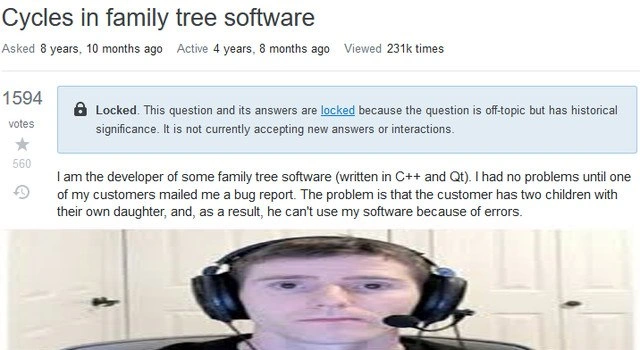
For seasoned developers, this meme triggers a knowing groan (and a chuckle) about assumption bugs and real-world data biting back. The Stack Overflow question shown – “Cycles in family tree software” – became legendary because it encapsulates a perfect storm of an edge case. The developer wrote a family tree application in C++/Qt, and everything worked fine under normal conditions. But then a user reported a bug that sounds like a twisted plot reveal: “He has two children with his own daughter.” In other words, the family tree app met a literal family loop (incest alert!), and the software just couldn’t handle it. This is hilarious to programmers because it’s one of those “you what?!” moments – the code assumed families don’t do that, yet here we are.

The humor comes from the collision of messy human reality with clean technical design. The dev’s data model likely treated the family as a simple hierarchy (each person has parents, who have their own parents, and so on). All good – until reality threw a very Game-of-Thrones-y curveball where a parent and child have children together. The program probably freaked out: maybe it threw errors like “Invalid family relationship” or simply crashed trying to display it. It’s as if the app said to the user, “Error: your family breaks the laws of ancestry!” – a ridiculous scenario that actually happened.

Why do senior devs find this so relatable? Because we’ve all been burned by an “impossible” input before. It’s reminiscent of the classic XKCD “Little Bobby Tables” comic, where a school’s database gets ruined by a student name containing SQL code ('); DROP TABLES;--). In both cases, the developer never imagined someone would feed that into their system. Here, the “malicious input” isn’t hacking – it’s a genuine (if disturbing) family situation that the program’s logic considered inconceivable. Real-world data has a way of exposing the one case you didn’t plan for. As engineers, we know that feeling: everything works until that one bizarre scenario sends your code off the rails.

In this case, the acyclic assumption was the ticking time bomb. The dev didn’t implement checks for cycles (why bother, family trees don’t loop, right?). Perhaps the internal code linked people in a tree structure or a database schema that enforced “no incest” implicitly. Maybe there was recursion to walk the family tree that ended up in an infinite loop. Or possibly the UI logic got stuck (“How do I draw this? Do I put the same person in two places?”). Regardless, the bug arises from a mismatch between the data model and reality. Senior engineers recognize this as a classic design flaw: modeling something as a tree when it’s actually a general graph. It’s the same kind of mistake as assuming all addresses are 5-digit ZIP codes, then getting one from outside the US, or assuming a username will never be null, then finding an empty string. Corner cases have a way of turning polite assumptions into production fires.

There’s also the meta-funny aspect that this question was hugely popular on Stack Overflow (1594 upvotes and counting, with over 230k views!). That many devs clicked because the title alone is golden – it reads like a joke: “I had no problems until… the customer has kids with their own daughter… now errors.” It was eventually locked for historical significance, meaning moderators froze it to preserve the Q&A as a piece of Stack Overflow lore. It’s off-topic (it’s not a typical concrete coding question with a clear answer), but it served as a cautionary tale and a bit of comedic relief for the community. In those answers and comments (before locking), you can imagine the tongue-in-cheek advice and shock: “Well, there’s your problem – your user’s family is literally a cycle. Time to upgrade your data structure… and maybe refer them to a family counselor!”

From a troubleshooting perspective, the developer likely had an “Oh no” moment followed by a serious refactor. Handling this properly might involve representing the family not as a strict parent-child tree but as a more flexible graph. That means adding checks to avoid infinite loops when traversing and perhaps updating the UI to show weird relationships (some genealogy apps draw such loops as marriages within the tree). Alternatively, perhaps the quickest patch was to validate inputs and pop up an alert: “Error: This software cannot support the provided relationship.” (In less polite terms, “please don’t try to register your incestuous relationship, we weren’t prepared for that”). Neither solution is pretty – you either complicate your code for a 0.001% use case or you outright disallow it, essentially telling a paying customer their family ties are too bizarre to log. Talk about a support ticket from hell!

Seasoned devs also appreciate the underlying lesson in robust design and testing. Did the developer have a unit test for “user is their own grandparent”? Of course not – nobody writes that test unless they’ve been bitten once. It’s a perfect example of why experienced engineers caution: “Never say never” with inputs. The moment you assume “oh, that will never happen,” Murphy’s Law sends you a user that does exactly that. We’ve seen it with date formats (someone will use 31st Feb), with file encodings, with network protocols, and yes, even with family trees. The senior perspective is a mix of amusement and empathy: “That poor developer! But also, what a legendary bug report.” It’s the kind of war story you later tell around the (virtual) watercooler: “Remember the time our app choked on an incest case?” – cue laughter and a mutual understanding that in coding, reality is often stranger than fiction.

Level 4: The Tree That Ate Itself

At the most abstract level, this meme is a lesson in graph theory and the pitfalls of assuming a family tree is a simple tree. In computer science terms, a typical family tree forms a directed acyclic graph (DAG) – parents point to children, and you can’t loop back around. Each person node has edges to their descendants, and there’s an implicit rule: no cycles. Why? Because a cycle would mean someone is, say, their own ancestor, which breaks the fundamental partial order of generations. In a DAG, you can do things like a topological sort (assigning each person a generation level) because there’s a clear “before and after” (ancestor vs descendant). Introduce a cycle, and that ordering collapses – there’s no way to linearly arrange family roles when Grandpa is also Dad to the same kid!

From a theoretical standpoint, the ancestor relationship is supposed to be antisymmetric – if A is an ancestor of B (and A ≠ B), then B cannot be an ancestor of A. In this meme’s scenario, that rule is violated in a spectacular way. A customer’s bizarre family situation created a loop in the ancestry graph: the father is also the maternal grandfather of his children. Formally, we’ve got Person Bob who’s parent of Alice, and together Bob and Alice are parents of X. Bob is an ancestor of X via two distinct paths (direct father, and grandfather through Alice). This isn’t a simple binary tree anymore; it’s a graph with a cycle. In graph theory lingo, we’ve hit a cycle in what was meant to be a tree, essentially turning the family tree into a graph Ouroboros, a snake eating its own tail.

Why is that catastrophic for software? Many genealogy programs (and algorithms in general) rely on recursion or traversal logic that assumes no cycles. Imagine a naive depth-first traversal to list all descendants:

void listDescendants(Person* p) {
    for (Person* child : p->children) {
        listDescendants(child);  // recurse into each child's subtree
    }
}

Such a function would overflow the stack or loop forever if there’s a cycle. In our case, when it gets to Bob’s daughter Alice and then her child (which is also Bob’s child), it might circle back and try to traverse Bob’s branch again, ad infinitum. Without a cycle check (like marking visited nodes), the algorithm literally runs in circles. It’s poetic that this notorious bug was posted on Stack Overflow, because the program likely stack-overflowed (crashed from infinite recursion) when faced with the incestuous loop!

Computer scientists have developed solid methods to handle general graphs – e.g. cycle detection using DFS or algorithms for strongly connected components – but those are applied when you expect potential cycles. Here the developer didn’t anticipate needing Tarjan’s algorithm or fancy graph handling; they assumed the data would stay a nice tree. This one “forbidden edge” (a parent-child link that shouldn’t exist in a proper tree) introduced a cycle that violates the program’s core assumptions. The result? The software logic enters a paradoxical state, much like a mathematical system hitting a contradiction. It’s the same kind of fundamental break you’d get if someone proved $1 = 0$ – all the remaining reasoning (or code execution) becomes nonsense.

There’s even a real-world parallel in genealogy called pedigree collapse, where due to intermarriage among relatives, the family graph isn’t a clean tree (ancestors show up multiple times). Serious genealogy software and algorithms in genetics account for loops to calculate things like inbreeding coefficients. But a parent-child loop is an extreme case of this – it’s like pedigree collapse on steroids, a direct cycle in one generation. The mathematics of ancestry wasn’t ready for a node that reaches around and points back at itself. In summary, the meme’s humor hides a deep truth: data models and algorithms must respect graph theory fundamentals. If you assume a DAG and reality gives you a cycle, no amount of clever coding jargon will save you – the program will simply tie itself in knots (or in this case, in loops). And that’s exactly what happened here: the poor family tree app encountered a logical impossibility in its universe, and like a computer seeing Divide by zero, it just imploded.

Description

A meme composed of a screenshot from a Stack Overflow question and a reaction image. The top part shows the question titled 'Cycles in family tree software'. The question text reads: 'I am the developer of some family tree software (written in C++ and Qt). I had no problems until one of my customers mailed me a bug report. The problem is that the customer has two children with their own daughter, and, as a result, he can't use my software because of errors.' The question is marked as 'Locked' for being off-topic but having 'historical significance'. Below this text is a picture of a young man wearing a gaming headset, staring at the screen with a look of profound shock and disturbance. The humor arises from the collision of a technical problem (a cyclical graph in a data structure that should be a tree) with a deeply unsettling real-world scenario. For developers, it's a legendary example of an edge case you would never anticipate, highlighting how messy human data can break the clean logic of software

Comments

7
Anonymous ★ Top Pick Some developers use unit tests for edge cases. This one apparently needed an ethics committee and a geneticist
  1. Anonymous ★ Top Pick

    Some developers use unit tests for edge cases. This one apparently needed an ethics committee and a geneticist

  2. Anonymous

    Shipped a ‘family tree’ class keyed on parent pointers only - one customer’s… unconventional cross-edge turned it into a strongly connected component and my topological sort filed for divorce

  3. Anonymous

    When you realize your elegant DAG implementation just became a directed graph because reality doesn't respect your business logic constraints

  4. Anonymous

    When your family tree software assumes a DAG but reality delivers a strongly connected component - turns out some customers have implemented their own version of 'circular dependencies' that no amount of topological sorting can resolve. The real bug isn't in the code; it's that you optimized for O(n) traversal of a tree structure when you needed cycle detection for a general graph. Classic case of domain modeling meeting edge cases that violate every assumption in your requirements doc

  5. Anonymous

    Real-world data's ultimate troll: turning your pristine family DAG into a cycle-ridden nightmare with one depraved user

  6. Anonymous

    Calling it a “family tree” doesn’t make it a DAG; ship it and prod will add a back‑edge, turning your topological sort into a soap opera

  7. Anonymous

    Never model a family “tree” as a tree - production will eventually deliver a strongly connected component, and your topological sort will start calling itself Grandpa

Use J and K for navigation