Skip to content
DevMeme
1166 of 7435
Fallout 3's Train Hat: The Ultimate Development Workaround
GameDev Post #1302, on Apr 13, 2020 in TG

Fallout 3's Train Hat: The Ultimate Development Workaround

Why is this GameDev meme funny?

Level 1: Pretend Train Ride

Imagine you’re playing pretend and you really want to have a little train ride, but you don’t have a toy train that can move on its own. What do you do? You get creative! You ask your friend to help out. You cut out a big cardboard train shape and kind of dress your friend up with it – like a train costume or a hat that looks like a train. Then your friend walks along a path (say, down the hallway or around the yard) while carrying this cardboard train on their shoulders. To everyone watching, it looks like a train is moving along with you riding in it, even though it’s really just your buddy underneath doing all the walking. It’s super silly, but it works – now you have a moving “train” ride in your pretend game! That’s exactly what the game developers did in this case: since they couldn’t use a real train in the game, they used a pretend solution. They basically had a character in the game wear the train like a costume and walk the route. It might look funny behind the scenes, but for the player, it felt just like a real train ride. Sometimes, when you don’t have the real thing, you make do with a clever pretend version, and it ends up working out just fine (and gives everyone a good laugh too!).

Level 2: Train Hat Trick

This meme recounts a famous bit of game developer ingenuity from Fallout 3, an open-world video game. In Fallout 3, the creators wanted to let the player ride on a train in one scene. The catch? The game’s engine didn’t support drivable trains or vehicles at all. (Imagine a car with no engine inside – it looks cool, but it can’t actually move on its own in the game.) What the engine could do easily was make characters walk around. In game development, a Non-Player Character (NPC) is any character controlled by the computer, not by a human player – think of villagers, monsters, or random people in the game world. Fallout 3’s engine had well-developed routines for NPCs: they could follow paths, navigate the world, and perform animations like walking or running. However, there was no built-in way to say “here’s a train, let it drive on the tracks and carry the player.” So the developers pulled off a train hat trick – they used an NPC to do the train’s job, by literally putting the train on the NPC’s head.

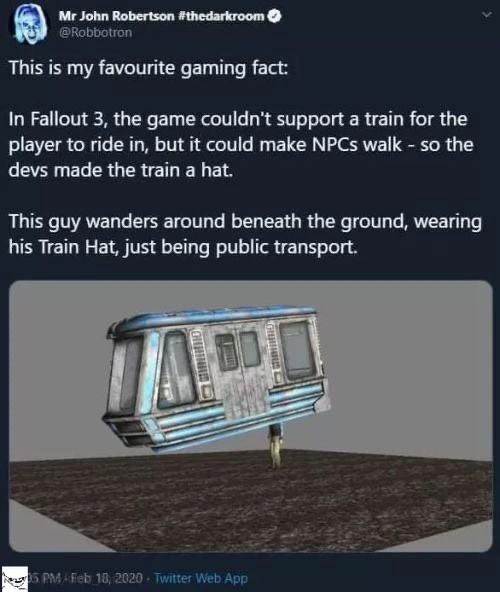
Here’s what happened in simpler terms: The developers took the 3D model of the train (basically the visual object that looks like a subway car) and treated it like a piece of wearable equipment for a character. Games often allow characters to wear items (like hats, helmets, or costumes) that attach to the character’s skeleton. In this case, they rigged the entire train car model to an NPC’s head as if the train were a giant “hat” or helmet. They then hid this NPC under the ground where players wouldn’t see the body, only the attached train above. Next, they made this NPC walk along the train tracks, following a predetermined route. Since the train model was attached to the NPC, it moved perfectly along with the NPC’s steps. From the player’s perspective, the subway car model glides down the tracks like a normal train ride. The player could stand inside it or be “riding” it, and it felt like being in a moving train – but under the hood, the game just sees an NPC taking a stroll with a fancy hat on! It’s a bit like those costume races where one person is the “legs” under a big costume. The game didn’t actually know about any “train” object; it only knew an NPC was moving and carrying something. The tweet’s image even shows the result: a subway car floating slightly above the ground with a pair of human legs poking out underneath – that’s the poor NPC literally carrying the train.

This solution is a prime example of a workaround in game development. A workaround means finding an alternate way to achieve something when the direct way is unavailable or not working. The devs couldn’t go the direct route (“make a train object that moves”), so they found another route that the engine would accept (“use an NPC, since NPCs can move”). It’s also a demonstration of clever EngineeringTradeoffs: rather than spend weeks adding new complex vehicle code to the game (which could introduce bugs or delays), they used an existing system (NPC movement) to get a similar effect in a fraction of the time. For a junior developer or someone new to game engines, it’s eye-opening to realize how much games rely on these tricks. Many features that seem straightforward in a game are actually achieved by repurposing systems in funny ways behind the scenes. You can almost imagine a developer saying, “We don’t have trains, but we do have NPCs. What if we just... make the train an NPC?” It sounds crazy, but in context it made perfect sense to get the job done. This highlights the HiddenComplexity in game development: things that look simple (like a moving train) might be implemented with layers of trickery to work around limitations. And it shows the spirit of CreativeProblemSolving – using whatever tools are at hand to fulfill the game design. Is it a bit funny and hacky? Absolutely! But players got their epic train ride scene without the game breaking, and that’s what matters in the end.

To put it in pseudo-code, the logic was something like:

if (!engine.hasVehicleSystem()) {
    NPC* trainCarrier = spawnNPC();
    trainCarrier->setPosition(beneathTrack);
    trainCarrier->attachModel(trainCarriageModel, HEAD);
    trainCarrier->followPath(trainTrackPath);
    // The player is now riding inside the trainCarrier's "hat" (the train model)!
}

In plainer words, the code is checking, “Does the engine know how to handle vehicles (like trains) by itself?” If not, then it executes the plan of spawning an NPC (trainCarrier), hiding it under the track, attaching the train model to that NPC’s head, and then making that NPC walk along a predefined path that follows the train tracks. The comment notes that the player is essentially riding inside the train model which is attached to the NPC. This is the programmer’s way of saying: use an NPC to carry the player through the level while wearing the train. It’s a quirky solution, but it works given the engine’s constraints.

For up-and-coming developers, this story is both amusing and educational. It shows that programming, especially in game development, isn’t always about doing things the “proper” or textbook way – it’s often about doing things the pragmatic way given your deadlines and tools. If the engine doesn’t support a feature you need, you might have to get scrappy. This might mean writing some unusual code or using an object for an unintended purpose. In a broader sense, this Fallout 3 train hack is like using duct tape to fix a problem – it’s not the most elegant long-term solution, but it absolutely works and lets you deliver the feature on time. And honestly, the fact that nobody noticed during normal gameplay (it became widely known later through developer talks and tweets) means it was a pretty successful hack! It only becomes comedy gold when you see the behind-the-scenes snippet of a dude under the floor wearing a train like a hat. For players and junior devs, it’s a reminder that behind the cool experiences in games, there’s often some very inventive engineering magic making it all possible.

Level 3: Off the Rails Workaround

In the world of GameDevelopment, this meme spotlights an infamous workaround: turning a train into a hat for an NPC. It’s a legendary example of developers hacking around engine limitations with creative ingenuity. In Fallout 3 (built on Bethesda’s somewhat creaky Gamebryo GameEngine), the devs hit a technical wall: the engine had no built-in support for drivable trains or vehicles that a player could ride. There was no ready-made “train object” or vehicle physics subsystem to commandeer. However, the engine did have a robust system for moving characters around. Non-player characters (NPCs) could walk along paths, follow waypoints, and carry objects. So the developers asked themselves, why not use an NPC to simulate the train? In a stroke of absurd genius, they literally turned the train model into an NPC’s headgear. The subway car became a “hat”!

Under the hood, the implementation was both simple and insane. The team took the 3D model of the train carriage and attached it to an invisible NPC’s head bone as if it were just another piece of armor or a goofy helmet. They then hid this NPC beneath the level (out of the player’s view) and made it walk along the train tracks. To the game, it was just a regular character moving normally. To the player, it looked like a train smoothly gliding down the tracks. Essentially, the NPC’s walking animation drove the train forward. It’s as if the developers told the engine, “Fine, if you won’t let us have a real train, we’ll just strap a train to something you do understand!” This clever Workaround exploited the engine’s strengths (character movement and pathfinding) to bypass its weaknesses (no vehicle system). The result: a functional “train ride” without writing a single line of actual vehicle code. Talk about thinking outside the (railroad) box! To illustrate the thought process, imagine some pseudocode in the devs’ toolkit:

if (!engine.supportsVehicles()) {
    NPC* conductor = spawnNPC("TrainConductor");
    conductor->setInvisible(true);              // hide the poor guy under the map
    conductor->attachModel(trainCarMesh, HEAD); // put the train on his head like a hat
    conductor->followPath(trainTrackWaypoints); // make him walk the train tracks
    player.enter(trainCarMesh);                 // player "boards" the train car (attached to NPC)
}
// All aboard the NPC Express!

Why resort to such a wacky solution? This is where EngineeringTradeoffs, ResourceConstraints, and a bit of TechDebt come into play. Bethesda’s engine was originally built for fantasy RPGs with horses at best – no subways in sight – and it had years of LegacyCode behind it. Adding a whole new vehicle system (with proper physics, controls, collisions, etc.) would have been an enormous effort, potentially full of bugs and HiddenComplexity. The project was likely short on time or budget (as game projects always are), so the devs did the pragmatic thing: use what already works. NPC AI and pathfinding were thoroughly tested and stable. By piggybacking on that system, they minimized risk. It’s a classic case of “use the tools you have to create the feature you want.” The trade-off, of course, is that it’s a total hack — the kind that makes engineers both chuckle and cringe. They essentially camouflaged a train as an NPC to satisfy the game design requirement without breaking the engine. Yes, it’s a bit hacky (there is literally a human wandering beneath the map wearing a train), but it allowed them to ship the feature on time. In software terms, they paid off one kind of problem (no vehicles) by incurring another (a weird hard-to-explain implementation), which is basically the definition of tech debt. But hey, sometimes shipping a game on schedule means choosing the devil you know.

This meme is hilarious to experienced devs because it captures that “anything to get it working” mentality we all recognize. We’ve all been there: a last-minute feature needs to work, the proper solution is too costly, so you jury-rig something unconventional and hope players never peek behind the curtain. The Fallout 3 train hat hack has become a famous anecdote in GameDev circles precisely because it’s such an outrageous example of CreativeProblemSolving under pressure. It shines a light on the hidden side of game development: beneath the polished graphics, there’s often a patchwork of clever tricks holding things together. Seasoned developers nod knowingly (and maybe with a bit of PTSD) at this story, because it epitomizes the wild fixes you invent when dealing with legacy systems and impossible deadlines. As absurd as a subterranean NPC carrying a subway car on its head sounds, it’s a testament to developer creativity and the dark art of working around engine limitations. In the end, the player got their epic train ride set-piece, none the wiser that “Big NPC Bob” was trudging along under the map, just being public transport for everyone. All aboard the hack train! 🚂🧢

Description

This image is a screenshot of a tweet from user 'Mr John Robertson #thedarkroom' (@Robbotron). The tweet text reads: 'This is my favourite gaming fact: In Fallout 3, the game couldn't support a train for the player to ride in, but it could make NPCs walk - so the devs made the train a hat. This guy wanders around beneath the ground, wearing his Train Hat, just being public transport.' Below the text is a 3D model of a weathered, light-blue and silver metro train car, which appears to be attached to a single leg or pole on a brown, textured surface, visually representing the absurd concept. This is a classic example of a clever, if unorthodox, development workaround. For senior engineers, this is a deeply relatable and humorous illustration of solving a problem under extreme technical constraints. The game engine (Gamebryo) lacked native support for player-controlled moving vehicles, so the developers created an illusion by attaching the train model as a 'hat' to an invisible NPC. The NPC then walks along a path underground, moving the train car with it, while the player is essentially locked in place inside the 'hat', creating the experience of riding a train. It's a perfect encapsulation of the 'whatever it takes to ship' mentality

Comments

7
Anonymous ★ Top Pick We've all shipped a 'train hat' at some point. Mine was a cron job that curled a health check endpoint every five minutes to keep a legacy service from falling asleep
  1. Anonymous ★ Top Pick

    We've all shipped a 'train hat' at some point. Mine was a cron job that curled a health check endpoint every five minutes to keep a legacy service from falling asleep

  2. Anonymous

    “Train-as-hat”: proof that even in AAA titles, slapping a shiny shell on a legacy walking NPC and calling it “vehicle support” is just the game-dev equivalent of wrapping the 2005 monolith in a REST façade and rebranding it “microservices.”

  3. Anonymous

    This is exactly the kind of solution you get when the architect who insisted "we'll never need vehicle physics" left for a FAANG company six months before the DLC requirements came in

  4. Anonymous

    When your game engine's API doesn't support vehicle physics but you've already promised rideable trains in the trailer, you don't refactor the entire collision system - you just make an NPC wear the train as a hat and call it 'creative asset management.' It's not a hack, it's 'leveraging existing animation infrastructure for novel transportation mechanics.' Ship it

  5. Anonymous

    Engine balks at player trains? No sweat - repurpose NPC pathfinding for 'hat-scaled' mass transit architecture

  6. Anonymous

    Peak senior move: when the engine can’t do vehicles, bind the metro car to an NPC’s head bone and ship “public transport as a service.”

  7. Anonymous

    Fallout 3 couldn’t do trains, so they made the train a hat on an NPC - public transport via Adapter pattern. Enterprise equivalent: no queues, just email; Kafka over Outlook

Use J and K for navigation