Skip to content
DevMeme
1167 of 7435
Code Optimization: For the Job vs. For the Leaderboard
Performance Post #1304, on Apr 13, 2020 in TG

Code Optimization: For the Job vs. For the Leaderboard

Why is this Performance meme funny?

Level 1: Chores vs High Scores

Imagine you have a chore to do at home, like cleaning your room. You know you should do it because your parents told you to and your room is messy. But you don’t really feel like doing it – it’s boring and you might drag your feet. Now imagine instead that cleaning your room was part of a game: say there’s a competition with your siblings to see who can clean their room the fastest or the best, and there’s a big scoreboard on the wall with your names. Suddenly, cleaning isn’t just a boring job, it’s a chance to win and show off! You’d probably get excited, maybe even race to tidy up, hoping to beat everyone and see your name at the top of that chart.

This meme is just like that, but for a computer programmer. In the first case, the programmer is told to make their code faster as part of work – kind of like being told to do a chore. They’re like, “ugh, I’ll do it because I have to.” In the second case, making the code faster is turned into a game with a high score list (a leaderboard). Now the programmer is like, “Yes! Let’s do this!” and is suddenly super excited, just like you would be with the room-cleaning game. It’s funny because it shows that whether you’re a kid or a grown-up coder, turning something into a game with points or scores can make even a boring job feel fun and motivating. The meme makes us laugh because we recognize that feeling: we all would rather play a game and go for a high score than do a task just because we’re told to. So, it’s basically saying everyone enjoys getting a high score more than doing their chores, even when the “chore” and the “game” are actually the same activity.

Level 2: Production vs Competition

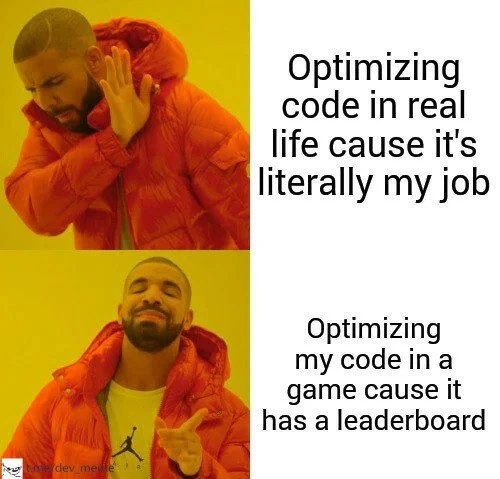
Let’s break down what’s happening in simpler terms. This meme is using the popular Drake Hotline Bling format to compare two situations side by side. In the first panel (Drake saying “no”), the caption is “Optimizing code in real life ’cause it’s literally my job.” This refers to when a developer is supposed to improve code performance as part of their normal work (like improving a program so it runs faster, which is indeed part of a developer’s job description, especially under Performance requirements). Drake’s dismissive gesture means the developer isn’t enthusiastic about it – they see it as just another boring task on the to-do list. In the second panel (Drake saying “yes” enthusiastically), the caption reads “Optimizing my code in a game ’cause it has a leaderboard.” Here, the same developer suddenly loves doing the exact same thing – making the code faster – but only because now it’s part of a game with a leaderboard (a scoreboard that ranks players by performance). Drake pointing approvingly implies “now this is something I like!”

So, why the difference? It comes down to motivation and context. “Real life” code optimization could mean, for example, you have a web app at work that is running a bit slow. Your boss or team lead might ask you to make the page load faster or reduce the CPU usage of a service. It’s important, but it might feel tedious. Often, as a junior developer, you learn about profiling tools (which help find slow parts of the code) and algorithms to optimize performance. You might fix a slow database query or rewrite a loop more efficiently. These tasks can be challenging, but sometimes they feel like chores – you do them because it’s your job, not necessarily for fun or glory. The reward is usually just that things run smoothly in production and maybe you get a nod from your team. It’s an essential part of developer productivity in a professional environment: you ensure the software meets performance standards so users are happy. But day-to-day, it might not be exciting, especially if the improvement is invisible to users or taken for granted.

Now compare that to optimizing code in a game with a leaderboard. Think of websites or programming contests where when you solve a problem, your solution is ranked by how fast it runs or how little memory it uses. For instance, there are coding challenge sites where after you submit a solution, you see your runtime and a leaderboard showing the top fastest solutions. Or imagine a hackathon at work where teams compete to improve some piece of code the most, and there’s a leaderboard in the office showing who’s in the lead. Suddenly, optimizing code feels like a sport. There’s a score attached to it, and maybe even other people (peers, friends, or an online community) can see how well you did. This taps into a competitive instinct: you want to climb that leaderboard, maybe get into the top 10 or claim the #1 spot. It’s gamified coding – turning a normal task into a game by introducing competition and points.

For a junior developer (or really any developer new to this experience), this can be super exciting. The same person who was bored tweaking a function at work might spend all night tweaking a solution for a coding competition just to improve the runtime from 200ms to 150ms, if it means they move up a rank. You’re no longer just writing code; you’re playing a game with code. And games are fun! This is the essence of work_vs_play_motivation: when something is work, we often do the minimum needed; when the same thing is turned into play, we give it our all. The meme captures that perfectly with Drake’s two expressions.

Let’s clarify a few terms here for context:

  • Code optimization (or performance optimization): This means making your code run better – usually faster, or using less memory/CPU. It could involve improving the algorithm (like using a more efficient method so it doesn’t take as long for larger inputs) or fine-tuning details (like using a faster library or cutting unnecessary calculations). In the meme, “optimizing code” is the task the developer has in both scenarios.
  • Production (or “real life” code): This refers to code that is running in the real world for users or customers – for example, the code behind a website or an app that people use daily. Optimizing production code might be critical if the app is too slow, but often you only optimize as much as needed to meet requirements. There’s also maintenance to consider – someone will have to understand and work on this code later, so you don’t want it to be overly complicated.
  • Leaderboard: In games or competitions, a leaderboard is a board or list that shows who is leading or scoring the most. Think of the high score table on an arcade game or the rankings in an online multiplayer game. In coding terms, a leaderboard might rank solutions by speed, by how few resources they use, or some other metric. It’s public (or at least visible to participants), so everyone can compare their performance.
  • Gamification: This is the practice of taking something that isn’t traditionally a game (like doing work or learning) and adding game-like elements to it – points, badges, leaderboards, levels, etc. The idea is to make it more engaging. In the context of coding, many learning platforms and contest sites gamify the experience to keep developers hooked and motivated.

Now, the Drake meme format (tagged as drake_meme_template or drake_preference_format) is a well-known Internet meme that developers love to reuse. It originates from a music video where the artist Drake first rejects something (with a hand-wave gesture) in one scene, then welcomes something else (pointing and smiling) in the next. Meme creators add their own text to those two panels to show a humorous preference. Here, the meme creator has put the two different optimization scenarios as Drake’s choices. It’s a perfect template because it instantly conveys “Thing 1: No thanks, Thing 2: Yes please!”.

This meme is very relatable to many in the developer community (DeveloperMemes usually hit home like this). If you’ve ever participated in a coding competition, a hackathon, or even a simple coding puzzle with a score, you’ve probably felt that rush to make your code the best it can be. Conversely, if you’ve worked on a long-term project, you might also be familiar with that slight groan when told to go back and optimize something that’s already “good enough” – especially if there’s pressure to move on to new features. The humor here comes from recognizing that inconsistency in ourselves and our peers. It’s a form of CodingHumor because it pokes fun at the coding lifestyle: we know performance matters, but we sometimes need an extra push (or a fun incentive) to really care about it.

To put it simply, in real life job settings, developers often weigh effort vs reward. If a program runs in 1 second and that’s acceptable, a junior dev might not be motivated to spend hours making it run in 0.5 seconds – there’s no visible reward for doing so, and they might have other tasks. But in a competition, making something run twice as fast could be the difference between being in 50th place or 1st place on the leaderboard. That’s a big reward in terms of pride and accomplishment! This triggers a competitive drive. It’s almost like two different mindsets:

Real Life Code (Production) Gamified Code (Competition)
Goal: Meet business requirements and deadlines. 👔 Goal: Climb the leaderboard and set a high score. 🏆
“Good enough” performance is fine if users aren’t complaining. “Not good enough!” Every millisecond counts for a better rank.
Prioritize clear, maintainable code (others will work on it later). Prioritize any clever tricks that make code faster (even if code becomes messy).
Reward: The software runs smoothly, maybe a thank-you from the team. Reward: Points, badges, a higher rank, and bragging rights among peers.

In the table above, you can see how the same activity – making code faster – is approached differently. In production, it’s about being practical and balancing effort with benefit. In competition, it’s all about maximizing performance because that’s how you win or get recognition. Notice also the mention of maintainability: in a work project, if you write very convoluted, “optimized” code, someone (maybe Future You or a teammate) will have to maintain that, which can hurt productivity later. That’s why in real-life coding, we often avoid weird micro-optimizations unless absolutely necessary. But in a contest, you’re not maintaining this code for years – you write it, submit it, and move on. So you can afford to get a bit wild and crazy with how you squeeze out performance. It’s akin to a race car versus a daily commuter car: the race car is tuned for maximum speed with no regard for comfort or durability, whereas the commuter car needs to be reliable and comfortable for the long haul.

For a newer developer, understanding this context is important. It teaches that performance tuning has its place and time. You might recall the first time you learned about making code efficient – say, learning about Big O notation (which describes how an algorithm’s run time grows with input size). It might have been a bit dry in class. But then perhaps you tried a coding challenge where if your code was too slow, it wouldn’t pass, so you had to optimize it. That necessity might have felt exciting, like leveling up in skill. And if there was a leaderboard showing your solution was faster than most others, that’s an extra thrill. On the flip side, when you get a job and someone tells you to rewrite a working piece of software just to save some memory, you might think, “Ugh, do I have to?” unless you clearly see why it matters. This meme exaggerates that feeling for comic effect.

In summary, the meme’s joke is clear when broken down: the same developer who’s unmotivated to do a work task (optimizing code as a duty) suddenly becomes highly motivated to do essentially the same thing when it’s part of a game with a scoreboard. It’s pointing out a funny quirk: we humans (yes, even logical programmers are humans!) often need the right incentive to give our best effort. And sometimes the incentive that works is not the one you’d expect – it could be as simple as a visible ranking or the spirit of competition rather than the knowledge that “I’m doing my job.” The Drake meme format makes this point in a punchy visual way that the tech community immediately “gets.” It’s both a nod to how gamified leaderboards can boost engagement and a gentle tease that perhaps we should bring a bit of that enthusiasm back to our daily work. After all, what if we approached real-life code optimization with the same energy as a high-score challenge? We might surprise ourselves – or at least have a bit more fun with those performance tickets in our backlog.

Level 3: Leaderboards Over Deadlines

In the world of code optimization, the meme humorously exposes a quirk in developer behavior: we often treat performance tuning at work as a mundane chore, yet become turbo-charged when the same task is part of a competitive game. This is a relatable developer experience that plays on the contrast between production obligations and the thrill of a gamified leaderboard. Why does this happen? At work, optimizing code (making it run faster or use less memory) is literally part of the job – important, yes, but it can feel routine or thankless. You might spend hours shaving 50ms off a database query and the only feedback is “Cool, it meets the SLA, now move on to feature Y.” In a game or coding challenge, however, every millisecond you trim off might bump your ranking and earn you bragging rights. Suddenly, performance optimization isn’t just a duty, it’s a high-score chase!

On a technical level, this means a developer might ignore micro-optimizations in enterprise code (e.g. “It runs in 0.5 seconds? Good enough for production, ship it.”), but the same person will obsess over microseconds in a contest or leaderboard scenario. The meme’s Drake format captures this perfectly: Drake dismissing “optimizing code in real life” represents that lukewarm attitude towards everyday performance tuning – it’s something you should do for maintainability and cost efficiency, yet it’s rarely exciting. In the next panel, Drake eagerly pointing at “optimizing my code in a game” symbolizes how competition flips that attitude into outright enthusiasm. Add a public scoreboard into the mix, and suddenly the developer is running profilers, analyzing algorithmic complexity, and maybe even breaking out low-level tricks to speed things up. It’s classic developer humor with a grain of truth: gamification taps into our competitive streak and dopamine hits. A leaderboard makes the abstract idea of “better performance” concrete and addictive – you can see your name climb ranks in real time. At that point, who cares if it’s 3 AM? There’s a new personal best to set!

This contrast also nods to an industry paradox. Seasoned engineers know the adage: “premature optimization is the root of all evil” (thanks to Donald Knuth). In production code, chasing tiny speed improvements can waste time or even introduce bugs, hurting overall developer productivity. Best practice is to optimize where it truly matters – usually guided by profiling data that shows a clear bottleneck – and not to gild the lily. Yet, when working on a programming puzzle or a hackathon challenge, those same careful engineers will gleefully throw caution aside and optimize everything, even beyond the point of practical returns. Why? Because in a contest, the incentive structure is flipped: performance is the point, and the environment is controlled. There’s no long-term maintenance, no angry customer at 2 AM because you tried a risky micro-optimization – just the immediate satisfaction of a faster solution and maybe a top spot on the board. In essence, the meme is poking fun at how context switches our mindset from “get it working sufficiently” to “make it blazing fast just for glory.” It’s funny because it’s true: give developers a gamified goal and they’ll often work harder for imaginary points than for a paycheck, at least in the short term. (If only corporate project managers could bottle that enthusiasm – imagine Sprint tasks with XP points and boss battles at the end!)

Underneath the humor, this speaks to human psychology. Gamification – adding game-like elements such as points, achievements, and leaderboards to non-game tasks – is a powerful motivator. It leverages our innate desire for competition and status. A public leaderboard essentially turns boring work into a sport. Even experienced devs who’ve seen it all can’t resist checking how they rank against peers. This is why we see internal hackathons, coding competitions, or even “performance tuning tournaments” at some companies; as soon as there’s a scoreboard, people pull out all the stops. They’ll rewrite functions in C for speed, vectorize computations, use bitwise hacks – whatever it takes to gain an edge. The meme captures this common phenomenon in a lighthearted way. The Drake meme template is ideal for this contrast: the top panel “nah” for the everyday duty, and bottom panel “heck yeah” for the same task made into a game. Every senior developer chuckles because they’ve either felt this themselves or managed someone who did – it’s a shared joke about how the motivation for performance work can shift dramatically depending on whether the reward is a pat on the back or points on a scoreboard.

To illustrate the drastic shift in approach, consider how a task might be handled in each scenario:

# At work (production code):
def compute_results(data):
    # Clarity and reliability come first, minor optimizations can wait
    data.sort()  # use a built-in, well-tested sort for simplicity
    result = [process(item) for item in data]  # clear and concise, even if not the absolute fastest
    return result

# In a competition (leaderboard mode):
def compute_results_competition(data):
    # Performance is king, even if code gets complex or less maintainable
    # Use a faster custom sort (e.g., specialized quicksort) to shave off milliseconds
    quicksort_in_place(data, low=0, high=len(data)-1)  
    result = []
    # Manual loop for speed instead of Python list comprehension
    for i in range(len(data)):
        result.append(process_optimized(data[i]))  # maybe an inlined or pre-optimized processing
    return result

In the production version (compute_results), the developer uses straightforward, readable Python constructs and trusts the optimized built-in functions (like TimSort for sorting) to do a decent job. It’s written with maintainability and clarity in mind, as one should for long-term code. In the competition version (compute_results_competition), we see the developer making the code more low-level and explicit: perhaps implementing a custom sort (imagine they know the data characteristics and can exploit them), unrolling loops or avoiding Python conveniences for marginal speed gains. Realistically, in Python the gains might be minor or the code might even become slower if misused – but in a lower-level language or optimized scenario, these are the kinds of tricks a dev might attempt to climb that gamified leaderboard. The code is more complex, harder to read, but if it runs a bit faster and edges out others, it’s worth it (in the contest context, at least). This example highlights how the work vs play motivation changes a developer’s priorities. In a job, you optimize just enough: you want code that is efficient and maintainable by the team. In a game or contest, you stretch every bit of your knowledge for speed, because the code’s life is short and the only goal is performance bragging rights.

Ultimately, the meme resonates because it’s exaggerating a truth: Many of us developers are intrinsically competitive nerds. We may not always get excited about shaving off 10% runtime in a backend service on a normal Tuesday. But turn the exact same challenge into something with a scoreboard, a rank, and maybe a shiny badge, and suddenly it’s like we drank three espressos – we’re up profiling memory usage at midnight, giddy with excitement as if we’re playing an intense video game. It’s the leaderboard lure in action. This scenario is developer humor gold because it pokes fun at ourselves: the code didn’t change, the performance problem is identical, but our attitude flips completely when gamification comes into play. We’re somewhat embarrassed to admit it, but it’s true — and seeing Drake embody that flip makes it hilariously clear and oh-so-relatable.

Description

This image uses the popular two-panel 'Drake Hotline Bling' meme format. In the top panel, the rapper Drake is shown in an orange puffer jacket, holding up a hand in a gesture of rejection or disapproval. The text next to him reads, 'Optimizing code in real life cause it's literally my job'. In the bottom panel, Drake is smiling and pointing in a gesture of approval, with the accompanying text, 'Optimizing my code in a game cause it has a leaderboard'. The meme humorously captures a common developer sentiment: the motivation to optimize code is far greater when it's for a competitive, gamified purpose rather than a professional obligation. For senior engineers, this speaks to the difference between extrinsic motivation (a paycheck) and intrinsic motivation (the thrill of competition and measurable achievement). After years of optimizing for business metrics, the clear, direct feedback and public recognition of a leaderboard in a coding game (like those by Zachtronics or on platforms like Advent of Code) can be a much more powerful and enjoyable driver for peak performance

Comments

7
Anonymous ★ Top Pick The product manager wants a 5% performance boost to improve user retention by 0.01%. I want to shave 2 nanoseconds off my solution to get on the global leaderboard. We are not the same
  1. Anonymous ★ Top Pick

    The product manager wants a 5% performance boost to improve user retention by 0.01%. I want to shave 2 nanoseconds off my solution to get on the global leaderboard. We are not the same

  2. Anonymous

    I’ll spend an hour shaving 5 µs off my Advent-of-Code entry for leaderboard glory, but in prod I’ll fix a 500 ms endpoint by sliding the AWS-Spend dial from “m5.large” to “m5.2xlarge” and call it “cloud efficiency.”

  3. Anonymous

    Spending 3 weeks shaving 50ms off a production endpoint that serves millions: "This is beneath my pay grade." Spending 3 weeks shaving 50ms off my Advent of Code solution to beat xXx_RustLord_xXx: "This is my Sistine Chapel."

  4. Anonymous

    The eternal paradox: we'll spend 40 hours shaving 10ms off a game loop to climb from rank 47 to 46 on some obscure leaderboard, but suggest optimizing that O(n²) query in production that's costing $10K/month in cloud costs? 'Premature optimization is the root of all evil,' we'll solemnly quote Knuth while our AWS bill screams in the background. Turns out the real performance bottleneck was the friends we made along the way - specifically, the competitive ones with public rankings

  5. Anonymous

    Prod SLO dashboard: meh at 220ms p99; add a public leaderboard and I’m suddenly unrolling loops, pinning cores, and hand‑writing AVX to win by 0.3 ms

  6. Anonymous

    Pro tip: Gamify prod SLOs with leaderboards - watch p99 plummet faster than your weekend CS:GO rank climbs

  7. Anonymous

    Prod: “We’ll optimize when it hits the SLOs.” Leaderboard: I’m aligning structs to cache lines and writing branchless code for the only OKR that matters - ego throughput

Use J and K for navigation