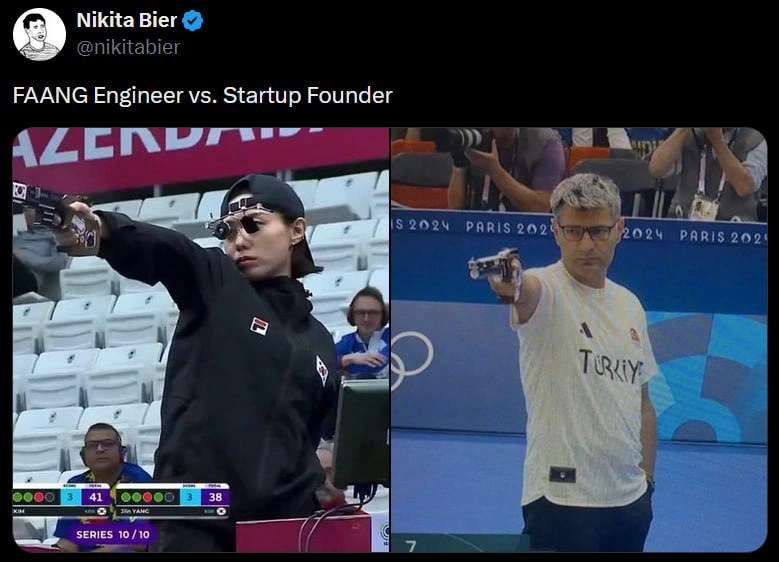
Comparing FAANG engineer precision to startup founder freestyle in Olympic shooter meme
Why is this Startup meme funny?
Level 1: Careful vs Carefree
Imagine two people trying to do the same task in totally different ways. One is very careful: like a kid building a model kit with instructions, making sure each piece is exactly right before moving on. The other is more carefree: like another kid who dumps out the LEGO box and starts building whatever comes to mind, trying things quickly and changing it up as they go. The meme is funny because it puts these two styles side by side – the super serious, follow-every-rule person (like a big company programmer) next to the bold, just-wing-it person (like a startup creator). It’s showing that you can solve a problem by being very precise and prepared or by being fast and inventive, and the contrast between those styles makes us smile. It’s like seeing one friend carefully color inside all the lines while another friend doodles something wild freehand – both can make a cool picture, but watching how differently they do it is the fun part.
Level 2: Structured vs Scrappy
Let’s break down why this FAANG-versus-startup comparison is funny by explaining the pieces. FAANG is an acronym for Facebook, Apple, Amazon, Netflix, Google – basically the biggest tech giants. A “FAANG engineer” means a developer working at one of these large companies (or similar big firms). These companies are known for their strong engineering culture with lots of established processes. “Process-heavy” means there are formal steps and rules for everything: writing up design proposals before coding, having multiple colleagues review your code, running extensive automated test suites, and following coding standards rigorously. It’s like having a very strict checklist to follow for each task. This ensures high quality and reliability because when you have billions of users, even a small mistake can cause a huge issue. In the meme’s left image, the shooter’s rigid textbook stance and the detailed scoreboard represent that structured, methodical approach. The engineer in a big company is careful and precise – much like an Olympic shooter aiming for a perfect bullseye. They focus on accuracy and consistency: for example, making sure the app rarely crashes or that the new feature uses the optimal amount of memory. They usually work in a specific area of a project (a specialist role), and there are often separate teams handling different aspects (one team for the database, another for the user interface, etc.). There’s a sense of order: clear roles, documented procedures, and maybe a chain of command to approve changes. This is CorporateCulture 101 – stability, predictability, and minimizing risk.
On the other side, a startup founder is the person who creates or co-founds a new startup company. StartupCulture is almost the opposite of corporate structure: it’s fast, lean, and often making things up as it goes. In a tiny startup, the founder might also be coding, testing, talking to users, and handling business decisions all in the same day – wearing all the hats at once. There aren’t many formal processes because the team is small and needs to move quickly. Instead of writing a 20-page design document and scheduling meetings, a founder will likely jump straight into building a prototype (a quick initial version of the product). They often embrace a “just ship it” mentality – meaning they prefer to put something out there for customers as soon as possible, then improve it based on feedback, rather than aiming for perfection from the start. This is akin to the shooter on the right casually taking a shot: it might not be textbook form, but it can still hit the target in a pinch. The right image even shows an Olympic setting with photographers, which is a fun touch – it implies the startup founder is taking big risks in front of the whole world. That’s true in real life: startup folks launch things to real users early and often, essentially “testing in public.” Sometimes startup developers merge code to the main app several times a day (continuous deployment), fixing issues as they appear, whereas a FAANG engineer might merge code far less frequently after extensive testing. The startup founder’s style is scrappy – that means they’re resourceful and quick, doing the best they can with limited people, time, and money. They might not follow conventional rules if those rules slow them down. For example, instead of writing exhaustive tests for every new feature, a startup team might write just a few or none at all initially, focusing on getting the feature working. They accumulate technical debt – a term for the “messiness” or shortcuts in code that you’ll eventually have to tidy up later – because doing things the clean, perfect way isn’t feasible when you need to ship features yesterday.
The tweet caption “FAANG Engineer vs. Startup Founder” sets up this direct comparison, and the images illustrate it brilliantly. Think of the FAANG engineer as having a structured approach: follow best practices, use precise tools, and aim for reliability. Think of the startup founder as having a scrappy approach: use whatever gets the job done, improvise solutions, and prioritize speed and innovation. Here’s a side-by-side comparison of the two archetypes to make it crystal clear:
| FAANG Engineer (Big Company) | Startup Founder (New Startup) |
|---|---|
| Follows a strict process (plans, design docs, code reviews, testing pipelines before launch) | Uses minimal process (possibly skips formal planning; coding on the fly and iterating quickly) |
| Highly specialized role (focused on one component or expertise area in a large system) | Wears many hats (coder, tester, product manager, CEO – does a bit of everything as needed) |
| Emphasis on reliability and precision (avoid breaking anything; lots of quality assurance) | Emphasis on speed and innovation (get features out fast; it’s okay if some things break, they’ll fix them) |
| Abundant resources available (big teams, dedicated tools/infrastructure, mentorship, time to refine) | Very limited resources (tiny team, tight budget, likely no luxury of dedicated specialists or fancy tools) |
| More risk-averse: prefers safe, incremental improvements (protect the existing users and systems) | More risk-taking: willing to try bold or experimental changes (needs to make a splash to survive/grow) |
As you can see, both types are trying to hit targets, but their strategies differ. The meme exaggerates these differences in a funny way: the FAANG engineer’s form is perfect and serious (like they’ve trained for every scenario), and the startup founder’s form is relaxed and daring (like they’re confident even without following all the rules). Developers chuckle at this because many have experienced the shift from one mode to the other. For instance, if you go from a startup job to a big company job, suddenly you have to slow down and be more formal (which can feel odd if you’re used to improvising). Conversely, someone leaving a big corporation to start or join a startup might feel like, “Wow, I have no safety net now, but I can finally break those strict rules and try new things quickly.” The tweet format (text on top with images below) is a common way tech folks share such jokes, and it immediately conveys the punchline without needing a lot of explanation. In short, the left picture = code carefully with process, the right picture = code quickly with creativity. Both approaches can succeed in their context, which is why seeing them side by side is amusing – it’s like two very different paths to potentially reach the same goal, shown as two Olympic shooters with completely different styles.
Level 3: Stance vs Swagger
On the left we have the FAANG engineer: disciplined stance, laser-focused aim, every move by the book. In big-tech culture, engineers operate like Olympic marksmen with a well-practiced ritual. Before pulling the trigger on a new feature, they’ll meticulously line everything up — design docs written, architecture diagrams reviewed, code style guides followed, and a battery of tests ready to fire. The scoreboard in that left image (showing SERIES 10/10 with scores) is a perfect metaphor for corporate development metrics: every sprint’s velocity, every service’s uptime, every tiny performance win is measured and displayed. The arena seats are empty, much like a controlled staging environment with no users around to cause unpredictable chaos. This is a world of structured release cycles and careful rollouts. A FAANG engineer’s daily routine might involve aiming at micro-optimizations or wrangling one small part of a massive system — and doing it with methodical precision. They hold their code like that pistol: steady, two hands if allowed, eyes on the sights. Hitting 10 out of 10 on internal code quality checks is the expectation. If something veers off by even a millimeter (a failing unit test or a slight dip in coverage), alarms go off and the process halts to correct the aim. It’s all about consistency and accuracy. In big companies, breaking production is about as unacceptable as an Olympian flinching during a shot. The upside is rock-solid reliability; the downside is it can feel like you’re moving in slow motion, taking forever to squeeze the trigger while the target (the market) might already be moving on.
Contrast that with the right image’s startup founder energy: one hand seemingly in pocket (figuratively, if not literally), hair dyed silver for flair, casually pointing the pistol with a devil-may-care arm extension. This guy exudes “move fast and break things” vibes. He’s on the Olympic stage (note the PARIS 2024 banner and the press cameras snapping away) representing the high stakes, public arena a startup lives in. But look at his posture — it’s unorthodox, maybe even freestyle by shooting standards. This is the coder-CEO who deploys to production from a laptop in a coffee shop via a flaky Wi-Fi, all while pitching to an investor over Zoom. No time for the textbook stance when you’ve got to hit a moving target called product-market fit. Startup culture glorifies speed and bold moves; it’s about seizing opportunity with a steady hand and a pinch of swagger. Founders often shoot from the hip, iterating in real-time: if one shot misses, they quickly adjust aim for the next. They’ll try crazy hacks and live demos in front of an audience (those photographers could be users or investors watching your every move). That casual stance in the meme says, “I got this — or if I don’t, I’ll figure it out on the fly.” It represents comfort with chaos. Unlike the FAANG engineer who might spend a week fine-tuning a solution, the startup founder will pull an all-nighter to hack together a prototype because tomorrow’s meeting could make or break the whole company. They tolerate more recoil and noise (bugs in production, creative code shortcuts, maybe a critical 3 AM pager alert) as long as they eventually hit a bulls-eye that matters — like a working MVP or a spike in user growth.
The humor here hits home for seasoned devs because it satirizes two extremes we’ve all seen (or lived). At a large tech company, deploying a single line fix can involve three design reviews, two approval meetings, and one risk assessment (ready, aim… aim… aim… fire?). Meanwhile, in startup land, shipping a whole new feature might be as informal as a Slack message saying, “just deployed, fingers crossed!” followed by the founder casually aiming a Nerf gun at the office gong to celebrate. It’s an exaggeration, of course — real FAANG engineers aren’t all bureaucratic robots, and not every startup coder is a reckless cowboy — but it rings true enough to make us grin. The FAANG engineer’s precision can tip into bureaucracy (ever sat through a meeting about the meeting for the project kickoff?), and the startup founder’s freedom can flirt with chaos (deploying database schema changes on a Friday evening by instinct, anyone?). This meme cleverly captures that contrast with a single glance. We see the left shooter’s perfect form as analogous to the robust engineering processes and code correctness emphasis in corporate culture. On the right, the chilled-out Olympic shooter is basically the YOLO approach incarnate — reminiscent of the early-days coder who pushes code to production while half-joking, “we’ll test in live.”
Despite the sarcastic framing, neither side is wrong — they each have a different mission. At FAANG scale, a bug affecting 1% of users might be millions of people, so that engineer’s rigid stance is justified by huge responsibility. At a raw startup, the priority is to build something people want before the money runs out; the founder has to take shots quickly and can’t wait for perfect form, because no one’s sitting in those empty stands to applaud a perfect practice shot. The meme lands with developers because it expresses a truth with a wink: working at a big company can feel like an Olympic sport of precision, and running a startup can feel like a high-adrenaline stunt. It’s the difference between carefully refactoring a codebase for a 0.001% efficiency gain versus slapping together a new feature overnight to keep your fledgling app alive.
To put it in code humor, the FAANG approach might look like:
# Big Company Approach (precise and process-heavy)
def launchFeature(feature):
spec = write_design_doc(feature)
review = schedule_architecture_review(spec)
if review.approved:
implement(feature) # coding the feature carefully
run_all_tests(feature) # exhaustive unit, integration tests
run_code_linters(feature) # style and quality checks
deploy_via_ci_pipeline(feature) # automated safe deployment
monitor_metrics(feature) # ensure no errors post-release
Whereas the startup founder’s approach is more like:
# Startup Approach (freestyle and iterative)
def launchFeature(feature):
implement(feature) # just code the feature quickly
deploy_directly(feature) # push to production immediately
if issues := user_reports(): # (if something breaks in prod...)
hotfix(feature, issues) # ...patch it live and keep going
Notice the difference: the first code block has layers of safety nets and checks (design docs, reviews, tests, CI pipelines) – just like an Olympian shooter’s careful stance, controlled breathing, and practice rounds before the final shot. The second skips straight to execution and deals with problems on the fly – akin to a daredevil shooter who just draws and fires, trusting their reflexes to correct course. This resonates with anyone who’s jumped between a CorporateCulture environment and a StartupCulture one. It’s both a love letter and a gentle roast of those archetypes: the engineer who won’t pull the trigger until everything’s perfect, and the founder who pulls the trigger to see what happens. The meme gets laughs because it exaggerates a relatable developer experience – we all know colleagues who are by-the-book perfectionists and others who are just ship it improvisers. And truthfully, in tech as in Olympic shooting, there’s a time and place for both styles.
Description
Screenshot of a tweet from “Nikita Bier @nikitabier” with the text “FAANG Engineer vs. Startup Founder.” Beneath the tweet text, two photos are placed side-by-side with a thin vertical divider. Left image: an athlete in a black hoodie and backwards cap stands in an empty-seat arena, holding a target pistol with a rigid, textbook stance; a scoreboard overlay at the bottom shows colored circles, the label “SERIES 10/10,” and scores of 41 vs 38. Right image: another athlete in a white jersey that reads “TURKIYE” stands on an Olympic blue floor, arm casually extended with pistol, hair dyed silver, photographers visible in the background, and a “PARIS 2024” banner above. The meme humorously equates the disciplined, process-heavy FAANG engineer with the left shooter and the risk-taking, unorthodox startup founder with the right shooter, playing on corporate-versus-startup stereotypes familiar to senior developers

Comments
16Comment deleted
FAANG engineer: six design docs, two capacity models, and a 1% canary to hit the bullseye; startup founder: SSHs into prod on a Friday and calls whatever it hits “market validation.”
The FAANG engineer spent 6 months designing a distributed microservices architecture for their shooting stance optimization system, while the startup founder just shipped it with a console.log('aim') and somehow still hit production targets
FAANG engineer arrives with enterprise-grade tooling, Kubernetes clusters, and a $500K TC package. Startup founder shows up with vim, a $2/month VPS, and somehow ships faster. Both hit production, but only one had to justify their IDE choice in a 47-person Slack thread
FAANG: architected for 99.999% accuracy. Startup founder: '7/10 ships to prod, iterate on the podium.'
FAANG engineer won’t pull the trigger without an RFC, a threat model, and three approvals - behind a feature flag; the startup founder already shipped, pivoted, and is A/B testing the recoil
FAANG: safety on, three approvals and a 12-page RFC before firing; founder: one-handed shot under a feature flag, hoping the runway doesn’t ricochet
Startup founder vs FAANG Engineer Comment deleted
Startup founders? Most of them talk a lot but don't deliver much 😂 new view: FAANG Engineer vs real old school dev Comment deleted
faang engineer/startup founder vs. bored autist Comment deleted
Dev Meme Admin vs normal dev Comment deleted
Jokes on you! I’m their target coz I posted a meme about their fav language Comment deleted
Uncaught ReferenceError: "gun.shoot" is not defined Comment deleted
It's opposite in reality Comment deleted
10 frameworks for 1 website vs 10 cores on vanilla C Comment deleted
The template is so hyped but what was the actual result of those two shooters? Comment deleted
IIRC they both got silver, they took part in slightly different competitions Comment deleted