Skip to content
DevMeme
5593 of 7435
Intel’s 13th-14th Gen CPUs: When Permanent Hardware Bugs Meet Dev Fatalism
Hardware Post #6136, on Aug 3, 2024 in TG

Intel’s 13th-14th Gen CPUs: When Permanent Hardware Bugs Meet Dev Fatalism

Why is this Hardware meme funny?

Level 1: No Undo Button

Imagine you got a fancy new remote-control car. You’re super happy with it. Then you see a news alert saying, “Oops, there’s a flaw in this model – if you drive it at top speed for too long, the motor will permanently burn out, and there’s no fix. Once it’s broken, it’s broken forever.” That’s pretty scary, right? You’d probably laugh a little in disbelief, like “Is this for real?!” and also feel worried about your new toy. You might handle it by joking, “Well, I have been racing it, and it’s still okay... so far!” with a nervous grin.

This meme is just like that, but with computer parts. It’s showing a real article headline about Intel’s new computer chips having a serious problem that can’t be fixed. That’s unusual and sounds absurd, almost funny in a “you’ve got to be kidding me” way. Usually, if something goes wrong in a computer, you can reset it, update it, or repair it. But here they’re saying if this chip starts acting up in that specific bad way, it will be like a broken toy that no update or restart will fix – ever. The person who posted it owns that exact chip, so they joked that they’re “not so proud anymore” of it (meaning: now they’re worried it might break). They add “no issues so far,” kind of like knocking on wood – hoping nothing bad happens.

The simple truth (and the reason people find this meme funny-strange) is that it’s highlighting how even the super high-tech “brain” of your computer can have a fatal flaw, and all you can do is shrug and laugh a bit to cope. It’s like finding out a brand new expensive toy might have a self-destruct button. There’s no undo button for that kind of problem, so people make jokes to deal with the uncomfortable feeling. In the end, everyone’s just hoping their own chip is okay, and joking about it is much better than sitting around scared.

Level 2: Bugs Aren't Just Code

Let’s break this down in simpler terms. We usually think of a “bug” as a mistake in software – like a glitch in a game or an app that makes it crash. Those are problems in the code, and developers can go in, change the code, and release an update to fix them. But this meme is talking about a hardware bug – a flaw in the actual physical computer chip (the CPU) that runs everything. The CPU (Central Processing Unit) is like the brain of your computer. Intel’s 13th Gen and 14th Gen CPUs (like the Core i9-13900K mentioned) are some of their latest, super-fast brain chips for PCs.

Now, a hardware bug means something is wrong in the chip’s design or manufacturing. It’s not about coding error in Windows or Linux – it’s the chip itself that has an issue. Sometimes, if the issue is minor, companies like Intel can release a special update called a microcode update. Think of microcode like a tiny set of instructions that tell the CPU how to behave internally – kind of a brain firmware. Your motherboard BIOS can load these updates when the computer starts. Microcode can fix certain small logic errors in the chip (like telling the CPU “hey, skip this broken step” or “use this slightly different method for that calculation”). That’s like if you had a car with a slightly buggy cruise control computer – you might update the firmware to get it working right. These CPUs actually get such fixes over time via BIOS updates or even through your operating system updates (ever seen a Windows update that says it includes a “CPU microcode reliability update”? That’s what it is).

But the story here – and why this headline is so attention-grabbing – is that Intel basically said: this bug can’t be fixed by any software or firmware update. It’s a physical problem. The wording “any damage is permanent” means if this bug is triggered, it will physically damage the CPU and there’s no reversing it. It’s like hearing that if you press the gas pedal of your new car a certain way, the engine will break and you’ll need a new engine. 😬 Usually, if a computer is crashing, you might suspect a bad driver or a software bug, and those can be repaired with updates. But here they’re warning that the CPU can cause crashes due to a defect and that in doing so it might harm itself for good.

So what can be done? It sounds like, not much — other than not triggering the bug. Intel’s statement (as per the article) likely suggests avoiding whatever specific scenario causes the crash. (Perhaps something like “don’t use this specific instruction sequence” or “don’t overclock beyond X”, though we’re not sure without the full article). If a CPU does get hit by this issue, it’s essentially a dead chip. No reboot or reinstall will help; the only solution is to replace the hardware. The phrase “no fix” implies even Intel isn’t offering a repair or a magical patch. This is unusual and pretty scary in tech because it’s rare for a company to say outright “if it breaks, that’s it.”

For a junior developer or someone new to hardware, the surprising concept here is that bugs aren’t just in software – they can be in the hardware too. And whereas software bugs are usually fixable after the fact, hardware bugs sometimes are not. They might require a recall (sending the product back) or just living with the issue. Companies try really, really hard to catch these before shipping chips, and they often succeed (hardware goes through intense testing exactly because you can’t easily fix it later). But every once in a while, a flaw slips through into a released product. This meme shows a screenshot of an article from The Verge (a popular tech news site) with that dramatic headline, and it’s become a talking point because it’s basically a worst-case scenario for a hardware flaw. The categories listed (Hardware, Bugs) and tags like CriticalBugs and HardwareHumor are there because the situation is about a serious hardware problem, and people are discussing it with a bit of humor. “Hardware humor” here is kind of tongue-in-cheek – nobody’s exactly laughing at broken CPUs, but seasoned devs often crack jokes to cope with bad news.

The person who posted this meme added a comment: “As a proud owner of 13900k I’m not so proud anymore (tho no issues so far)”. The Core i9-13900K is one of those affected Intel 13th Gen chips – a very powerful and expensive processor that a PC enthusiast or developer might have in their rig. The poster is basically saying: “I was proud of having this top-of-the-line CPU, but after reading this news, I’m feeling a bit uneasy. So far my PC’s fine, nothing’s gone wrong yet, but now I have this worry in the back of my mind.” It’s a mix of disappointment and nervous humor. They haven’t encountered the bug, and hopefully never will, but knowing it exists kind of spoils the pride of ownership. That’s a feeling many techies can relate to: imagine buying something cutting-edge and then reading about a fatal flaw in it. Yikes! You’d probably joke like “well, that’s not what I wanted to hear... haha... 😅”.

In summary, the meme is highlighting a real-world tech problem: a CPU bug that can’t be patched. For newcomers, the key takeaway is that this is unusual – most problems in computers can be fixed via updates, but hardware issues of this severity are rare and serious. The developer community is reacting with a sort of collective sigh and a wry smile, because after dealing with countless software bugs, now even the hardware has a show-stopping bug. It’s the kind of news that makes everyone a bit anxious, so we fall back on humor: “just our luck, right?”

Level 3: No Patch for Burnt Silicon

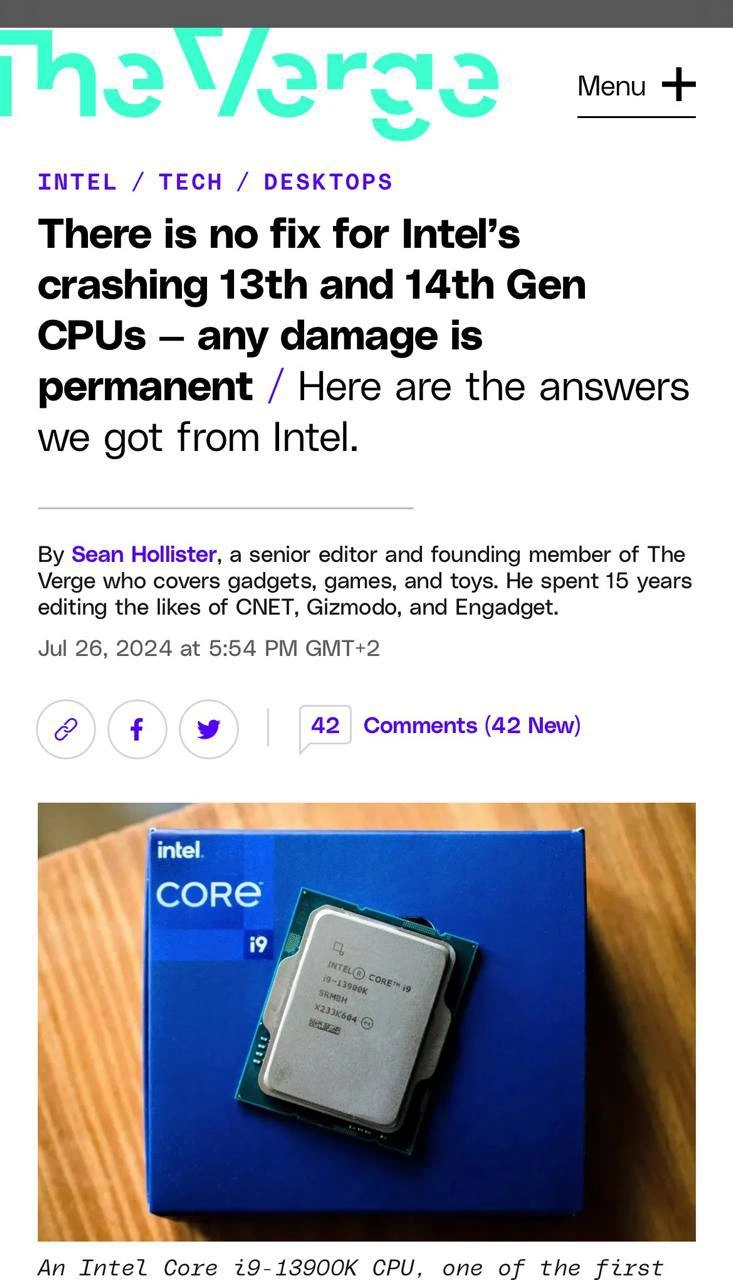
“There is no fix for Intel’s crashing 13th and 14th Gen CPUs – any damage is permanent.”
– Actual headline on The Verge, screenshot in meme

For seasoned developers and system engineers, this headline hits like a tragic punchline. It reads almost like an Onion article, but nope, it’s real tech news. The humor here is as dark as it gets: a critical bug in the CPU itself, with no hope of a patch or workaround. In the software world, we’re used to bugs – irritating, yes, but ultimately fixable with enough debugging and a couple of all-nighters. Worst case, you roll out a hotfix or push a firmware update. But this? This is the one bug you can’t debug in your IDE or solve with a Git patch. It’s as if Intel dropped the mic and said, “Yeah, it’s broken. If it breaks, it’s broken-broken. Good luck.”

This meme resonates with a kind of weary laughter from the dev community. SystemCrashes are something we’ve all dealt with, but usually we assume the cause lies in software or maybe a replaceable part like RAM or a drive. We have a whole playbook: check the logs, blame a rogue pointer, suspect the OS, maybe joke “it’s always DNS” or blame cosmic rays flipping a bit. Rarely do we seriously conclude “the brand-new CPU has a fatal flaw.” That’s the stuff of nightmares. And here we have a mainstream news article spelling it out in bold: the silicon itself is suspect number one – and if it falters, it’s Game Over for that processor. EngineeringAbsurdity is a fitting tag: it’s absurd that cutting-edge chips worth hundreds of dollars could have a flaw so severe that the only “fix” is to RMA the chip and hope the next one doesn’t implode.

From a senior perspective, this brings back memories of past fiascos:

  • The Pentium FDIV bug in the ‘90s taught a whole generation that even mighty Intel can ship a broken math unit. Intel had to eat crow (and $500 million) replacing those.
  • There was the AMD Phenom TLB bug (circa 2007) where a Translation Lookaside Buffer flaw could cause random system hangs. The interim "fix" was a BIOS patch that disabled part of the cache – effectively trading performance to avoid the bug. It was a band-aid; the real fix came in a new revision of the CPU.
  • More recently, Spectre/Meltdown didn’t physically damage chips, but they lived in silicon and forced us to fundamentally change OS behavior to mitigate security holes. Those were classed as errata we could live with (begrudgingly).

But notice the pattern: usually there’s some mitigation – maybe a microcode update, maybe a performance-sacrificing switch, maybe a recall if it’s truly dire. What’s funny (in a grim chuckle way) about the 13th/14th Gen situation is how unequivocal it is. The headline might as well be screaming “Permanent Hardware Damage: Abandon All Hope Ye Who Run This Code.” That’s an extraordinary thing to announce. It triggers a kind of developer dread because it’s beyond our control. It’s like hearing the foundation of the building you work in is cracked: not much a software engineer (or even the building’s IT guy) can do about that, except evacuate.

The original poster’s quip captures this fatalism perfectly: “As a proud owner of 13900K I’m not so proud anymore (tho no issues so far).” That’s the kind of half-joking, half-anxious tone an engineer uses when fate is out of their hands. They shelled out for a top-of-the-line Intel i9, bragging rights and all, and suddenly it’s like they bought a sports car only to find out the engine might seize if they rev too high. They haven’t experienced crashes yet, so they joke “no issues so far” – implicitly adding “...crossing fingers.” It’s gallows humor. Every experienced dev or hardware enthusiast reading that will smirk in commiseration. Yeah, works on my machine… until the day it doesn’t.

In the dev world, we often talk about risk management and redundancy. We’ll cluster servers, have failover plans, keep spare power supplies. But no one designs a system expecting the CPU itself – especially a flagship Intel CPU – to have a defect that can irreversibly fry it. How do you plan for that? Stash a second identical server on standby? Pray? The fatalistic vibe of this meme is basically saying: “We’ve gotten to a point where even our hardware might just up and die due to a manufacturing oops, and we as developers can’t do a darn thing except laugh (to keep from crying).”

There’s also an implicit jab at Intel and the tech industry’s pace. As a senior dev might note: chip launches have been feverish, pushing silicon to its limits to one-up AMD and meet market expectations. Sometimes engineers know about a bug but deem it an edge case – “we can fix it in microcode later,” they assume. But here we have a bug that slipped through that’s so bad microcode can’t fully save it. The result? The company line boils down to “avoid the conditions that cause it, and if you don’t, well, the damage is done.” It’s the ultimate CriticalBugs scenario: one that flips the usual script. Instead of software patch coming soon, it’s hardware recall not coming (or at least not publicly announced in that headline).

For the battle-scarred ops folks and developers, there’s bitter amusement in how this inverts the usual blame game. We joke "It's never the hardware, until it is." This time it is the hardware, unequivocally. Picture a stressed sysadmin in a war room: all eyes are on them during a production outage. They mutter, “It’s not our code, it’s not the RAM, it’s not even the OS… it might actually be the CPU acting up.” In most companies that claim would earn you some raised eyebrows or laughs. But hey, show them this Verge article and you’ve got backup for the wildest scapegoat ever.

To put it simply, this meme’s dark humor comes from that stark phrase: “no fix – any damage is permanent.” It’s the kind of line that normally belongs in a sci-fi dystopia or a sarcastic tweet, not an official statement about real hardware. Developers share it with a sarcastic smirk: “2024, folks — when even our CPUs have zero-day hardware bugs. Patch Tuesday? More like Trash Tuesday, time to throw out the chip!”

In summary, the senior-perspective joke is that we’ve reached the pinnacle of “Works on My Machine” irony: the machine might be fundamentally flawed, and all our clever code can’t save us. It’s a sobering laugh at the absurd fragility lurking under the hood of bleeding-edge tech:

// Pseudo-error depicting the unfixable CPU bug
try {
    executeCriticalInstruction();
} catch (HardwareFatalException &e) {
    // Log and permanently disable this core
    fprintf(stderr, "CPU core fried: %s\n", e.what());
    shutdown(); // no recovery possible
}

In other words, “No patch available. Please replace your CPU and press any key to continue.” – the sort of message that every seasoned engineer prays they’ll never see in real life, now meme-ified for our Schadenfreude and horror.

Level 4: Irreversible Silicon Snafu

At the deepest technical level, this meme highlights a silicon-level bug — a flaw baked directly into the CPU’s hardware. Modern Intel CPUs like the 13th-gen Core i9-13900K and its 14th-gen kin are marvels of microarchitecture: billions of transistors forming caches, ALUs, branch predictors, and out-of-order execution pipelines. When a defect lurks in those circuits, we call it an erratum (a hardware bug). Intel typically documents errata in lengthy PDFs, offering workarounds or microcode patches for each. Microcode is essentially firmware for your CPU’s brain: it’s a layer of low-level instructions that can be updated (via BIOS or OS updates) to tweak how certain operations execute. Think of it as a tiny software bandaid applied to the CPU’s logic.

But here’s the catch: microcode has its limits. It can often skip or reorder instructions to avoid known logic faults, but it cannot rewire physical transistors or resurrect fried circuits. If a bug causes actual permanent hardware damage – say, overstressing a voltage rail or mismanaging current in a way that breaks transistors – then microcode is as helpless as a high-level patch trying to fix a shattered silicon wafer. You can’t software-update your way out of a burnt-out gate array. This is the territory of irreversibility. It’s as if a certain sequence of instructions or a specific workload toggles a self-destruct circuit inside the chip. Once tripped, poof – that part of the silicon is electrically toasted, forever.

From a theoretical standpoint, this is an extreme manifestation of hardware reliability limits. Engineers push these CPUs to the bleeding edge of performance (think 5+ GHz boost clocks and aggressive voltage spikes on a nanometer-scale process). There’s scant margin for error. We’ve seen similar tales in tech history: the infamous Pentium FDIV bug (1994) where a transistor-level mistake led to math errors that no software could truly fix (Intel had to physically replace chips), or the more recent Meltdown and Spectre flaws (2018) which were designed behavior quirks that required OS and microcode mitigations at significant performance cost. But at least those could be mitigated. Here we’re dealing with something closer to an electrical fault – perhaps akin to electromigration or a timing hazard that causes literal component degradation. It’s the kind of bug where once the CPU starts crashing due to this fault, it might have already damaged itself internally (for example, a memory cache cell blown out or a PLL circuit destabilized). The Verge headline bluntly says "any damage is permanent," which in engineering terms implies no amount of rebooting or patching will restore the lost functionality. The only true solution is a revised hardware stepping (a new physical revision of the CPU without the flaw) or straight-up replacing the CPU. In other words, this is a hard-stop at the intersection of computer science and physics: when a bug transcends from brittle logic into burnt silicon, we’ve entered a realm where even the best software-engineering practices kneel before the laws of electricity.

So in this Hardware horror story, the punchline for the technically inclined is that we’ve found a bug you can’t blame on your code, your OS, or even your firmware – it’s etched in the very silicon. It’s an EngineeringAbsurdity where the usual arsenal of fixes (patch the OS, update drivers, apply new microcode) just bounce off the immovable reality of a flawed CPU design. In a darkly comic way, it’s a reminder that sometimes the root cause really is the CPU. When that happens, all our clever software abstractions crumble, and we’re left staring at a very expensive piece of doped silicon that has effectively /dev/null’d itself.

Description

Mobile screenshot of a The Verge article. Top banner shows the cyan Verge logo and a hamburger icon labeled “Menu”. Section tags read “INTEL / TECH / DESKTOPS”. Bold headline text states: “There is no fix for Intel’s crashing 13th and 14th Gen CPUs - any damage is permanent / Here are the answers we got from Intel.” A by-line underneath credits Sean Hollister and date “Jul 26, 2024 at 5:54 PM GMT+2”; a speech-bubble icon shows “42 Comments (42 New)”. Lower half displays a photo of an Intel Core i9-13900K CPU angled on its blue retail box. The image underscores hardware-level faults that software, firmware, or microcode patches cannot repair, highlighting the grim reality of silicon defects for developers operating production systems

Comments

47
Anonymous ★ Top Pick Architectural takeaway from the 13900K fiasco: immutable infrastructure is brilliant right up until the immutability is the bug - you can’t rollback a 10 nm etch
  1. Anonymous ★ Top Pick

    Architectural takeaway from the 13900K fiasco: immutable infrastructure is brilliant right up until the immutability is the bug - you can’t rollback a 10 nm etch

  2. Anonymous

    Intel finally achieved true hardware immutability - once your CPU degrades, that state change is cryptographically permanent. It's like they implemented write-once memory at the silicon level, except nobody asked for WORM drives in their processor cores

  3. Anonymous

    When Intel said their 13th and 14th gen CPUs would have 'lasting performance,' they weren't kidding - the damage is literally permanent. It's the hardware equivalent of a memory leak you can't patch: no microcode update, no BIOS fix, just a very expensive paperweight that occasionally crashes. At least with software bugs you can blame the previous developer; with silicon degradation, you can only blame physics... and maybe the validation team that signed off on those voltage curves

  4. Anonymous

    Intel's 13th/14th Gen: hardware tech debt that compounds faster than a legacy monolith under prod load

  5. Anonymous

    Postmortem TL;DR: not a kernel bug - just electromigration; rollback doesn’t apply to silicon lattices, so the runbook is “drain node, swap CPU, update RMA budget.”

  6. Anonymous

    Intel’s 13th/14th‑gen taught me that “graceful degradation” can be literal - leave PL2 on “Motherboard Unlimited” and your V/F curve turns into a write-once log

  7. @razordude 1y

    RIP Intel https://m.youtube.com/watch?v=b6vQlvefGxk&list=WL&index=1&pp=gAQBiAQB

  8. @Hollow_Arigo 1y

    https://www.youtube.com/watch?v=boMaTNuYTyg&pp=ygUg0LvRg9GH0YjQtSDQutGD0L_QuCDRgNCw0LnQt9C10L0%3D

  9. @beton_kruglosu_totchno 1y

    depends on VID table, you might never have issues

  10. @Hollow_Arigo 1y

    POV: Buying Intel

    1. dev_meme 1y

      I bought Ryzen few years ago for my relatives, it was 5600X Guess what? It didn’t booted Went to replace, we tried it on 3 different mobo and it didn’t worked so I got replacement Guess what? New one didn’t booted either but a bit differently Third one didn’t booted neither 4th one finally worked, like, fml Tell me about choosing Ryzen for home PC 🤡

      1. @Hollow_Arigo 1y

        Okay, your story was fun but you are first and alone from who I hear about 3 Brocken chips. Maybe you just unlucky. I use ryzen 3+ years and everything is great. My friends using ryzen and still, everything great.

        1. dev_meme 1y

          I never heard about getting 3 broken CPUs in a row too

        2. dev_meme 1y

          And you can imagine how joyful was that experience of communication with the shop to got those replacements

        3. @Araalith 1y

          TBH Opteron was good, but Ryzen is just "cheaper and almost as good as Intel"

          1. @qtsmolcat 1y

            My experience is that ryzen is generally better in performance vs power usage

        4. dev_meme 1y

          Well, “I use ryzen 3+ years and everything is great.” is pretty bad take I use Intel for 20+ and never had a defective chip. It doesn’t mean their QA catches all defective chips But to get 3 defective chips in the row from the shop means manufacturer got some serious problems with QA of their products

          1. @Araalith 1y

            I have used Intel since the 8088 series, and not a single chip has failed. In contrast, I have two burned-out AMD chips - one had a stuck fan and the chip died in a few seconds, as if the overheating protection was a joke, the second just died without any visible reason.

            1. @Le_o_R 1y

              A long time ago I watched a video where a guy was running an Intel CPU without a fan and an AMD CPU without a fan. The Intel kept shutting off. The AMD fried.

              1. @leandrofriedrich 1y

                THG ❤️

          2. @Agent1378 1y

            I bet shop fucked with customer and gave back the same chip

      2. @Araalith 1y

        AMD is the best heater ever. Why do you need it booted?

        1. dev_meme 1y

          To produce heat? How else to do you load it properly to warm up a room?

          1. @Araalith 1y

            Just turn it on

  11. @beton_kruglosu_totchno 1y

    btw the best protection other than buying ryzen is this: https://www.youtube.com/watch?v=2G-Y0yDSfeA

    1. @Hollow_Arigo 1y

      buying specific motherboard to fix Intel issues? great

    2. @megapro17 1y

      What a fuck tldr

      1. @beton_kruglosu_totchno 1y

        1) Intel seems to request even higher voltage before load hits to never have undershoots, can be as high as 1.6V+ (even high voltage rail resistance does not make it safe) 2) specifically on Gigabyte motherboards there's setting which tells Intel "never use anything higher than X" which means that CPU does not destroy itself anymore but works at lower frequencies naturally And if voltages are indeed THE problem then it's the most straightforward solution of that problem.

  12. @beton_kruglosu_totchno 1y

    Buildzoid also uncovers new Intel property in that video.

  13. @razordude 1y

    My USB peripherals may be randomly disconnecting and reconnecting or lagging on my Ryzen PC, but at least it's not going to suddenly stop working 👌

  14. @SamsonovAnton 1y

    Thanks god I just started using 11900 (which I had bought 2 years ago but did not have time to assemble). 😆

  15. @samorosnie 1y

    U guys using something newer than 4th gen?

    1. Deleted Account 1y

      same.

    2. @Le_o_R 1y

      i7 3rd gen is my daily driver. It's some Dell laptop my employer got rid of.

  16. @SomeWhereIBelong 1y

    Why would anyone use intel at this point i dont get it

    1. @dsmagikswsa 1y

      It is like why people use Windows at this point too...

  17. @Edward_James 1y

    Well... Recall exists

    1. @ZgGPuo8dZef58K6hxxGVj3Z2 1y

      Greed exists

      1. @Edward_James 1y

        Then intel should collapse 😂 70% of market would be a sweet piece of cake and a lot of cheap intel slaves to hire lol

  18. @ZgGPuo8dZef58K6hxxGVj3Z2 1y

    10th gen gang

  19. @Hollow_Arigo 1y

    GN?

    1. @Johnny_bit 1y

      https://youtu.be/b6vQlvefGxk

    2. @ZgGPuo8dZef58K6hxxGVj3Z2 1y

      GamersNexus new drama channel

  20. @Le_o_R 1y

    Laughing in i7 3rd gen like a maniac.

  21. Deleted Account 1y

    i'm starting to think that laptops with this generations will be resold very cheap.

  22. @kandiesky 1y

    Intel today is AMD in the era of the FX

    1. @kandiesky 1y

      Except they are doing worse while still maintaining market dominance

Use J and K for navigation