Skip to content
DevMeme
5628 of 7435
Exiting Vim the Cloud-Native Way by Deleting the Kubernetes Pod
IDEs Editors Post #6175, on Aug 21, 2024 in TG

Exiting Vim the Cloud-Native Way by Deleting the Kubernetes Pod

Why is this IDEs Editors meme funny?

Level 1: Door vs. Demolition

Imagine you’re stuck in a room and can’t figure out how to open the door. It’s a regular door, but maybe the handle is a bit tricky. Instead of fiddling with the handle or asking for help, you decide to do something wild: you get a big wrecking ball and smash the entire house down just so you can step out of the room. 😅 That sounds crazy, right? You solved the problem – you’re not in the room anymore – but you went WAY too far for such a simple thing.

This meme is funny for the same reason. Quitting Vim is like opening that door – it should be simple (if you know how). Deleting a Kubernetes pod is like knocking down the whole house – a huge effort for a small task. People laugh because it’s an over-the-top solution. It shows someone getting so frustrated by a little problem (quitting an editor) that they use a giant high-tech tool (managing containers in the cloud) to fix it. It’s the silliness of using a bazooka to swat a fly, and that feeling of “Okay, that’s one way to do it… 😂” is what makes the joke click. Even if you don’t know Vim or Kubernetes deeply, you can understand that destroying a big thing to stop a small thing is humorous overkill.

Level 2: From :q to kubectl

Let’s break this down in simpler terms. This meme is joking about two tools from very different worlds: Vim and Kubernetes. If you’re a junior developer or new to these, here’s what you need to know:

  • Vim is a text editor that you run in a terminal (that’s why it’s tagged CLI, for Command Line Interface). It’s powerful and popular among programmers for editing code. But Vim has a steep learning curve, especially because of its modal nature – it has different modes like Normal mode and Insert mode, and the keys do different things depending on the mode. A famous problem for beginners is “How do I exit Vim?”. If you open Vim without knowing the commands, pressing the usual keys won’t close it. The correct way is to press the ESC key (to make sure you’re in Normal mode), then type :q and hit Enter to quit. If you made edits and want to save, you’d do :wq (write and quit). If you want to quit without saving changes, you use :q!. These shortcuts aren’t obvious, so countless newbies have panicked and even resorted to closing the entire terminal window or rebooting the computer just to get out of Vim! It’s such a common pain point that “exiting Vim” became a long-running joke in programming communities. The GitHub link shown (hakluke/how-to-exit-vim) is a real repository that humorously lists ways to quit Vim – which tells you how widespread this little problem is. EditorWars is a related tag hinting at the playful debates over which text editor is superior (Vim vs Emacs vs Nano, etc.), and Vim’s tricky exit is often a punchline in those debates.

  • Kubernetes is a system for managing containerized applications – basically, it helps run software in isolated units called containers across many machines. Think of a container as a lightweight mini-computer or an app wrapper. Kubernetes (often abbreviated “K8s”) is used by DevOps engineers to deploy and scale applications reliably. In Kubernetes, a Pod is the smallest unit of deployment – usually one container (or a few tightly-coupled ones) running together. Deleting a Kubernetes pod means you are stopping that container (and anything running inside it). Typically, you might delete a pod if it’s misbehaving, and Kubernetes will often replace it with a fresh one if it’s part of a deployment. This is where the DevOps_SRE mindset comes in: rather than manually fixing a problem on a live server, you often just destroy the faulty unit and let the system bring up a new healthy one. It’s a bit like if an application is acting up, you restart it; with Kubernetes, you might script the restart or replacement of an entire container instance. Containerization and tools like Kubernetes make this process easy and standard.

Now, why is it funny to mention “exiting Vim by deleting the Kubernetes pod”? It’s funny through exaggeration and mismatch. Exiting Vim should be a very simple, small action – just a keyboard command within a text editor. Meanwhile, deleting a Kubernetes pod is a much bigger action in a completely different scope – it’s an operational command that affects servers or applications running in the cloud. It’s like saying, “I didn’t know how to close this program, so I shut down the whole server.” The meme is essentially joking that someone would use this massive hammer (Kubernetes pod deletion) to solve a tiny nail of a problem (quitting an editor). That’s an example of over-engineering: using a very complex or excessive solution for a simple task. Developers find this hilarious because it blends a newbie mistake with an expert’s tool in a silly way. It’s as if someone said, “I lost my house key, so I’m hiring a construction crew to knock down the door” – logically possible, but way too much!

In the DevOps world, there’s a grain of truth that makes the joke land: engineers really do automate fixes by restarting or recreating environments. If an application is unresponsive, an SRE might delete the pod and let the system heal. But here, the “application” in question is just Vim, the editor program. Normally, you’d never manage Vim with Kubernetes – you run it directly on your computer or inside a simple container you control. That contrast is what creates the humor. It plays on the image of an overzealous DevOps engineer who’s so deep into container orchestration that even their text editing is managed by Kubernetes! And when stuck, their instinct is not “type the exit command” but “issue a cluster command” 😄.

So, for a junior developer: the meme is mixing up a basic developer hurdle (learning to exit Vim with :q) with an advanced infrastructure concept (Kubernetes pods). It’s making fun of the scenario where someone doesn’t know the simple solution and instead uses an extremely advanced tool as a workaround. Part of the joke is also cultural – everyone in programming hears about someone struggling with Vim at least once, and everyone in DevOps knows how powerful (and complex) Kubernetes is. Putting them together creates a silly mental image that’s easy to laugh at.

Level 3: Exit as a Service

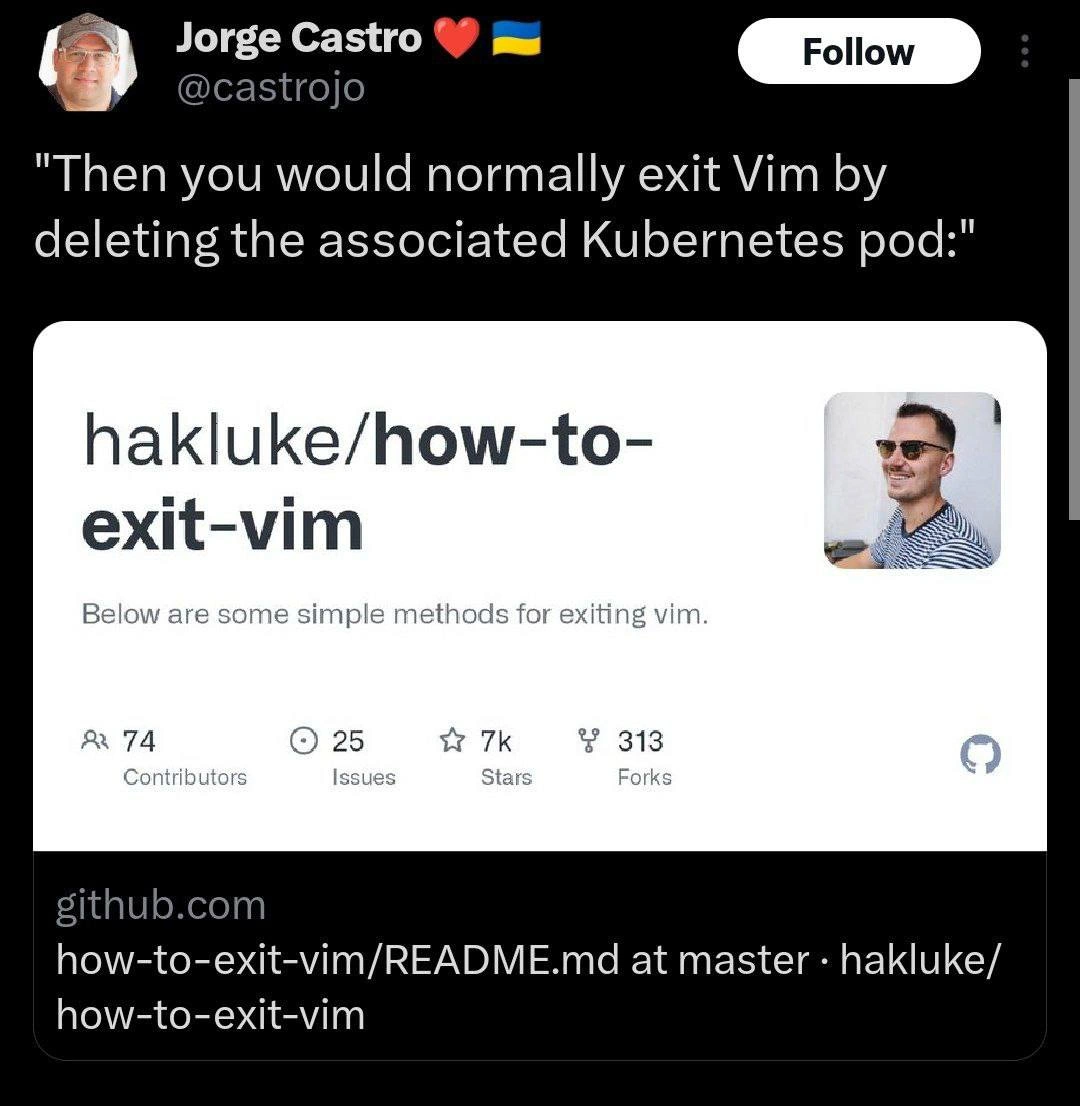
At first glance, this meme mashes up a classic CLI dilemma with modern cloud-native overkill. We have the venerable text editor Vim – notoriously tricky to exit for the uninitiated – and the heavyweight solution: deleting a Kubernetes pod to kill Vim. It’s like using a rocket launcher to crack a nut, and that absurdity is exactly why experienced developers are chuckling. The tweet’s author quips that “you would normally exit Vim by deleting the associated Kubernetes pod”, dryly normalizing an outrageously over-engineered workaround. This hits on two insider jokes at once: the eternal struggle of exiting Vim and the DevOps tendency to solve problems with containers and orchestration, even when it’s total overkill.

Let’s unpack the humor from a senior DevOps/SRE perspective. Vim is a powerful modal editor that’s been around since the 1970s (an era of punch cards and green-screen terminals). It lives in the command-line (hence the CLI tag) and famously doesn’t let you quit with a simple click or keystroke. You have to know the magic incantation (:q or :wq commands) to exit. Every developer has seen a newcomer go “Help! I’m stuck in Vim, how do I get out?!” – it’s a running joke on Stack Overflow and Reddit. In fact, there’s a popular GitHub repository hakluke/how-to-exit-vim (highlighted in the meme) with thousands of stars ⭐, collecting dozens of ways to leave Vim. When a repository about quitting an editor has 7k stars and 300+ forks, you know it’s a universal developer pain point turned joke.

On the other hand, Kubernetes (K8s for short) is a cutting-edge container orchestration platform – practically the poster child for Containerization and DevOps workflows. It automates deploying, scaling, and managing applications in containers (lightweight runtime environments). In Kubernetes, an application runs inside a pod, which you can think of as a small capsule containing one or more containers. Pods are meant to be ephemeral and disposable – the DevOps mantra is often “cattle, not pets,” meaning you kill and replace servers (or pods) rather than lovingly hand-fixing them. This mindset is great for microservices in production: if something misbehaves, you terminate the pod and let the system spin up a fresh one, instead of SSHing in to debug interactively.

Now, the tweet jokingly suggests applying this cattle-not-pets philosophy to a Vim exit problem. An expert DevOps engineer might grin because it parodies their everyday tools: Can’t figure out a process? Just recycle the container! It’s absurd – deleting a whole pod (which could be an entire microservice instance) just to stop Vim is like demolishing your cloud instance because you forgot a keyboard shortcut. Yet, it’s funny because it’s relatable: many of us have felt that “ugh, just nuke it from orbit!” frustration. In high-pressure ops scenarios, we sometimes do reach for the quickest hammer (kill the process, reboot the server, etc.) when a simpler proper fix eludes us. This meme exaggerates that impulse to the extreme. It’s poking fun at how over-engineering and modern tooling can be comically misused. After all, Kubernetes is one of the most complex ways to run software – it’s overkill to manage a single text editor session, which makes the joke deliciously ironic.

To seasoned developers, there’s also an editor war subtext. Vim is revered by power users for its efficiency, but it’s infamous among newcomers. Instead of learning Vim’s commands, the meme’s “DevOps style” user opts for brute force via infrastructure. It’s a tongue-in-cheek dig at those who perhaps rely too much on heavy DevOps machinery for simple tasks. The DevOps/SRE crowd knows how much configuration and automation goes into Kubernetes – using it to solve a one-off editor exit is hilariously disproportionate. It hints at the kind of Rube Goldberg solutions you might see in large orgs: Why teach developers Vim commands when you can containerize the editor and write a microservice to close it? 😜

In real-world terms, envision someone editing a file in a Docker container running on Kubernetes (perhaps via kubectl exec into a pod). They get stuck in Vim and, instead of pressing the right quit command, they open another terminal and run a one-liner to delete the pod. That’s essentially pulling the plug on Vim by destroying the entire environment it runs in. Problem solved – Vim is definitely not running anymore! Of course, any unsaved work is toast too, and if that pod was doing more than just editing… well, you’ve just blown away a chunk of your application. It’s an obviously terrible idea in practice, which is why it works as programmer humor. It exaggerates the frustration newbies feel with Vim into a scenario no seasoned admin would actually recommend (unless they really needed a laugh or had zero other options).

To highlight the contrast between the sensible approach and the meme approach, consider this comparison:

# The proper way to exit Vim (in normal mode):
:q    # quit (fails if unsaved changes)
:wq   # save and quit
:q!   # quit without saving (force quit)

# The meme's DevOps way to "exit Vim":
kubectl delete pod myapp-pod-12345
# This command force-deletes the entire pod (and Vim along with it). Extreme much?

In a nutshell, the meme lands because it bridges a universal newbie mistake with a touch of DevOps dark humor. It’s the senior engineer’s inside joke: mixing a 40-year-old text editor quirk with the latest cloud orchestration tech. Everyone from sysadmins who remember trying to quit vi on a UNIX system, to Kubernetes gurus who automate everything, can share a laugh here. The experienced folks nod knowingly at both the pain of :q and the absurdity of using a grenade when a flyswatter would do.

Description

A screenshot of a tweet by user Jorge Castro (@castrojo). The tweet's text reads, "Then you would normally exit Vim by deleting the associated Kubernetes pod:". Below this text is a preview of a GitHub repository titled 'hakluke/how-to-exit-vim'. The preview shows that the repository has 74 contributors, 25 issues, 7k stars, and 313 forks, with a short description that says, "Below are some simple methods for exiting vim." The technical joke stems from the absurd conflation of two separate, well-known developer pain points. Exiting the Vim editor is a classic meme because its commands are not intuitive to beginners. Deleting a Kubernetes pod is a fundamental but significant action in container orchestration. The humor lies in proposing a ridiculously destructive, high-level infrastructure solution for a trivial, low-level text editor problem, satirizing both the complexity of modern cloud-native environments and the 'nuke it from orbit' approach to problem-solving

Comments

28
Anonymous ★ Top Pick My junior asked for help exiting Vim. I told them to delete the pod. Now they're filing a ticket because the 'uncommitted changes' warning is holding up their entire sprint
  1. Anonymous ★ Top Pick

    My junior asked for help exiting Vim. I told them to delete the pod. Now they're filing a ticket because the 'uncommitted changes' warning is holding up their entire sprint

  2. Anonymous

    I finally solved the Vim exit problem: mapped :q! to “kubectl delete pod $(hostname)” - editor closes, pod restarts, CI goes green, and Prometheus now thinks I’m pair-programming with Chaos Monkey

  3. Anonymous

    When your infrastructure is so cloud-native that even exiting Vim requires a kubectl delete pod --force --grace-period=0, you know you've achieved peak DevOps enlightenment - or you've just containerized your inability to remember :wq

  4. Anonymous

    When your incident response playbook for 'developer stuck in Vim' is literally `kubectl delete pod`, you know you've achieved true cloud-native enlightenment. Why learn :wq when you can just treat the entire runtime environment as ephemeral? It's not a bug, it's infrastructure as cattle - if the editor won't exit, just shoot the whole pod and let Kubernetes resurrect a fresh one. Bonus points if your deployment has a liveness probe that detects 'Vim session duration > 5 minutes' and auto-restarts. This is what happens when immutable infrastructure meets the world's most notorious modal editor: the nuclear option becomes the path of least resistance

  5. Anonymous

    :q! for juniors; for architects, it's kubectl delete pod --grace-period=0 - because Vim's state is eventual consistency across modes

  6. Anonymous

    Cloud‑native way to quit Vim: alias :q to “kubectl scale deploy/editor --replicas=0” - because even exiting should be declarative and idempotent

  7. Anonymous

    Senior move: when :q! fails inside a debug pod, alias quit to 'kubectl delete pod --force --grace-period=0' - nothing says modal editing like Kubernetes garbage collection

  8. @Araalith 1y

    killall5 -9 still works

    1. @sylfn 1y

      are you sure killall5 instead of killall?

      1. @SamsonovAnton 1y

        killall5 is the SystemV killall command. It sends a signal to all processes except kernel threads and the processes in its own session, so it won’t kill the shell that is running the script it was called from. Its primary (only) use is in the rc scripts found in the /etc/init.d directory. 🤔

      2. @Araalith 1y

        Absolutely. We can't take chances.

    2. @ageek 1y

      😂😂

  9. @mpolovnev 1y

    Why would one exit VIM?

  10. @elonmasc_official 1y

    Why would one use VIM?

  11. @CreshchenieRysiINemnogoKerosina 1y

    Why would VIM?

  12. @mira_the_cat 1y

    how to exit tmux

  13. @deadgnom32 1y

    aren't vscode users doing the same with bazilions of plugins?

  14. @deadgnom32 1y

    yeah, but nobody is using bare VSCode. BUT if you frequently browse servers over ssh — you frequently use bare vim as it's very powerful and lightweight. and VSCode is pretty much useless without vim plugin. very hard to use. you kinda need mouse all the time. hover on things, wait until it reacts... while the whole thing could be done quick and easy with vim keys.

  15. @deadgnom32 1y

    firstly. nobody is spending time on memorizing macros. it happens by itself during usage. secondly. you propose inefficient work over gaining an efficient skill. it's like chopping trees with a knife because you don't have time to sharpen your axe.

    1. @mira_the_cat 1y

      just using mouse is faster than keyboard

      1. @deadgnom32 1y

        you joking?

        1. @mira_the_cat 1y

          no

          1. @mira_the_cat 1y

            eg. just selecting some code using mouse is faster than figuring out how many lines are there and then typing something like 13x whatever or something like this

            1. @deadgnom32 1y

              nobody is counting lines you have more semantic and simple ways for that.

              1. @mira_the_cat 1y

                like "this if and a line after it"?

                1. @deadgnom32 1y

                  like visual select and then jump to corresponding bracket. it's 3 clicks

        2. @azizhakberdiev 1y

          If you can't switch your focus between keyboard and mouse then skill issue

  16. @deadgnom32 1y

    vim keys are widely used in many software for developers. so that's untrue what you are saying. you can find them in document viewers, text editors / viewers, browsers, window managers and so on.

Use J and K for navigation