The Great Meme Format War: Rage Comics vs. Wojaks
Why is this DevCommunities meme funny?
Level 1: Back from the Dead
Imagine you had a toy or a style that was super cool when your parents were young, but nobody has played with it or worn it for a long time. Now picture waking up one day and everyone at school is suddenly obsessed with that old thing – like they all dug up a bunch of old Pokémon cards or started wearing 80’s neon leg warmers. You’d probably be shocked and say, “Oh my gosh, they’re everywhere!” It’s funny and a little weird because you thought that trend was completely gone, but now it’s back and everyone’s acting like it’s the hottest new thing. That’s exactly the feeling this meme is joking about: something from the past coming back to life all over the place, surprising everyone who thought it was long gone. It makes us laugh because seeing old stuff suddenly become popular again is like watching a zombie come out of its grave – a little spooky, a little silly, and totally unexpected!
Level 2: Rage vs Wojak
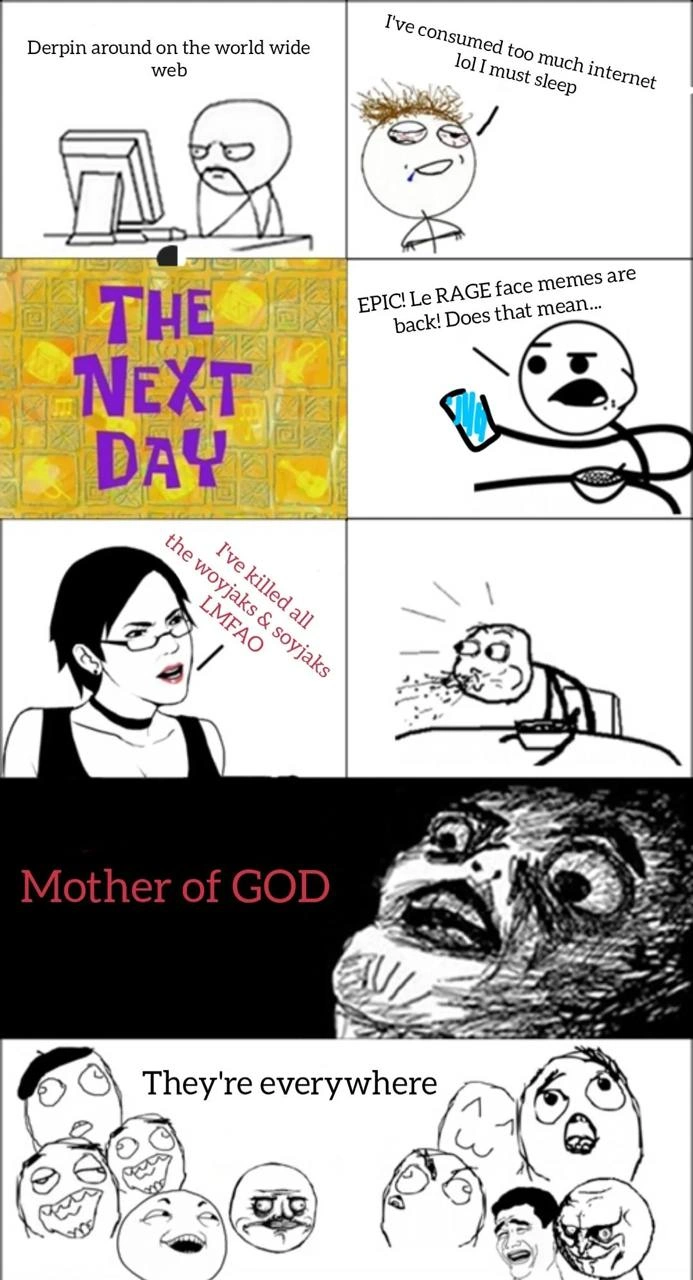
Let’s break down the meme for those who didn’t live through the old meme wars (or the matching shifts in dev culture). The image is an eight-panel comic strip drawn in the style of rage comics – those black-and-white cartoon faces that were super popular in online communities around 2010. Rage comics were essentially DIY comics: people would use a set of recurring crudely-drawn faces (like Trollface, Forever Alone, Cereal Guy, Poker Face, and others) to tell short funny stories about everyday life or internet/gaming experiences. If you’ve ever seen those simple line-art memes expressing extreme emotions (anger, joy, disbelief), that’s the rage comic genre. They were the MemeCulture of their time, kind of the way image macros (like top text/bottom text Impact font memes) were. In developer forums and sites like Reddit, you’d often see rage comic memes about coding frustrations or office IT humor. They’re a bit old-school now — we call them legacy internet humor — but at the time they were the cutting edge of relatable comedy.
Now, over the years, meme trends moved on. By the late 2010s and early 2020s, a different style of character became popular: the Wojak. Wojak (sometimes just called "Feels Guy") is a simple cartoon of a bald-headed, sad-looking man that originated on image boards. It was used to convey feelings or stereotypes. From Wojak, multiple variations evolved — including Soyjak, which is basically a Wojak styled to mock a certain overly excited or effeminate expression (often portrayed with an open mouth and glasses). Wojaks and Soyjaks started to dominate many corners of the internet’s humor scene; they were a new language of memes, often used in more politically incorrect or edgy humor contexts. If rage faces were the meme language of the 2010 era, Wojaks were a big part of the 2020 era meme vocabulary.
So this comic sets up a scenario: On day one, the stick figure (let's call him Derp, a classic placeholder name in rage comics) is just casually browsing the internet (panel 1 caption: "Derpin around on the world wide web" — using derp slang and even saying "world wide web" as a goofy throwback). He consumes a bunch of content and decides it’s time to sleep (panel 2 text: "I’ve consumed too much internet lol I must sleep" – you can almost hear the tired gamer or developer saying that after hours online). The next day (as shown by the SpongeBob title card in panel 3), he checks his phone and sees something shocking: Rage face memes are back! In panel 4 he excitedly says, "EPIC! Le RAGE face memes are back! Does that mean…", implying he’s wondering if this is real – are the old memes he used to love truly popular again? He’s holding up his smartphone with a big grin. It’s like a developer waking up to find out an old framework or library they used to use is suddenly trending on GitHub again. It’s exciting but also confusing.
Then in panel 5, the comic shows a modern-style meme character – a smug anime-style face (this is not a classic rage face but rather representing a more contemporary meme figure, possibly an avatar of internet culture) – declaring "I’ve killed all the wojaks & soyjaks LMFAO". This is basically saying: the old memes have defeated the new memes. It’s as if someone says "I removed all the newfangled stuff, long live the classics!" In a dev context, imagine a sysadmin joking "I’ve uninstalled all the fancy new tools, we’re back to our old stack, haha!". The "LMFAO" (internet slang for laughing really hard) and the fact it's an anime avatar deliver the message with a strong smug/ironic tone. This panel uses diagonal red text, which was a style sometimes used for dramatic or ironic effect (it makes the statement look extra bold and meme-y).
Panel 6 shows the Cereal Guy rage face doing his famous spit-take. In rage comics, Cereal Guy is usually shown holding a bowl and spoon and spitting out cereal in shock at something unbelievable. Here, he’s reacting to the news that all the Wojak/Soyjak memes have been "killed" (i.e., wiped out or replaced) by the return of rage faces. This is the moment of pure surprise. For someone new to this: picture reading your social media feed and suddenly all the memes look like they’re from 2009, not a Wojak in sight – you’d probably do a double-take (maybe not literally spit your breakfast, but you’d be surprised!).
Panel 7 goes dark and dramatic: It shows another rage comic classic face often labeled "Mother of God" face. This face has bulging eyes and a shocked expression, typically paired with the phrase "Mother of God…" as a reaction to something overwhelming. The meme uses big red text "Mother of GOD" on black for extra drama. This is the cartoony way to say "Oh. My. Gosh." or "This is horrifying/amazing." At this point, the character (and the reader) realizes this isn’t a small thing – it’s a full-blown comeback.
Finally, panel 8 says "They're everywhere" with an image of a crowd of rage faces peeking in. Indeed, all those old rage faces (the laughing Trollface, the goofy grin "Me Gusta", the crying "Forever Alone", etc.) are drawn together, literally everywhere. This drives home the joke: you can’t escape them; the feed is completely overrun by these resurrected memes. It’s like logging into your favorite developer forum and every post is suddenly some ASCII emoji from the 90s – all the new stuff has been eclipsed by retro content. In programming terms, this parallels the idea of legacy systems or deprecated tech popping up in every corner. For example, imagine if you joined a new company thinking you’ll work with the latest tech stack, and on day one you discover not only do they use an old language like COBOL, but COBOL is everywhere in their code! You’d probably have a "Mother of God" moment yourself. It’s the shock of seeing something you thought was outdated now absolutely ubiquitous.
In simpler terms, this meme humorously compares meme generations to technology generations. Rage comics (old generation memes) versus Wojaks/Soyjaks (new generation memes) is akin to, say, using an old framework vs a modern one. The fact that the old one comes roaring back is both funny and a bit scary. Communities online often get excited about the Next Big Thing, but sometimes the old thing comes back instead. This can happen in programming, too: sometimes an old library or pattern that everyone abandoned can suddenly regain popularity (perhaps renamed or repackaged), surprising folks who lived through its first life. That’s why we have tags like LegacyVsModern and GenerationalShiftInTech: they highlight this clash and turnover between the tried-and-old versus the new-and-trendy. The meme uses extreme cartoon exaggerations to poke fun at how chaotic and LOL-worthy it is when nostalgic content overload happens — when our feeds (or codebases) get flooded with something from the past.
So if you’re a newer developer or meme enthusiast who missed the rage comic era: now you know. Those weird doodle faces were the Wojaks of yesteryear. And if one random day your Twitter or Reddit feed fills up with them, you’ll understand that it’s an inside joke about tech nostalgia — the old memes staging a comeback tour, just like an old programming technique suddenly trending again. It’s both a celebration of internet history and a lighthearted jab at how things in tech (and humor) are cyclical. Today’s cutting-edge meme or tool might be tomorrow’s cringe relic… and then someday, it might become cool again.
Level 3: Nostalgia Overflow
For the seasoned developer (or internet veteran), this collage hits like a chaotic class reunion – all the legacy characters from our past are back on the screen at once. The meme is riffing on a generational shift in tech culture: after years of Wojaks and Soyjaks dominating meme culture, suddenly the old rage comics style is staging a comeback. This feels absurdly nostalgic and a bit horrifying, much like seeing that outdated legacy module you finally ripped out of your codebase suddenly reappear in a new merge request. Mother of GOD, we thought we banished that thing!
Each panel of the meme is a throwback reference: the stick-figure at a beige CRT monitor with "Derpin around on the world wide web" immediately transports older devs to the days of static forums and dial-up tones. (Yes, the meme literally says "world wide web" – a phrase so old-fashioned that reading it might trigger flashbacks to the Netscape Navigator era. It’s deliberately archaic, like an Easter egg for those who remember when we actually called it the World Wide Web.) The second panel’s exhausted character saying "I've consumed too much internet lol I must sleep" captures that late-night content overload feeling, phrased in the slightly naive, early-meme way (back when saying "LOL" in your meme wasn’t considered uncool). The SpongeBob-style "THE NEXT DAY" title card in panel 3 is another nod: it’s a classic transitional gag from early 2010s internet humor and SpongeBob episodes – a double-dose of nostalgia.
Then comes the twist: panel 4’s excited cereal guy (one of the iconic rage faces) proclaims "EPIC! Le RAGE face memes are back! Does that mean...". The use of "Le" here is very specific meme culture: back in the rage comic era, people would prefix actions with "le" for comedic effect (e.g., "le me browsing reddit"). It was nonsensical faux-French seasoning for memes. Seeing it now is intentionally cringe-funny – it’s like an old catchphrase we’re embarrassed we used, yet here we are chuckling at it again. The senior dev parallel: imagine someone on your team exclaiming, "Epic! The old framework is back!" or "We're writing in Perl again?! Does that mean..." — a mix of excitement and dread, because you recognize exactly what’s coming next.
Panel 5 introduces a new character style: an anime-style avatar smugly declaring in red diagonal text, "I've killed all the wojaks & soyjaks LMFAO." This represents the new meme regime (the Wojak/Soyjak generation) being vanquished. In internet meme lore, Wojak (also known as "feels guy") and Soyjak (a pejorative variant with exaggerated features) took over forums and chats in the late 2010s with their own edgy, often cynical humor. They had, in effect, usurped the old rage faces as the go-to reaction images. So this panel is like the ghost of memes past gleefully announcing a coup: the old guard (Rage Comics characters) have retaken the meme throne by eliminating the new competitors. The LMFAO (laughing my freaking a** off) at the end and the overconfident anime persona are dripping with the kind of edgy internet sarcasm you’d see on image boards. A veteran developer might connect this to something like an old, supposedly superceded technology magically “killing off” its modern replacements. For example, there was a phase when NoSQL databases were hyped to replace SQL completely; a decade later, guess what – SQL is everywhere again. It's as if the old tech said, "I’ve killed all the NoSQLs, LMFAO," and the dev community collectively spat out its coffee in shock.
Speaking of spitting coffee, Panel 6 gives us the classic cereal-spitting guy — a rage comic staple used to express utter shock or disbelief. Here, he’s spewing flakes everywhere at the news that the old memes have slain the new memes. This is exactly how an onlooker might react: "Wait, what? The thing we all thought was outdated and uncool is now dominant?!" In developer terms, this is the feeling of reviewing a pull request and discovering a block of revived legacy code. Picture scanning a modern codebase and suddenly finding a fresh commit that adds import jquery.min.js all over again, or encountering a brand new microservice written in a language you retired years ago. Cereal out the nose. It’s funny because it’s true: the initial reaction is disbelief that something you personally put in the nostalgia bin has returned in force.
Panel 7 ups the dramatic flair: a dark background with huge crimson serif text "Mother of GOD" overlaying the infamous wide-eyed horror face (known from rage comics as the "Mother of God" guy, usually used when witnessing something shocking or grotesque). This is the climactic oh no moment. The phrase itself — “Mother of God” — is an old-school meme catchphrase that became part of internet vernacular through these comics. For the meme’s narrative, it captures the protagonist’s realization that this isn’t a one-off glitch: the rage faces are truly back en masse. For a seasoned dev, it’s that sinking feeling when you realize the temporary “quick fix” of using an outdated library has spread everywhere. Perhaps you chuckled when one legacy snippet cropped up as a joke, but now it's in production systems everywhere you look. Mother of God, what have we done? It humorously dramatizes the horror of seeing past mistakes or old art styles flooding back into current circulation.
Finally, Panel 8 cements the punchline: a crowd of assorted rage faces filling the frame under the caption "They're everywhere." This is essentially a swarm of legacy content overwhelming the modern landscape. It’s the meme equivalent of dozens of zombie processes taking over your CPU – you thought you terminated them, but suddenly your screen is swamped by their smiling, trollish faces. There’s Trollface, Me Gusta, Y U NO Guy, Poker Face – all the OGs have returned from exile. In dev culture terms, imagine walking into work to find all your colleagues suddenly using an IDE from 2005 and referencing old StackOverflow answers from 2010 as if they were new. Or discovering that a trend you swore was buried (like the infamous tabs vs spaces debate) is somehow raging again among the new hires. It’s both comical and a tad exhausting. The caption "They're everywhere" nails that exasperation.
This meme hits home for many in tech because we’ve lived through cycles like this. One year everybody collectively agrees something (be it a style of meme or a coding practice) is cringe or obsolete. Fast forward a few years, and a new generation, blissfully ignorant of the prior consensus, embraces it wholeheartedly. The veterans watching this happen oscillate between schadenfreude (it’s perversely satisfying to see the newbies learn the hard way) and mild panic (please no, not this again!). It’s funny because the situation is absurdly relatable: technology and internet culture both have a short memory and a tendency to repeat themselves. Like a cringey code snippet copy-pasted into eternity, these rage faces just won’t die – and here they are, gloriously clogging our feeds once more.
Level 4: The Memetic Ouroboros
On a theoretical level, this meme points to a cycle of culture and technology much like an Ouroboros (a snake eating its tail, symbolizing eternal return). In memetics (the study of how ideas spread, coined by Richard Dawkins), internet jokes and references are like genetic material— they mutate, compete, die out, and sometimes resurrect when conditions are right. Here we see a tongue-in-cheek meme revival: classic rage comics faces from the early 2010s (practically ancient in internet time) have reappeared to "pollute your feed." This echoes how long-deprecated libraries or programming patterns unexpectedly resurface in modern codebases after years of dormancy. Just as legacy code can linger in a system’s dark corners until someone unknowingly reintroduces it, legacy memes can linger in the collective memory and pop back up when a new generation discovers them (often ironically).
In technology history, there's a concept akin to a hype cycle or even a pendulum swing. What was old hat becomes novel again once the community forgets why it fell out of favor. Think of how computing paradigms oscillate: centralized mainframes -> personal PCs -> thin-client web terminals -> cloud (centralized again) -> edge computing (back to distributed). The meme reflects this recursive pattern in internet humor: rage faces had their heyday, got replaced by newer meme formats like Wojak/Soyjak characters, and now those old rage faces resurface like a forgotten framework new developers find “cool” again. It’s a memetic form of "Everything Old is New Again."
In fact, social networks and dev communities undergo generational turnover. A new cohort might not carry the biases or cringe factor associated with a once-overused meme or tech tool, so they revive it with fresh eyes. Academically, you could liken it to cultural amortization: given enough time (say a decade, which is ~ infinity in internet years), the cost of cringe decays to zero and the meme can be valued for nostalgia or retro appeal. The humor here taps into that deep truth: whether it's design patterns or dank memes, if you wait long enough, yesterday’s "deprecated" fashions will re-emerge, provoking equal parts laughter and shuddering horror from those who lived through it the first time.
Description
A multi-panel rage comic depicting the cyclical nature of internet meme formats. The comic starts with a user browsing the web, then waking up the next day to discover rage comics are popular again. A character announces the death of 'woyjaks & soyjaks,' leading to the classic 'Cereal Guy spit take' and 'Mother of God' reactions as a crowd of old-school rage faces appears. The meme uses classic rage comic characters (like Cereal Guy, Mother of God, and others) and a Spongebob 'THE NEXT DAY' title card to structure its narrative. For a technical audience, this comic is a humorous allegory for the cyclical trends in software development, where old technologies and paradigms often resurface and replace the current 'modern' ones, illustrating that patterns in tech culture often mirror broader internet culture
Comments
7Comment deleted
The return of rage comics is the tech industry's equivalent of finding out monolithic architectures are being rebranded as 'macro-services' and are suddenly considered best practice again
Rage faces are the jQuery of memes - everyone swears they’ve ripped them out, yet one unexpected dependency update and they’re back in production
Watching rage comics resurface is like discovering your company's critical payment system still runs on a COBOL mainframe from 1987 - you're simultaneously horrified and impressed it survived this long
This meme perfectly captures the tech industry's relationship with legacy systems: just when you think rage comics are safely deprecated and archived in /dev/null, some PM discovers them in production, fills the entire S3 bucket with 'nostalgic content strategy,' and suddenly you're debugging why your CDN is serving 2011-era image macros at scale. The real horror isn't the memes returning - it's realizing your infrastructure was never designed to handle the recursive nature of internet culture, and now you're the one spitting out your coffee during the incident postmortem
Watching rage faces flood the timeline feels like a JS framework release cycle: v1 was Wojak, v2 Soyjak, and now v3.0 ‘legacy mode’ ships everywhere with no rate limits, no feature flags, and a migration guide that just says “Mother of GOD.”
Cowboy deploy hits main while you're farming rage faces: availability wins, consistency weeps, partition by memes
Rage faces returning is the meme-world’s microservices-to-monolith loop - Mother of God, after 200 services and four sidecars, we’re shipping a “platform” again