Handling Exceptions Nobody Asked For
Why is this Bugs meme funny?
Level 1: Pretending It’s Fine
Imagine you’re playing outside and you accidentally knock over your mom’s favorite lamp. The lamp breaks and there’s a little smoke coming from a shorted wire – it’s a real mess! Instead of telling an adult or trying to fix it, you quietly prop the broken lamp back up so it looks unbroken, maybe spray a bit of air freshener to cover the burn smell, and then sit down with a big smile like nothing happened. When your mom comes in and smells smoke, you just sip your juice and say, “Everything is okay!” even though the lamp is still smoking. 😅 It’s pretty obvious the lamp is broken and the room might catch fire, but you’re pretending all is well. That’s exactly the joke of this meme: something went seriously wrong, but the character (or in real life, the computer program) just says “this is fine” and acts like nothing’s wrong. It’s funny because we know they should be freaking out or fixing the problem, but they’re stubbornly ignoring it — a silly and dangerous kind of pretend play.
Level 2: Caught but Not Fixed
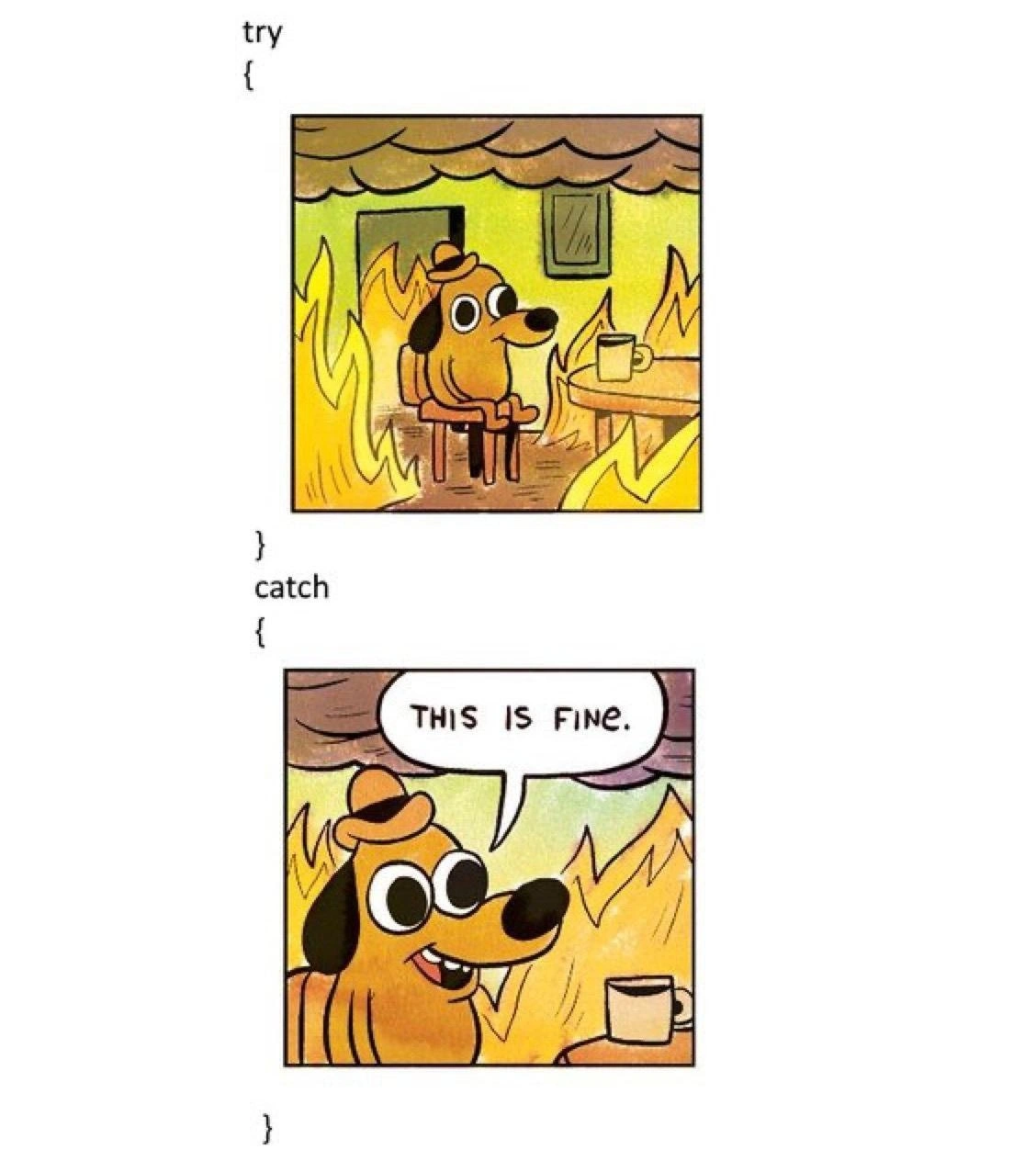
Let’s break down what’s going on for a newer developer. The meme is styled to look like code: we see the keyword try followed by a { ... } block, and later a catch with another { ... } block. In programming, especially in languages like Java, C#, or JavaScript, a try/catch structure is used for ExceptionHandling. Here’s how it works:
try {
// Code that might throw an exception (something risky)
performCriticalOperation();
} catch (Exception e) {
// Code that runs if an exception happens
System.out.println("This is fine."); // Pretending everything is okay
}
In the try block, you put code that might throw an exception. An exception is basically a runtime error or unexpected event that can disrupt normal flow — think of things like trying to read a file that isn’t there, dividing by zero, or a database connection failing. If everything in the try block runs smoothly, the catch block is skipped. But if something goes wrong inside try, the program immediately jumps to the corresponding catch block to catch the exception. The catch block is meant to handle the error: for example, you might clean up resources, show an error message to the user, or log the details of what went wrong for later debugging. This way, your program doesn’t just crash abruptly; you have a chance to respond to the problem.
Now, what’s funny (and cringey) in the meme is how the catch block handles the error. Instead of actually fixing anything or at least reporting the issue, the catch here effectively does nothing useful – it just shows the “THIS IS FINE.” message (like in the comic panel) or might even be completely empty. This is a textbook example of silent failure or ignored exceptions. The code is basically saying: “I caught the error, so the program won’t crash... but I’m not going to tell anyone or do anything about it.” It’d be like wrapping the burning house in fireproof walls so from the outside everything looks stable, but inside the house, the fire is still raging. For a junior developer, it’s important to understand why this is bad. If you catch an exception and just move on as if nothing happened, you might cause more problems: the program’s state might be wrong because something that was supposed to happen didn’t. And since you didn’t log or signal the error, you won’t know a bug occurred until much later (if ever). This makes Debugging_Troubleshooting really hard because there’s no error message or stack trace to follow — it’s as if the bug vanished into thin air.
Think of a simple scenario: suppose you have a piece of code that deducts money from a user’s account and it throws an exception (say, the database updated failed or timed out). If you catch that exception and ignore it, the program might continue running without deducting the money and without telling anyone. The user might get a message “Transaction complete – This is fine” while in reality the transaction failed. Neither the user nor the developers would immediately know something went wrong. That’s a production incident waiting to happen! Proper error handling would, for instance, catch the exception, log an error like “Transaction failed, could not connect to database,” maybe show the user an apology message, and perhaps retry or alert an on-call developer if it’s serious. But an empty or “this is fine” catch does none of that. It just masks the failure.
The meme uses the “this is fine” dog – a well-known image in internet culture – to drive this point home in a funny way. In the comic panel inside the try block, the dog is surrounded by flames (this represents the risky code that’s literally on fire with problems). Then in the catch block’s panel, the dog says “THIS IS FINE.” The developer humor here is: the code encountered a disaster, caught the exception, and then the program (like the dog) smiles and carries on as if everything is okay. It’s poking fun at those situations where a program should be sounding an alarm but instead silently keeps going. Every programmer is told early on, “don’t just catch exceptions blindly – handle them properly!” This meme is a comical illustration of why. It resonates with anyone who’s seen ErrorHandling done poorly. As a junior, the takeaway is: catching an error is only step one – you also need to do something meaningful with that error information. If your catch block is effectively just { } or prints a useless message, you’re heading down the path of difficult bugs and late-night patch fixes. Always remember, as funny as the “THIS IS FINE” meme is, you don’t want your code to be that dog in the burning house! Use exceptions to log errors, alert the team, or fail gracefully, not to pretend the errors never happened.
Level 3: Swallowing the Flames
In this meme, a famous cartoon dog cheerfully declares “THIS IS FINE” while sitting in a room engulfed in flames — and the whole scene is literally wrapped inside a try { ... } catch { ... } code block. This tongue-in-cheek format brilliantly satirizes an error handling anti-pattern that seasoned developers know all too well: swallowing exceptions. Here, the production fire (a critical runtime failure in a live system) is “handled” by a catch block that does essentially nothing useful, much like the dog calmly sipping coffee in a burning house. The code just catches the error and pretends everything’s okay. Instead of alerting anyone or stopping the system, the exception disappears into a black hole, and the software continues running as if nothing happened. For experienced engineers, this scenario hits a nerve — it’s a humorous exaggeration of those nightmare bug hunts where an important error was quietly ignored by badly written exception handling.
From a senior developer’s perspective, the meme highlights how poor code quality in error handling can turn serious production incidents into silent, longer-lasting problems. In a well-designed system, a try/catch block is supposed to be a safety net: you catch an exception (an unexpected error like a database outage, null pointer, or other runtime failure) and then do something appropriate — log the error, clean up resources, maybe notify an on-call engineer, or at least fail gracefully. The worst practice, however, is catching an exception and doing nothing (or logging a misleading message like “All good!”). That’s exactly what this meme mocks: the catch block that effectively says “No error, no problem!” even as everything is on fire. It’s the software equivalent of a broken fire alarm that cheerfully says “All clear” while the building burns.
Any developer who’s been on pager duty or debugging a tough issue can relate to the dark humor here. You get called at 3 AM because something is clearly wrong in production — say, data is corrupted or a critical feature isn’t working — yet there are no error alerts or logs. Later, combing through the code, you find a catch(Exception e) { /* ignore */ } or a catch that just outputs “This is fine.” 😩. In other words, the code caught the exception and ignored it, so the system never logged the failure or stopped; it just carried on in a flawed state. This “nothing to see here” approach makes troubleshooting a nightmare. The bug might smolder for a long time, compounding damage, because the one mechanism that could have signaled an issue (the exception) was effectively gagged. The meme’s imagery nails this dynamic: the dog in the burning room is the code after an ignored exception – happily (and delusionally) running along, while under the hood everything is going wrong.
Beyond the immediate chuckle, there’s a real lesson: silently catching and suppressing errors is dangerous. Proper ExceptionHandling isn’t about making errors go away; it’s about handling them in a controlled way. Swallowing exceptions leads to silent failures — the system state might be inconsistent or important operations might have failed, but you’d never know until much later. Seasoned devs have learned (often the hard way) that it’s usually better to fail loudly (or at least log loudly) than to masquerade a failure as success. The meme resonates because it’s a sardonic reminder that pretending “everything is fine” in code is just as absurd as the dog ignoring the fire. It’s a snapshot of DeveloperHumor that encapsulates both a laugh and a wince of recognition: we’ve seen this bad practice, we’ve inherited code with // TODO: handle exceptions left undone, and we know that a silent failure can be far more destructive (and harder to fix) than an overt crash with a clear error message. In short, the meme is funny to experienced developers because it exaggerates a real-world CodeQuality disaster—turning a blazing production bug into a quiet, false calm—and we’ve all been the firefighter at some point, desperately wishing that “fine” really meant fine.
Description
A multi-panel comic strip depicting a knight in full armor standing over a slain dragon, yelling up to a princess in a tower. The dialogue shows the knight proudly announcing he's 'handled the dragon exception' to rescue her. The princess, however, retorts that she didn't need rescuing and never asked him to kill the dragon. The humor lies in the application of a programming concept - exception handling - to a fantasy scenario. It satirizes the common developer anti-pattern of over-engineering or proactively solving a problem that the end-user (the 'princess') is either unaware of or doesn't consider a problem, leading to a solution that is technically implemented but functionally unwanted
Comments
17Comment deleted
That's not a handled exception, that's a memory leak in the requirements gathering phase that resulted in you creating a daemon process nobody can kill
Current resilience strategy: try { criticalPath(); } catch(Exception ignored) { prometheusCounter.success++; return 200; } - turns real fires into green dashboards and my pager into Schrödinger’s smoke alarm
After 20 years in the industry, I've learned that the most dangerous code isn't the complex distributed system or the clever bit manipulation - it's the junior's first PR with 47 empty catch blocks, each one a tiny time bomb waiting to turn your 3am on-call into a forensic archaeology expedition through logs that just say 'Something went wrong.'
The classic 'Pokemon exception handling' - gotta catch 'em all, but never actually deal with them. It's the architectural equivalent of putting duct tape over your check engine light: the dashboard looks clean, but your production environment is still on fire. Senior engineers know that an empty catch block is just technical debt with better PR - you're not handling the error, you're just making it someone else's 3 AM problem
Catch-all exceptions: because propagating that NPE up the callstack would just be rude to the users
Our resilience strategy: catch(Throwable t) { log.debug('THIS IS FINE'); success_counter++; } - SLOs stay green, the room stays on fire
Our resilience strategy was catch(Exception) { return 200; } - observability called it denial-as-a-service
depending on the language, you have to. try{ int number = Integer.parseInt(someStringWithPossiblyANumberInIt); }except NumberFormatException{ System.out.println("string is not an integer"); } Comment deleted
int GetInt(string prompt) { while(true) { Console.Write(prompt + “>”); Try { return int.Parse(Console.ReadLine()); } catch { Console.WriteLine(“We need a valid number here.”); } } } Comment deleted
If you want to have exit/cancel then you can use different catches and let the ExitRequestedException through. And wherever you have the beginning of a subroutine you should exit it should leave it and continue by whereever you are supposed to Comment deleted
lol my condolences Comment deleted
I prefer Golang way to wrap the error in the result rather than try catch pattern….especially in Java Comment deleted
Either pattern is really good too Comment deleted
What about log, retry, rollback or just return null instead? Comment deleted
JS supports exceptions so they can be used for flow-control. Also there are some similar mechanics like retry - finalize (rxjs) or then-catch-finally for Promise. Comment deleted
inform the user about the error? Comment deleted
an app can still work after errors. it's not always 5xx, it can be 4xx. Comment deleted