Skip to content
DevMeme
5496 of 7435
Heaven's First Data Breach: A Divine Security Incident
Security Post #6023, on May 25, 2024 in TG

Heaven's First Data Breach: A Divine Security Incident

Why is this Security meme funny?

Level 1: Oops, But We Care

Imagine you trusted your friend with something very important – say your secret diary – and you asked them to keep it safe. But one day, your friend loses the diary or lets someone else read it. You’re upset, of course, because that was your personal stuff. When you ask what happened, all your friend says is, “I’m sorry! I really care about your privacy, you know. I take keeping your secrets seriously.” You’d probably think, “If you really cared, how did you lose my diary in the first place?”

That feeling is exactly why this meme is funny. It shows a big, hopeful moment (going to Heaven) suddenly turning into a silly, familiar apology. It’s like expecting a hero’s welcome and instead getting a form-letter “oops, we messed up, but we still care about you!” People laugh because it’s such an unexpected letdown. The promise doesn’t match what just happened. In other words, even in the most heavenly place, someone might still drop the ball and then give you the same old sorry speech.

Level 2: The Standard Breach Notice

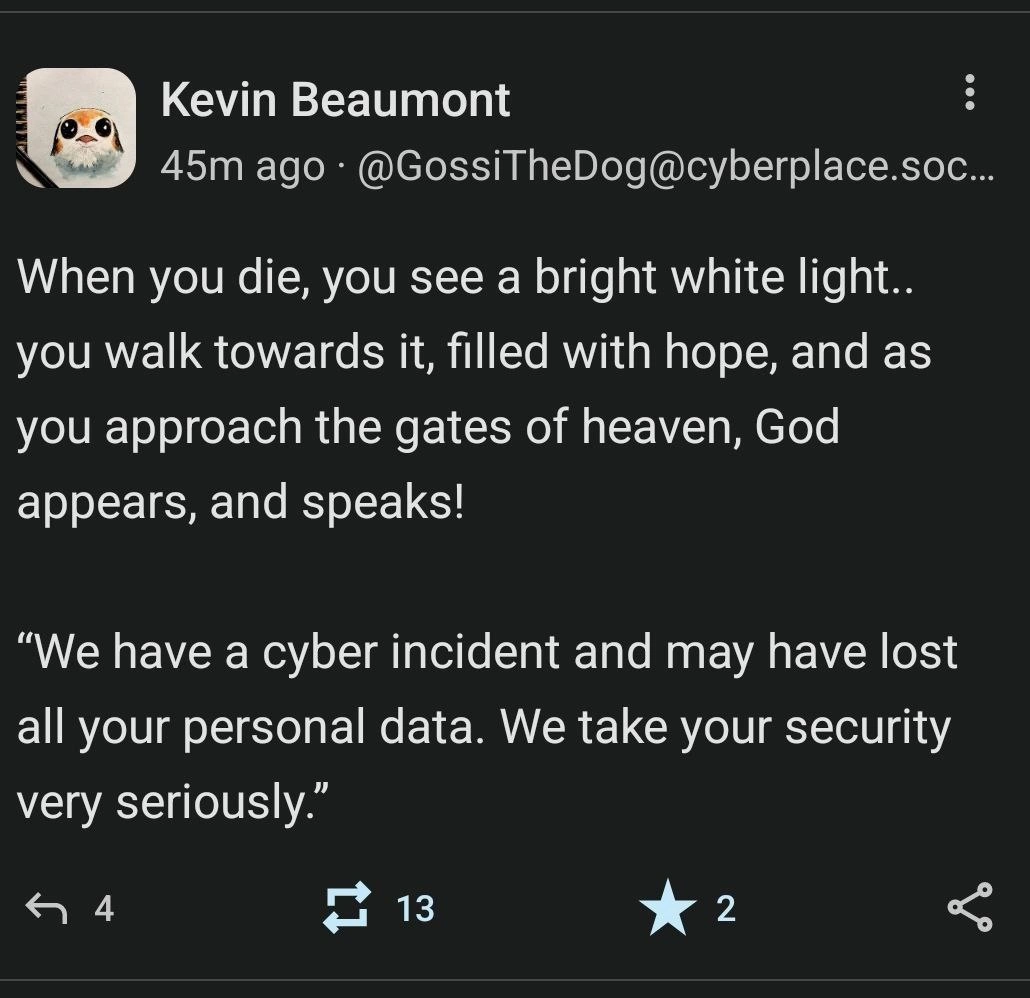
This meme is essentially a screenshot of a social media joke by a cybersecurity expert (Kevin Beaumont) that imagines Heaven having to issue a corporate-style breach announcement. Let’s break down what’s happening in simpler terms. In the scenario, you (the user) have died and are approaching Heaven. Instead of a warm welcome, God appears and gives a statement that sounds exactly like an email a company would send after a data breach. A data breach is when sensitive information (like your personal data – e.g. your name, address, passwords, or other private details) gets accessed or stolen by someone who shouldn’t have it. It’s a big oops in the world of Security and DataPrivacy. Companies are often legally and ethically required to notify users when this happens – that notification is called a data breach notification.

Now, the language in such notifications has become pretty standardized (read: almost cliché). The meme highlights two key phrases you’ll almost always see:

  • Cyber incident – This is a polite way of saying something went wrong with the computer systems, possibly a hack or security breach. Companies use the term incident instead of outright saying “we got hacked” because it sounds more controlled and less alarming. It could mean a hacker broke in, or maybe an employee accidentally exposed data – basically any security problem gets labeled an “incident” in corporate-speak.
  • We take your security very seriously. – This is the classic line companies include to assure you that, despite the mishap, they really do care about protecting your data. You’ve probably seen similar lines like “your safety is our top priority” or “we value your privacy” from various businesses. Here, God is using that exact promise, which is what makes it so funny. It’s such a formal, scripted response showing up in an unlikely place.

Why do companies always say that? It might sound silly, especially if the situation proves otherwise, but it’s part of a standard apology format. When a breach happens, the company’s tech security team and PR people quickly put together a message to inform users. They usually follow a template that covers what happened, what data might be affected, how seriously they take it, and what they are doing about it. They want to reassure customers: “Yes, something bad happened, but we’re on it and we do care about protecting you.” It’s a bit like if a teacher loses your homework and then says, “I really care about your grades” – a kind of unconvincing comfort after the fact, but they feel they have to say it.

In the meme’s imagined scenario, even Heaven is treating a data loss as an official incident. Kevin (the guy who wrote the post) is joking that the formal tone of a breach notice is so universal that you’d hear it even in the hereafter. This is poking fun at how commonplace and copy-paste these statements have become. People in tech, especially those in information security roles, have seen these breach announcements so often that the phrasing starts to feel automatic. There’s a bit of a wink to the audience here: everyone jokes about the line “We take your security very seriously” because it’s included in almost every apology after a hack, to the point that it feels a little empty. It’s not that companies don’t mean it – they probably do – but when you’ve read that same sentence dozens of times from different firms, it loses impact.

For someone new to this, think of it this way: if you ever get an email from a website or bank saying something like, “We detected unauthorized access to our systems and some of your data may have been involved. We take your security very seriously and have fixed the issue...,” you’re experiencing exactly what this meme is talking about. It’s a standard security breach response message. The meme just takes that standard message and puts it in the mouth of God at Heaven’s gate, which is totally out of context and therefore comically absurd.

So, to recap in simple terms: the joke is that even in Heaven (a place you’d assume is perfectly safe and trustworthy), you’re greeted with the kind of apology message we usually see from companies after they mess up. It’s making fun of the overused corporate language. Developers and security folks find it funny because they’ve had to write or read many “we had an incident, but we take security seriously” notes in real life. This meme exaggerates it to the highest level: even the Almighty has to break out the standard breach disclosure template.

Level 3: Breach at the Gates

The meme paints a darkly comic picture that any seasoned information security professional can appreciate. Imagine the ultimate moment of truth – you die, approach the pearly gates of Heaven expecting eternal bliss – and instead you’re met with a bureaucratic breach disclosure. For a veteran security engineer, this scenario prompts equal parts laughter and a tired sigh. It’s hilarious because God delivering a stock data breach notification is absurd, and it’s painful because the script is so familiar. The text in the image is basically the standard breach response every company uses, copy-pasted into a scene where it absolutely doesn’t belong. This contrast is the crux of the humor: even in paradise, you can’t escape corporate spin and the dreaded line “We take your security very seriously.”

Let’s unpack that infamous phrase. Every time a company suffers a breach or leak of personal data, their PR and legal teams insist on including some variation of “we deeply care about your privacy and security.” It’s meant to reassure, but after the tenth incident, it starts to sound about as sincere as “your call is very important to us” on hold music. In the meme, hearing the Almighty recite this line is the ultimate irony. Seasoned engineers have written or read this exact sentence so often that it’s become a running joke in cybersecurity memes. When a bank, a social network, or even a gaming site gets hacked, the user email inevitably contains that promise of seriousness. By now, incident comms fatigue has set in – both for the writers and the readers. The security teams are tired of drafting it, and users roll their eyes seeing it. In fact, if you listen closely, you can hear a collective groan across the internet whenever yet another “We take security seriously” memo goes out. It’s the industry’s equivalent of a band-aid on a bullet wound – necessary to say, but not terribly convincing.

The wording in this heavenly breach notice hits every trope of the postmortem template (pun intended) for corporate incidents. First, there’s the vague opener: “We have a cyber incident.” Notice it doesn’t say “We got hacked” or “Our database was left open to the world” – it’s phrased as neutrally as possible. Companies love the term cyber incident because it sounds clinical and less alarming, implying a manageable event, even if hackers just ran off with the crown jewels. Next comes “may have lost all your personal data.” The use of “may have” is classic PR ambiguity. In reality, if they’re sending this notice, they almost certainly lost something important, but lawyers advise them to hedge the wording. And “lost” is a gentle way of saying “it was stolen” or “we left it unsecured and someone grabbed it.” Finally, we arrive at the crown jewel of breach clichés: “We take your security very seriously.” By this point, that sentence triggers a reflexive smirk from any developer or security analyst. It’s boilerplate text that has appeared in countless breach apologies. The irony, of course, is that if you’re reading those words, something not-so-serious must have occurred in their security practices.

To illustrate how formulaic these communications are, here’s essentially the standard breach notification anatomy that Heaven’s message parodies:

  • Acknowledgement: An opening that an “incident” occurred (never outright calling it a hack). For example: "On [Date], we identified a cybersecurity incident involving unauthorized access…".
  • Assessment: A description of what might be affected. e.g., "Some of your personal data may have been compromised." Always couched in uncertainty until investigations finish.
  • Reassurance: The iconic promise. "However, we take your security very seriously and are taking steps to address this." This is the PR equivalent of saying “please don’t lose all trust in us.”
  • Apology & Next Steps: A sorry and what they’re doing about it. "We regret this happened. We have engaged top security firms, notified authorities, and are updating our safeguards. As a precaution, please reset your password." Often they’ll throw in free credit monitoring or identity theft protection if personal info was leaked.

Sound familiar? It should – because essentially every major breach letter follows this template. From Yahoo’s massive data breach to Equifax’s infamous leak of millions of Social Security numbers, the public statements all read like they were drafted from the same Mad Libs sheet. In fact, when news of a hack breaks, infosec folks half-jokingly predict the exact phrasing the company will use. “We take your {insert essential thing here} very seriously” has become a punchline in the tech industry for this reason.

Now, Kevin Beaumont (@GossiTheDog, the author of this meme post) is a well-known figure in the cybersecurity community – someone who’s seen a breach or twenty. His choice of scenario reflects a kind of gallows humor that resonates with security professionals. These are people who have spent countless late nights in war rooms, scrambling to patch systems and draft these very communications. The Security and DataPrivacy folks reading this have likely been in the trenches of a security breach response, preparing polished statements under duress. The meme lands so well because Kevin is essentially saying: “We’ve written this same apologetic line so often, it’s practically universal – even God has it on standby.” The small icons at the bottom (the 13 boosts and 2 favorites within 45 minutes of posting) show that many others immediately recognized the truth in the joke and appreciated it. It’s a shared relief to laugh at the absurdity.

There’s also an undercurrent of critique here. Companies often proclaim vigilance after the fact, but were they truly serious about security before things went sideways? It’s a pointed question insiders ask every time they see that line. The meme slyly suggests that even an entity as infallible as God might be paying lip service: Heaven’s IT governance might not have been up to snuff if all your personal data can be lost. It’s a cheeky way to say “look, if even Heaven can slip up, no wonder earthly companies do.” But also, “taking security seriously” should ideally happen before a breach, not just be expressed in a PR note after. As a cynical veteran might say, the time to prove you take security seriously is long before the incident, not in the apology after.

Finally, consider the context of protecting personal data. Losing people’s information is a big deal under privacy laws, so organizations are obligated to notify users – hence these templates exist at all. The meme exaggerates this to cosmic proportions: apparently even the afterlife has a compliance department making sure you get your breach notification promptly upon arrival! It’s funny because it treats heavenly salvation like a service provider that failed a privacy audit. Imagine St. Peter handing you a clipboard with a privacy breach form to sign – it’s ridiculous and yet fits perfectly with the trope. This blend of high spiritual stakes (your eternal fate) with low corporate jargon (“cyber incident”) creates an absurd contrast that security insiders find hysterical.

In summary, why is this meme so relatable and funny for developers and security engineers? Because it nails a truth we all recognize: the corporate breach apology has become so standardized and overused that it transcends reality. We’ve grown cynical hearing it. Placing that dry, predictable statement in the most hallowed, otherworldly setting possible is the ultimate way to highlight its banality. The next time a real company says “We take your security very seriously” in an email, a lot of us will chuckle darkly and think, “Yep, heard that one in Heaven too.”

Level 4: Omniscience isn't Enough

Even an omniscient system is not immune to the fundamental limits of security and trust. In theoretical computer science and information security, achieving a state of absolute, unbreakable security is practically impossible. This is akin to the Halting Problem in computing – there’s no general algorithm that can catch every possible flaw in every program. Similarly, a system with all-knowing oversight (even a divine one) can’t guarantee that no breach will ever occur. There are simply too many variables, interactions, and unknowns in any complex network. In security terms, the attack surface (all the points where things can go wrong) tends to grow beyond what any one entity, even an all-powerful one, can flawlessly manage.

From a cryptographic and theoretical perspective, perfect security would require catching every vulnerability and blocking every attack method, which edges into NP-hard territory – essentially problems so computationally complex they might as well be impossible to solve completely. Even if Heaven’s IT department had supernaturally infinite compute power, the combinatorial explosion of possible system states means some corner-case exploit could slip through. The meme plays on this idea by humorously suggesting that not even God’s network is breach-proof. It’s a cosmic reminder of a core principle: security is a journey of risk management, not a final destination. For example, a zero-day exploit (an attack using a vulnerability not publicly known) can strike any system before defenses catch up. No amount of divine foresight can predict every novel exploit technique – an ironic nod to the fact that omniscience in lore doesn’t equate to omnipotence in cybersecurity.

This brings us to the modern principle of Zero Trust Architecture – “never trust, always verify.” In advanced security design, even internal systems must continuously authenticate and check each other because trust boundaries can always be breached. The joke implicitly imagines that Heaven might have neglected a Zero Trust approach. Perhaps they assumed the Pearly Gates were impenetrable and let their guard down (no multi-factor authentication for angels at login). If even paradise suffered a data spill, it underscores the almost theological truth in Infosec: trust is a vulnerability. In academic security models, you often plan for “Byzantine failures” – assuming even internal components might turn malicious (the term comes from the Byzantine Generals Problem). Here, the thought of a breach in the afterlife is like an ultimate Byzantine scenario – a trusted realm compromised.

In summary, the meme’s absurd setup aligns with deep security theory: no system can be 100% secure. It illustrates a kind of security theodicy: if an all-powerful administrator (God) can’t stop a breach, it reaffirms the inevitability of breaches in our mundane systems. Much like theologians ask why evil exists if God is all-good, security professionals grimly joke about why breaches happen even when “we take security very seriously.” The answer in both domains is similar – there are inherent limits to what can be controlled, be it human free will or system complexity. Thus, even an omniscient being in charge of the ultimate cloud (Heaven) might still end up delivering that dreaded breach notification.

Description

This image is a screenshot of a text-based social media post by Kevin Beaumont on a platform with a dark theme. The post sets up a spiritual scene: 'When you die, you see a bright white light.. you walk towards it, filled with hope, and as you approach the gates of heaven, God appears, and speaks!'. The punchline that follows is a jarringly corporate and all-too-familiar message: '“We have a cyber incident and may have lost all your personal data. We take your security very seriously.”'. The humor stems from the dramatic and hilarious contrast between a profound, metaphysical experience and the cold, impersonal, and clichéd language of a corporate data breach notification. It satirizes how commonplace these security failures have become and mocks the hollow platitudes companies use to manage the fallout, suggesting that not even the afterlife is safe from a cyber incident

Comments

13
Anonymous ★ Top Pick So the final incident response plan is God issuing the press release. I bet the root cause analysis just says 'acts of God'
  1. Anonymous ★ Top Pick

    So the final incident response plan is God issuing the press release. I bet the root cause analysis just says 'acts of God'

  2. Anonymous

    Turns out the pearly-gates SOC skipped tabletop exercises - now they’re praying for a celestial GDPR waiver

  3. Anonymous

    After 20 years in tech, you realize 'We take your security very seriously' is just the enterprise version of 'thoughts and prayers' - both equally effective at preventing the next inevitable incident while your PII floats through yet another darknet marketplace

  4. Anonymous

    Even in the afterlife, you can't escape the dreaded 'We take your security very seriously' email - proving that some technical debt follows you beyond the grave. At least when God delivers your breach notification, you know the root cause analysis will be thorough, though the remediation timeline might be 'end of days.'

  5. Anonymous

    In the afterlife, the IR runbook still says 'may have' because SIEM retention was seven days and logging was 'cost-optimized' - God’s compliance timer is 72 hours anyway

  6. Anonymous

    At this point, "we take your security very seriously" is the global catch(legal) around notifyUsers(); fixRootCause() is still blocked behind a SIEM procurement ticket

  7. Anonymous

    Even omnipotence can't patch the zero-day in the Book of Life's SQL injection flaw

  8. @trainzman 2y

    What if you wanted to go to heaven

    1. @SamsonovAnton 2y

      Then you are free to do so, as they have lost all your personal data, so they have nothing on you — you are clean, legit!

      1. @CcxCZ 2y

        Yup, ever since Pope retconned limbo/purgatory.

    2. @ffngs 2y

      But god said.

  9. @SamsonovAnton 2y

    So, this turns out to be hell, where you will spend eternity fixing security holes, but in vain.

  10. @SamsonovAnton 2y

    — And you should have taken backups very seriously! — you tell the god. — There are three types of admins: those that do not back up, those that do, and those that verify restorability. What kind of admin are you?! — Go to hell, nerd! — I have already been there: have you ever heard of dependency hell?...

Use J and K for navigation