A Homelab Enthusiast's Alternative to Therapy: 3TB of RAM
Why is this Hardware meme funny?
Level 1: Big Computer, Happy Mind (Plain Analogy)
Imagine someone is feeling a bit sad or stressed out, and instead of doing the usual thing to feel better (like talking to a friend or getting help from a doctor or therapist), they decide to do something really BIG and different that makes them happy: they go and get the biggest, coolest computer they can find! It’s like if you were worried about a test in school, and to feel better, you convinced your parents to buy you a super high-tech calculator and a whole library of books. Playing with that awesome calculator might cheer you up for a while because it’s new and exciting, but it doesn’t really make the test go away, right?
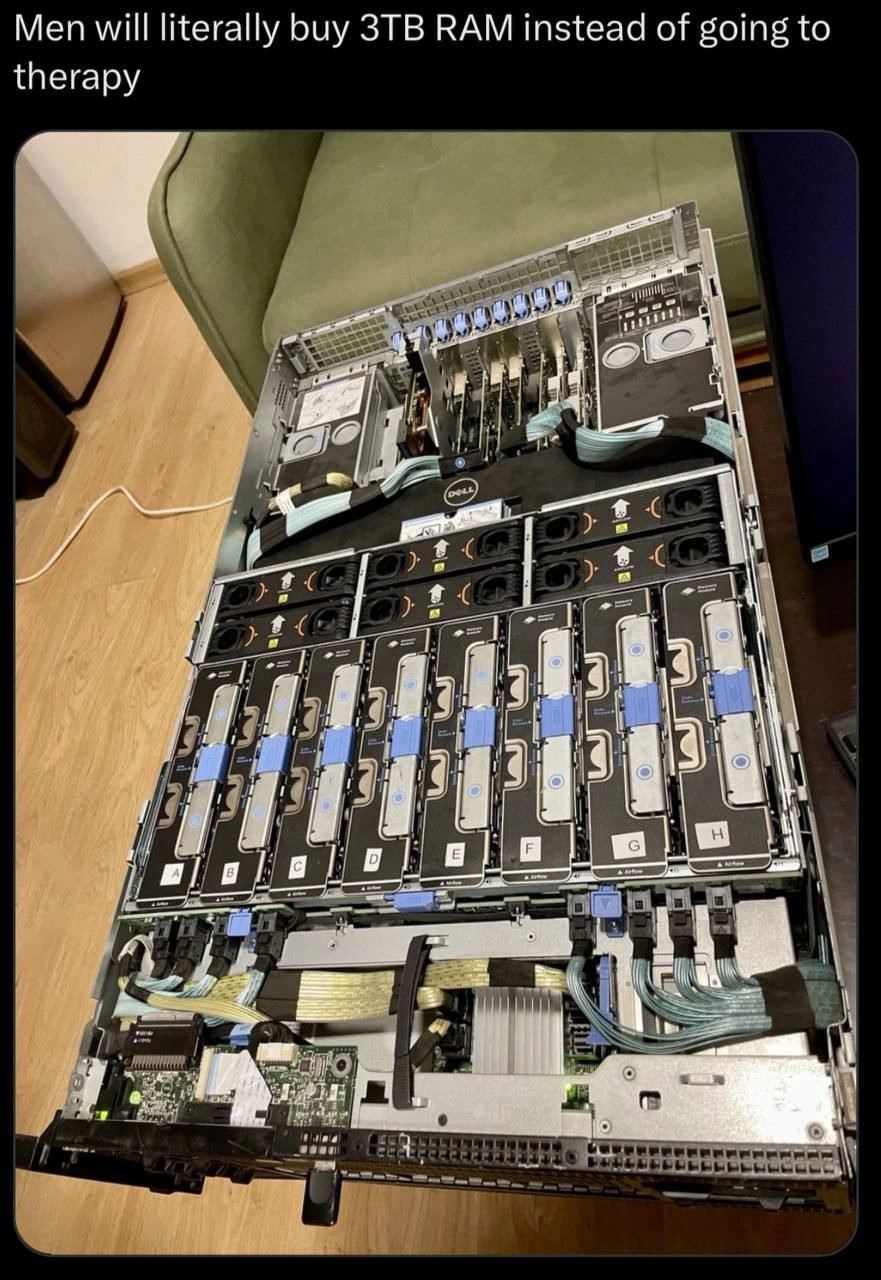
In the picture from the meme, a guy literally put an enormous, powerful computer (the kind that usually lives in special labs or big company server rooms) right on his living room couch, as if it’s a personal buddy or a pet. This computer has so much memory (think of memory like the computer’s ability to remember stuff quickly – and this one can remember a ton of stuff at once). He’s super happy with this machine because tech stuff is his passion, and it comforts him. It’s a funny and cute scene because normally you’d expect a person or maybe a cat on the couch, not a giant computer with its electronic “guts” showing! The joke behind it is simple: sometimes people avoid dealing with their feelings by focusing on their hobbies or toys. Here, the hobby just happens to be an outrageously powerful computer setup. So the meme is joking that this guy chose a “computer therapy” – buying gadgets to feel good – instead of “talk therapy.” It makes us smile because the solution is so over-the-top. It’s as if buying this shiny, mighty machine is a big warm hug for him. In real life, of course, if you’re truly upset, talking to someone is important. But we can laugh at how relatable it is that when we’re down, we might say, “I know what will cheer me up – a new toy!” In this case, the toy just happens to be a mega-computer. It’s a silly, heartwarming illustration of someone finding comfort in what they love, and that’s why it’s funny and endearing even to folks who don’t know much about computers.
Level 2: Server on the Sofa (Junior Perspective)
At first glance, this meme shows a very powerful server casually sitting on a living room couch, which is an unusual sight. Let’s break down why this is both impressive and humorous:
The Hardware: The machine is a Dell PowerEdge rack-mount server (the Dell logo is visible on the front). It’s described as “2U”, meaning it’s two rack units tall – standard for data centers, where servers are stacked in racks like pizza boxes. Normally, a beast like this lives in a server room or a data center, not on a sofa next to someone’s coffee table! Its lid is off, revealing the insides. You can see eight large modules labeled A through H; these are memory riser boards loaded with tons of RAM sticks (DIMMs). Each riser board can be thought of as an extension that holds a bunch of memory modules. Servers use risers when the motherboard alone can’t fit all the memory slots needed. The blue latches on them are handles to pull the boards out – blue often indicates touch points for service in Dell’s design (i.e., “grab here to remove”). All those pale green flat cables (some with teal plastic) are connecting the risers to the main board, basically highways for data between the RAM and the CPUs. In front of the risers, near the bottom of the image, are multiple black circular fans (with little arrows indicating airflow direction). These fans are hot-swappable and designed to pull huge volumes of air through the server to keep those high-end components cool. A server like this likely has multiple CPUs (processors) – possibly 2 or 4 separate CPU chips – to handle a lot of tasks at once. Surrounding all this are power supply units and other circuit boards (visible on the left, with some status LEDs). It’s truly enterprise-grade hardware, essentially a little data center in a box.
3 TB of RAM: Now, the text highlights “3TB RAM”. RAM (Random Access Memory) is the fast working memory of a computer, used to hold data that the CPU is actively working on. Most everyday laptops have maybe 8 GB or 16 GB of RAM. High-end gaming rigs or workstations might have 32 GB or 64 GB. Even a powerful server might typically have 128 GB to a few hundred GB for heavy applications. But 3 TB (terabytes) is 3,000 GB – an astronomical amount for a single machine. It’s the kind of capacity used by big corporations, like for a database server that load an entire company’s database into memory, or for scientific computing where you hold huge datasets (imagine a whole genome database or real-time analytics on billions of records). To achieve 3 TB, this server is filled with dozens upon dozens of memory modules. It likely uses special high-capacity sticks (maybe 32 GB, 64 GB, or even 128 GB per stick) and every slot is populated. The mention of ECC memory is important: ECC stands for Error Correcting Code. These RAM sticks have extra chips that detect and correct small memory errors. In large memory systems, ECC is crucial because statistically, with so many bits of data, some bits will randomly flip due to electrical noise or cosmic rays(!). ECC catches those so your server doesn’t miscompute data if a bit flips from 0 to 1. In short, 3 TB of RAM is overkill for any kind of typical personal use – it’s the kind of spec that turns heads in the IT world. It means this person has the capability to run extremely memory-intensive workloads at home, like dozens of virtual machines simultaneously, or simulate entire networks, or run big-data processing jobs, all within this one box.
Home Lab Setup: Seeing this enterprise box in an apartment is a sign of a serious hobbyist or professional who’s made a home lab. A home lab is basically a mini version of a company’s tech infrastructure that someone sets up at home to learn, experiment, or just because they enjoy it. This could include servers, networking gear, maybe a rack in the corner with blinking switches, etc. People into home labs often buy older used enterprise equipment (companies decommission gear and you can find it relatively cheap compared to its original price). It’s a way to get hands-on experience with real hardware like servers and infrastructure software (virtualization, container clusters, etc.) outside of work or school. The post even wishes everyone could have “such a cute home-based playground 🥰”. The heart emoji shows affection – the poster genuinely loves this setup. It’s calling the massive server “cute”, which is nerdy and adorable. For context, this is not something an average user would need; it’s very much a niche enthusiast thing, akin to a car enthusiast rebuilding a high-end engine in their garage for fun.
The Joke – Therapy via Tech: The top caption says: “Men will literally buy 3TB RAM instead of going to therapy.” This is playing on a comedic stereotype/meme. There’s a running joke format on the internet that “Men will literally [do some elaborate thing] instead of going to therapy.” It humorously laments that some people (particularly men, as the stereotype goes) avoid therapy or talking about their mental health, and rather distract themselves with projects or obsessions. Here, the elaborate thing is buying a ton of computer hardware. So the meme is saying: rather than dealing with feelings or stress in a conventional healthy way (like seeing a therapist), this sysadmin guy literally installed a data-center class server in his living room as a form of retail therapy. Retail therapy means shopping to make oneself feel better – buying stuff as a comfort. The “sysadmin edition” of retail therapy jokingly means a systems administrator (the person managing servers) buys servers and components to feel better. It’s a tongue-in-cheek commentary on how techies might cope with life or job stress by diving deeper into tech as a comforting hobby. Many people in IT can relate: if you had a rough week, building a new PC, upgrading your rig, or setting up a cool Raspberry Pi project can be a way to unwind and regain a sense of control and joy. In moderation, that’s a fun hobby; taken to an extreme, like parking 3 TB of RAM on the sofa, it looks delightfully ridiculous.
Why it’s Funny: The image is almost surreal – a gigantic, industrial-looking server where your dog or a stack of pillows might normally be. It’s clearly out of its element (notice the stray power cord running across the hardwood floor to feed this beast, and how the couch cushions are being used as its resting spot). The incongruity is humorous: this machine belongs in a buzzing server room, yet here it is next to someone’s TV perhaps. It’s like seeing a racehorse in someone’s kitchen – an impressive thing in a very unlikely setting. Additionally, the caption implies a story: the owner might have thought, “I’m stressed or bored, so I’m going to spend money on a crazy server build.” It pokes fun at the idea that sometimes tech people solve emotional or personal issues by focusing on technical problems or goals. Even if you’re a junior dev or just starting in IT, you’ve probably seen a bit of this culture: the excitement of a new gadget or upgrading your PC can be a real mood lifter on a bad day. This meme takes that to an extreme degree for comic effect.
Terms and Tags in Context:
- OverEngineering: This setup is a prime example of over-engineering in a personal context – using far more resources than necessary. No one needs 3 TB of memory at home; this is doing it because you can (or got a good deal on used parts) and because it’s cool. It’s performance optimization gone fantastically overboard, or perhaps just a flex.
- Performance: The mention of low-latency, in-memory performance is genuine – a server like this can crunch data very fast due to everything being in RAM. It’s the dream setup for certain high-performance tasks. But the joke is none of that is probably required for whatever the person is doing at home; it’s partly just for personal satisfaction and learning.
- MentalHealthInTech: The meme directly touches on a mental health trope. Tech is a high-stress field sometimes, and there’s humor and truth in observing how people handle that stress. Instead of, say, meditation or therapy, many of us play video games, build tech projects, contribute to open source at midnight, etc. It’s a wink to a community understanding: “yeah, we deal with our issues by geeking out.”
- ServerRoomStories: This tag is about anecdotes involving servers/infrastructure. A server on a couch is a story – you’d definitely snap a picture and share it, just like this post did. It’s a one-image story of “I have a full data center server at home, check it out!”
- HardwareTradeoffs: Bringing an enterprise server home involves trade-offs. You get power and bragging rights, but you also inherit noise, high power usage, and complexity. For example, these big servers might require special 240V outlets or draw so much current that you can’t run them on the same circuit as your fridge or microwave. They often are so loud that some home lab folks build sound-dampening boxes or run them in garages. The meme doesn’t show those consequences, but an informed viewer knows they’re lurking behind the scenes. That contrast adds another layer to the humor – the image looks clean and cool, but any IT person knows, “I bet that thing sounds like a jet engine and makes the room hot.”
- home_lab_setup: This is clearly a proud home lab setup example. The poster even calls it a “playground”. Many juniors aspire to have a home rack or a few servers to play with. It’s great hands-on learning. This meme might actually inspire some to think, “Wow, you can actually get a server like that at home? Neat!” It might also caution, “But do I really want something that intense, or should I stick to cloud VMs for learning?”
In essence, from a junior perspective, this meme is teaching a bit about high-end hardware (what a serious server looks like inside and how much memory it can hold) and also sharing an inside joke about tech lifestyle. It’s saying: We tech folks sometimes take our passion to hilarious extremes. It’s okay if you don’t get all the details of the server components; the big idea is that this is far beyond normal, and that contrast is funny. Everyone can relate to the idea of buying something nice to cheer up. Here we learn that, in the sysadmin world, “something nice” might just be a several-thousand-dollar, 3-terabyte RAM server on the couch instead of, say, a new TV or a vacation. It’s both an aspirational gadget pic (for hardware geeks) and a light-hearted commentary on priorities.
Level 3: Server as Security Blanket (Senior Perspective)
For seasoned engineers and sysadmins, this meme hits on a hilariously familiar coping mechanism: when life or work gets challenging, some of us don’t slow down and reflect – we tinker harder and over-engineer something as a distraction. The caption "Men will literally buy 3TB RAM instead of going to therapy" is a tech twist on a popular internet meme that jokes about avoiding mental health help by doing anything else (especially something extravagant or convoluted). In our industry, that “anything else” often translates to HardwareHumor: scaling up the specs, building out a home_lab_setup, or pursuing an epic performance project in off-hours. It’s funny because it’s true – how many times have we half-jokingly said “it’s not a bug, we just need a bigger server” or “don’t optimize the code, just throw more hardware at it”? Here that idea is cranked up to 11 and made personal: the sysadmin isn’t just throwing RAM at a program, he’s throwing RAM at his problems. The phrase "retail therapy, sysadmin edition" (as in the post’s title) nails it: retail therapy is when you shop to feel better; the sysadmin edition is buying an enterprise box in an apartment and filling it with an ungodly amount of memory. Because hey, blinking lights and successful POST beeps are cheaper than a psychologist… or so we jokingly tell ourselves.
The image underscores the gag by placing a hulking Dell PowerEdge 2U server right on a living room couch. Visually, it’s absurd: a place meant for cozy human relaxation is occupied by this rackmount beast, lid off, proudly displaying its rows of memory risers and cooling fans as if it were reclining in a therapy session of its own. There’s actually a witty subtext here: in classic psychotherapy imagery, a patient lies on a couch and unloads their problems. Here, the server is on the couch, almost implying the tech is both the patient and the therapist! The sysadmin “talks” to the machine by working on it, and the machine “listens” by just existing as a comforting presence. It’s devotion by distraction. Seasoned IT folks chuckle because we’ve known colleagues (or ourselves) who find solace in setting up elaborate infrastructure at home — configuring networks, building NAS storage solutions, running cluster orchestration on a few spare servers — all as a way to unwind after a stressful week. It’s both productive and procrastinative: you feel enthusiastic and accomplished technically, while possibly ignoring emotional or non-technical to-dos.
The performance angle in the meme also jabs at our propensity to solve problems by scaling up. In practice, when an application is slow or a service is struggling, senior engineers know the ideal fix is to dig into profiling, optimize the code or architecture, maybe reduce memory footprint, etc. But the tempting fix (especially if you have budget or spare hardware) is often “just add more resources.” Got a memory leak? Instead of combing through logs at 3 AM, maybe we increase the heap size or double the container’s memory limit. Got slow database queries? Throw them onto a bigger instance with more RAM for caching. This is a well-known anti-pattern humorously called “hardware instead of therapy” in some circles – basically using brute force computing power to paper over issues. It’s akin to self-medicating stress by binge-buying gadgets; here we self-medicate poor software performance by buying ridiculous hardware. The meme resonates with any senior dev who’s heard a solution like “we’ll just scale vertically” come up one too many times in meetings. Sure, it works up to a point (vertical scaling can be effective until it hits economic or physical limits), but it’s rarely the healthy long-term solution, whether we’re talking system design or one’s personal life.
There’s also a community aspect: the post’s message “Wish you all to have such a cute home-based playground 🥰” is relatable to anyone who’s fallen in love with their side-project lab. Only in tech do people call a 50+ kilogram, loud, power-guzzling server “cute”! But we do feel that affection – it’s our baby, our playground. Senior folks might joke, “Sure, I could’ve paid for therapy, but then I wouldn’t have my own mini data-center, would I?” In those words lies recognition of a common trade-off: investing time and money in tech hobbies often at the expense of other aspects of life. We jest about it because we know it’s a bit imbalanced, yet the thrill of, say, seeing 3 TB of RAM get recognized on boot, or configuring a complex virtualization setup on this machine, is genuinely exciting for an engineer. It’s a tangible accomplishment in a field where many of our daily work outcomes are abstract. There’s a sense of control and mastery in making a machine do our bidding, whereas mental health or life problems feel messy and not easily “fixable” with logic and tools.
The OverEngineering on display is both comical and awe-inspiring. A veteran techie will note practical realities: A server like this on a couch raises eyebrows – “Is that thing plugged into a standard wall outlet? Hope the apartment’s circuit can handle the surge when it powers on!” or “Those cooling fans sound like a vacuum cleaner; so much for a quiet evening at home.” Indeed, high-performance hardware tradeoffs include noise, heat, and electricity bills. This machine could easily draw a few hundred watts idle (and over a thousand under load), making it an eccentric space heater. But from the sysadmin’s perspective, these are minor inconveniences compared to the joy (and maybe self-esteem boost) of running enterprise-grade kit in your living room. It’s bragging rights in the ServerRoomStories subreddit or homelab forums: “I’ve got a 4-socket, 3TB RAM server on my sofa, ask me anything.” The senior perspective sees the humor in that brag: it’s half brag, half confession of coping mechanism.
Ultimately, the meme lands a double punch: it satirizes how tech folks might address personal issues in the same way they address technical issues – by doubling down on tech. And it nostalgically celebrates that over-the-top passion for performance and gear that many of us had early in our careers and still carry deep down. A grizzled sysadmin might chuckle and then half-seriously mutter, “Well, at least if I have a breakdown, I’ve got 3TB of RAM to cache my feelings.” It’s funny because it’s ridiculous, and it’s funny because it’s a tiny bit true. Ultimately, any senior engineer reading this knows that neither faulty code nor personal anxieties truly disappear with more RAM, but for a moment – basking in the hum of a powerhouse server – it sure feels like it 😉.
Level 4: NUMA Nirvana (In-Memory HPC at Home)
At the extreme technical end, this meme showcases a kind of homebrew supercomputer. The server on the couch isn’t just any PC – it’s a multi-socket Dell PowerEdge machine configured with an almost absurd 3 terabytes of RAM. In computing terms, that’s entering the realm of in-memory computing, where entire massive datasets reside in volatile memory for lightning-fast access. Think of in-memory analytics frameworks or real-time databases: they eliminate disk bottlenecks by keeping everything in RAM. With 3 TB, you could load up billions of entries (on the order of $10^{12}$ bytes of data) directly into memory, enabling analytics and computations at speeds traditional storage can’t touch. This is essentially a single-node HPC (High-Performance Computing) setup – the kind a research lab might use for heavy simulations, improbably transplanted into a living room.
But achieving this performance optimization feat involves serious architecture. A server supporting 3 TB RAM is almost certainly a NUMA system (Non-Uniform Memory Access). That means multiple CPU sockets, each with local memory banks – possibly those eight riser boards labeled A through H correspond to regions of memory controlled by different CPUs. In a NUMA design, memory access times aren’t uniform: a processor can access its own local RAM faster than memory attached to another socket (due to interconnect overhead like Intel’s QPI/UPI links or AMD’s Infinity Fabric connecting the CPUs). The OS and applications have to be NUMA-aware to fully bask in this “memory nirvana” – otherwise, a thread might be reaching across the system for data and negating the benefit of all that low-latency RAM. In Linux, for instance, system calls like mbind or NUMA allocators are used to ensure memory locality, and without them, performance can paradoxically drop if the workload constantly crosses NUMA boundaries. So ironically, taming a monster server like this can feel like therapy for a performance engineer: you’re constantly balancing memory placement and CPU affinity to keep those nanosecond access times consistent.
Another deep aspect here is memory reliability. At this scale, ECC memory (Error-Correcting Code memory) isn’t optional – it’s a necessity. With literally trillions of bits in use, the probability of a single-bit flip due to cosmic rays or electrical interference is high over time. ECC DIMMs include extra parity bits that allow the detection and correction of most single-bit errors (and detection of double-bit errors), essentially acting like a built-in therapist that “soothes” memory hiccups before they become full-blown crises (crashes or corrupt data). High-end servers often support advanced memory resilience modes too: for example, memory mirroring (where each memory write is duplicated on a backup DIMM, akin to RAID-1 but for RAM) or memory sparing (having standby memory modules that automatically replace a failing module on the fly). These technologies (sometimes branded with names like Dell’s Fault Resilient Memory or similar, hinted by tags like ecc_memory_flex) ensure that a machine loaded with insane amounts of RAM can run for years without succumbing to the equivalent of a memory nervous breakdown. After all, if you’re going to park 3 TB of RAM in your home, you’d want it stable and error-free – it’s the pinnacle of Hardware reliability meeting obsessive performance needs.
From a theoretical performance perspective, stuffing all data into RAM is like flattening the traditional memory hierarchy. Normally, data might live on disk, move to SSD (faster), then into RAM (faster yet), and then into CPU caches (L1/L2/L3) which are fastest and closest to the actual compute units. Here, with everything already in RAM, the storage tier is essentially bypassed for active data – disk becomes just an initial source or backup, not a working medium. This yields huge gains in throughput for memory-bound tasks, but it shines a light on other limits: memory bandwidth becomes crucial (can the CPUs pull data from those DIMMs fast enough, across all channels?), and the CPU processing power itself is the next bottleneck. If one sysadmin at home tries to use this like a personal cluster, they may find that while they have space for all the data, they might still need highly parallel code (multi-threading across dozens of cores) or else the terabytes of data just sit idle, waiting for a single thread to crunch them. In essence, this “therapy via terabytes” strategy trades one kind of complexity (slow I/O or complex distributed systems) for another kind (NUMA tuning, parallel algorithm design, and power/cooling challenges). It’s a reminder of the classic computer science wisdom: there’s no such thing as a free lunch. You can buy insane hardware to avoid certain problems (like slow disk seeks or network latency), but you then step into a new arena of problems (like NUMA latency and energy consumption). Still, to a true tech enthusiast, that challenge is half the fun – wrangling a behemoth server is both a flex and a fascinating hobby. In summary, at this deep technical level the meme highlights a kind of overengineering nirvana: using a data-center grade memory monster to brute-force performance (and perhaps emotional satisfaction), while slyly acknowledging all the intricate engineering (from ECC to OS memory managers) that makes such overkill somewhat feasible outside its natural habitat. It’s a profound intersection of Infrastructure fetish and the eternal desire to push computational limits – all framed as a tongue-in-cheek alternative to pushing personal emotional limits in therapy.
Description
This image displays a large, opened enterprise-grade server, likely a Dell PowerEdge model, placed on a wooden floor next to a casual green sofa. The server's internal components are fully visible, showcasing a massive array of RAM modules filling almost all available slots, along with intricate cabling, fans, and drive bays. The text caption overlaid on the image reads, 'Men will literally buy 3TB RAM instead of going to therapy.' The meme humorously plays on the stereotype of tech enthusiasts, particularly those in the 'homelab' community, who invest in excessively powerful, enterprise-level hardware for personal projects. The joke lies in portraying this expensive hobby as a coping mechanism or a form of retail therapy, suggesting that building an overpowered home server is a way to deal with life's problems instead of seeking actual therapy. It's a relatable observation for many engineers who find solace and a sense of control in designing and managing complex technical systems

Comments
33Comment deleted
Therapy helps you resolve past conflicts, but 3TB of RAM lets you run a Kubernetes cluster that creates brand new, far more expensive conflicts with your monthly power bill
Because nothing says "emotional resilience" like fitting the entire working set of a Spark cluster - plus your unresolved feelings - into L3 cache
The real therapy is explaining to your spouse why the home kubernetes cluster needs more RAM than the entire IT department you manage at work, and that yes, the electric bill spike is just 'optimizing for latency'
When your homelab has more redundancy than your emotional support system, and your RAID array is more reliable than your mental health strategy. At least with 3TB of RAM, you can keep all your unresolved issues in memory without swapping to disk - though eventually, even the most robust garbage collector can't clean up years of accumulated technical debt in your psyche
Why talk about your problems when you can mlock them, set NUMA affinity, and watch the page faults disappear?
We finally fixed the OOMs - 3TB of LRDIMMs so the Java service can leak 2GB/hour and still hit the SLOs until Q4
3TB RAM: because childhood cache misses are best fixed with fully populated channels and ECC scrubbing
average gentoo users Comment deleted
Lol, meanwhile me who used Gentoo on EeePC 901 to squeeze more performance out of it's anemic CPU (mostly -Os TBF) Comment deleted
Bro, touch some grass Comment deleted
yoo, that kool Comment deleted
thats cool but how do you compile your software on it Comment deleted
distcc? Comment deleted
very slowly, probably :) Although it could be bearable with less software in the system. Comment deleted
I mean it is a point of gentoo What I wouldn't do to minimize all of the huge package recompilations Looking at you libreoffice, Firefox, and rust Comment deleted
Even Debian correctly piloted would have the same footprint. Gentoo is about controlling every part of the system, though. Also looking at Chromium and libav Comment deleted
hardware issue Comment deleted
2 actually, CPU and especially HDDs which came with those Comment deleted
thats what a hardware is, pookie Comment deleted
Binhost for the few big things (read, C++); the rest of it is actually pretty fast. Often faster to resolve, fetch, and compile than Debian figures out it's stuff and downloads it's debs from it's mirrors. (-: Comment deleted
Did you try -flto at all? If you did, how did it go Comment deleted
It's like a decade since it's PSU died. Not sure in what shape that was back then. Possibly? Comment deleted
When AAA devs said "just buy new high end pc" and you do Comment deleted
Still crashes with out-of-memory errors. Comment deleted
Because in core there's memory leak in eventloop Comment deleted
And then we kissed Comment deleted
Me after i bought 512 GB RAM: 😅 Comment deleted
Oh no, the thing is from dell. I only have bad experience with them… Comment deleted
But why, what the reason of such big amount of ram? Comment deleted
Running Java Comment deleted
Best space heater. Comment deleted
@purplesyringa 🥺 Comment deleted
Chrome: finally, a worthy opponent Comment deleted