Skip to content
DevMeme
4092 of 7435
Sleep? Or Just One More Hour of Coding?
MentalHealth Post #4463, on Jun 16, 2022 in TG

Sleep? Or Just One More Hour of Coding?

Why is this MentalHealth meme funny?

Level 1: Yay vs Yikes

Imagine you have a secret puzzle and a computer program, and someone shouts “I broke the code!” In one case, it’s like a kid proudly announcing, “I figured out the secret message!” – that’s the yay feeling. They solved a tough riddle and now everyone is happy and clapping. In the other case, it’s like a kid sadly admitting, “I messed up my game and now it’s not working.” – that’s the yikes feeling. They pressed the wrong buttons or changed something they shouldn’t have, and the game or toy stopped working, so now they feel scared or upset.

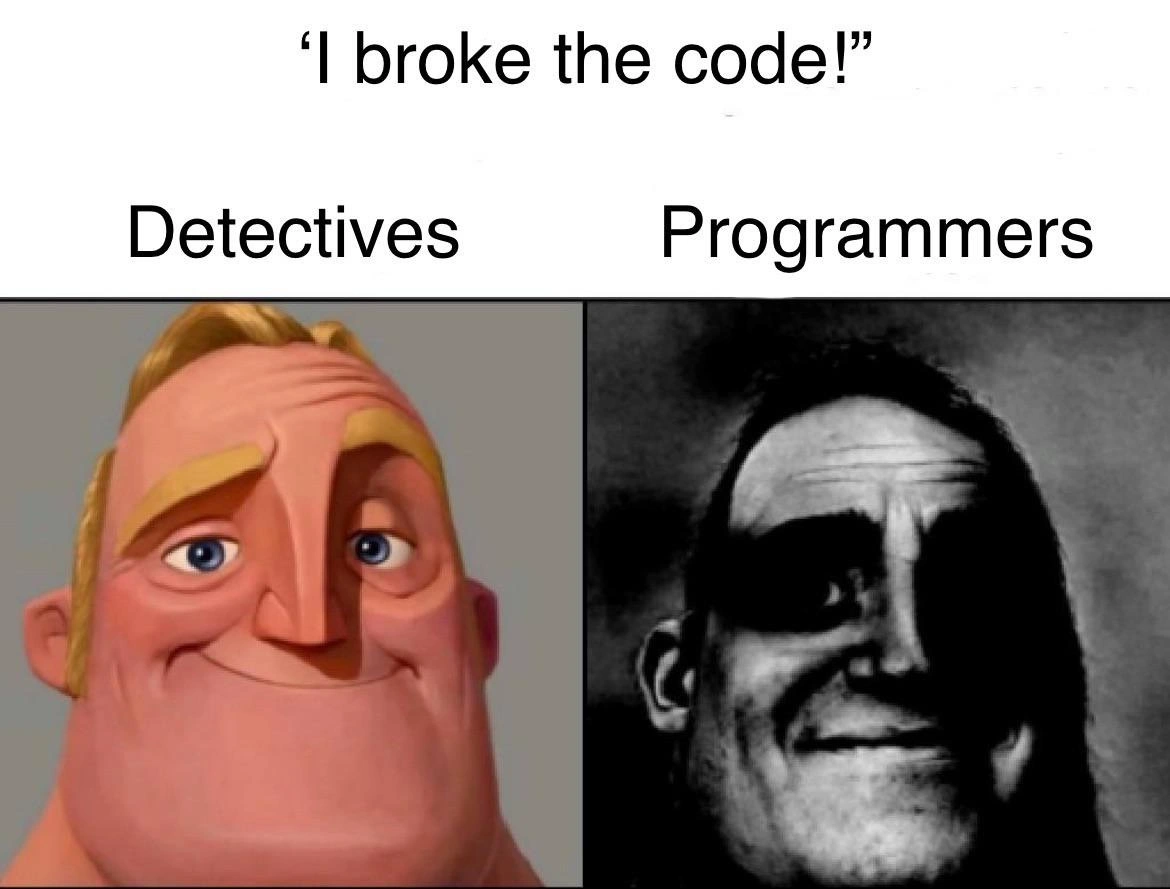
This meme is funny because it shows those two opposite feelings with the exact same words. On the left, the character is smiling big because “I broke the code!” means he achieved something great (like cracking a secret). On the right, the same character looks scared in black-and-white because “I broke the code...” means he caused a problem (like breaking a machine). It’s a bit like how saying “I cracked it!” can mean “I solved it!” but if you say “I cracked it” about an egg, it means you made a mess. Here “code” is the tricky word: it can mean a secret puzzle or it can mean a computer program.

So, the joke is that one person uses the phrase and becomes a hero, and another person uses the same phrase and feels like the villain (by accident!). It teaches us that the same sentence can mean something totally different depending on the situation. And anyone who writes software (computer programs) laughs at this because they know the rollercoaster feeling: one moment you’re a genius for solving something, the next moment you’re groaning because something broke. In simple terms: solving a mystery = good excitement, breaking your toy (or code) = bad panic. The meme just puts those two side by side to make us go “Oh, wow, that’s so true and so funny!”

Level 2: Decoding vs Debugging

At this level, let’s break down what’s happening in the meme and why it’s funny to anyone with some programming experience. The key joke is that the phrase “I broke the code” can mean two very different things:

  • Detective context (decoding): When a detective or spy says “I broke the code,” they mean “I cracked the secret code!” They solved a puzzle or deciphered a hidden message. For example, imagine a detective finds a mysterious note in symbols and figures out what it says – that’s breaking a cipher. This is a good thing. It’s exciting because the detective made progress in the investigation. In everyday terms, it’s like solving a riddle or puzzle that was stumping everyone. They feel proud and relieved. In the image, that’s why Mr. Incredible is smiling under the “Detectives” label – it represents the happiness and confidence when a secret code is finally understood.

  • Programmer context (debugging): When a programmer says “I broke the code,” they mean “I broke the software.” In other words, something in the program or website is now not working because of a change they made. In tech slang, “breaking the code” often means you introduced a bug. A bug is an error or flaw in software that causes it to produce a wrong result or crash. So a developer might push an update, and suddenly the app stops working or tests start failing – that’s when they realize, “Uh oh, my update broke the code.” This is a bad thing. They feel anxious or horrified because broken code can mean users are experiencing errors or the team’s project is on hold until it’s fixed. In the meme’s right side, Mr. Incredible’s face is in grayscale, looking freaked out under “Programmers” – visually highlighting that scared, drained feeling of a programmer who discovers they’ve caused a problem.

So why is this opposite reaction happening? It’s all about the two meanings of the word “code.”

  • For a detective, code means a secret code or cipher – like a hidden message that needs decoding. Breaking that kind of code = success.
  • For a programmer, code means computer code – the instructions that make a program run. Breaking that code = failure (the program doesn’t work).

In normal English, if you say something is “broken,” it’s usually negative – like a broken toy or a broken phone. But the funny quirk here is that in the detective world, “broken code” is positive! It’s short for “code broken open,” as in “the mystery is solved.” Meanwhile, in programming, broken code is literally broken, as in “this software is busted now.” The meme highlights this contrast with the two pictures of Mr. Incredible.

Let’s connect this to common developer experiences. If you’re a new developer (or know someone who codes), you might have already encountered situations where a small mistake can break your whole program. For example, maybe you left out a semicolon ; or a curly brace { in your code and suddenly nothing runs. The compiler (the tool that converts your source code to a running program) might throw an error and refuse to go on. That’s essentially “breaking the code” at a basic level – the program can’t even build or start because of a typo or syntax error. It’s an awful feeling the first time it happens, because everything was working a minute ago, and now you just see red error messages. Even more stressful is when your code compiles fine, but then has a runtime error or bug that you only catch when testing or (gasp) when it’s already live for users. For example, a classic runtime error is a null pointer exception – like if your code tries to use something that wasn’t initialized, and the program crashes. If that sneaks into a live application, you might say “that deployment broke the code in production.”

On the flip side, maybe you’ve also had the satisfaction of solving a tricky problem or puzzle in code. That can feel like being a detective. Say you had a piece of data that was encoded or a puzzle in a programming challenge, and you figured it out – you might excitedly announce “I cracked it!” That’s similar energy to a detective breaking a cipher. But notice we say “cracked it” or “solved it” rather than “broke the code” in everyday coding situations, because within developer circles, “broke the code” usually implies something went wrong.

The developer experience (DX) angle here is about emotional rollercoasters. Developers often joke about the highs and lows of coding. One minute you’re a hero because you implemented a new feature; the next minute you’re in despair because that new feature introduced a bug that caused an outage. This meme captures that whiplash perfectly with one phrase. It’s very relatable developer humor. Pretty much any coder with a few years under their belt has had a moment where they broke something unintentionally – maybe they took down a website feature or caused a build (the compiling/testing process) to fail – and they felt that “world going grayscale” sensation just like Mr. Incredible on the right. If you’re newer to coding, don’t worry, it happens to everyone! It can be fixed, but that initial moment of “oh no, I did something wrong” hits hard.

We can also explain the meme’s appeal through the lens of shared experience. The reason so many people in tech find this funny is because they’ve been there. It’s a little inside joke. Just like people might laugh about a common school experience (like accidentally sending a text to the wrong person), developers laugh (sometimes nervously) about breaking the code. It’s almost a rite of passage to see your code crash something. And just as detectives share war stories of the hardest codes they cracked, programmers share stories of the worst bugs they had to fix under pressure. Here, “I broke the code” is that triggering phrase that every dev recognizes. When you hear a colleague say it, you instantly know there’s trouble. In many teams, if someone breaks the build (meaning their code made the project not compile or the tests fail in the integration system), it’s common to pause and help fix it before doing anything else. Some offices even have lighthearted penalties for it, like having to wear a silly hat or buy doughnuts for the team – it’s a way to make light of the stress. All this is to say, the meme uses a simple text and an image to tap into a whole bundle of developer cultural knowledge.

Finally, the image choice of Mr. Incredible is itself a nod to meme culture. The “Mr. Incredible becoming uncanny” format was popular on the internet: it shows a normal happy character versus a distorted horror version to compare two situations. Here it’s used brilliantly: the detective side’s success is the happy Mr. Incredible (colorful and normal), and the programmer side’s failure is the dark, horror Mr. Incredible. If you haven’t seen that character, he’s a superhero from a Pixar movie known for being confident and strong. So putting him in the detective context fits (hero solving a code), and corrupting his image for the programmer side exaggerates how terrifying a serious software bug can feel. It’s an exaggeration of course – in reality, a broken program isn’t the end of the world, but in the moment a programmer might feel dread like that face shows.

In summary, this meme is playing on a pun. “Code” means different things in the two panels, and “broke” has opposite effects. Detectives decode secrets = joy. Developers break software = fear. It’s funny because of that unexpected flip. And it’s very relatable if you’ve ever frantically tried to fix something you unintentionally broke in a codebase. The meme basically says: Same sentence, totally different vibe.

Level 3: Sherlock vs Stacktrace

This meme perfectly captures a piece of developer dark humor: the phrase “I broke the code” triggers polar opposite reactions depending on your frame of reference. On the left side (“Detectives”), you have the triumphant moment – akin to Sherlock Holmes excitedly proclaiming he’s cracked a secret cipher that reveals the villain’s plan. On the right side (“Programmers”), you get the opposite vibe – a senior developer staring at a failing application with that dreaded realization: “Oh no... I broke the code.” The humor lands because of this double-edged phrase. It’s a linguistic bait-and-switch that tech folks immediately get. We’re used to hearing about “code breakers” as heroes in spy novels or detective movies, decoders of secret messages. But in our daily software life, “code breakage” usually means we just pushed a buggy commit that took down a service or crashed the build pipeline. The meme plays on that shared experience: one context turns the phrase into a victory shout, the other into an admission of guilt and impending panic.

Senior developers especially have a visceral reaction to the programmer’s side of this meme. Why? Because most have lived through the scenario behind the horror face. Picture this real-world scene: It’s late on a Friday, a new deployment goes out. Moments later, monitoring alerts start blaring – something’s wrong. Logs are red, errors are flying. A nervous message pops up: “Guys... I think my last commit broke production.” Immediately, hearts sink. That uncanny, shadowy Mr. Incredible face on the right perfectly mirrors the oh-no-not-again look of a dev who realizes they’ve unleashed a bug into the wild. It’s the look of someone already imagining the upcoming incident bridge call with the ops team, project managers, maybe even the CTO dialed in if the outage is big. Instead of a detective’s champagne for cracking the case, the developer is reaching for coffee and mentally preparing to troubleshoot under pressure. The phrase “broke the code” flips from exhilarating to excruciating in milliseconds – that’s the emotional whiplash the description refers to, and it’s all too real in the developer world.

The contrast is also about culture and context. In detective or cryptography circles, breaking a code is the goal. You want to find the flaw in the enemy’s encryption or the pattern in the riddle. In programming, breaking code is decidedly not the goal; it’s the dreaded side-effect of a mistake. Yet, funnily enough, once the code is broken, the programmer somewhat becomes a detective themselves – a very stressed detective debugging a mystery they inadvertently created. A senior dev will tell you that debugging a nasty bug can feel exactly like solving a crime: you collect clues from error logs, use deductive reasoning to narrow down suspects (which commit or module did it), and sometimes perform an autopsy on the core dump. This meme nails that ironic role reversal: earlier in the day the dev was just building features, now they’re in full investigator mode because something borked the system. Except, unlike a detective cracking a cipher with celebration, the programmer’s investigation is accompanied by dread of what they’ll uncover (and how much blame or sleepless hours they’ll accumulate).

Let’s talk about the images: they chose Mr. Incredible – a superhero dad from Pixar’s The Incredibles – to personify these emotions. The left image is him in bright, friendly color, smiling confidently. Label: “Detectives.” He’s the picture of pride and relief, like “Yes! We solved it!” The right image is a meme-famous distorted grayscale version of Mr. Incredible (often dubbed the “uncanny” or horror Mr. Incredible) with a haunted expression. Label: “Programmers.” That face screams trauma and regret: exactly how you feel when you realize you just broke something critical. This Mr. Incredible Becoming Uncanny format was a trend where the left panel is normal and the right panel increasingly disturbed – here it’s used to show the descent from joy to fear. Every dev who’s been on-call or responsible for a big system has had at least one moment that turns them from the smiling hero into that shadow-faced husk, even if just for a little while.

The meme also hints at how a single phrase can mean completely different things in different subcultures. This is a textbook example of a phrase with dual meaning: “break the code.” In a spy thriller, it means decipher a secret. In a dev stand-up meeting, “the code broke” means something’s malfunctioning. We all rely on context to tell which is which. The humor emerges from mashing those contexts together instantly. When a non-tech friend hears “I broke the code,” they might genuinely be unsure: Did you solve some cool puzzle, or did you literally break your app? It’s reminiscent of other developer in-jokes where common words have special meaning for us. For example, “Did you get an exception?” has a normal English meaning (something unusual happened) versus a programming meaning (an error object was thrown), but at least those are related. Here, “broke the code” in one context is wildly positive and in another is wildly negative – that’s pure comic reversal.

From a DevOps/organization perspective, hearing “we broke the code” triggers the incident response protocols. When someone says that in a tech company, it’s all hands on deck: halt new deployments, ping the #production-alerts channel, maybe start rolling back to the last good version. There’s a bit of gallows humor among seasoned teams: they might joke “Who broke the build this time?” but everyone knows it’s serious to fix it fast. Meanwhile, in a completely different workplace, a detective saying “I broke the code” might get them a round of applause in the office – or at least a high five from a colleague for solving a case-critical clue. The meme cleverly juxtaposes these scenarios. Senior devs nod knowingly because they’ve often been on both sides of similar statements. They’ve been the solver who’s congratulated for finding the root cause of a bug (detective mode applied to code), and they’ve also been the tired engineer whose own change caused the issue in the first place (suspect turned sleuth).

Ultimately, the meme is relatable developer humor because it highlights a shared anxiety in engineering culture. There’s a kind of unspoken rule: don’t be the one to break the code right before a deadline or a weekend. The phrase “I broke the code” is almost folklore in engineering teams – uttered with the same energy as yelling “Fire!” in a crowded theater. Hearing it instantly raises blood pressure in anyone who’s been through a production outage. We laugh at the meme because it’s better to laugh than cry about those experiences. It’s a knowing laughter that comes from surviving past debugging nightmares. And on the flip side, it’s also a bit of wordplay that tickles our love for ambiguity in language. Engineers enjoy a good double meaning (how many times have we joked about “cache invalidation” or “off by one errors” in everyday life?). “I broke the code” lands as a joke because it so perfectly encapsulates two opposite scenarios in four simple words. It’s a comedic reminder that context is king – in communication and in code.

Level 4: From Enigma to Enigmatic Bugs

At the highest level, this meme exploits the dual meaning of "code" – bridging the world of cryptography and software development. In cryptographic history, breaking a code means deciphering a secret message or encryption. Think of Alan Turing at Bletchley Park, building early computers to crack the Nazi Enigma cipher. Cryptanalysis (code-breaking) is a deeply mathematical and computational challenge: figuring out a cipher’s key or logic without having the secret key. It often involves advanced concepts like frequency analysis, prime factorization (for RSA encryption), or exploiting algorithmic weaknesses. Breaking a strong cipher might require exponential time brute force – an almost intractable problem by design (e.g., trying $2^{128}$ possibilities for a 128-bit key). Yet when a cryptographer exclaims “I broke the code!”, it’s a eureka moment, a triumphant cry signifying that an information-theoretic fortress has been breached by ingenuity and compute power. The phrase drips with victory, as centuries of theoretical research (Shannon’s information theory, Kerckhoffs’s principle) and practice culminate in deciphering what was once indiscernible. In detective stories and hacker lore alike, breaking a code means unraveling complexity and finding truth hidden by intentional obfuscation.

Contrast that with the software engineering context: breaking the code means something entirely different – it indicates that a program’s logic has been busted, often unintentionally. Here, code refers to the source code of a software project – the human-written instructions that tell computers what to do. When a developer says “I broke the code,” they usually mean a recent change has caused the program to fail: maybe it no longer compiles into executable form, or it compiles but throws a runtime exception, or produces wrong results. This kind of breaking is not a celebrated feat but a dreaded mishap. Interestingly, both senses involve complex systems (one a mathematical cipher, the other a software codebase), but the nature of the complexity differs. A cipher is intentionally designed to be hard to crack, whereas a software system often becomes hard to maintain by accident as it grows. In one case, “breaking the code” overcomes deliberate complexity (like strong encryption) through skill; in the other, “breaking the code” accidentally introduces a flaw into a fragile lattice of logic and dependencies.

There’s a delightful irony in this reversal. Early computers were essentially born to crack codes – Turing’s Bombe machine was a specialized computer to break Enigma. Now, decades later, we have incredibly powerful general computers, and we still talk about “broken code,” but meaning our complex programs fell apart. In theory, debugging a broken program is a different kind of challenge than cryptanalysis: there’s no single formula or key to discover. Debugging approaches a kind of search problem in a vast space of possible causes – sometimes verging on an NP-hard problem if one considers all the interactions and states a program can have. The theoretical limits of computation rear their head: Alan Turing also proved the Halting Problem, showing we can’t have an algorithm that infallibly detects all possible bugs or infinite loops in arbitrary programs. So unlike a detective’s cipher (which, though hard, is a solvable problem given enough time or the right insight), a software bug can be conceptually unbounded in complexity. We rely on heuristics, testing, and experience to track it down, not a guaranteed method. That’s why when a senior dev sees the phrase “I broke the code,” an inner voice screams because they know they might be in for a long night of stack traces, monitoring dashboards, and searching through commit histories.

At a systems level, code breaking vs broken code also highlights opposing relationships with computers. When breaking a cipher, the computer is your ally, crunching numbers to reveal a secret. When code breaks in a program, the computer becomes a strict judge, halting execution on the first illegal operation (like accessing invalid memory leading to a segfault, or dividing by zero, or hitting an unhandled null pointer). Cryptography leans on computational hardness as a shield; software bugs reveal how unforgiving computational processes are when you violate even a small assumption. Formal languages (programming languages) and compilers are rigid – one missing semicolon or a type mismatch, and you get a compiler error failing the build. The same brittleness exists at runtime: one off-by-one index error can crash a program or corrupt data. So, “breaking” software is disturbingly easy; keeping complex software un-broken is the real challenge.

In summary, the meme’s humor at this level comes from an appreciation of context and complexity. The exact same words represent the climax of a cryptanalytic saga on one hand, and the start of a production firefight on the other. It’s a little linguistic quirk that exposes a profound dichotomy: success through solving a complex puzzle vs. failure through the introduction of complexity-induced chaos. Seasoned engineers and computer scientists chuckle (perhaps a bit darkly) because they grasp both sides: the elegance of code-breaking theories and the harsh reality of broken code in practice. It’s a nod to the breadth of the term “code” in technology – from the arcane art of cipher cracking to the daily grind of making sure our software doesn’t collapse under its own weight. And it underscores a truth: whether you’re decrypting messages or debugging programs, cracking something open is thrilling – unless that “something” was your critical production application, in which case it’s terrifying.

Description

This meme features the 'Daily Struggle' or 'Two Buttons' meme format. A nervous, sweating character is faced with two red buttons. The first button is labeled 'Go to sleep at a reasonable hour.' The second button is labeled 'Stay up until 3 AM debugging a 'quick' issue.' The character is shown aggressively mashing the second button. This meme is a painfully accurate depiction of the developer's tendency to get sucked into a coding problem, losing all track of time in the process, a phenomenon sometimes called 'the zone' or 'flow state.' For senior engineers, it’s a humorous but also cautionary take on the importance of work-life balance and the dangers of burnout

Comments

8
Anonymous ★ Top Pick The best time to fix a bug is when you're so tired you can barely see the screen. That way, you have a 50/50 chance of either fixing it or accidentally deleting the entire codebase
  1. Anonymous ★ Top Pick

    The best time to fix a bug is when you're so tired you can barely see the screen. That way, you have a 50/50 chance of either fixing it or accidentally deleting the entire codebase

  2. Anonymous

    In cryptanalysis, "breaking the code" gets you a medal; in our stand-up, it gets you the pager and a 2-AM "we need a hotfix before the CFO notices" ticket

  3. Anonymous

    After 20 years in tech, 'I broke the code' still triggers my PTSD from that one Friday deployment where a single semicolon took down production for three Fortune 500 clients - meanwhile, my detective friend celebrates with champagne every time he cracks a cipher

  4. Anonymous

    The phrase 'I broke the code' perfectly encapsulates the existential duality of software engineering: detectives celebrate cracking encryption or solving mysteries, while we experience immediate cortisol spikes knowing we've just introduced a race condition in the payment service that won't surface until 3 AM on a Saturday. The real horror isn't breaking the code - it's the git blame that follows

  5. Anonymous

    In crypto, 'I broke the code' earns applause; in engineering, it earns a SEV‑1, a red Jenkins, a git bisect pointing at your commit, and a hurried debate about rollback vs hotfix behind a feature flag

  6. Anonymous

    Detectives: case closed. Programmers: Jira ticket opened, on-call awakened

  7. Anonymous

    In cryptography, breaking code is a medal; in a monorepo it’s a P1, a red CI, a revert, and a reminder that implicit contracts need actual contract tests

  8. @ZgGPuo8dZef58K6hxxGVj3Z2 4y

    😂😂😂😂😂😂😂😂💀💀💀💀

Use J and K for navigation