Sales dazzles client with slides while engineers silently endure impossible promise
Why is this Stakeholders Clients meme funny?
Level 1: The Impossible Promise
Imagine your friend is bragging to everyone at school that you can pull off a huge, crazy project by tomorrow – say, baking 100 cupcakes for a party. The teacher (who is like the customer in this story) gets really excited hearing this and is counting on those cupcakes. But here’s the problem: you’re the one who would actually have to bake them, and you know there’s just no way you can do 100 cupcakes overnight. You give your friend a shocked look, because they never asked you first and what they’re promising is impossible for you to deliver. Before you can say anything, your friend quickly puts their hand over your mouth and says, “Don’t worry, it’ll be done!”
Now the teacher is happy and smiling, imagining a wonderful party with those cupcakes. And you’re sitting there, metaphorically like a good dog with your mouth held shut, thinking, “Oh no, how did I get into this?” You’re not allowed to correct your friend in front of everyone (that would embarrass them and make the teacher upset), so you just sit quietly, even though you know the truth.
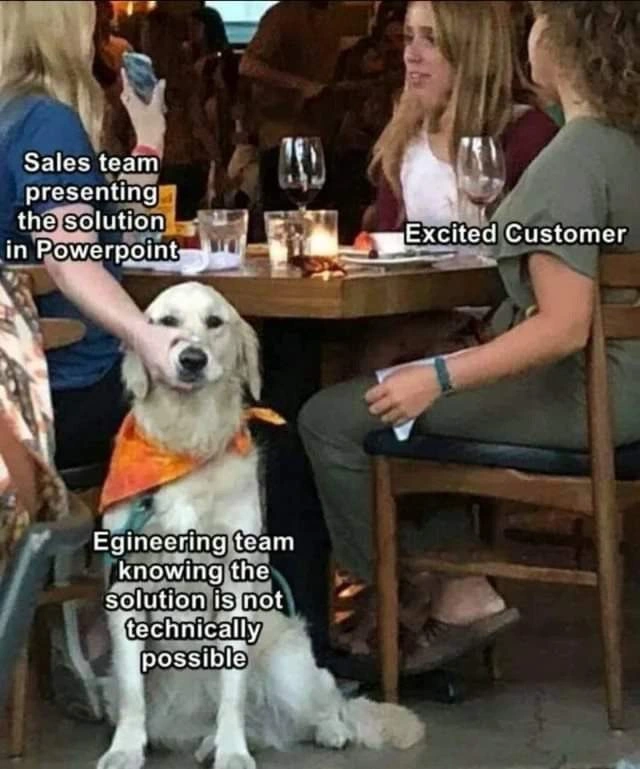
This is exactly what’s happening in the meme, but in a workplace scenario. The sales team is like that overpromising friend, the excited customer is like the teacher who believes the promise, and the engineering team is like you – the person who actually has to do the work and knows it’s impossible in the given time. The meme is funny (and a bit cringe-y) because we can all picture being in that situation: someone promises something big to make others happy, and the person who has to fulfill it is left silently thinking, “This is too good to be true – we can’t actually do that!” It’s an everyday type of mix-up, just dressed up in tech company clothes.
Level 2: But Can We Build It?
Let’s break this down in simpler terms. We have two main groups here: the sales team and the engineering team. The sales team’s job is to keep the client (the customer) happy and excited. They often do this by giving presentations, often using PowerPoint slides – basically a bunch of digital “posters” with bullet points and pictures that make the product look amazing. In the meme, the sales person (with the phone, presumably showing slides) is telling the excited customer about a solution. They’re probably describing all the cool things the product or project will do, trying to impress the customer. This is where big promises sometimes get made. The phrase “presenting the solution in PowerPoint” hints that what’s being shown is more theoretical than actual – it’s a plan or idea, not something that’s been built for real yet.
Now, the engineering team are the people who have to actually build or implement that solution. They know the nuts and bolts of how things work behind the scenes (coding, system limitations, all the technical stuff). When the meme says “engineering team knowing the solution is not technically possible,” it means the engineers hear what’s being promised and immediately realize there’s a big problem: from a technical point of view, what the sales team is promising can’t be done (at least not in the way or timeframe that’s being claimed). Maybe it violates some technical constraint. For example, imagine sales promises “We’ll process all your data in real-time,” but the engineers know the company’s servers and software can’t handle that much data so fast – that would be a technical impossibility without major upgrades. Or sales might promise a new feature that sounds simple in words but is extremely complicated to code. Engineers are trained to spot these issues, so they’re sitting there thinking, “Uh oh, this isn’t realistic.”
The humor (and pain) of the meme comes from the communication gap and misaligned expectations between these teams. Communication gap means one side (sales) isn’t really on the same wavelength as the other side (engineering). They’re not effectively communicating about what can actually be done. Misaligned expectations means the client now expects one thing (because of what sales said), but the engineers expect something very different (because they know the actual limits). This gap can cause a lot of trouble later.
In the image, the engineering team is represented by the dog with its mouth being held shut. This is symbolic: it’s like the engineers want to speak up and say, “Hey, that’s not possible!” or “It won’t work that way,” but they are being silenced. In a real meeting, an engineer might stay quiet for many reasons: maybe their boss or the sales person gave them a look that says “Don’t contradict me in front of the client,” or maybe company protocol is to never show doubt during a client presentation. It’s a bit of corporate etiquette: don’t air the technical concerns until after the client is out of the room. So the engineers endure the moment in silence. They “silently endure” this impossible promise. You can almost imagine one engineer nudging the other under the table like, “Did they really just promise that? This is going to be a long week.”
For someone new to the industry, this scenario is a rite of passage. The first time you see a non-technical team member (like a salesperson or executive) promise something to a client that you know is extremely hard or impossible, your jaw might drop. You might think, “Why would they promise that? We can’t do that!” This meme is basically that feeling captured in one image. The client expectations have been set super high by the presentation. The customer (like the woman labeled “Excited Customer”) is happy and looking forward to this amazing solution. The engineering reality, however, is that there’s a serious problem – maybe it can be done, but not within the timeframe or budget promised, or maybe it defies a fundamental limitation of the software/hardware.
Let’s clarify a few terms that show up in discussions of this meme:
- Stakeholder: This means anyone with a stake or interest in the project. The client is a stakeholder (they want a product that meets their needs), the sales team are stakeholders (they want the deal to go through), and the engineering team are stakeholders too (they want to build something that works). In healthy projects, all stakeholders communicate well with each other. In this meme, stakeholders are not aligned: the client and sales are on one page (believing the vision), and engineering is on another page (knowing the tough reality).
- Client expectations: What the customer believes they will get. Here, the client expects the shiny solution that was described in the slides. If those expectations are set too high or are based on something unrealistic, that’s a big issue. Managing client expectations is a huge part of project management – it’s about being honest about what’s possible so the client isn’t later disappointed.
- Technically possible: This refers to whether something can be done given the current technology, knowledge, and time. Sometimes sales promises something that might be theoretically possible (like, yes, maybe one day we can have flying cars) but not practically feasible in the context of this project (we can’t build you a flying car by next month). Engineers use their knowledge to assess feasibility. When they say something is “not technically possible,” they mean “it cannot be done with our current system or within the constraints we have.” It could violate physical laws, known limitations of software, or simply be beyond what the team knows how to do right now.
- Communication gap: a disconnect where two groups aren’t understanding each other. In tech companies, a communication gap often happens between technical folks and non-technical folks. Maybe the salesperson doesn’t understand the complexity of what they’re promising because it sounds easy on the surface. Or maybe the engineers failed to explain those difficulties in advance. Bridging that gap is hard – it requires translation from tech language to business language and vice versa. When it’s not bridged, you get situations like the meme: one side enthusiastically selling a dream, the other side thinking “this is a nightmare.”
This meme is corporate humor because it pokes fun at something that happens in company life a lot. Many new developers eventually experience a meeting or call where they have to practice diplomacy. For example, you might hear a client ask, “Can you add X feature by next month?” and before you can say “Well, that’s really hard…,” a project manager or sales rep jumps in with, “Absolutely, we’ll make it happen!” Your eyes widen because you know that’s a stretch. After the meeting, the real talk happens internally: the engineering team will explain why that’s not so simple, and the team will have to either negotiate a new plan or somehow try the near-impossible.
The collaboration challenge here is clear: how do you keep the client happy (with optimistic promises) while also being honest and realistic about what can be done? It’s a tough balance. Good communication early on can prevent these situations – for instance, involving technical leaders in sales discussions to keep claims grounded. But in the meme scenario, that didn’t happen. So the sales team essentially painted the engineering team into a corner.
In short, at Level 2 we see the straightforward situation: Sales made a big promise using fancy slides, the customer believes it, and the engineers quietly know it’s a big problem. It’s a humorous portrayal of a very real workplace situation. If you’re a junior developer, take note: this is a gentle warning that stakeholder pressure can sometimes push people to promise more than what’s realistic. It becomes the development team’s headache later. The meme is funny because it’s true – and a little painful – but it’s also a reminder: next time, try to make sure everyone talks honestly before the promises go out the door!
Level 3: PowerPoint Pipedreams
Ah, the classic sales vs engineering showdown: a glossy slide deck brimming with promises versus the harsh limitations of reality. In this meme’s restaurant scene, the sales team is dazzling an excited customer with a slick PowerPoint presentation. The slides likely depict a “solution” that does everything short of brewing coffee – and of course, it’s all going to be delivered impossibly soon. Meanwhile, under the table, we (the engineering team) sit like that golden retriever with a forced grin, effectively muzzled from blurting out: “Actually, that’s not technically feasible!”. This darkly comic scenario hits home because it satirizes a misaligned expectations disaster-in-the-making.
Let’s decode the humor: The sales folks are in full-on promise mode, tossing around buzzwords and guarantees to dazzle the client. They’re treating the project as if it were magic: “Sure, our platform will seamlessly integrate with all your legacy systems by Q4 – no problem!” It’s the kind of lie optimistic claim that gets nods and applause in a boardroom. Salespeople are incentivized to close the deal, so everything sounds easy on a slide. In the world of PowerPoint, there are no compiler errors, no API rate limits, and definitely no physics or CAP theorem to worry about. The PowerPoint world is a utopia where scaling is unlimited, integration is “plug-and-play,” and every feature you could want is just one click away. Slideware (features that exist only in slides) has zero bugs. It’s beautiful and entirely imaginary. This is why we call such grand plans PowerPoint pipedreams – pipedreams being fantasies with no basis in reality.
Now contrast that with the engineering perspective represented by our furry friend. The engineering team knows enough about the actual product and technology to realize the “solution” being sold is, to put it mildly, a heap of nonsense. Their collective internal voice is screaming, “This is not technically possible with our current architecture/budget/timeline!” Perhaps the promised feature violates fundamental constraints (like guaranteeing 100% uptime across multiple datacenters – something that trips over the laws of distributed computing and the reality of outages). Or maybe sales committed to a completely custom module that would take a year of coding, when the client expects it in two weeks. It could be as absurd as promising integration with a system that doesn’t even have an API, or claiming the software supports an industry standard that was never actually implemented. The specifics don’t matter – every senior developer has dozens of war stories of impossible promises made on their behalf.
The meme perfectly captures the StakeholderExpectations nightmare: the client’s expectations are through the roof after that dazzling presentation, but the engineering team’s expectations are dread, knowing they’ll face stakeholder pressure to deliver miracles. Notice how the dog’s mouth is being held shut by a hand – that’s likely a metaphor for management or sales silencing any technical objections. In many real meetings, an engineer brave enough to interject with “Actually, we can’t do that in this timeframe” might get a side-eye or a “let’s discuss that internally later” from the sales lead. The company wants to close the deal first and worry about implementation later. That’s why the engineering team often has to bite their tongue. The humor comes from that communication gap: one side is painting a fantasy, while the other side is dying inside because they know how the story will really end (with overnight coding marathons, blown budgets, or a disappointed client – likely all three). It’s relatable humor for anyone in tech because we’ve all been that silenced engineer at some point, forced to watch a train wreck in slow motion.
This scenario is a textbook example of MisalignedExpectations in corporate culture. It highlights a fundamental collaboration challenge: the people who sell the work and the people who do the work are not on the same page. Why does this keep happening? Often, it’s systemic. Sales teams are rewarded for optimism and closing deals; if they were too cautious about technical details, deals might slip away. Engineering teams, on the other hand, are rewarded (or at least held accountable) for reality – shipping working software, maintaining uptime, not breaking the product. When these incentive structures clash, you get the “promise anything now, deal with consequences later” approach. The engineering reality check is viewed as a threat to the sale, so it gets suppressed (like a hand over the dog’s mouth). The result? A promise that might require bending the laws of computing, and an engineering group internally asking, “Are we seriously going to attempt this?”
Veteran developers have felt this pain many times. It’s the reason behind countless late-night deploys and emergency patches. You can almost smell the coming technical debt: to make an “impossible” feature happen quickly, corners will be cut, hacks will be introduced, and the codebase will suffer for it. Or perhaps the promise is so outlandish it simply can’t be done – then the company will scramble for a face-saving alternative, or find someone to blame. The meme’s dark humor hints at those outcomes without saying it outright. We laugh (or more accurately, we grimace) because we can predict the aftermath with uncanny accuracy.
To illustrate the divide between the sales slide deck fantasy and the engineering reality, consider a few typical lines from these meetings:
| Sales Pitch (Slideware) | Engineering Reality Check |
|---|---|
| “Our solution can integrate with anything!” | We have no API for half the integrations they want. |
| “It’ll be ready next month, guaranteed.” | Even in a crunch, this would take 6+ months of dev work. |
| “The demo you saw is exactly how it works.” | The demo was hard-coded; the real product isn’t built yet. |
| “We’ll achieve 99.999% uptime, no worries.” | We have a single server and zero redundancy – oh no. |
| “AI and blockchain? Already included!” | We have neither; they just strung buzzwords together. |
Each of these is a reality check that the engineers wish they could blurt out on the spot. But they can’t – not without derailing the meeting or jeopardizing the deal. So like the muzzled dog, they sit quietly, maybe forcing a polite smile, while internally calculating just how impossible the promise is. The mismatched expressions in the meme (the customer thrilled, the dog’s face saying “kill me now”) capture this irony brilliantly.
Historically, this dynamic has led to infamous outcomes. Think of “vaporware” – products that are sold in concept but take forever to materialize (if ever). Many old-school enterprise software deals were made on vaportware: sales promised a module or feature that didn’t exist yet, then engineering was tasked to build it under panic. Sometimes it works out by sheer herculean effort; other times you get massive delays or project failures (and plenty of finger-pointing). The corporate humor here is that everyone in a big organization knows this happens, but it’s almost an open secret. New shiny slides today, grumpy programmers debugging at 2 AM a few months later. As the saying goes in project management: *“Underpromise and overdeliver”* – but many sales teams do the opposite. This meme holds up that uncomfortable truth with a laugh.
In summary, Level 3 exposes the full absurdity that senior devs recognize: the CommunicationGap where sales pitches a dream and engineering inherits a potential nightmare. It’s funny because it’s true – terribly, repeatedly true – and we cope by joking about it. The next time you see a overly enthusiastic PowerPoint promise, and some poor tech lead giving a thousand-yard stare, you’ll remember this dog meme and think, “Here we go again…”.
Description
The meme shows a dimly lit restaurant scene: two women sit at a wooden table with wine glasses, candles, and menus; above them appears the label “Excited Customer.” To the left, a partially visible person with a phone is captioned “Sales team presenting the solution in Powerpoint.” On the floor beside the table sits a golden retriever in an orange bandana; another hand firmly closes the dog’s mouth. Text over the dog reads “Egineering team knowing the solution is not technically possible,” misspelling “Engineering.” The image satirizes the common enterprise dynamic where sales markets a glossy, slide-deck vision that engineering teams know cannot be delivered within technical constraints
Comments
6Comment deleted
“Sales just promised sub-10 ms globally consistent writes on a single-AZ RDS instance, and I’m over here throttling my inner DBA like a golden retriever being told not to bark.”
The engineering team has mastered the art of the 'technically possible if we rewrite physics, hire 200 developers, and get a time machine' smile - it's the same expression you make when the CEO asks if we can 'just add AI to make it faster' during the quarterly all-hands
The engineering team's face when sales promises a 'simple integration' that requires rewriting the entire microservices architecture, migrating to a different database paradigm, and somehow achieving both ACID compliance and eventual consistency simultaneously - all before the customer's fiscal year ends next month
PowerPoint: the only runtime where CAP is “yes,” the SLA is a Slide Level Agreement, and engineering smiles because they know who’s on call
PowerPoint is the only runtime where sales achieves linearizability, infinite scale, and GA next week; engineering applies manual backpressure with the only control left - a hand
PowerPoint: where every feature scales infinitely, until engineers remind them of the CAP theorem mid-demo