Skip to content
DevMeme
1690 of 7435
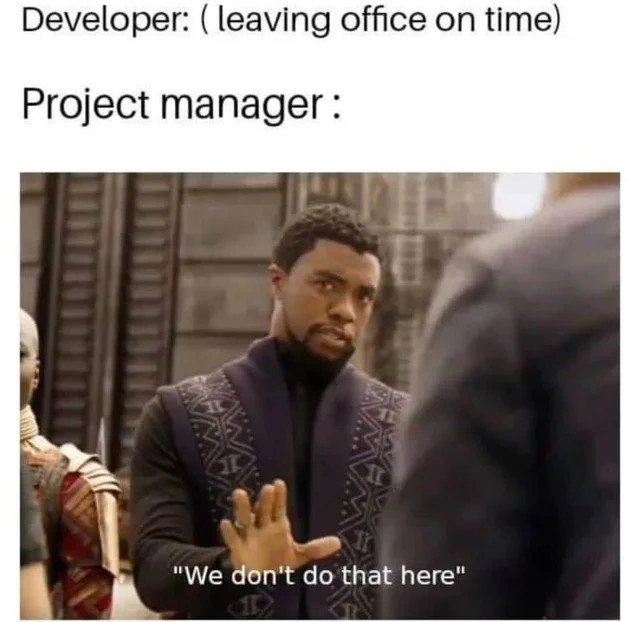
Developer leaves at 5 PM; project manager answers, “We don’t do that here.”
Management PMs Post #1886, on Aug 8, 2020 in TG

Developer leaves at 5 PM; project manager answers, “We don’t do that here.”

Why is this Management PMs meme funny?

Level 1: No Going Home Yet

Imagine you’re at school and the final bell rings at the end of the day. You’re excited to pack up your stuff and go home to play. But then your teacher stands at the door with their hand up like a stop sign and says, “We don’t go home at 3 o’clock in this class.” You’d probably be confused and a little upset, right? It’s funny in a silly way because everyone knows when school is over, you’re supposed to go home. This meme is showing a similar idea at a job: the worker wants to leave when the work day is officially finished, but the boss is acting like that teacher, basically saying, “Nope, we’re not done, you can’t leave yet.” The humor comes from taking a normal rule (going home on time) and showing an authority figure completely rejecting it. It’s exaggerating a real feeling many grown-ups have at some jobs — that sometimes the boss makes you stay late even when you thought you were free to go.

Level 2: Overtime All The Time

This meme uses a scene from a superhero movie to make its point. The text at the top sets up a dialogue:
Developer: (leaving office on time)
Project manager: (reaction) …

Below that, we see King T’Challa from Marvel’s Black Panther raising his hand in a stop gesture with the subtitle “We don’t do that here.” In the original movie, it’s a light-hearted line, but in this meme it’s applied to office culture. Here’s what’s happening in simple terms: the developer is trying to go home at 5:00 PM (which is a normal end-of-day for many jobs), and the project manager basically says, “Nope, that’s not how we do things in this workplace.” The joke implies that in this company or team, nobody leaves at the official closing time.

Let’s break down why that scenario is familiar in tech circles. A project manager (PM) is someone who plans and oversees work on a software project — they set deadlines (due dates for when features or projects should be finished) and track progress. A developer writes the code and fixes bugs to build the product. Ideally, if a work day is 9 AM to 5 PM, a developer can go home at 5 PM when their tasks for the day are done. But in many software teams, especially when a release date is coming up or a project is behind schedule, there’s an expectation of overtime. Overtime means working extra hours beyond your normal schedule (like staying late in the evening, or even working weekends).

This meme is specifically referencing crunch time, a slang term in the tech and gaming industry for periods when the team is expected to work long hours to meet a tight deadline. A workplace with crunch culture treats this like a normal thing — for example, pushing every evening late or doing “mandatory” Saturdays as a deadline nears. In such environments, leaving right at 5 PM might be viewed as leaving early, because everyone else is still grinding away. The project manager in the meme is effectively enforcing that culture by stopping the developer from leaving on time. The phrase “We don’t do that here” means “this behavior (going home at 5) isn’t normal or acceptable among us.”

For someone early in their career, this highlights a reality you might encounter: Sometimes the boss or the team unofficially expects you to stay later than your official hours. Maybe there’s an important demo tomorrow, and at 4:55 PM your PM comes by and says, “We really need to finish feature X tonight.” You glance at the clock and sigh, realizing you might be in the office for a few more hours. The meme exaggerates it with humor by having the PM outright refuse to let the dev leave, as if it were a strict rule. Of course, in real life a manager might not literally say “we don’t do that,” but they might say things like “Everyone’s still working hard — we need all hands on deck right now.” The effect is the same: you feel pressure to stay late.

Key terms from the meme: Work-life balance is the idea of having a healthy divide between your job and your personal life. Leaving the office on time is one way to keep that balance (so you can have your evening for rest, family, or hobbies). The joke here is that the manager doesn’t seem to care about that balance at all. Deadline pressure refers to the stress everyone feels when a due date is approaching and there’s still a lot to do. When deadlines are tight, a common but controversial solution is to hustle harder and work longer – hence the expectation of overtime. The meme is playfully saying that at this company, working late isn’t just occasional; it’s the norm (“we don’t do [leaving at 5] here”).

The reason developers find this meme funny is that it rings true from personal experience. It’s poking fun at a serious problem in many tech workplaces. New developers might be surprised by this: you get hired for a 9-to-5 job, but then find out that, especially during crunch periods, you’re kind of expected to be available 9-to-7 or 9-to-9. Many companies and managers are trying to improve on this and encourage people to go home on time, but clearly the meme is relatable enough that it struck a chord. It basically says, “Our team’s culture is that nobody leaves until the boss is satisfied (which might be much later than 5).” If you’ve ever looked around at 5 PM and noticed you’d be the only one leaving, you understand the awkward humor here. This meme uses a bit of pop culture fun to highlight that awkwardness and the clash between work culture and normal working hours.

Level 3: The 5 PM Taboo

At 5:00 PM sharp, a developer dares to pack up and head out — only to be met by the project manager’s outstretched hand and that iconic proclamation: “We don’t do that here.” This meme scene is a comedic gut-punch for seasoned engineers because it satirizes the all-too-familiar crunch culture in tech. The image pulls from Marvel’s Black Panther, with King T’Challa (Chadwick Boseman) making a polite-but-firm stop gesture. In the meme’s context, he’s essentially channeling the project manager who refuses to let the developer leave work on time. The humor lands because it’s painfully relatable: in many software teams, walking out the door at the official closing hour can feel like a forbidden act.

Why is leaving on time treated like a betrayal of the tribe? This joke pokes fun at the unwritten rule in many companies that deadlines trump everything — including your personal life. The developer’s innocent attempt at work-life balance collides with the PM’s reality of “stay until it’s done.” It highlights an industry anti-pattern where managers plan unrealistic schedules or promise features to clients without padding for the unexpected, then unofficially expect engineers to work overtime to make it happen. Seasoned devs have been through these “death march” projects: feature creep and optimistic timelines leading to late nights, pizza-fueled coding sessions, and sarcastic office jokes like, “Oh, you’re working a half day?” aimed at anyone leaving before the sun sets. The meme gets a laugh (or a groan) because every experienced developer has either heard or felt that exact sentiment: Seriously, you think you’re done at 5?

Under the hood, this is a crack at dysfunctional corporate culture. Management often pays lip service to “work-life balance” in company brochures, yet when push comes to shove, any poor soul leaving at 5 PM might get side-eye or a guilt trip. There’s a systemic issue being mocked here: instead of adjusting scope or deadlines (the sane approach), some project managers simply squeeze more hours out of their team as a default solution. It’s reminiscent of the classic Mythical Man-Month problem — believing that throwing more hours (or people) at a late software project will magically catch it up. Veterans know it usually just leads to burnout and buggy code, but still, the cycle repeats. The humor is dark because it’s true: this absurd situation shouldn’t happen, yet it does in plenty of organizations. By evoking King T’Challa’s dignified “We don’t do that here” line, the meme gives developers a witty way to commiserate. It’s a shorthand for deadline pressure so intense that normal healthy behavior (like leaving work on time) gets treated as an outrageous act. And every engineer who’s survived a crunch knows the feeling when a manager’s stance is essentially, “The day’s not over when the clock strikes 5; it’s over when I say so.”

So the meme hits home for senior folks: it’s a knowing head-shake at how management expectations can become detached from humane norms. We chuckle because King T’Challa’s calm authority as he says “We don’t do that here” is exactly how a PM might respond, whether in words or just in attitude, to a dev grabbing their coat at quitting time. It’s funny and tragic at once — a perfect encapsulation of tech’s twisted love affair with overtime. The fact that everyone instantly recognizes this scenario means the meme has tapped into a shared industry truth. In short, leaving at 5 PM in crunch time is treated as heresy in some offices, and this image humorously crowns the PM as the gatekeeper of late-night coding duty. Work-life balance? In these halls, we don’t do that here.

Description

The meme has two text lines in black font on a white background: "Developer: (leaving office on time)" followed by "Project manager:". Beneath this, a film still shows a man in an ornate dark purple-and-black vest raising one hand in a stopping gesture toward someone off-camera; the setting looks like a high-tech hall with metallic walls. A subtitle at the bottom of the frame reads, "We don't do that here". The humor plays on crunch culture in software teams - developers hoping to maintain work-life balance while project managers implicitly demand overtime to hit deadlines. Senior engineers will recognize the commentary on unrealistic schedules, deadline pressure, and management expectations common in large corporate environments

Comments

6
Anonymous ★ Top Pick Told the PM I’d leave at 5; he reacted like I’d proposed enforcing ACID on our eventually-consistent microservices: “We don’t do that here.”
  1. Anonymous ★ Top Pick

    Told the PM I’d leave at 5; he reacted like I’d proposed enforcing ACID on our eventually-consistent microservices: “We don’t do that here.”

  2. Anonymous

    The same PM who insisted we needed "unlimited scalability" for our 50-user internal tool now can't understand why sustainable pace matters more than their arbitrary deadline that was reverse-engineered from a board meeting

  3. Anonymous

    The irony here cuts deep: we've mastered distributed systems, automated deployments, and achieved sub-millisecond latencies, yet somehow the concept of a developer leaving at 5 PM remains the most architecturally impossible feature request. It's the one edge case that breaks every project manager's mental model - as if work-life balance violates some fundamental CAP theorem where you can only have two of: Consistency in delivery, Availability after hours, or Partition tolerance from burnout

  4. Anonymous

    Leaving on time is treated as a nonfunctional requirement - always descoped at sprint planning and replaced by a P0 called “one last quick thing.”

  5. Anonymous

    Leaving on time? That's like a zero-downtime deploy in a legacy monolith - PMs invoke the 'nope' theorem

  6. Anonymous

    When the critical path is “voluntary overtime,” it’s not Agile - it’s an undocumented dependency with a 0% SLO and compounding burnout interest

Use J and K for navigation