Skip to content
DevMeme
6243 of 7435
Engineering team’s blank stare at the sudden “AI-first” pivot
AI ML Post #6846, on Jun 4, 2025 in TG

Engineering team’s blank stare at the sudden “AI-first” pivot

Why is this AI ML meme funny?

Level 1: When Coach Changes the Game

Imagine you play on a soccer team, and all season you’ve been practicing soccer. Suddenly, one day at practice, your coach walks in and says, “From now on, we’re not a soccer team, we’re a basketball-first team!” You’d probably blink and stare at them, thinking it’s a joke. Your teammates would look at each other, confused.

Why the confusion? Well, you have soccer cleats on, a soccer ball at your feet, and you’ve been drilling soccer passes and goals for months. Now the coach is excitedly saying basketball is the cool new thing and you all need to play basketball instead. There are new terms you don’t know, new skills you haven’t learned (like dribbling a basketball or shooting hoops), and the coach hasn’t given any plan — just a big announcement. You’d stand there with a blank face because it doesn’t really make sense and it came out of nowhere. It feels silly and sudden.

In the meme, the company’s boss is like that coach. The boss said, “We’re now an ‘AI-first’ company,” kind of like saying “we’re a basketball team now” because AI is the popular thing everyone’s talking about (just like basketball might be super popular). The engineering team is like the players who were ready to keep playing soccer (the work they were doing before). When they hear this news, they just stand there, not smiling, not clapping, just staring. They’re thinking, “Huh? We’re doing what now?”

It’s funny in a relatable way. We’ve all had adults or leaders suddenly change plans on us because they got a new idea or want to copy a trend. Imagine your teacher suddenly says, “Forget our science project, we’re all going to make TikTok videos for a grade because that’s what’s popular!” You might giggle at first, then realize they’re serious and feel a bit worried or puzzled. That’s the feeling here. The engineers’ blank look is like when you and your friends exchange silent glances that say “This is a bad idea, but I guess we have to go along with it.”

So, in simple terms: The boss is chasing the newest shiny idea (AI, like the coach chasing basketball) and the team is left standing there confused, because it’s a big change thrown at them without warning. The humor comes from their totally unimpressed, blank faces – they look just like a group of kids whose game got changed suddenly. They’re not angry or crying; they’re just comically expressionless, as if saying, “Alright, if you say so… but we have no idea how to do that.” It’s a funny picture of a surprise big change and a team that doesn’t quite know what to do with it, much like kids in a class being told recess is replaced by a pop quiz.

Level 2: Buzzword Compliance 101

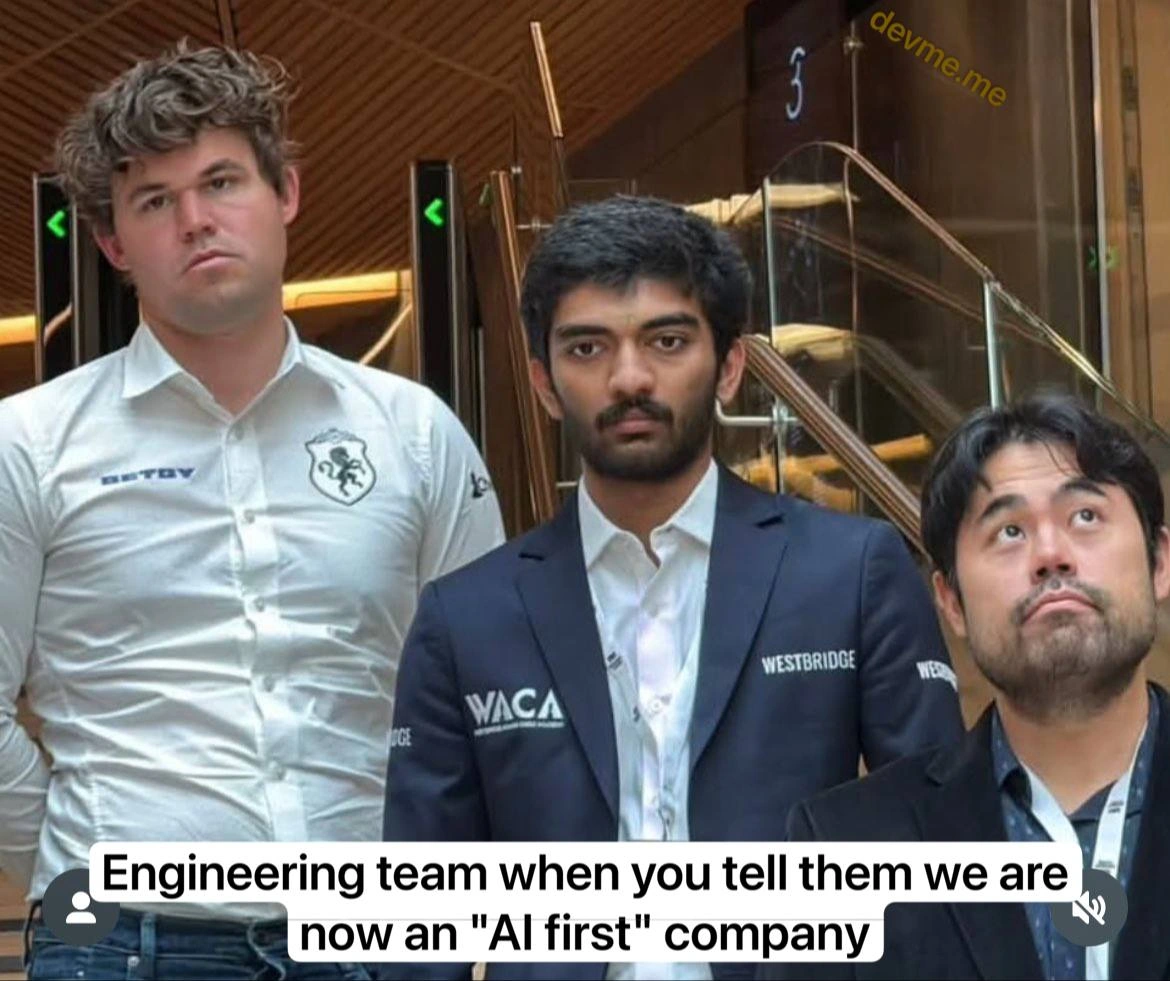
So, what’s actually happening in this meme? Let’s break it down in simpler terms. The caption reads: “Engineering team when you tell them we are now an ‘AI first’ company.” In everyday language, an executive (like a CEO or a manager) has just told the engineering team that the company’s new main focus is artificial intelligence (AI). This is a sudden change in direction – basically a big pivot. A pivot means the company is changing its strategy or focus, often drastically. Here, the pivot is towards being “AI-first,” which implies putting AI at the core of everything the company does from now on.

Now, why would an executive say this, and why are the engineers staring blankly?

  • AI-First, Explained: Saying “we’re an AI-first company” is a bold statement. It means the boss wants every product or project to use some form of Artificial Intelligence / Machine Learning (AI/ML). AI is technology that tries to make computers smart, enabling them to learn from data and make decisions or predictions (like a voice assistant or a recommendation system). AI-first suggests AI should be considered at the start of every design; it’s not just an add-on, it’s the central theme. This sounds cool and innovative, right? The issue is how sudden and superficial this announcement feels.

  • The Hype Cycle: In the tech world, there’s something called the hype cycle. When a new technology becomes popular (like AI, blockchain, VR, etc.), everyone talks about it like it’s the magic solution to everything – this is the hype. Companies then rush to adopt it, sometimes without fully understanding it (that’s the hype-driven pivot). Inevitably, reality sets in: the tech has limitations, projects fail or take too long, and people get disappointed – that’s the crash after the hype. Right now, AI is at a huge hype peak. Ever since breakthroughs like ChatGPT showed very human-like text responses, a lot of executives feel pressure to not miss out. This leads to declarations like “We have to be an AI-first company!” almost as a knee-jerk reaction to the trend. It’s part of the TechHypeCycle and very much an IndustryTrend at the moment.

  • Buzzword Overload: Terms like “AI-first” are what we call buzzwords in corporate lingo. A buzzword is a catchy term that’s very popular, often to the point of being overused or misused. Buzzwords sound impressive (think “synergy,” “blockchain,” “metaverse”), but they’re sometimes more style than substance. Buzzword compliance means going along with whatever buzzword is hot right now so the company seems up-to-date. For example, a few years ago, every tech CEO was saying “mobile-first” (meaning design for mobile phones first). Then it was “data-driven” and “cloud-first.” More recently we heard “Web3” or “metaverse” as new focuses. Now it’s AI everywhere. If tomorrow quantum computing becomes the buzzword, some companies might suddenly proclaim themselves “quantum-first.” It’s almost like a game of catch-up with the trends. This meme’s scenario is exactly that: an executive mandate (a top-down order) to embrace the latest buzzword (AI) across the board – essentially because it’s the in thing.

  • Engineers’ Perspective: Now think about the engineering team – these are the developers and tech folks who actually have to make things happen under the hood. They’ve probably been working on the company’s products with certain tools and roadmaps. A sudden pivot to AI means their plans are upended. It could mean:

    • Learning new tools or programming frameworks (like Python’s TensorFlow or PyTorch for machine learning, if they aren’t already familiar).
    • Revisiting projects to see “where can we add AI here?”, which is not straightforward. You can’t just inject AI blindly; it needs data, models, and a valid use case.
    • Potentially working overtime to create demos or prototypes to prove the company is now AI-focused, often with tight deadlines (because if the boss is announcing it now, they likely want results fast to show stakeholders).

    If you’re a junior developer on that team, initially you might feel excited but nervous. Excited because hey, working on AI sounds cutting-edge and could be great for your experience. Nervous because you might not have a background in AI, and now suddenly it’s a priority. There’s also confusion: “We’re doing this because… everyone else is? Is this actually good for our product or our users?” The engineers in the photo aren’t jumping for joy; they look stunned or skeptical. That’s a sign that they might be thinking: “This came out of nowhere. Do we even have the data or expertise to do this? Are we just doing this for show?” Essentially, they’re not convinced this mandate makes sense — at least not the way it was dropped on them.

  • Corporate Culture Clash: In many tech companies, there’s a bit of a cultural divide often jokingly referred to as “suits vs. hoodies.” The “suits” are the business people: executives, managers, those who deal with investors and marketing. They literally might wear suits or at least business casual, and they focus on big-picture strategy and how the company is perceived. The “hoodies” are the developers/engineers: they often dress more casually (yes, hoodies and t-shirts), and they focus on building and maintaining the actual software or product. In this meme’s image, interestingly, the engineers themselves are in suits (perhaps for a formal event or meeting), but their body language is still very much “engineer.” They look uncomfortable, stiff, and not at all sold on what’s happening. This highlights a common scenario: management might make grand announcements (“We will innovate with [hot tech]!”), expecting enthusiasm, but the technical team might respond with cautious silence because they foresee the challenges ahead. It’s a bit of an inside joke in CorporateHumor circles: the boss says a fancy phrase, the room of engineers goes quiet and stares, maybe exchanging a few side-glances.

  • Key Terms Defined: Let’s clarify some terms to ensure everything’s clear:

    • Artificial Intelligence (AI): Technology that enables machines to mimic human-like intelligence, learning from data and making decisions. It includes things like machine learning, where algorithms improve at tasks as they see more examples. AI can be anything from voice assistants (like Siri/Alexa), to recommendation systems (like what’s on your YouTube/Netflix feed), to advanced Large Language Models (like GPT) that can generate text.
    • Machine Learning (ML): A subset of AI focusing on algorithms that learn from data. Often when companies say “we use AI,” they specifically mean using ML models. For example, an app that learns your music taste and suggests songs uses machine learning.
    • AI-first: A strategy or approach where AI technology is placed at the forefront. It means when designing any new product or feature, the question will be “How can we use AI here?” It’s the successor to phrases like “mobile-first” (design for mobile before desktop) or “cloud-first” (build on cloud infrastructure before considering on-premises).
    • Pivot: A significant change in business strategy. If a company was doing A and now suddenly decides to focus on B instead, that’s a pivot. Startups pivot a lot when the original plan isn’t working out or a new opportunity seems better. In our context, pivoting to AI means changing projects and priorities to incorporate AI everywhere.
    • Executive Mandate: A top-down command from high-level management. When the big boss says “We’re doing this. No discussion,” that’s an executive mandate. It often bypasses the usual decision-making processes. Here, the AI-first pivot is presented as one of those “because I said so” mandates from leadership.
    • Buzzword Compliance: This is a tongue-in-cheek term. It means doing something mainly to check a box that you’re following the latest trend. If everyone is talking about AI and you feel pressure to say “Yes, us too!”, that’s trying to be compliant with the buzzword of the day. It might involve rebranding, like adding “AI” to product names or using the jargon in marketing, sometimes without much substance behind it initially.
    • AI Hype vs. Reality: A lot of jokes (and frustration) in the tech world come from the gap between hype and reality. Hype is when people talk about AI like it’s magic, capable of anything and guaranteed to revolutionize the world next week. The reality is that AI projects can be very challenging: models can be inaccurate or biased, they need tons of good data, they require compute power, and integrating them into existing systems without issues is non-trivial. “AI hype vs. reality” refers to comparing what people think AI will do (often overly optimistic) versus what it actually can do right now (impressive but with limits).
  • Common Scenario for a Junior Dev: If you’re early in your career, you might actually encounter a scenario like this on a smaller scale. For instance, maybe you joined a team to work on a web application, and suddenly the product manager says, “We should add a chatbot that answers customer questions using AI, because our competitors have one.” At first, that sounds cool – you get to work on something with AI. But then you realize:

    • You’ve never integrated an AI chatbot before.
    • There’s no one on the team with deep AI experience.
    • The timeline is short because it’s a reaction to competition.
    • You have to research third-party AI services or libraries and figure out how to make them work with your app.
    • There might be unexpected issues, like the AI giving wrong answers or needing a lot of data from your company to train properly.

    It can be overwhelming. The excitement turns into stress if it’s not well planned. This meme captures exactly that kind of moment – but magnified to an entire company pivoting, not just a feature. The team’s blank expressions basically say, “Uh… okay… so how are we supposed to do that?”

  • Why the Blank Stare?: The text describes it as a blank stare, and indeed in the image, the engineers look expressionless, maybe a bit tired or bewildered. That reaction comes when you’re presented with something that is either nonsensical, extremely hard, or just dropped on you without warning. It’s the look of quiet disbelief. They’re professionals, so they’re not going to facepalm or openly argue in that moment; they’ll stand there politely. But you can tell they’re not thrilled. It’s like when a teacher announces a huge project due tomorrow out of nowhere – students might just stare in shock. Here, the boss likely expected some excitement or at least acknowledgement. Instead, the room is silent, and these guys are looking on as if to say, “Alright… if you say so,” with a side of “this is not going to be fun.”

  • Suits with Sponsor Logos?: A quick note on the image details: the engineers are wearing blazers with patches that say “WACA” and “Westbridge,” and one has a shirt with a lion crest logo. This makes them look like they’re part of some sponsored competition or startup showcase. It adds to the corporate/formal atmosphere of the scene. They’re not in casual dev attire; they look like they were possibly dressed up to present something or attend an important meeting. This visual detail emphasizes how out-of-element they might feel – they’re probably more comfortable dealing with code problems than doing PR poses. It could even imply that this AI-first announcement came at a fancy event (maybe a tech conference or an investor meeting), and these engineers were brought on stage as the “AI team” suddenly. And they’re just thinking, “We learned about this new direction the same time as you all did… and we have no clue what our plan is yet.”

  • Relatable Feelings: To a newer developer or someone early in their tech career, this meme might seem humorous but also a bit daunting. It’s basically showing you a peek into how companies sometimes operate internally. Things can change on a dime if upper management decides so. The people who have to implement those changes (engineers, designers, project managers at the ground level) often have to adjust very quickly. It can be frustrating. But it also teaches an important lesson: be adaptable and always keep learning. If your company suddenly wants AI everywhere, you might have to start learning about AI concepts, or at least how to integrate existing AI services. It’s not fair when it’s done without preparation, but it happens. The blank stares are a form of professional restraint – the team is staying calm externally, even if internally they’re worried or rolling their eyes. In meetings, especially with higher-ups, junior devs might take cues from seniors. If the seniors are quiet and expressionless after such news, it often means “we hear you, but we have serious doubts.”

  • The Comedy in It: Why is this funny to people in tech? Because it’s extremely relatable in a satirical way. The humor isn’t slapstick; it’s that painfully awkward, dry humor you get from real-life scenarios. Think of shows like “Silicon Valley” where the jokes often come from ridiculous corporate decisions and the deadpan reactions of the engineers. Here, the joke is basically: “Our boss just dropped this huge demand on us, and we’re all internally screaming, but externally we’re just… blank.” The caption sets that up clearly, and the image delivers it with their faces.

To sum up this level: The meme is highlighting a common tech industry trend where companies try to jump on the latest buzzword bandwagon – in this case, AI – and the engineering team is left looking bewildered and unenthusiastic. AIHype in the boardroom meets AI reality in the trenches. If you’re new to the field, know that these pivots happen, and part of growing as a developer is learning how to navigate them (and when it’s safe to chuckle about them with your colleagues). For now, it’s okay to simply appreciate the humor: those blank stares are the team’s polite way of saying “this is nonsense, but we’ll figure it out, I guess.” They’ve likely been through similar situations, and now so will you eventually – welcome to the wild ride of the tech industry’s trend du jour! 🚀


Level 3: Hype Cycle Hangover

The engineering team’s blank stares say it all. In a sleek boardroom or Slack announcement, the execs just declared, “We are now an AI-first company!” – cue the collective internal eyeroll. This is classic corporate buzzword whiplash. Today’s mandate: pivot everything to AI/ML. Yesterday it was “mobile-first,” last year “cloud-first,” and who can forget “blockchain-first”? The devs have seen this hype train before, and they know the destination: a heap of unrealistic expectations and a codebase held together with duct tape and hope machine learning wrappers. It’s a textbook case of AI hype colliding with engineering reality.

Let’s break down why this scene is comedic gold for anyone who’s survived a few tech hype cycles:

  • Buzzword Blitz: In tech CorporateCulture, nothing’s more jarring than an executive mandate that comes out of nowhere. One week it’s business as usual, next week the CEO’s at an all-hands meeting saying, “AI is the future, so drop everything and sprinkle AI on every product!” It’s like playing Buzzword Bingo and suddenly realizing someone’s trying to win by yelling “AI!” for every square. The phrase “AI-first company” makes leadership sound visionary on CNBC, but to the engineers it sounds like “we have no clear plan, but our strategy deck will look trendy.” This disconnect is where the humor kicks in: the suits expect a standing ovation for their forward-thinking pivot, but the devs are giving them the 1,000-yard stare of “Seriously? Again?”.

  • Déjà Vu of Tech Fads: Those dull, unamused faces in the photo? That’s the look of pivot fatigue. Most senior engineers have scars from previous hype-driven overhauls. Remember when every product had to be “social” or “mobile” overnight? Or the TechHypeCycle that crowned blockchain as the solution to everything from banking to sandwich-making? Each time, leadership insisted the company become “_first” in whatever trend:

    • Mobile-first (circa 2010): “Quick, rebuild our entire product for smartphones because everyone’s got one!” 📱
    • Cloud-first (2014): “Migrate everything to the cloud ASAP. On-prem is passé.” ☁️
    • Big Data-first (2015): “Hire data scientists, we’re doing AI/ML because we have tons of data (that we haven’t actually collected yet)!” 📈
    • Blockchain-first (2018): “Put it on a blockchain! Doesn’t matter what it is. Investors love blockchain.” 🔗
    • Metaverse-first (2022): “We need VR meetings and NFT integrations. The IndustryTrends_Hype demands it.” 🕶️
    • And now AI-first (2025): “Integrate ChatGPT into everything, add ‘AI-powered’ to all product names. We’re riding the AIHypeCycle!” 🤖

    Each of these pivots was hailed as transformative. And each time, the developers ended up pulling all-nighters to retrofit systems with half-baked features that were quietly abandoned once the hype died down. The HypeCycle hangover is real: after the Peak of Inflated Expectations always comes the Trough of Disillusionment. These engineers know that pattern. They’re bracing for the inevitable moment when the fancy AI initiative hits the hard wall of legacy code, lack of training data, and angry customers beta-testing glitchy “smart” features.

  • AI-First Reality (vs. Fantasy): On paper, “AI-first” sounds exciting. In practice, it’s often a polite way of saying “we’ll awkwardly shove AI into our product line whether it fits or not.” The humor here is that management acts like adding AI is as simple as flipping a switch. Real engineers know it’s more like rebuilding the airplane mid-flight. Need a recommendation engine or a chatbot? Sure – just ignore the months of data collection, model training, and edge-case handling required. 🙄 The team’s blank look = “You want a state-of-the-art machine learning system now, on top of our existing mess of a codebase? Are we also getting a magic wand with that request?” The meme caption nails this absurdity. It’s AIHypeVsReality in one image: executives envisioning an AI revolution, engineers envisioning endless Jira tickets to make it happen.

  • Suits vs. Hoodies: The image even visually contrasts cultures. The guys are literally in suits and branded blazers (sponsor logos and all), looking like they’re at a venture funding pitch. This formal attire screams “executive presentation mode.” But their facial expressions scream “we’d rather be back at our desks in hoodies.” It’s a nod to the classic suits_vs_hoodies clash in tech culture: the business side obsessed with glossy trends, the engineering side focused on practical implementation. Right now, the engineers have been dragged into the boardroom for the big AI announcement. They’re standing there stiffly, maybe after hearing a slick PowerPoint about “AI synergy” and “disrupting the market with GPT-4 integration,” and they look utterly unimpressed. It’s that contrast between ManagementHumor (the boss expecting excitement) and CorporateHumor (the team giving a collective poker face). If this were a cartoon, you’d draw little thought bubbles above them: “Did they seriously bring us here for this?”“Guess I’ll be rewriting perfectly fine code to use some AI API now.”“Wake me when this meeting is over.”

  • Unspoken Pain Points: There’s a shared understanding among developers in this meme: hype-driven pivots can be a nightmare. They’re thinking about the technical debt this will create. Just last week the backlog was full of normal feature requests and bug fixes; now half of those will be dropped or rushed because “we need an AI demo by Q3.” The CTO might already be asking the team to integrate a random Machine Learning library or call some cloud AI service to magically label the product “AI-powered.” It’s management-by-keyword: if the quarterly report includes enough AI mentions, maybe the stock will tick up. Meanwhile, the engineers are left holding the bag – implementing half-understood algorithms, wrestling with models that don’t quite work as advertised, and explaining to confused Product Managers why “just use AI” isn’t a one-click fix. One can almost hear an exhausted senior dev explaining, “No, Karen, we can’t just ‘add some AI’ to get 10x improvement. That’s not how any of this works.”

  • Why This Keeps Happening: Part of the dark humor here is knowing that these scenarios repeat. Management_PMs often have incentives to chase trends – it looks great in press releases and investor meetings. If competitors announce AI features, the higher-ups feel compelled to not fall behind (even if the company’s actual needs or capabilities don’t align). Buzzword compliance becomes a corporate survival skill. From the cynical engineer’s perspective, it’s like watching a fad-chasing carousel: the terminology changes (“AI-first” being the buzzword du jour), but the outcome is the same – rushed projects and disillusioned devs. And of course, the boss rarely wants to hear the realistic timeline or challenges. Dissent risks being labeled as “not being on board with the vision.” So the team stands there, blank-faced, swallowing any protest. They’ll nod along today and later huddle to figure out “Okay, how on earth do we actually do this AI thing with zero training and no budget?”.

To illustrate the communication gap, consider this little translation table of corporate-speak to engineer-think:

Executive Says Engineer Hears (Inner Monologue)
“We’re now an AI-first company!” “Time to rebrand everything and pray it works.”
“This is cutting-edge AI innovation.” “Our boss saw a cool demo on Twitter last night.”
“Every team must integrate AI by Q4.” “No extra resources, unrealistic deadlines incoming.”
“Our competitors are doing AI, so…” “We’re jumping off a bridge because everyone else is.”
“It’s a game-changer for customers.” “It’ll impress investors; customers will be beta-testers.”

It’s funny because it’s true. The ManagerExpectations column is all grand vision; the engineers’ reality is full of caveats and cynicism. The meme captures that exact moment of disconnect – the deadpan looks of a team mentally preparing for the oncoming storm of nonsense.

  • The Human Angle: Beyond the technical hassle, there’s an emotional resonance here. Seasoned engineers feel pride in building things that work and skepticism toward trendy rewrites that smell of snake oil. Being told to pivot on a dime triggers blank_stares_reaction because it often devalues the work they’ve been doing. It’s like, “So… was everything we built so far not good enough, and now we chase this shiny thing?” That can be demoralizing. Those blank looks hide a mix of anxiety (“Do I need to learn a whole new tech stack now?”), resentment (“Management has no clue how hard this is.”), and dark humor (“Maybe if I stare into space hard enough, I’ll astral project out of this meeting.”). It’s a coping mechanism as much as a meme joke.

Finally, consider the sheer absurdity from a technical perspective. AI isn’t a feature you toggle on; it’s an entire stack of data collection, model training, validation, and continuous tweaking. The phrase “AI-first” suggests a complete reorientation of architecture and priorities. It’s the kind of change that, if genuine, would require thoughtful planning, new hiring (hello, ML engineers and data scientists?), and significant R&D. But the meme implies this is more of a knee-jerk, “because everyone’s talking about it” directive. In code, it’s tantamount to:

# Pseudocode for the sudden AI-first directive:
for product in company.products:
    product.features.append("Uses AI")  # just slap the label on everything
    product.deadline = yesterday        # rush all changes, of course

# Developer's sarcastic reaction:
print("Sure, let's just sprinkle some AI fairy dust on our entire stack overnight. What could go wrong?")  

It’s humor by exaggeration. The code comment “just slap the label on” and the deadline “yesterday” poke fun at how management often wants the results immediately, as if adding AI is like adding a coat of paint. And that print line? That’s basically the engineering team’s collective inner voice, dripping with sarcasm.

In summary, this meme hits home for many in the tech world. It highlights the clash between IndustryTrends_Hype and engineering pragmatism. The joke shines through the engineers’ blank expressions: they recognize that an “AI-first” pivot announced this casually is more about buzzword compliance than realistic planning. They’re not angry or yelling; they’re past that. They’re at the resigned, stone-faced stage that experienced devs know all too well. As a wise, battle-scarred coder might mutter, “Here we go again…” – and that’s exactly why we’re laughing (albeit with a groan) at this scene. It’s funny because it’s a snapshot of truth in our hype-driven industry, and everyone involved – even the engineers in the photo – seems to recognize the circus for what it is. 🎪🤖


Description

Photo of three male professionals standing shoulder-to-shoulder in a sleek corporate lobby. Their faces are blurred for privacy, but their stiff posture and neutral expressions suggest forced formality. Two wear navy blazers with white sponsor patches reading “WACA” and “WESTBRIDGE,” while one wears a tight white dress shirt with a lion crest logo; all look more ready for a venture-fund pitch than a sprint review. Behind them, polished turnstiles glow green and a wooden slat ceiling and glass staircase reinforce the upscale office vibe; a small yellow 'devme.me' watermark sits in the upper-right corner. A meme caption in bold white text at the bottom reads: “Engineering team when you tell them we are now an 'AI first' company,” highlighting the executive-level buzzword whiplash senior engineers often face
Comments

18
Anonymous ★ Top Pick Sure, we can become “AI-first” - I’ll just add a --gpt flag to the Makefile and ship it to production, right after the board deck compiles itself
  1. Anonymous ★ Top Pick

    Sure, we can become “AI-first” - I’ll just add a --gpt flag to the Makefile and ship it to production, right after the board deck compiles itself

  2. Anonymous

    Nothing says 'we've run out of actual product ideas' quite like pivoting to 'AI first' right after your engineering team finally got the microservices migration stable and the technical debt under control

  3. Anonymous

    When the C-suite discovers ChatGPT exists and suddenly your perfectly functional microservices architecture needs to be 'AI-enhanced' - because nothing says 'we understand our technical debt' quite like adding a $200K/month OpenAI bill and three new abstraction layers to wrap LLM calls that could've been a regex

  4. Anonymous

    Their faces: the exact moment the hype vector diverges from the engineering feasibility manifold

  5. Anonymous

    AI‑first is easy: put a GPT proxy in front of the monolith, call it the “semantic orchestration layer,” and let Finance discover egress pricing

  6. Anonymous

    AI-first is the new microservices: same slide deck, except now the service boundaries are prompts, the data contracts are embeddings, and the outage is called a hallucination

  7. @casKd_dev 1y

    gg

  8. Deleted Account 1y

    GET THE F** OUT F THESE F**IN' BOTS!!!😡

  9. @yevhen_k 1y

    * chess masters * 21 comments * me wanting to see a people of culture discussing chess and development in a meme language and jokes * ??? * votekick combo

    1. @qtsmolcat 1y

      Bots are botting today

    2. @afdanilkin 1y

      Would it be possible to remove votekick messages after kicking, maybe after some delay?

  10. Deleted Account 1y

    what's this command?

    1. @azizhakberdiev 1y

      Replicates any text that comes after /

      1. Deleted Account 1y

        i didnt got it

  11. @Iizvullok 1y

    I like how the faces of the left and the middle guy are basically the opposite shape of each other.

    1. @offensive_otter 1y

      tfw Magnus and Gukesh being called “the left and the middle guy”

  12. @AmindaEU 1y

    Hah

  13. @offensive_otter 1y

    How about “NOPE”?

Use J and K for navigation