When the firmware “fix” is a watchdog reboot every half-hour
Why is this EmbeddedSystems meme funny?
Level 1: Off and On Again
Imagine you have a toy robot that sometimes starts acting crazy or freezes if you play with it for too long. Fixing the robot’s inner problem would be like opening it up and repairing the wiring – pretty hard for you to do. So instead, you come up with a silly trick: every 30 minutes, you simply turn the robot off and then on again. By doing this, the robot always resets before it has a chance to get all confused and freeze up. You haven’t actually fixed anything inside the robot, but it seems to keep working because you keep giving it a fresh start. This is funny because it’s such a lazy shortcut: it’s like if your car was about to get too hot and break down, and rather than fixing the engine, you just pull over and restart the car every half hour. The meme makes us laugh because we know turning something off and on again is a super common quick fix (even non-techy people do it with their phones or Wi-Fi routers when they act up). Doing it every 30 minutes on purpose is an over-the-top version of that idea. It’s as if the engineers said, “We can’t solve the problem, so we’ll just keep resetting it before anyone notices!” It’s a goofy solution – like putting a band-aid on a leaking pipe instead of patching the hole – and that’s why it’s both relatable and amusing to anyone who’s dealt with stubborn gadgets.
Level 2: Band-Aid Reboot Fix
Let’s break down the joke in simpler terms. In firmware development (writing software for small electronics), a “bug” is a mistake in the code that makes the device act weird or crash. Debugging is the hard work of finding and fixing those mistakes. Now, a microcontroller is like a tiny computer chip that runs one special program (the firmware) to control a device – think of the chip in a microwave or a toy drone. These chips often have a built-in helper called a watchdog timer. A watchdog timer is hardware that’s always counting down; the running program must “pet” or reset this timer regularly to show it’s still alive and well. If the program ever gets stuck due to a bug (maybe it’s stuck in an endless loop or frozen), it will stop petting the watchdog. When the timer hits zero, BAM! the watchdog assumes the system is in trouble and reboots the microcontroller automatically, kind of like an overseer hitting the reset button. This mechanism is originally there to recover from serious errors without human intervention.
Now, this meme jokes that instead of actually fixing a software bug on an embedded device, the developers choose to use the watchdog or a timer to reboot the system every 30 minutes on purpose. In other words, they know something goes wrong if the device runs too long, but they can’t (or won’t) solve it properly. So their “solution” is just to restart the whole system regularly before things go bad. It’s a bit like turning a machine off and on again every so often to avoid any build-up of problems. This is why we call it a band-aid fix or workaround – it covers up the symptom (the crash or glitch) without removing the cause (the actual bug in the code). Such a quick fix adds technical debt, a term developers use to describe short-term solutions that will likely cause more work later. The device might seem to run fine in short bursts, but because the underlying bug is still in the firmware, there’s a hidden “debt” that might come back as a bigger problem (for example, what if one day the device needs to run for hours continuously? That bug will resurface).
For a junior developer or someone new to EmbeddedSoftwareDevelopment, this scenario might be surprising. You’d think in professional EmbeddedSystems and IoT projects, every bug gets fixed the right way. But in reality, when deadlines loom or a bug is too hard to pin down, teams sometimes opt for a workaround like this periodic reset strategy. It’s a quick relief: the system resets and clears out any bad state, kind of refreshing itself. We also see this approach outside of microcontrollers – like when people schedule a server to restart in the middle of the night to prevent slowdowns, or when an app automatically restarts to avoid crashes after running too long. As a newcomer, it’s important to learn why this is generally a bad habit: it makes the system seem stable, but you haven’t increased your understanding of the system’s behavior or eliminated the bug. It’s a bit like sweeping dirt under the rug; the room looks clean, but the dirt is still there. The meme’s humor comes through that contrast: “Fix the bug properly? Nah.” versus “Just reboot it every 30 min!”. It highlights a real-life engineering shortcut in a funny, exaggerated way. Even if you’re new to firmware development, you can grasp that restarting a device again and again is an absurd way to claim you fixed something – and that’s exactly why developers are laughing (perhaps a bit guiltily) at this meme.
Level 3: Reboot-Driven Development
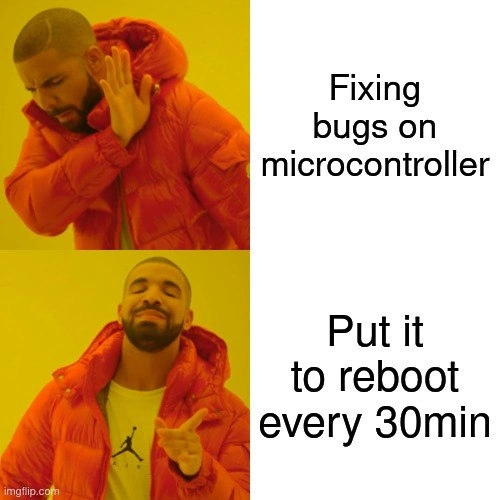
This meme captures a darkly humorous truth in embedded systems development: when faced with a nasty bug in a microcontroller’s firmware, harried engineers will sometimes choose a band-aid solution over a proper fix. In the top panel, Drake is rejecting “Fixing bugs on microcontroller,” which represents the ideal (but painful) path of painstaking debugging & troubleshooting. Tracking down an intermittent bug on a tiny MCU can be infamously difficult – you might have no operating system, no fancy debugger GUI, perhaps just an LED or serial console to log data. Imagine chasing a wild pointer or race condition that only manifests after 27 minutes of uptime; it’s the kind of debugging pain that can consume days and gallons of coffee. Now enter the bottom panel: Drake approves “Put it to reboot every 30min.” This is the all-too-common workaround in firmware projects under crunch: if you can’t find the bug, at least reset the system before it bites. Essentially, you configure a watchdog timer or a simple loop to force a restart every 1800 seconds, thereby flushing out whatever weird state was accumulating. It’s a classic form of technical debt – trading long-term reliability for short-term relief. The code might look like this in a real project:
// Pseudo-code: reboot system every 30 minutes to avoid hard faults
const uint32_t REBOOT_INTERVAL_MS = 30UL * 60UL * 1000UL; // 30 minutes
uint32_t startTime = millis();
void loop() {
// ... normal operation ...
if (millis() - startTime >= REBOOT_INTERVAL_MS) {
Serial.println("Oops, time to restart before things blow up!");
NVIC_SystemReset(); // Force a microcontroller reset (instead of real bug fix)
}
// Continue normal operation...
}
In this exaggerated snippet, instead of truly fixing the bug (like that pesky memory leak or logic error), the firmware just nopes out and reboots on a timer. The meme is funny because it’s relatable: many seasoned developers have seen something similar in real life. For example, an IoT sensor deployed in the field kept crashing overnight, so the team scheduled a 4 AM reboot via the watchdog – voila, no more overnight crashes (and no more midnight calls, at least until the next issue). Or think of home Wi-Fi routers that mysteriously need a restart every so often; some ISPs literally program nightly reboots to keep them “stable.” It’s Debugging_Troubleshooting meets duct tape: rather than fixing the bug (Drake hand up: “nah”), just restart the system periodically (Drake pointing: “yeah”). Every experienced engineer recognizes this as a technical debt ticking time-bomb. Sure, the device now appears stable (since it never runs long enough to fail), but the bug is still lurking in the code like a dormant volcano. Yet, we also smirk because we’ve been there: maybe the product demo is in two days, all other options exhausted, and somebody quips, “What if we just reboot it every so often?” – and to everyone’s surprise (and slight shame), it works. It’s the ultimate embedded software development shortcut – the kind born from exhaustion and tight deadlines – and the meme nails the contrast between the right way vs. the expedient way. In short, “reboot every 30min” is the cynical veteran move: a hack that trades real reliability for a semblance of stability, guaranteeing that any creeping bug gets periodically swept under the rug. It’s funny because it’s true: sometimes in firmware development, system stability via reboot is the unofficial game plan.
Level 4: Prophylactic Reboots
At the deepest technical layer, this meme hints at the software aging phenomenon and a brute-force remedy known as software rejuvenation. In long-running embedded systems, tiny issues like memory leaks, buffer overflows, or resource fragmentation can accumulate over time, leading to a firmware hard fault (the embedded equivalent of a fatal crash). Fully debugging these elusive issues on a bare-metal microcontroller is often as hard as solving the halting problem – the system’s state space is enormous and formal verification is impractical under tight deadlines. So engineers employ prophylactic reboots: a scheduled reset (often via a hardware watchdog timer) that periodically purges the system state before latent bugs can snowball into failure. This approach treats the symptoms, not the cause, but it leverages a fundamental concept from reliability engineering: by resetting to a known good state regularly, you avoid the long-tail of uncertain behavior. It’s a cynical inversion of high-availability design – instead of ensuring continuous uptime, you embrace downtime in controlled bursts. Surprisingly, this strategy can be mathematically justified in some cases: if the probability of failure increases with uptime (a non-memory-safe firmware might have a failure rate that rises the longer it runs), then restarting at fixed intervals can maximize overall availability by keeping the system in its fresh, low-error-rate state. In other words, we’re manipulating the system’s mean time to failure, effectively resetting the clock before the grim tortoise of undefined behavior catches up. It’s an engineering war story as old as embedded computing: when confronted with intractable debugging pain, sometimes the most pragmatic course is to burn it all down and boot anew on a schedule – a sacrificial offering to the gods of uptime. This meme takes that deeply technical compromise and presents it with a wink, acknowledging both the cleverness and the absurdity of trading real bug fixes for a timed watchdog reboot ritual.
Description
A two-panel Drake Hotline Bling meme on a yellow background. In the top left panel, Drake faces away with a hand raised in rejection; to the right, black text on a white background reads "Fixing bugs on microcontroller." In the bottom left panel, Drake points approvingly toward the camera; to the right, text reads "Put it to reboot every 30min." The meme humorously contrasts the tedious task of tracking down elusive embedded firmware defects with the quick-and-dirty workaround of scheduling a periodic restart, a classic embedded developer shortcut that trades real reliability for a watchdog-style reset. It highlights technical debt, debugging pain, and the all-too-common reliance on reboot loops in microcontroller projects

Comments
7Comment deleted
Rebrand the 30-minute watchdog reboot as an “edge-side rolling deploy,” and suddenly your panic loop qualifies as an HA feature on the SLA slide
The watchdog timer isn't a bug fix, it's a feature that ensures our memory leaks have a consistent 30-minute lifecycle in production
A watchdog reset every 30 minutes isn't a workaround, it's garbage collection for C - the heap gets reclaimed, just along with everything else
When your embedded system has a memory leak but the deadline was yesterday, suddenly that 30-minute watchdog timer isn't a hack - it's 'proactive system health management.' Ship it with a cron job and call it a feature. The real embedded systems engineer knows that sometimes the most reliable state machine is the one that starts fresh every half hour. Just don't tell the customer that 'high availability' means 'available again in 30 minutes.'
Embedded CAP theorem: pick Availability and Partition tolerance - reboot frequently to fake Consistency
In embedded, the watchdog timer is just C’s garbage collector - reboot every 30 minutes and call it self-healing
Couldn't reproduce the heap corruption; the watchdog can - every 30 minutes