Stack Overflow: The True Senior Developer
Why is this DevCommunities meme funny?
Level 1: Big Mess, Little Note
Imagine you walk into a room and see a huge mess – toys and stuff thrown everywhere, totally disorganized. On the door, there’s a tiny sticky note that says, “This room is messy.” You have to laugh a bit, right? Like, obviously it’s messy! And that little note isn’t helping you clean it up at all; it’s just stating the obvious. In this meme’s story, the code is that giant mess. It’s an old, super-complicated program with thousands of parts jumbled together. And the only hint left by the person who made the mess is basically “Yeah, it’s broken.” 🙃 Of course it turned out to be broken! It’s funny in the same way the messy room note is funny – someone created a gigantic problem and the only acknowledgment is a small, almost silly warning. It makes people laugh because it’s so absurd: the problem was huge and known, and yet that’s all the help or explanation anyone gave. It’s like if you got a puzzle with half the pieces wrong and the maker just wrote on the box, “There are mistakes in this puzzle.” You’d giggle at how ridiculous that is, even as you struggle to fix it. The humor comes from that contrast between the big mess and the little note saying “whoops!”
Level 2: Spaghetti Code Maze
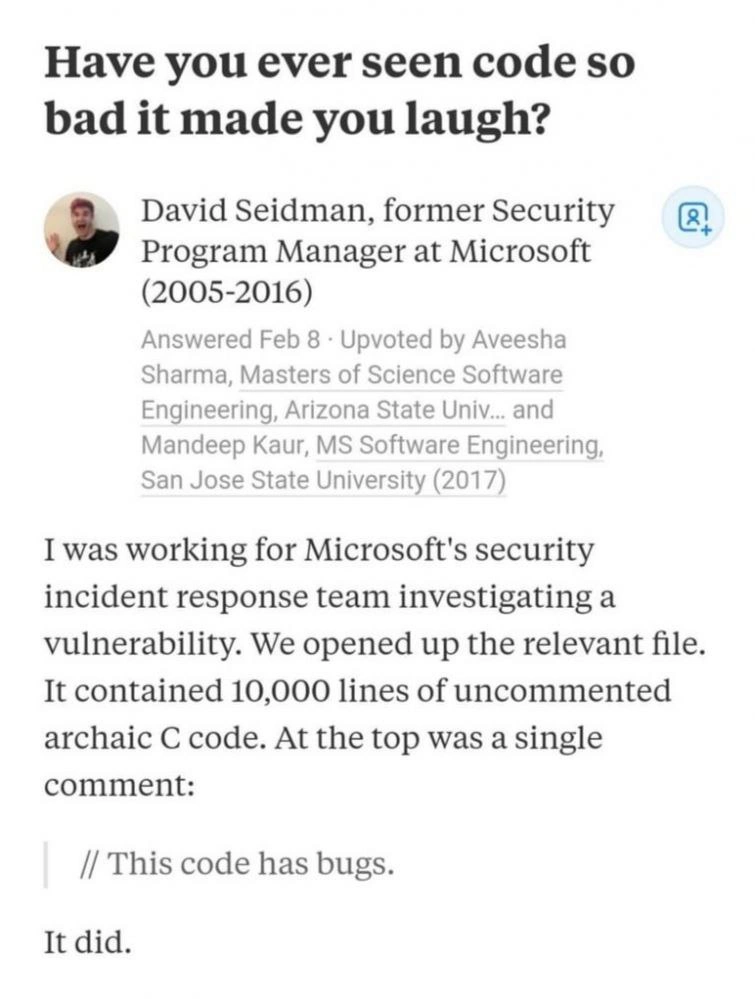
Let’s break this down in simpler terms. This meme is describing a legacy code scenario so extreme it’s laughable. Legacy code means old code that’s still in use — often written many years ago with outdated practices (think of it like an old machine that’s still running). In the story, a security engineer opened a file from such an old system and found it was huge: about 10,000 lines long. To put that in perspective, that’s like an entire novel’s worth of code in one place! Modern developers usually split code into smaller modules or files for clarity, but this was one gigantic chunk. And the shocker? It had basically no comments inside explaining how anything works.
Code comments are the little notes in source code (like // this part does X). They’re written in plain language to help humans understand the software. Good code usually has comments to clarify tricky logic or document why something is done. But in this 10k-line behemoth, there was exactly one comment at the very top, and it simply said: “This code has bugs.” 😅 That’s it. No further explanation, no guide, just a heads-up that “something’s wrong here.” It’s as if you opened a big puzzle box and the only hint on the first page was “pieces might be missing.” Not very reassuring, right? Developers found this funny because it’s an absurdly minimal code comment for such a massive, complicated file. It’s both a warning and a shrug. The original programmer essentially admitted “I know this is broken” and then went radio silent on the details.
Now, what do we mean by “bugs” in this context? In software, a bug is any error or flaw that makes the program behave incorrectly. It could be a calculation mistake, a crash, a security hole – anything that’s not supposed to happen. When that lone comment says “This code has bugs,” it’s warning that the program has known issues. And according to the story, it really did: they were investigating a security vulnerability, which is a serious kind of bug that bad guys can exploit. So the comment wasn’t kidding; the code was literally causing problems. This makes the situation even more ironic. The person inheriting the code (the poor engineer who has to fix it) is basically being greeted with “Welcome, there are mistakes here… somewhere.” Talk about a nightmare debugging scenario!
Why is this code so hard to work with? Two big reasons: its size and its messiness. Spaghetti code is a slang term we use to describe code that is tangled and complicated, like a bowl of spaghetti. In spaghetti code, the flow of the program twists and turns unpredictably. There might be lots of intertwined conditions (if/else), loops, maybe even goto statements jumping around – all woven together without clear structure. Imagine a maze where passages loop back and cross each other randomly. That’s what 10,000 lines of SpaghettiCode feels like. And here, there were no signposts (comments) inside that maze. So if something went wrong, a developer would have a terrible time figuring out where or why. They’d have to read and troubleshoot hundreds of lines just to understand a single part. No wonder the Quora answer said the code made him laugh – sometimes you have to laugh at the sheer absurdity of a task like that to stay sane.
This scenario is a perfect storm of bad CodeQuality and TechnicalDebt. Code quality refers to how well-written and maintainable the code is. High quality code is organized, clear, and (ideally) documented; low quality code is disorganized, confusing, and fragile. This one was firmly in the “low quality” camp. And then there’s technical debt: a term for when developers take shortcuts that save time in the short run but create bigger problems down the line (just like financial debt accumulates interest). At some point in the past, whoever wrote this code probably said, “We’ll fix it later, just ship it now.” That “later” never came, so the messy code accumulated bugs in software like a dust-covered attic accumulates cobwebs. By the time our engineer opened it, it was a full-on haunted house of issues. The single comment “this code has bugs” is basically an acknowledgement of a code smell – an obvious sign that there’s deeper trouble in the code. It’s like a funky smell coming from your car engine: you know something’s off even if you haven’t looked inside. Here the smell was so strong (so to speak) that the coder literally labeled it for anyone who followed.
For a newer developer (or anyone, really), stumbling onto a file like this would be overwhelming. Picture being asked to fix a program and being handed a mega file with no documentation except a note that it’s known to be broken. You’d feel lost at sea. Debugging such a system means painstakingly reading through the code, trying to understand what each part is supposed to do, and guessing where it might be going wrong. It’s slow, difficult work, like detective work without any clues. In well-kept code, you’d have unit tests, comments, maybe a design document – something to help you troubleshoot. Here you have zilch. So when developers see this meme, they laugh in sympathy. It’s an exaggeration of real situations we sometimes face: maybe not 10,000 lines and one comment, but certainly messy, under-documented code that someone else left behind. It’s a cautionary tale too. The lesson is, don’t be that coder! Don’t leave a gigantic mess for the next person with only a cheeky “oops” note. Write helpful comments, break your code into smaller pieces, and fix known bugs properly, not with a "// TODO: fix later" and a prayer. Otherwise, one day a future engineer might screenshot your code and share it as an example of “so bad it’s funny” – just like this.
Level 3: Here Be Dragon Bugs
This meme shares a war story that every seasoned engineer can grimly chuckle at. A Microsoft security engineer recalls digging into a critical system during an incident response (hunting a vulnerability), only to find a 10,000-line file of uncommented, archaic C code. At the very top, the original developer had left exactly one comment:
// This code has bugs
…and absolutely nothing else in the way of documentation. Talk about a red flag! That lone comment basically screamed “Abandon hope all ye who enter here.” It’s the programming equivalent of a medieval map marking uncharted territory with “Here be dragons.” In this case, the dragons are countless bugs lurking in a spaghetti code jungle. The Quora Q&A format asks if you’ve seen code so bad it made you laugh – and oh boy, did this deliver. The answer’s punchline, a deadpan "It did," confirms what every developer suspects: this monstrosity was indeed crawling with errors. 🐛
Why is this funny (in a painful way) to experienced devs? Because it encapsulates the ultimate CodeQuality nightmare. Normally, code comments exist to guide you through logic, clarify intent, or warn about tricky portions. Here, the only comment simply admits the entire thing is broken. It’s a mix of honesty and despair – a dark DeveloperHumor gem. The original programmer knew the code was a hot mess and basically waved a tiny white flag in that comment. It’s like they’re whispering from the past, “Yeah... good luck with this, you’ll need it.” Meanwhile, those 10k lines of LegacyCode are staring back at you with no further hints. It’s hilarious in the way that you either laugh or cry when facing something so absurdly unmaintainable. Veteran engineers have been there, confronting a giant hairball of a codebase with maybe a snarky comment or two left behind, so this RelatableDeveloperExperience hits home.
Let’s talk about those 10,000 lines of archaic C. In a well-structured system, you’d never pack that much logic into a single file without any explanation. This “big ball of mud” design (a famous term for sloppy, entangled architecture) is a breeding ground for BugsInSoftware. C is a powerful low-level language, but with great power comes great responsibility – you manage memory manually, use pointers, and one wrong pointer arithmetic or unchecked buffer can spawn a nasty vulnerability. In such archaic_c_code, you often find things like cryptic macros, global variables all over, and functions hundreds of lines long doing way too much. Reading it feels like navigating a labyrinth. Without comments, you have zero signposts. Imagine trying to decipher why a piece of code is subtracting 1 from a pointer here, or why there’s an obscure goto jumping there, with no remarks – it’s DebuggingFrustration at its peak. Every veteran dev knows the dread: if the code’s author couldn’t even be bothered to leave a clue beyond “this is buggy,” there’s a high chance you’re stepping into a minefield. 💣
From a senior perspective, that lone comment is both comically underwhelming and terrifyingly honest. It’s underwhelming because it states the obvious – of course a 10k-line undocumented C file “has bugs.” It’s terrifyingly honest because it implies the author was aware of deep problems but shipped it anyway. This scenario is a textbook example of TechnicalDebt run amok. Over years (or decades), quick fixes and kludges piled up into a teetering Jenga tower of code. Maybe deadlines were tight, or that code was inherited from some 90s-era system and nobody dared to refactor it. The result? A “live” system full of CodeSmells (like giant functions, no comments, magic numbers, you name it) that everyone treated with a “do not disturb” policy. That is, until something exploded and the security team had to dive in. Only then do you uncover this time capsule of bad practices, complete with a cynical warning at the top. It’s funny in hindsight because it’s so outrageous, but it’s also an indictment of how software entropy and neglect can turn any program into a bug-infested swamp.
Every experienced developer reading this can practically hear the sarcastic voice of that comment. It’s the kind of grim insider humor you acquire after surviving many 3 AM outages and futile hunts through legacy systems. We laugh because we’ve seen SpaghettiCode that bad (or worse) and sometimes humor is the only coping mechanism. That single comment “// This code has bugs” is both a facepalm and a wink. It’s as if the original dev is saying, “Yup, I know this is garbage. No, I didn’t fix it. Tag, you’re it.” In a code review or post-mortem, this would be legend. You’d better believe it made those Microsoft engineers laugh – a kind of you’ve got to be kidding me laugh. It’s a shared understanding that in our industry, truth is often stranger (and funnier) than fiction. After all, when you encounter a Debugging_Troubleshooting scenario this outrageous, sometimes all you can do is meme it and share the catharsis.
Description
This meme likely pays homage to Stack Overflow as the ultimate source of knowledge for developers. It might use a format like the 'Expanding Brain' meme, where the final, most enlightened stage is 'Copying and pasting from Stack Overflow without understanding it.' Or, it could be a 'Two Buttons' meme, with the choices being 'Spending hours debugging' and 'Finding the answer on Stack Overflow in 5 minutes.' The humor comes from the universal reliance on Stack Overflow, even among senior developers, and the self-deprecating acknowledgment that a lot of modern software development is built on the collective knowledge of the community

Comments
7Comment deleted
I'm not saying I'd be lost without Stack Overflow, but my career would be a series of frantic 'git reset --hard' commands
Achieved 100% documentation coverage: that one comment doubles as the requirements, threat model, and the post-incident RCA
That comment is the software equivalent of a surgeon leaving a note saying "patient may experience complications" before retiring to the Bahamas
When your entire security posture depends on a 10,000-line C file whose only documentation is a comment that reads '// This code has bugs,' you've achieved what enterprise architects call 'honest documentation.' It's the software equivalent of a warning label that just says 'Danger: Product' - technically accurate, maximally unhelpful, and somehow more terrifying in its brevity than any detailed threat model could ever be
The only comment in a legacy codebase guaranteed to stay accurate forever: '//This code has bugs.' No regressions there
10k LOC of uncommented C and a lone // This code has bugs - finally, a codebase with an accurate threat model and complete documentation in one line
10k lines of legacy C and one comment: // This code has bugs - the only SAST report that’s ever been 100% accurate