Skip to content
DevMeme
1374 of 7435
Elon Musk's Child's Name: A Pointer Problem
CS Fundamentals Post #1546, on May 8, 2020 in TG

Elon Musk's Child's Name: A Pointer Problem

Why is this CS Fundamentals meme funny?

Level 1: Map vs Treasure

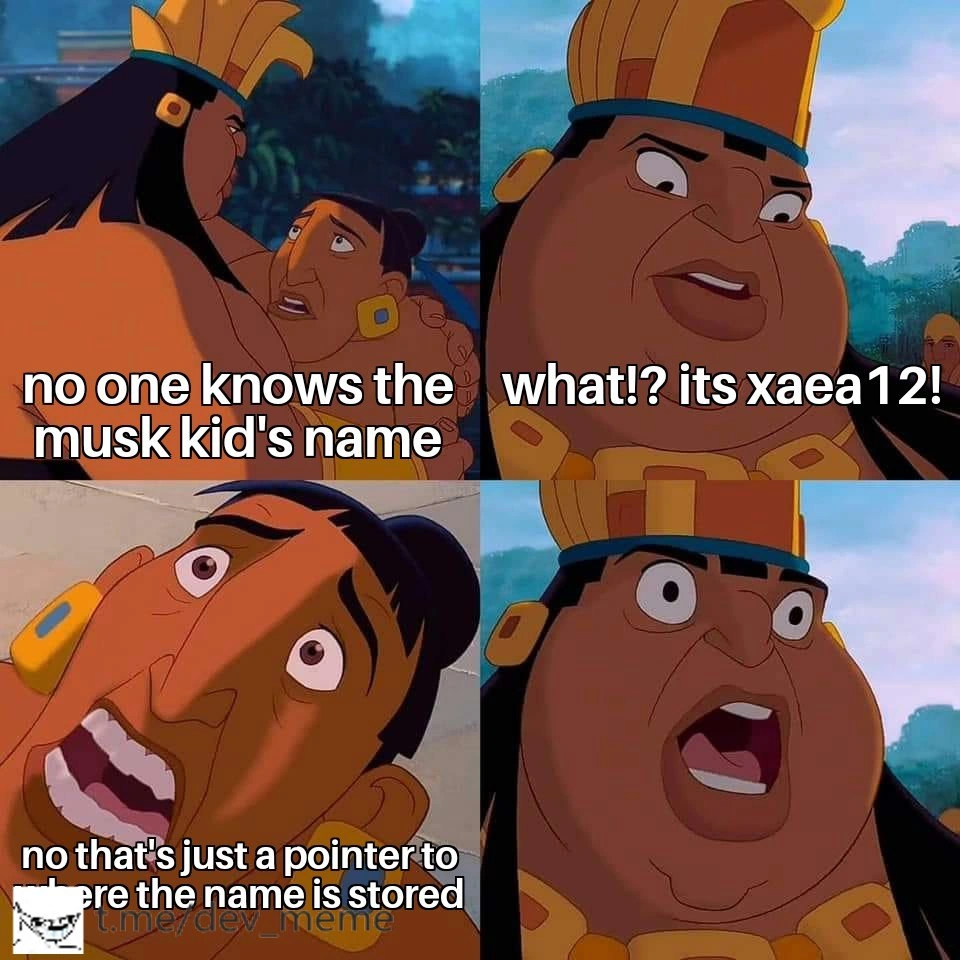
Imagine you ask your friend, "What did Elon Musk name his baby?" and your friend gives you a strange answer like "XAEA12." That sounds like a secret code, right? In this meme, one cartoon character is saying the baby’s name is “XAEA12” and the other character realizes that’s not a name at all – it’s more like a clue. It’s as if instead of telling you the baby’s real name, they gave you a treasure map with an X on it. The joke is that “XAEA12” is being treated like a map that points to the real name, rather than the actual name itself.

Think of it this way: a pointer is like a house address, and the actual name is the person living in that house. If someone asks for the baby’s name and you give them an address, that’s pretty confusing! They’d be like, “Wait, what? I need to go to this address to find out the name?” In normal life, we expect a name to be something like "Alice" or "Bob," not a mysterious code. So the meme is funny because one character is basically saying, “No, no, that crazy string of letters and numbers isn’t their real name. It’s just the address where the name is stored!” The other character’s eyes go wide in shock because who on earth gives out an address instead of a name?

In super simple terms, it’s like if you asked me my name and I handed you a slip of paper that said "locker #42 at the library." You’d have to go to that locker, open it, and maybe inside you find a paper that says “Charlie.” Giving the locker number instead of just saying “Charlie” is a silly extra step. That’s what the meme is joking about. It’s funny and absurd because we don’t usually treat names like that. The big character in the meme looks horrified and surprised at the end – just like you’d be if you realized you were only given a code and still don’t know the baby’s real name! The humor comes from the surprise and the silliness of treating a name as if it were hidden behind a secret code or pointer. It’s a way to laugh about how complicated things can get when you swap something simple (like a name) with something complex (like a technical reference).

Level 2: Pointer vs Value

Let’s break down the joke in simpler terms. In programming, especially in languages like C or C++, a pointer is essentially a variable that holds a memory address – think of it as a reference or a link to where some data lives in the computer’s memory. The actual data (say, a name or a number) is stored at that memory location, and the pointer "points" to it. The trick is that the pointer itself is not the data; it's more like a signpost telling you where the data is. To get the actual data, a programmer must dereference the pointer (follow the pointer to the memory address and retrieve what's there). If you don't dereference and instead treat the pointer like the data, you end up with either gibberish or an irrelevant number (the address).

Now, Elon Musk’s child’s name X Æ A-12 is quite unusual — it doesn’t sound like a typical first name at all. When the meme says “no that’s just a pointer to where the name is stored,” it’s humorously suggesting that this string “XÆA12” isn’t the real name but just an address or code that leads to the real name. In other words, the meme pretends that Elon gave his baby an address instead of a name, and you’d have to go look up that address to find the actual name. This taps into the concept of indirection (one thing pointing to another) that programmers learn early on. It’s like when a variable doesn’t hold a value directly but points to another variable that holds the value.

To a newer developer or someone learning programming, here’s an example in plainer terms: imagine you have a box (memory address) and inside that box is a piece of paper with the baby’s actual name (value) written on it. Instead of telling people the name on the paper, you tell them the box number “X Æ A-12.” That string looks confusing and not at all like a name; it’s more like an ID or code. In the meme, one character hears “XAEA12” and is bewildered – it doesn’t compute as a name to them. The other character (presumably a programmer type) clarifies that “XAEA12” is just a location (a pointer) where you’d find the real name. Their explanation is technical: they’re treating the weird name as if it were a pointer in a program. The humor comes from this mismatch – normal people think of a name as the actual thing you call someone, but the developer mindset sees “X Æ A-12” and goes, “This must be a reference to something else!”

Let’s connect this to some basic CS_Fundamentals you might encounter as a junior developer or computer science student:

  • Pointer: A special type of variable that holds the address of data instead of the data itself. In C, you declare a pointer using the * symbol (e.g., int *ptr; means ptr will hold the address of an integer). You then assign it the address of a variable (e.g., ptr = &someInteger;).
  • Value vs Address: If you have a pointer ptr that points to a value, ptr (by itself) represents the address (like 0x1000). *ptr (with an asterisk to dereference) represents the actual value at that address. Forgetting to put that * when needed can mean you’re working with an address when you meant to use the value.
  • Dereferencing: The act of going from the pointer to the actual value. In code, if ptr is a pointer, *ptr gives you the thing it points to. If you don’t do this, you never actually get the real data.
  • Manual Memory Management: In languages like C, you manage memory manually — you decide when to allocate memory (using functions like malloc) and free it (with free). Pointers are part and parcel of this because they store addresses returned by malloc, etc. It’s powerful but also one of the sources of many bugs like memory leaks or crashes if mishandled.
  • Pointer Arithmetic: An interesting aspect of pointers is that you can perform arithmetic on them. For example, if ptr points to the first element of an array, ptr + 1 points to the second element (it jumps by the size of one element). In the context of the joke, the string “A-12” humorously looks like an arithmetic expression (A - 12). Some developers jokingly read "X Æ A-12" as if it were code: maybe a variable X, some symbol Æ (which isn't actually an operator, but looks wild), and A-12 which reads like "A minus 12". It’s not literally valid code, but our nerd brains can’t help but try to parse it. That’s why the meme’s explanation about a pointer hits home — it’s playing off how programmers instinctively interpret strange strings as something technical.

Another layer here is the classic saying in development that "naming things is hard." In fact, there’s a well-known humorous quote: “There are only two hard things in Computer Science: cache invalidation and naming things.” When something as human as a baby’s name starts to look like a complex computer identifier, it’s like that joke coming to life. NamingThings in programming refers to how developers struggle to pick clear, descriptive names for variables, functions, etc. It’s oddly appropriate here: Elon Musk’s baby name became a huge talking point because it was so out there. Engineers seized the opportunity to treat it as if it were a badly chosen variable name or a memory pointer. The meme encapsulates that by having the character say effectively, “Oh, XAEA12? That’s not a name, it’s just a reference to the name’s location.” This is the kind of DeveloperHumor that makes programmers laugh and non-programmers scratch their heads. It’s not laughing at the baby or the family, but laughing at how our technical brains reinterpret something unusual in our own terms.

For a junior dev or someone without a background in C, what you need to know is that pointers are a fundamental concept that can be tricky at first. Many newcomers accidentally use pointers incorrectly. For instance, printing a pointer’s value (address) when they meant to print the actual string is a common mistake. The output might be a bizarre number (like 42110816) or a hexadecimal like 0x2a5b7c90 instead of “John Doe.” When the meme character confidently asserts the baby’s name is a pointer, it’s referencing exactly that kind of scenario – as if someone printed a pointer variable and read out the nonsense address thinking it was the name. The other character corrects them as a senior would guide a junior: "No, you have to follow that pointer to get the real value!" The wide-eyed shock in the last panel is relatable to any beginner who’s had that revelation: “Oh! The pointer isn’t the actual data!”

Lastly, it helps to know that this meme came out when Elon Musk’s child’s name was a hot topic. It’s a PopCultureReference woven into a tech joke. Even if you don't get all the pointer talk at first, the idea of “that’s just a pointer to the name” is comical because it implies the real name is hidden or indirect. It’s like saying, “We gave the baby a code name, and you’ll have to decode it to find the actual name.” For a junior developer, this meme is a light introduction to how experienced programmers see the world: everything is abstractions and references. Even a baby name can be fodder for discussing how data is stored and referenced in memory! So, the next time you see a weird name or string of characters, remember this meme and ask: is that the value, or just a pointer to something else? 😄

Level 3: Another Level of Indirection

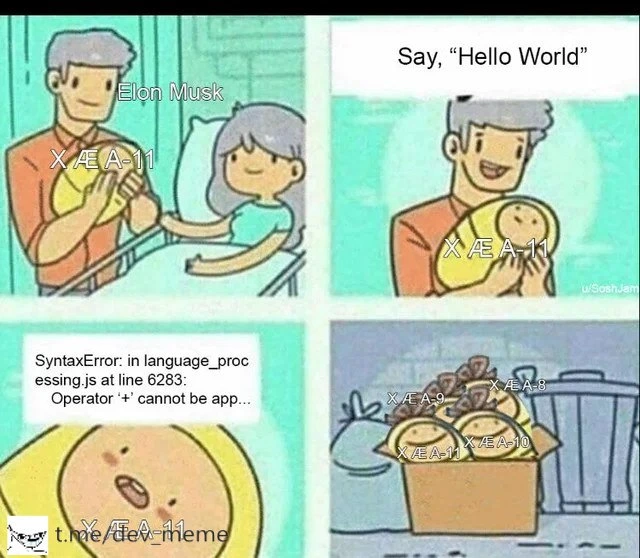
This meme brilliantly combines low-level programming humor with pop culture. It references Elon Musk and Grimes's famously cryptic baby name X Æ A-12 (often written as "XAEA12" in text form). Seasoned developers immediately recognize that this "name" looks more like code or a memory reference than a typical name. The four-panel format (using characters from The Road to El Dorado) sets up a punchline about pointers, a core concept in CS_Fundamentals. One character is shocked to hear the name "XAEA12," and the other explains with deadpan logic, "No, that's just a pointer to where the name is stored." This joke lands because it treats the strange name as an indirection – a classic idea in computing where you don't have the thing itself, but rather a reference to it.

In programming (especially in C/C++ and other LowLevelProgramming languages), a pointer is a variable that holds a memory address, essentially pointing to the location where some data (a value) is stored. Here the meme implies that "X Æ A-12" isn't the actual value (the real name); it's just an address that points to the real name hiding somewhere in memory. This is hilariously meta for developers, because Elon’s choice of name unintentionally reads like a technical NamingThings gag. We have a running joke in development that there are only two truly hard problems: cache invalidation and naming things (and some add off-by-one errors as a tongue-in-cheek third). Giving a child a name like X Æ A-12 feels like a programmer took that naming challenge literally and threw in some PointerArithmetic for good measure! It’s as if the parents defined a constant or memory location instead of a name. Many devs joked at the time that "X Æ A-12" resembled a Wi-Fi password, a variable from code, or indeed a pointer—something only manual memory management geeks would come up with.

On a technical level, the humor also plays on the confusion between a pointer and the data it references. In C, for example, if you have a char* (pointer to a sequence of characters) and you print it incorrectly, you might just print a memory address (like 0x7ffeefbff5c0) instead of the actual string. The meme’s punchline essentially says: “You thought that weird string was the actual name? Nah, it’s just the memory address – you haven’t seen the real name yet!” This is funny to developers because of how often beginners (and even seasoned programmers under pressure) mix up pointers and values. It’s a classic mistake: treat the pointer like the data and you’ll get gibberish or a crash. The big character’s bulging eyes in the final panel mirror a programmer’s shock when they realize they were reading an address, not the actual value. It’s the “you forgot to dereference the pointer” face.

To illustrate, consider how a C programmer might handle a name:

char *namePtr = "XAEA12";   // pointer to a string literal in memory (like Musk's baby's "X Æ A-12")
printf("Pointer: %p\n", namePtr);  // prints something like 0x556a32f1 (an address in memory)
printf("Value: %s\n", namePtr);    // prints "XAEA12" (the actual name string)

In the code above, namePtr holds the address of the text "XAEA12". Printing with %p (pointer format) shows the raw address (a seemingly random hex number). Printing with %s (string format) dereferences the pointer to display the actual name. The meme joke imagines that X Æ A-12 is like seeing the %p output instead of the %s output – we got the pointer, not the pointed-to value! That’s why the one character corrects the other: what they thought was the name is actually an address for the name. This resonates with developers who deal with pointers and memory. It’s a clever way of saying the name is so unconventional that it doesn’t even feel like a name – it feels like an address in memory where the real name must be stored.

Beyond the specific Elon Musk reference, this meme taps into the broader humor of DeveloperHumor. It mixes a trending PopCultureReference with hardcore PointersInC nerdiness. The child’s name was the talk of the internet for being unusual, and programmers couldn’t help but interpret it through a computer-science lens. It’s a lighthearted reminder that to a coder, everything can look like a snippet of code or a computer joke. When faced with something like “X Æ A-12,” our engineering brains involuntarily attempt to parse it: Is that an array? A constant? Some crazy pointer math (maybe A - 12)? 🤔 The meme exaggerates this instinct to hilarious effect. The phrase “just a pointer to where the name is stored” also echoes the idea of indirection in computing: the notion that you can solve problems by adding a layer of reference (as the famous saying goes, "All problems in computer science can be solved by another level of indirection", albeit often said tongue-in-cheek). Here, that extra layer of indirection is the baby name itself acting as a reference. And of course, the more indirection, the more confusion – hence the bewilderment and shock on the characters’ faces.

In summary, at the senior-dev level this meme is chuckle-worthy because it’s a perfect storm of tech in-joke and real-world absurdity. It satirizes how hard naming things can be by showing a name so bizarre that it might as well be a memory address. It also riffs on the crucial difference between a pointer and its value, a concept that causes real bugs and late-night “aha!” moments in debugging sessions. Any programmer who has accidentally used a pointer incorrectly (like printing or using the wrong variable) can relate to that sudden realization – just as the character in the meme does. And since many of us in tech followed the news of Musk’s baby name with fascination and humor, this meme delivers an instant payoff: we get it. It’s a pop culture moment reinterpreted through a geeky lens, and the result is both educational (if you think about it) and ridiculously funny.

Description

A four-panel meme using the 'Chief Tannabok's Reaction' format from the animated film 'The Road to El Dorado'. In the first panel, a character states, 'no one knows the musk kid's name'. In the second panel, the chief reacts with confusion, saying 'what!? its xaea12!'. In the third panel, the first character explains, 'no that's just a pointer to where the name is stored'. The final panel shows the chief with a look of complete shock and astonishment. The humor is derived from applying a core computer science concept - pointers (variables that store memory addresses) - to the real-world absurdity of Elon Musk's child's name. The joke suggests that 'X Æ A-12' is not the actual name, but merely the memory location where the true, and perhaps even more complex, name resides. This resonates with developers familiar with languages like C or C++ where direct memory manipulation is common. A watermark for 't.me/dev_meme' is visible in the bottom left
Comments

7
Anonymous ★ Top Pick The real problem isn't dereferencing the pointer to get the name, it's that the memory is probably managed by Tesla's autopilot team, so you risk a segfault every time
  1. Anonymous ★ Top Pick

    The real problem isn't dereferencing the pointer to get the name, it's that the memory is probably managed by Tesla's autopilot team, so you risk a segfault every time

  2. Anonymous

    X Æ A-12 isn’t the kid’s name - it’s the char*, and every reporter trying to pronounce it is basically dereferencing uninitialized memory

  3. Anonymous

    Wait until someone tries to dereference it and gets a segfault because Elon forgot to malloc space for the actual name

  4. Anonymous

    This perfectly captures the eternal struggle of explaining pointers to anyone: 'No, the variable name isn't the data - it's just a symbolic reference to a memory location where the actual value lives.' It's like telling someone their house number isn't their house, it's just how the postal service finds where they actually live. And just like Elon's naming choices, sometimes the abstraction layer between identifier and implementation is... unconventional. At least with pointers, we have the decency to use `*` for dereferencing instead of making the compiler parse Æ

  5. Anonymous

    Forget baby name books - Musk consulted K&R: char *kid = "X Æ A-12"; good luck dereferencing that at family gatherings

  6. Anonymous

    xaea12 isn't the name; it's a pointer - dereference at the registrar and pray it isn't NULL

  7. Anonymous

    X Æ A-12 isn’t the name, it’s a char* - remember to dereference with const and bounds-check or you’ll segfault the family tree

Use J and K for navigation