The Interplanetary Expansion of curl to Mars
Why is this Tooling meme funny?
Level 1: Toys on Two Planets
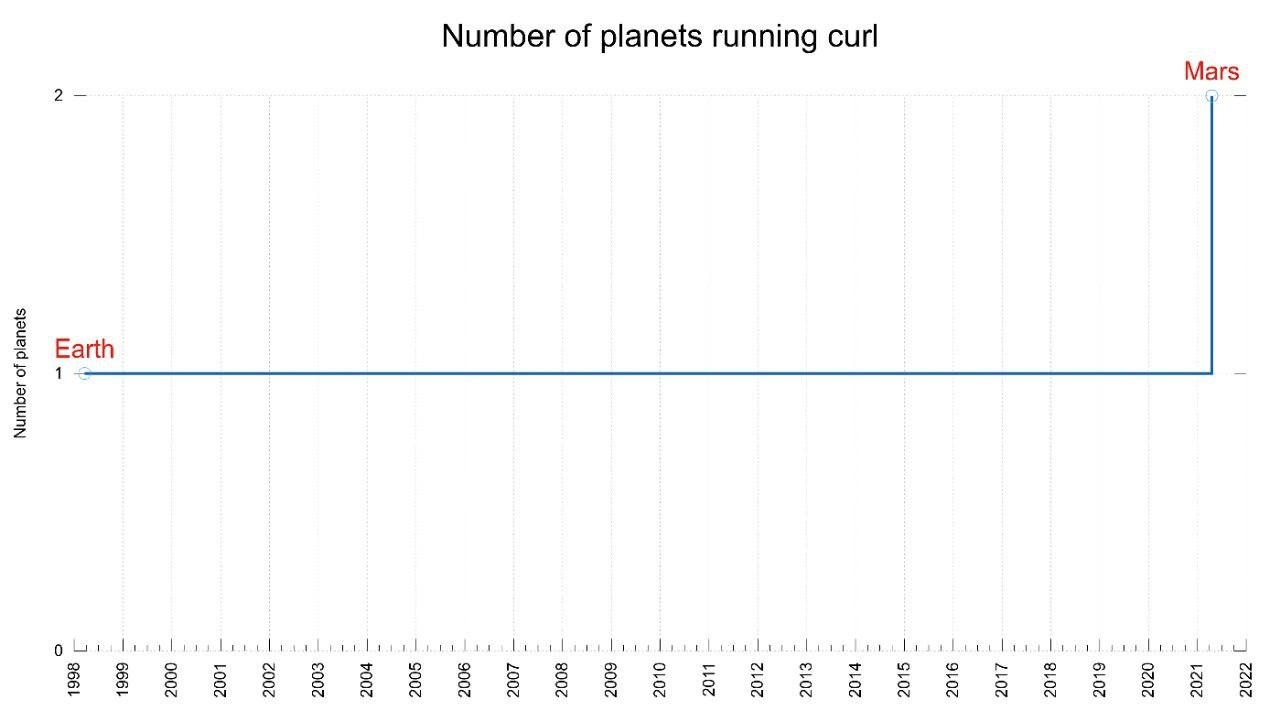
Imagine you have a favorite little gadget or toy that only people on Earth have been playing with for a long, long time. Now suddenly, astronauts (or robots!) bring that toy all the way to Mars, and they start using it there too. This funny chart is showing exactly that kind of situation. For years, the line on the graph stayed at just 1 planet — meaning only Earth had the toy. Then, when Mars got it, the line jumps up to 2 planets. It’s a way of saying, “Wow, now our toy is being used on another planet!” That idea is both amazing and silly, which is why it’s funny. We usually talk about how many people use something, not how many planets use something, right? So treating “Mars” like just another user is a goofy exaggeration. It’s like saying your favorite game was being played in one playground (Earth) and now it’s being played in a second playground far, far away (Mars). The humor comes from mixing a normal everyday thing (a tool we use on computers) with an extraordinary scenario (taking that tool to a different world). It makes us smile because it shows something very ordinary achieving something really extraordinary — almost like a beloved toy that hitched a ride on a rocket and is now enjoyed on another planet!
Level 2: Mars Rover’s Toolbox
Let’s break down the joke in simpler terms. The meme shows a very basic line chart labeled “Number of planets running curl.” The X-axis is time (years 1998 to 2022) and the Y-axis is the count of planets. For every year from 1998 up through 2021, the chart is flat at 1 planet. There’s a note in red text by that flat line saying “Earth.” Then at 2022, the blue line jumps up to 2 planets and there’s a red label “Mars” at the new point. The humor here revolves around a command-line tool called curl and the idea that it’s now being used on two planets: Earth (which of course has all our computers) and Mars (where we’ve sent rovers with computers).
First, what is curl? curl (pronounced like “curl” as in curling a ribbon) is a popular command-line tool used by developers to transfer data using URLs. In plainer words, it’s a program you run in a text-based terminal (CLI, or Command Line Interface) to fetch information from the internet or send data. For example, if you type a command like:
$ curl https://example.com
and press enter, your computer will reach out to example.com and retrieve the webpage data, then print the HTML content in your terminal. Developers use curl all the time for things like testing APIs (web services), downloading files, or checking if a website is responding. It’s a tiny but powerful tool in virtually every programmer’s toolbox, available on almost every operating system. You type commands into a terminal window, and curl will perform the network request for you — kind of like a browser without the graphics, just the underlying data transfer.
Now, why does the chart talk about planets? Well, until recently, all the computers running tools like curl were on Earth, naturally. The number of planets that had curl was just one (Earth itself). The meme uses the format of an adoption metric or growth chart, but instead of “number of users” or “number of downloads,” it humorously uses “number of planets.” It stays at 1 for a long time because from 1998 (around when curl was first released) up to 2021, only Earth had humans and computers using curl. In 2021/2022, something noteworthy happened: we effectively brought Earth’s software to Mars. NASA landed the Perseverance rover on Mars in 2021, and along with it the Ingenuity helicopter drone. What’s special is that these machines run software that included a lot of familiar open-source tools. In fact, the little helicopter Ingenuity ran on a Linux-based system — that’s the same kind of operating system many servers and developers’ computers on Earth use. With a Linux computer on Mars, it’s very likely that standard utilities (like curl and other cli_utilities) could be present or at least could be run there. NASA engineers could use them for sending or receiving data internally. So essentially, Mars now has a computer that can do the sorts of things our Earth computers do, potentially including running curl to make network requests (even if such requests on Mars are mostly to talk to the rover or orbiter and not directly the global internet).
The chart’s big jump to “2 planets” in 2022 is a jokey way of saying “Hey, our favorite command-line tool is now being used on two worlds!” This is a crossover of space exploration and developer culture. It’s both a factual reference and a funny exaggeration. The factual part is that yes, we really did operate a system on Mars running Earth-style software (there was even a lot of buzz in the tech community about the first Mars rover running Linux and leveraging open source code). The exaggerated, funny part is presenting that as if curl has a “user base” metric measured in planets. No tech company actually charts “number of planets using our product” — at least not seriously — so it’s a silly, playful metric. It pokes fun at how tech folks love metrics like active users, market penetration, etc., by going one step beyond global: interplanetary.
For a newer developer or someone not deeply into space or command lines, here’s the context: CLI tools like curl are very common in programming and IT. They run in a text-only interface (think old-school looking black screen with text, where you type commands). These tools are valued for being lightweight and scriptable. curl in particular has been around for ages (since the late 90s) and is known for being super reliable and present on most systems. It’s so common that when something new happens — like a computer on Mars — techies joke that of course curl (being everywhere) would be there too. The meme falls under TerminalHumor or DeveloperHumor because you kind of need to know what a terminal and curl are to get the joke fully. It’s also tagged TechHistory since it references curl’s long history (over two decades of use) and a historic event (code running on Mars).
In simpler terms: This meme is celebrating that a piece of software many developers use every day has now, in a way, “spread” to another planet. It’s like a brag and a laugh at the same time. No one actually went and “sold” curl to Martians; rather, humans took our existing tech and used it in a Mars mission. The red labels “Earth” and “Mars” on the graph hammer home which two planets we’re talking about. Earth was the original place where curl lived. Mars is the new addition in 2022. The straight blue line from 1998 to 2021 next to Earth just shows nothing changed in that regard for a long time (only Earth had it). The spike up to Mars at 2022 is the funny “big news” moment in the graph. It’s drawn in a dry, data-science way, which makes it even funnier because it treats a joke like serious data.
The meme resonates with developers because it combines a bit of nerdy pride (open-source tools going interplanetary!) with the absurdity of measuring software popularity by planet. If you’ve ever used the terminal or run curl to test something, you might chuckle that somewhere, about 140 million miles away, a robot might be doing something similar. And if you haven’t used curl before, now you know: it’s a simple tool with out-of-this-world reach!
Level 3: A CLI Odyssey
The meme captures a moment in tech history where a trusty old command-line tool achieved ultimate ubiquity: it’s now on more than one planet. For seasoned developers, this line chart is a witty tribute to curl, the venerable “URL transfer” utility that’s been a staple of the CLI (command-line interface) toolkit since 1998. The graph’s title, “Number of planets running curl,” and its deadpan flat line from 1998 to 2021 labeled Earth, set us up for a classic punchline: a sudden jump to Mars in 2022. It’s a sly reference to the fact that NASA’s recent Mars missions (like the 2021 Perseverance rover and its sidekick, the Ingenuity helicopter) carried modern computing tech — even a Linux-based system — to the Red Planet. In other words, software we use every day on Earth, potentially including curl, hitched a ride to Mars. The community around developer humor seized on this as a milestone: our CLI tools are now interplanetary.
Why is this so humorous to those in the know? First, it’s a satire of adoption metrics and tech hype. We’re used to startups bragging about user growth charts or apps expanding to new regions, but “market penetration” usually stops at continents, not planets. Here we have a tongue-in-cheek metric that stayed comically stagnant at 1 planet for decades (because, of course, all our computers are on Earth), only to double to 2 with the Mars mission. That jump to “2 planets” is absurdly dramatic and trivial at the same time — it’s literally just one extra planet, but what an extra planet it is! The graph treats Mars as if it were just another new market, giving us an astronomical take on the phrase “going global” (more like going interplanetary). This line_chart_meme format — a flat line and a sudden spike — is a familiar comedy setup in developer circles, often used to exaggerate a sudden change in an otherwise quiet trend. In this case, the trend is the spread of a command-line tool beyond Earth, a scenario nobody had on their bingo card until recently.
For veteran devs, there’s also a layer of pride and inside joke in seeing curl specifically as the star here. curl is known for being everywhere: it’s bundled in countless apps, used in every corner of the world, embedded in TVs and cars, part of API testing, build scripts, you name it. It’s the quintessential commandLineTools utility that you find pre-installed on Linux, Mac, and even Windows these days. We often joke that “if it runs an OS, it probably has curl.” So naturally, when news hit that NASA used open source software on Mars (yes, even something as unglamorous as a CLI utility), devs gleefully extended that joke to planets. It’s as if our informal guarantee — “it runs everywhere” — suddenly needed an update: everywhere now includes a whole new world. In a field where frameworks and languages can rise and fall in a few years, seeing a 24-year-old tool still not just alive but literally on Mars is both hilarious and genuinely satisfying. It’s like the tech equivalent of an old friend from high school unexpectedly becoming an astronaut — you can’t help but cheer and chuckle.
The senior perspective here also nods to the sheer reliability and simplicity of something like curl. Space is unforgiving: if software crashes on Mars, you can’t just hop over and fix it. So the fact that NASA’s engineers were comfortable bringing familiar tools is a quiet compliment to their robustness. It reminds experienced devs of the paradox of software longevity: sometimes the least flashy, most basic tools survive and conquer scenarios that cutting-edge tech can’t. We’ve seen tech fads come and go since 1998, but curl soldiered on through the Dot-com bust, Web 2.0, the rise of mobile, cloud computing, and now cross_planet_deployment. That blue line on the chart is flat for so long because curl was already ubiquitous on Earth for decades — it didn’t need to grow, it was already everywhere. The punchline is that only something truly universal (or stubbornly indispensable) could achieve multi-planet support. It’s both a ridiculous exaggeration and a subtle truth: in the lore of developer humor, “works on my machine” has evolved to “works on my planet,” and with curl we’ve broken even that barrier.
And of course, one can’t ignore the meme’s playful homage to space history. The annotation “Mars” in 2022 feels like a cheeky one small step for [a] CLI, one giant leap for CLI-kind. It evokes the grandiosity of space exploration in a context as mundane as a networking tool. We’re essentially patting ourselves on the back as a tech community for reaching a new frontier in the nerdiest way possible. It’s the ultimate crossover of TerminalHumor and astronaut coolness: Neil Armstrong’s giant leap, meet Daniel Stenberg’s (creator of curl) little command. For a senior engineer who’s seen technology evolve, this graph hits all the right notes — it’s historically aware, absurdly grand, and celebrates the unassuming tools that quietly make history. After all, today’s developer humor might just be tomorrow’s trivia: “Did you know one of the first things a Mars rover’s Linux system could do was run curl?” Now that’s a pub story for the ages.
Level 4: Interplanetary Networking Realities
On a cosmic network scale, running curl on Mars isn’t as simple as typing a URL in a terminal. When Earth’s favorite command-line HTTP client goes extraterrestrial, it bumps against the unforgiving laws of physics. The speed of light becomes a very real network latency limit — signals between Earth and Mars take minutes (anywhere from ~3 to 22 minutes one-way, depending on orbit). A traditional curl HTTP request, which on Earth enjoys milliseconds of round-trip latency, would time out long before an ACK if used naively across planets. In practice, to make something like curl work off-world, engineers have to employ Delay/Disruption Tolerant Networking (DTN) protocols. DTN is essentially an interplanetary internet standard: it’s designed to handle huge delays and patchy connectivity by storing and forwarding data packets patiently until a link becomes available. It’s as if curl on Mars must drop its packets into a cosmic mailbox, confident that at some point the Deep Space Network (NASA’s global array of gigantic radio antennas) will deliver them to the right server back on Earth. This is networking taken to the extreme — the ultimate cross_planet_deployment of internet protocols.
The joking notion of Mars running curl hides serious engineering: the rover’s computer might run a form of Linux or VxWorks where curl (or its underlying libcurl library) is available, but connecting from Mars isn’t your everyday Wi-Fi. The underlying TCP/IP suite, which curl relies on for HTTP, must be finely tuned (think very long timeout thresholds and zero room for noisy retransmissions over millions of kilometers). Alternatively, a store-and-forward layer (the DTN Bundle Protocol, championed by Vint Cerf for space use) steps in to buffer HTTP requests and responses in transit. In essence, if a rover on Mars does curl https://earth-server/api, it might actually be sending a bundle into space that eventually reaches an Earth gateway which then completes the HTTP transaction. It’s an otherworldly workaround so that our familiar web tools can function despite planetary distances.
This extreme scenario illustrates just how robust and flexible our tooling has become. curl was born in the late 90s dial-up era, yet its design (built atop TCP/IP and supporting numerous protocols) was so solid that, with a little network wizardry, it can hitch a ride on interplanetary communications. The meme’s graph humorously simplifies this triumph into a sudden jump from 1 to 2 planets, but behind that jump is decades of progress in networking and space tech. It’s both a tongue-in-cheek celebration and a genuine nod to the network_requests innovations that allow a tool as humble as a CLI utility to reach across the void. We’re essentially joking about a delay-tolerant HTTP GET from Mars, which is both absurd and awe-inspiring — a reminder that the same fundamental protocols we use for cat videos and API calls can scale to the scale of the solar system (with a few tweaks). In short, the adoption_metric of “number of planets running curl” hitting 2 is funny, but it’s also a small footnote in the history of computing: our software has literally become planet-agnostic.
Description
A deadpan-humor line graph titled 'Number of planets running curl'. The y-axis is labeled 'Number of planets' ranging from 0 to 2, and the x-axis represents time from 1998 to 2022. A flat blue line begins in 1998 at a value of 1, labeled 'Earth', indicating that for over two decades, Earth was the only planet known to run the ubiquitous command-line tool, curl. In 2021, the line abruptly jumps to a value of 2, with the new data point labeled 'Mars'. This chart is a clever data visualization joke celebrating a real-world event: the landing of NASA's Perseverance rover on Mars in February 2021. The rover runs on an embedded version of Linux, which includes the curl software, thus technically making Mars the second planet in our solar system to have the software operating on its surface. The humor appeals to senior developers' appreciation for foundational tools and the sheer nerdiness of tracking their adoption on a planetary scale
Comments
16Comment deleted
Forget cross-region latency; I'm trying to debug a `curl` request with a 20-minute round-trip time just for the TCP handshake
Marketing: “curl adoption up 100% - we’re officially multi-planet!” SRE: “Great, whose pager covers the 40-minute RTT when Mars 500s?”
After 26 years of Earth-exclusive curl usage, Mars finally joined the club in 2022 - though with a 14-minute round-trip latency, their REST API response times are absolutely astronomical
After 25 years of Earth-only deployment, curl finally achieved multi-planetary redundancy and can now claim 100% uptime across all inhabited solar system bodies. The SLA just got a lot more interesting when your failover datacenter is 140 million miles away with a 20-minute ping
We finally went beyond multi‑region - curl now runs with a ~22‑minute RTT; at last a latency budget product can’t blow through
Earth: 8B humans, 1 curl planet. Mars: 2 rovers, leading - efficiency wins the space race
curl just shipped to Mars - marketing can finally say “planet-scale,” and SREs have to add a new SLA constraint: the speed of light
lmao Comment deleted
Why, something in recent rover OC? Comment deleted
https://www.theverge.com/2021/2/19/22291324/linux-perseverance-mars-curiosity-ingenuity Comment deleted
Aah, funny But why exactly curl then?) Comment deleted
i audibly laughed to this hahaha 😂 Comment deleted
this post's a piece of shit author is gay liked? you are dumb **ck the admin's mom below is a moron above is a retard comments don't mean a thing only stupid watch Comment deleted
unsubscribed. Comment deleted
0/10 with rice Comment deleted
macaroni better Comment deleted