Skip to content
DevMeme
2713 of 7435
Apple's 'Generous' Open Source Contribution to FreeBSD
OpenSource Post #2998, on Apr 20, 2021 in TG

Apple's 'Generous' Open Source Contribution to FreeBSD

Why is this OpenSource meme funny?

Level 1: A Tiny Thank-You

Imagine a very rich kid who just got a huge box of free toys from a community toy drive. He uses those toys to build an awesome treehouse and have lots of fun (he didn’t have to pay for any of it). Now, the organizers of the toy drive (the people who gave out the free toys) rely on donations to keep giving toys to other kids. The rich kid’s parents say, “We should really give something back because we got all these toys for free.” But then they realize there’s no rule saying they have to give anything. So instead of giving a fair amount, they decide to drop just a tiny donation in the charity box – say, one single dollar. The next day, the toy drive’s thank-you board lists donors in the “$1 to $5” range, and there’s the rich kid’s name alongside kids who have much less. It’s a bit funny and a bit unfair: the rich kid got a lot of value, and gave almost nothing in return, yet acts like he contributed. Everyone kind of chuckles because it’s so silly and stingy. In the meme, Apple is like that rich kid – it got loads of free code (to help build its products) and said “thank you” with just a tiny $100 thank-you gift. The picture with the big pipe dropping one dollar and a little character happily catching it shows this in a cartoon way. It’s like using a fire hose to drop a single drop of water. We find it funny because we all recognize that feeling: when someone who could help a lot only helps a tiny bit and thinks that’s enough. It’s a joke about not sharing fairly, told with silly drawings so it doesn’t feel too mean – just playfully pointing out the obvious.

Level 2: No Strings Attached Code

This meme centers on how open-source software licensing works and how companies respond. Let’s break it down. FreeBSD is an open-source operating system, and a lot of its code ended up in Apple’s macOS (the core of macOS is called Darwin, which borrowed heavily from FreeBSD). Now, FreeBSD uses the BSD license, which is what we call a permissive license. A permissive open-source license basically says: “Here’s our code, you can use it for free, modify it, even include it in your commercial product. All we ask is that you give us credit and don’t blame us if something goes wrong. You don’t have to share your changes if you don’t want to.” In other words, no strings attached to the code – it’s a gift with minimal obligations. This is different from copyleft licenses like the GPL (GNU General Public License), which require that if you modify the code and distribute your version, you must release your modifications as open source as well (that’s the “share-alike” principle). Big companies often prefer permissive licenses (like BSD or MIT) because they can use the code internally or in products without having to open up their own proprietary code in return. It’s totally legal and within the rules of the license.

In the meme’s first panel, when the stick figure at “Apple HQ” says “We used BSD code, now it’s time to contribute back,” you might expect that means giving back in a big way – perhaps contributing code improvements to FreeBSD or providing significant funding. That’s generally considered good open source etiquette. But the smaller figure reminds him, “Hold on, it’s BSD licensed, right? I have an idea.” The idea here is basically: because the code’s license doesn’t force us to do anything, we can choose a very minimal way to “give back.” In this case, the meme jokes that Apple’s way to contribute is to make a donation to the FreeBSD Foundation – and not a huge one, but just enough to say they did something. The FreeBSD Foundation is a non-profit organization that supports the FreeBSD project (pays for development, servers, conferences, etc.). They rely on donations from individuals and companies because the software itself is given away for free (they can’t charge license fees due to the open-source model).

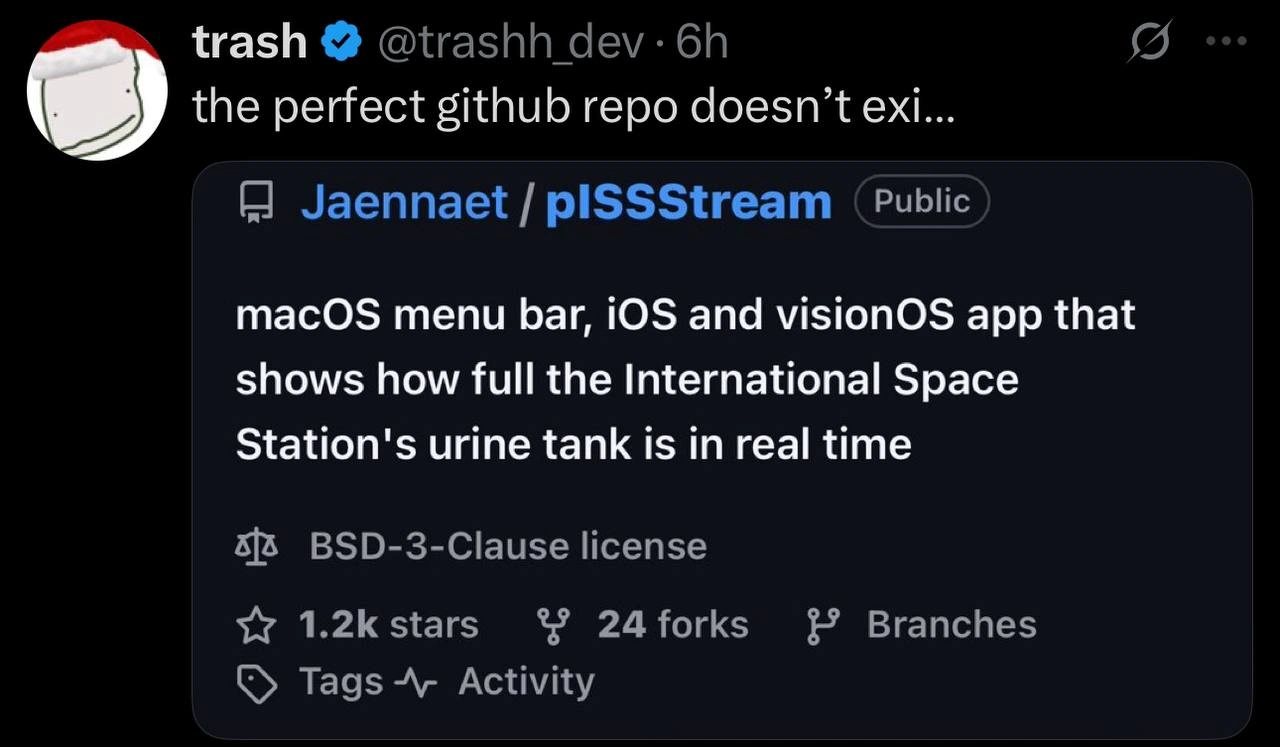
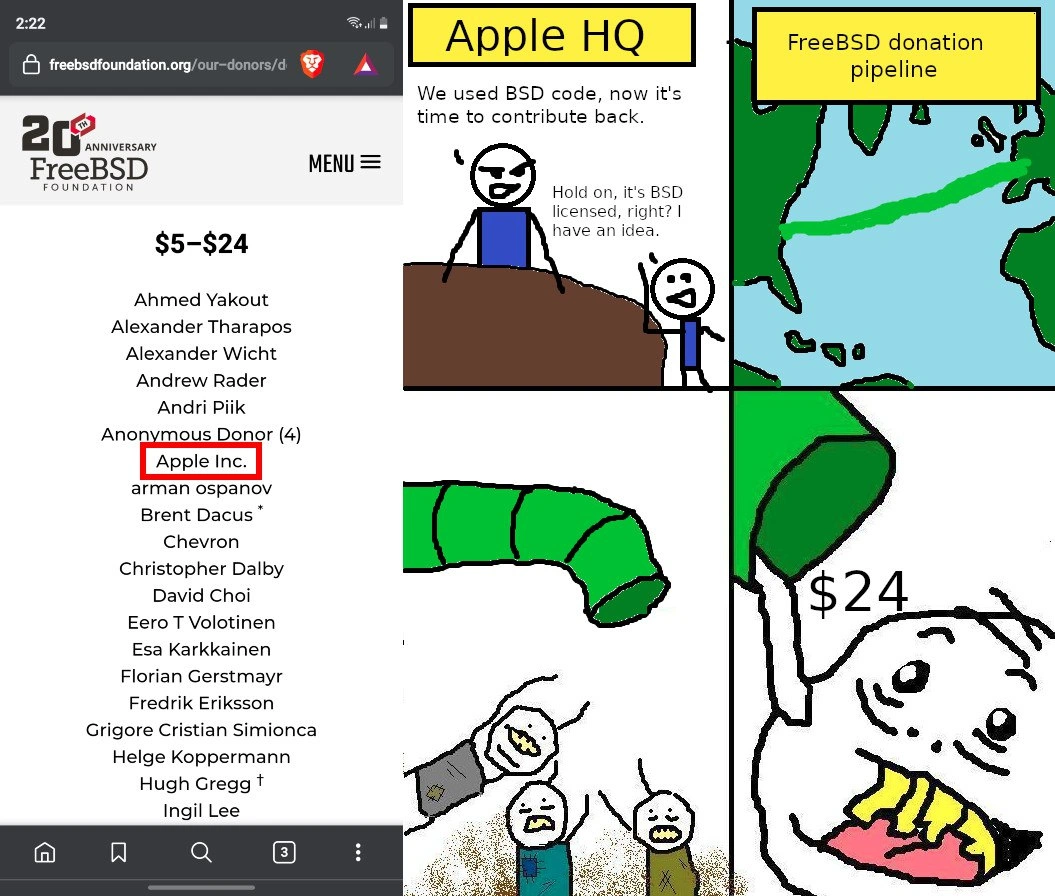
The screenshot on the left side of the meme is actually from the FreeBSD Foundation’s donor page. Under the $100–$249 donation tier, you can see a list of donors’ names. And there, highlighted, is Apple Inc. This means Apple donated somewhere between one hundred and two hundred forty-nine dollars. For context, Apple is one of the richest companies in the world – so seeing them listed in a relatively low donation tier is surprising and funny to developers. It’s like finding out a billionaire tipped a waiter with a couple of quarters. Other names around Apple’s on the list are individual people (Alexandru Popa, Andrew Diamond, etc.) and even an entry for Anonymous Donor (4) which means four people gave in that range anonymously. There’s even a mention of “LinkedIn Matching Gifts” – likely LinkedIn matched some employee donations. So Apple’s name stands out because we’d expect a company of that size to possibly be in a higher sponsorship bracket (often big companies give thousands or more to foundations). But here they are in the $100 category, which is often where regular individual supporters show up.

The right side of the meme is a little comic drawn in a deliberately crude MS Paint / stick-figure style (a common style for tech humor, similar to stick_figure_humor you might see on internet forums). It has four panels:

  • Panel 1 (Apple HQ): Two stick figures in Apple’s offices. One is enthusiastic about giving back after using BSD code. The other has a devious suggestion – pointing out the project’s license is BSD. The phrase “it’s BSD licensed, right?” is key – it implies “since the license doesn’t require us to do anything, we can do the bare minimum.”
  • Panel 2 (FreeBSD donation pipeline): A world map with a big green pipeline drawn from Apple to what we assume is the FreeBSD Foundation. This sets up the expectation that something large (like a big flow of support) is going to travel through that pipe. Think of it like those cartoonishly large pipes you’d see in a Mario game, except it’s delivering money in this case. The label "FreeBSD donation pipeline" is just humorously formal wording for this imagined money channel.
  • Panel 3: The pipe is shown dropping a single “100$” bill (the comic even labels the dollar amount on the bill). This is the punchline image – such a huge pipeline, but only one $100 comes out. It visually represents how a huge company might funnel only a tiny amount back to the open source project it benefited from.
  • Panel 4: A happy, blob-like creature lies under the pipe with its mouth wide open, gobbling the $100 bill. This funny character could represent the FreeBSD project or community, eagerly devouring whatever small sustenance it can get. Its expression is overjoyed, which is part of the irony – as if even a $100 donation is a feast for them. The creature looks a bit like a silly grub or worm. (It might even be a distorted take on the FreeBSD mascot, which is a cartoon daemon called “Beastie,” but in the comic it’s drawn humorously as this blob guy eating money.)

The overall joke is clear even to a newer developer: Apple used a lot of open-source code that they got for free (thanks to the bsd_license with no strings attached), and in return they gave a very minimal_corporate_donation – just enough to appear on the donor list. This is funny in a dry way because it feels disproportionate: Apple’s products and profit massively benefited from FreeBSD’s volunteer-driven work, but the payback was perhaps just $100. The “loophole” mentioned in the title refers to the idea that Apple is taking advantage of the BSD license terms – not breaking the rules, but certainly using the most favorable interpretation for themselves. Under a stricter license (like GPL), Apple would have been required to share their own code changes back or at least fulfill some conditions, but with BSD license, contributing becomes optional and unenforceable.

For a junior developer or someone new to open source, this highlights a few concepts:

  • Open source funding is hard: Projects like FreeBSD often rely on the goodwill of users and companies to donate money or developer time. There’s no selling of the software itself (since anyone can download it for free), so they need sponsors to keep going.
  • Companies use open source a lot: Major companies incorporate open-source software into their products all the time because it saves time – why reinvent the wheel if a robust free solution exists? Apple did this by using parts of FreeBSD for macOS’s underlying technology.
  • Different licenses, different expectations: A “permissive” license like BSD or MIT is very company-friendly; it doesn’t demand much back. A “copyleft” license like GPL demands that improvements be public. Companies often avoid copyleft if they want to keep their modifications proprietary (Apple, for instance, is known for keeping tight control over its source code).
  • Token contributions: Sometimes companies will give a small contribution (money, or a token code contribution) to the open source projects they use, partly as thanks and partly for public relations (“See, we support open source!”). The humor here is that Apple’s token is really small relative to its size.

So, the meme is funny to developers because it points out a real situation in a goofy way. Apple basically got a bunch of valuable code free of charge (because of the no-strings-attached code license), and then used the bare minimum effort to acknowledge that – a $100 donation. We laugh (or maybe groan) because it feels a bit like a greedy move: perfectly legal, but kinda cheap. The stick-figure comic with the pipeline_meme imagery exaggerates this to drive the point home visually, making it easy to get even if you just skim it. Once you know the context – Apple, BSD license, FreeBSD Foundation – the joke lands: it’s pointing out the imbalance between how much is taken and how little is given back in the world of open-source and big corporations.

Level 3: Trickle-Down Open Source

At first glance, this meme highlights a bitter irony in corporate open-source usage. Apple Inc., a company with a market cap in the trillions, shows up on the FreeBSD Foundation donor page in the humble $100–$249 tier – sandwiched between individual donors and anonymous contributors. The humor isn’t subtle: Apple has built core parts of macOS and iOS on FreeBSD (an open-source Unix-like OS), leveraging the permissively licensed BSD code for huge commercial gain. Yet their way of “giving back” is a token-sized donation, barely enough to buy lunch for a few developers. The four-panel MS-Paint style comic drives this home with dark sarcasm. In Panel 1, inside “Apple HQ,” a stick figure manager proudly declares, “We used BSD code, now it’s time to contribute back.” Any seasoned engineer might raise an eyebrow here – after all, big companies often talk a big game about OpenSourceContribution. But the smaller stick figure chimes in: “Hold on, it’s BSD licensed, right? I have an idea.” This is where the BSD license loophole comes into play. The BSD license is permissive, meaning Apple can use and modify BSD-licensed code without any obligation to release their changes or pay royalties. No legal strings attached. So what’s the “idea” hinted at? The comic jokingly suggests that instead of contributing substantial code fixes or funding, Apple decides to send a paltry donation – technically contributing back, but in the cheapest way possible.

The next panels illustrate a satirical “FreeBSD donation pipeline.” In Panel 2, a giant green pipe stretches across a world map from Apple to the FreeBSD Foundation. It gives the impression of a massive conduit ready to deliver something big – a playful exaggeration of Apple’s resources and reach. But Panel 3 reveals the punchline: out of the huge pipe drops a single $100 bill. Panel 4 depicts a goofy grub-like creature (representing the FreeBSD project or its hungry maintainers) ecstatically gobbling up the bill. The disproportion is comical: a giant pipeline for a tiny outcome, like using an entire freight train to deliver one apple. This visual metaphor screams “trickle-down open source” – massive corporate benefit flowing through a tiny drip of payback. It’s a jab at how opensource_funding often works in reality: gargantuan tech firms extract enormous value from community-maintained code, then give back pennies on the dollar (if anything at all).

For veteran developers, this scene prompts a knowing, if rueful, grin. We’ve seen this pattern before. The meme’s subtext riffs on the CorporateCulture of doing the legal minimum. Because the code was under a BSD-style license, Apple faced no obligation to upstream their improvements or share profits – a stark contrast to copyleft licenses like the GPL that would compel sharing modifications. The bsd_license effectively provided a loophole (by design, not accident) that Apple could slip through: “We got what we needed for free, so technically we owe nothing. How about we drop a crisp $100 in the tip jar and call it a day?” It’s a cynical interpretation of OpenSourceLicenses: one side grants freedom hoping for goodwill, the other side takes freedom and optimizes for shareholder value. The meme captures this with biting humor. Apple’s name listed among $100 donors (highlighted in the screenshot) is the kind of detail open-source veterans screenshot and circulate on Twitter with a mix of amusement and outrage. It’s the modern equivalent of a billionaire leaving a few coins in the charity basket – not illegal, but eyebrow-raisingly stingy.

From a senior dev perspective, there’s also historical irony here. Apple’s OSX/macOS core, called Darwin, is built on the XNU kernel which incorporated FreeBSD components decades ago. Apple benefitted immensely from BSD’s permissive licensing – it allowed them to create a proprietary OS without having to open-source their own code in return (as the GPL would require). Many of us recall how Apple even replaced GPL-licensed tools in macOS with BSD-licensed alternatives to avoid copyleft obligations. This meme indirectly nods to that legacy. The “I have an idea” quip in Panel 1 is basically Apple’s legal team realizing: Why contribute significant engineering effort or money back when the license lets us off the hook? Instead, Apple can make a tiny OpenSource “donation” and still claim they support the community. And indeed, at some point Apple did donate a trivial amount to the FreeBSD Foundation – enough to get listed, but not enough to remotely match the value extracted.

The comedic brilliance is in the contrast. Apple likely spends more money on daily catered snacks at Cupertino than on that donation. By naming Apple Inc. in the same breath as small individual donors, the meme spotlights how minimal_corporate_donation looks next to the outsized benefits reaped. It’s a shared joke among developers because it’s a too-real example of big tech’s relationship with open source: lots of use, little give. The stick_figure_humor and crude MS-Paint comic aesthetic amplify the absurdity – this isn’t a polished PR graphic from Apple, it’s an intentionally scrappy doodle, as if drawn by a disgruntled open-source contributor in their spare time. The grub-like character joyfully eating the $100 bill adds a dark punch: it’s as if the FreeBSD project is so starved for funding that even a single $100 meal is cause for (sad) celebration. The whole meme lands as a satire of the OpenSourceContribution imbalance, leaving experienced devs smirking and thinking, “Yep, that’s corporate open source for you – gigantic pipes, tiny payback.”

Description

A composite image that juxtaposes a real screenshot with a satirical four-panel comic. On the left, a screenshot of the FreeBSD Foundation's donor webpage shows a list of names under the '$100-$249' contribution tier, with 'Apple Inc.' highlighted in purple. The URL is visible at the top: 'https://freebsdfoundation.org/our-donors/donors...'. On the right, a comic strip explains this donation. The first panel, labeled 'Apple HQ', shows a figure saying, 'We used BSD code, now it's time to contribute back,' while another deviously remarks, 'Hold on, it's BSD licensed, right? I have an idea.' The subsequent panels depict a 'FreeBSD donation pipeline' as a tiny pipe trickling a pittance to grateful developers, while a monstrous caricature of a corporation greedily devours immense profits derived from the code, spitting out a meager '100$'. The meme sharply criticizes the massive disparity between the value multi-trillion-dollar companies like Apple derive from foundational open-source projects (FreeBSD is a core component of macOS and iOS) and their often minuscule financial contributions back to those projects. The permissive BSD license, which allows for such use without requiring code reciprocation, is central to the joke's premise
Comments

10
Anonymous ★ Top Pick Apple's contribution to FreeBSD is the most efficient use of capital in history: a $100 check to help maintain the foundation of a multi-trillion-dollar ecosystem
  1. Anonymous ★ Top Pick

    Apple's contribution to FreeBSD is the most efficient use of capital in history: a $100 check to help maintain the foundation of a multi-trillion-dollar ecosystem

  2. Anonymous

    Apple’s entire ‘give back’ pipeline is a stateless microservice: ingest millions of BSD LOC, emit { "donation": 100 }, 200 OK

  3. Anonymous

    Apple built a trillion-dollar empire on BSD's shoulders, then tossed back enough for a nice dinner in Cupertino. It's like forking someone's repo, making billions from it, then sponsoring them at the 'Bronze' tier on GitHub - technically contributing, but the asymmetry is so stark it becomes performance art

  4. Anonymous

    Apple's $100-$249 donation to FreeBSD is the technical equivalent of a trillion-dollar company leaving a 0.00001% tip after building an entire OS empire on BSD's permissive license. It's the perfect demonstration of why GPL advocates have trust issues - when your kernel is literally derived from someone else's decades of work, maybe spring for the $250+ tier? At least they're honest about 'having an idea' when they saw that BSD license

  5. Anonymous

    FreeBSD donors: Keeping ZFS snapshots pristine without systemd's drama, one shocked Wojak at a time

  6. Anonymous

    BSD license economics: Apple ships Darwin; FreeBSD gets the $100 “thanks for the OS” tip - adoption maximized, reciprocity optional. Legal applauds, the foundation buys coffee

  7. Anonymous

    BSD turns ‘open a PR to upstream our changes’ into ‘open a PO for $100 to the foundation’ - Legal happy, XNU untouched, ship it

  8. @Alexmitter 5y

    That's why the GPL exists. It's a gift that keep on giving back.

  9. @stansmolin 5y

    Do you know that anybody could make this donation among anonymous donors as a joke?

    1. @Bender666 5y

      I didn't consider that before reading your comment...

Use J and K for navigation