The Hidden Architecture of AWS DynamoDB
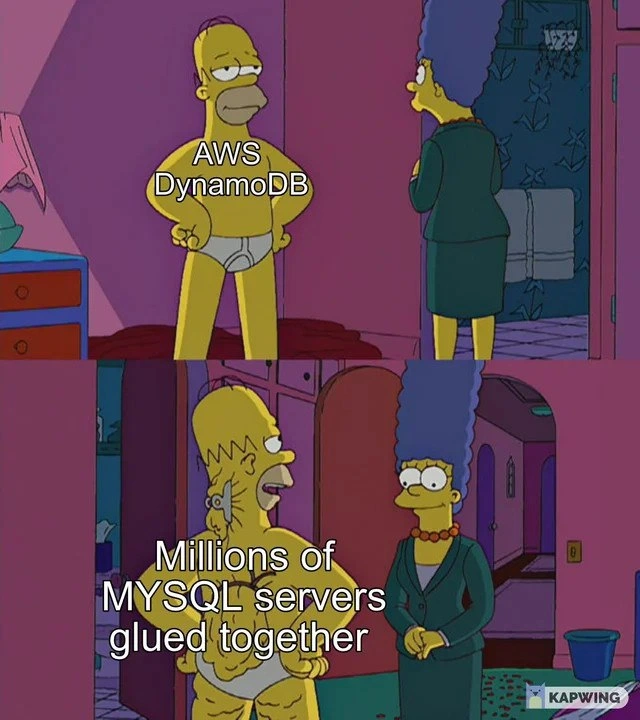
Why is this AWS meme funny?
Level 1: Fancy Icing, Plain Cake
Imagine you go to a bakery and see a huge, beautifully decorated cake on display. It’s labeled “SuperCake 3000 – the ultimate cake experience.” It looks amazing on the outside, with shiny frosting and a cool name that makes it sound super advanced. You’re impressed at first. But then the baker lets you in on a secret: inside, that giant fancy cake is actually made up of hundreds of normal cupcakes stuck together with icing. It’s not one miraculous new cake recipe – it’s just a lot of regular cupcakes in disguise! Suddenly, you realize this “SuperCake 3000” isn’t using some magical baking method; it’s simply a clever way of presenting many ordinary cakes as one. You chuckle because the grand cake turned out to be something quite ordinary behind the facade.
This meme is playing on the same idea. DynamoDB is like that fancy-named cake with nice frosting (Homer showing off proudly), and the millions of MySQL servers are the humble cupcakes hidden inside (Homer’s backside reveal). We find it funny because AWS tried to dazzle everyone with a big, cool offering – but behind the scenes it’s the usual stuff we’ve known all along, just multiplied and stuck together. It’s a bit like when someone claims they built a giant robot, but really inside the robot suit you find a bunch of kids standing on each other’s shoulders. The surprise is not scary or bad; it’s amusing. We’re essentially laughing at the contrast between the fancy presentation and the simple reality underneath.
Level 2: Shards Behind the Curtain
Let’s break down the meme in simpler terms. Amazon Web Services (AWS) offers a database service called DynamoDB. On the surface, DynamoDB is presented as a modern “NoSQL” database – meaning it doesn’t use the traditional rows-and-columns, relational approach of databases like MySQL. Instead, it’s key-value or document-based, which is supposed to make it more scalable across many machines. AWS calls DynamoDB “serverless”, implying you don’t have to set up or worry about any servers yourself. It just feels like an endless, always-on data service you can query. In the first panel of the meme, Homer Simpson represents AWS DynamoDB – he’s standing proudly, facing forward, as if to show off how impressive he is. This is analogous to AWS showing off DynamoDB as this fully-managed, magical service. Homer’s front-facing confidence is like DynamoDB’s marketing: “Look how great I am!”
Now, in the second panel, Homer turns around and we see text on his back that says “Millions of MySQL servers glued together.” This reveals the joke: behind DynamoDB’s impressive front, the service might just be composed of a huge number of ordinary MySQL databases stuck together. MySQL is a very common open-source relational database (the kind that uses SQL and tables). It’s reliable and well-understood, but a single MySQL database can only handle so much traffic or data on one machine. Sharding is a technique where you split a big database into lots of smaller ones – each holds a portion of the data (for example, customer IDs 1-10000 on shard 1, 10001-20000 on shard 2, and so on). By doing this, you can handle more users or data by adding more database servers, each responsible for just a slice of the whole dataset. It’s like having many librarians, each managing part of a library, instead of one librarian for a giant library – things can be handled in parallel.
When the meme says “glued together,” it humorously suggests that AWS took many MySQL servers and connected them with some glue or duct tape to make them work as one. Of course, in reality the “glue” is sophisticated software and networking that routes requests to the correct database shard. But saying “glued” makes it sound like a clumsy, makeshift assembly – which is part of the humor. Marge, standing there unimpressed, represents the informed viewer (developers or IT folks) reacting to this reveal. Her body language says, “Hmm, I figured as much.” The joke resonates because often in engineering, a fancy new product is actually built from older, well-known components in the background. It’s like if you found out a high-tech self-driving car was actually a regular car with a bunch of smartphones taped together running the navigation – you’d smirk at how un-glamorous the truth is. Here, DynamoDB’s vaunted “NoSQL, scalable datastore” might just be an army of old-school SQL databases under the hood.
For a junior developer, the meme is highlighting the difference between marketing terms and implementation reality. Serverless sounds like there are no servers, but really it means the servers are hidden in the cloud provider’s data centers. DynamoDB being a NoSQL service means it doesn’t present a SQL interface or require you to manage the schema like MySQL does, but internally it still has to store data on servers and disks somewhere. The choice of MySQL in the joke is deliberate: MySQL is the classic relational database everyone knows, so it represents “traditional database tech.” By contrast, DynamoDB is seen as a modern solution. Saying DynamoDB = lots of MySQL is a funny way to say “modern solutions often use lots of traditional tech behind the scenes.” It’s a bit of an exaggeration – AWS likely has their own engine or heavily modified systems – but it lands the point.
In simpler terms: DynamoDB’s secret sauce might just be a ton of regular databases working together. The meme is funny because it pulls back the curtain (like in The Wizard of Oz, when the great wizard is revealed to be just a man operating machines). Homer’s backside label is the reveal of the wizard behind DynamoDB: millions of MySQL processes chugging away, handling data partitions. And Marge’s lack of excitement mirrors an engineer saying, “Yep, thought so. Nothing truly magic here, move along.” This doesn’t mean DynamoDB isn’t impressive – it is, because coordinating millions of shards is hard – but it’s a tongue-in-cheek reminder that at the end of the day, our fancy cloud services still run on good old servers and databases.
Level 3: Servers All The Way Down
To an experienced engineer, this meme lands as a knowing smirk: AWS DynamoDB, touted as a cutting-edge NoSQL, serverless database, is being cheekily unmasked as just a huge cluster of traditional databases (MySQL, of all things!). It’s the classic cloud joke: “serverless still means there are servers – you just don’t see them.” In the first panel, Homer (sporting the label “AWS DynamoDB” on his chest) stands proud in his tidy-whities, much like AWS marketing proudly flaunting DynamoDB as a sleek, fully-managed service. Marge’s neutral stance reflects the tech community’s polite interest. But in the second panel, Homer turns around to reveal the not-so-sexy backside label: “Millions of MySQL servers glued together.” Marge’s unchanged, mildly unimpressed expression says, “I knew it… nothing special, after all.” This is a jab at the engineering reality behind the marketing façade – the cloud’s equivalent of catching someone wearing a fancy outfit backwards, revealing the tag still on it.
Why is this funny to senior devs? Because it rings true. We’ve all seen the hype: “We built a revolutionary datastore!” – only to discover it’s using tried-and-true components under the hood. DynamoDB’s promise is ultra-scalable, low-latency data storage without worrying about infrastructure. Sounds magical, but seasoned folks suspect (correctly) that such magic is achieved by brute-force scale and partitioning. The meme basically says, “Yep, DynamoDB achieves scale by doing the obvious thing: running lots of MySQL instances behind a curtain.” This is like finding out a gourmet restaurant’s secret sauce is just good old ketchup mixed with spices – you chuckle because part of you expected it.
There’s an industry saying: “Any problem in computer science can be solved by another level of indirection… except the problem of too many layers of indirection.” Here, AWS added a layer of indirection (the DynamoDB service API) in front of a legion of databases. It’s a fancy distributed systems trick: use a routing service to direct requests to many backend shards. As a result, developers get the illusion of one big, limitless database. Insiders grin at this because it’s a bit of an open secret: many so-called “NoSQL” or new-wave databases achieve scalability by sacrificing some features and scaling out horizontally. The simplest way to scale out a datastore is sharding – break the data into chunks and put each chunk on a different server. Guess what traditional SQL databases like MySQL can do? Store data reliably on a single node. Guess what they struggle with? Running a single instance for planet-scale loads. But if you use 10, or 100, or 1000 MySQL servers, each holding a portion of the data… well, now you have a distributed database! It won’t magically handle joins or complex transactions across nodes, but neither does DynamoDB – it, too, gives up some SQL features to gain scalability. This is why the meme hits home: DynamoDB’s performance comes from a classic horizontal scaling strategy that any senior dev who has managed a high-traffic system has either implemented or at least considered.
The phrase “glued together” is dripping with sarcasm. Glue implies a quick-and-dirty assembly, like AWS just took a bunch of off-the-shelf MySQL servers and stuck them together with some scripting and load balancing – voilà, a global scale NoSQL service. While in reality AWS engineers put a ton of work into DynamoDB’s reliability and performance, the joke exaggerates it as a hodgepodge. Seasoned developers have lived through this pattern in-house: when your single database can’t handle the load, you shard it into many. Perhaps you even write a library or proxy so the application can talk to this cluster as if it were one database. Over time, that homegrown solution might get complex “glue code” to handle edge cases (rebalancing shards, handling failures, denormalizing data to avoid cross-shard joins, etc.). The meme is basically pointing at DynamoDB and saying, “Heh, we know what you are – a glorified shard-manager for MySQL.” It’s hyperbole, sure (DynamoDB likely uses a more specialized engine than vanilla MySQL for storage), but the humor lies in the recognition. It’s like recognizing an old friend under an alias: “Haven’t we met before? You look awfully like my old MySQL cluster, just wearing an AWS cape.”
This speaks to a broader marketing vs. engineering theme. Marketing loves terms like “NoSQL”, “serverless”, and “cloud-native” – conjuring images of futuristic tech running on pure genius. Engineers know these translate to “we handle the messy details for you.” And those messy details? Often solved with boring, battle-tested tech behind the scenes. There’s comfort and cynicism in that realization. Comfort because using proven components (like MySQL) means the system is built on known reliability. Cynicism because it reminds us that there’s rarely a completely new invention – just clever reapplications of fundamentals. Many senior devs have been burned by “magic” solutions before. When they peel back the layers, it’s “just Linux boxes and databases, same as ever.” So Marge’s unimpressed look = an experienced engineer hearing the hype, then learning the truth and going, “figures.”
Another wink hidden here is the concept of serverless databases. DynamoDB is called serverless because you don’t manage any machines yourself. But experienced folks joke that “serverless” really means “someone else’s servers.” Homer revealing his backside labeled “MySQL servers” is basically saying, “Yep, here are the servers – lots of them – we just hid them from you!” It resonates with anyone who’s had to maintain physical servers or VMs before – the cloud just abstracted that away. But abstraction doesn’t negate reality; it just means now it’s AWS SREs doing the 3 AM pager duty when one of those countless shards misbehaves. (As a grizzled veteran might dryly note, “Better their pager than mine.”) The meme humorously confirms what old-timers suspect: that even the most modern cloud services are not pure wizardry, but massive deployments of conventional tech under new branding.
Finally, consider the Simpsons meme template choice. Homer Simpson in nothing but underwear, confidently posing, represents AWS DynamoDB flaunting itself. When he turns and the truth is literally written on his back, it’s an exposure. This visual gag is perfect: AWS DynamoDB’s front-facing image is cool and sexy (like Homer thinking he’s seductive); the back side is the honest reality (lots of plain old MySQL instances – the equivalent of Homer’s dull backside). Marge’s nonplussed face is essentially the developer community thinking, “We’re not fooled, but okay.” It’s a fun way to say: under the covers, cloud services are doing the same hard things we’ve always done – just at a scale and automatioŋ level we’re happy to pay for. The laugh comes with a side of respect: sure, it’s “just MySQL shards,” but gluing together that many shards and keeping it seamless is an engineering feat (one that many of us are relieved we don’t have to manage manually anymore). In short, the meme hits on shared industry experience – that mix of mild cynicism and admiration when the next big thing turns out to be built on well-worn building blocks. We chuckle because we’ve been there, and hey, at least this time someone else is handling the dirty work!
Level 4: Beneath Dynamo’s Façade
Deep inside a distributed system like AWS DynamoDB, all the magic boils down to fundamental design choices: partitioning data and managing consistency across nodes. DynamoDB’s glossy exterior hides a massively sharded architecture. In theory, Amazon could have built a brand-new storage engine from scratch (inspired by their famous Dynamo paper on key-value stores). That paper introduced techniques like consistent hashing to distribute keys across nodes and quorum replication to balance availability vs consistency. But here’s the dark secret of cloud engineering: why reinvent the wheel when you can repurpose a proven technology a thousand times over? In practice, a “brand-new” NoSQL service can be a swarm of reliable old databases, each handling a slice of data. It’s the Partition Tolerance part of the CAP theorem in action – you can’t escape splitting data onto multiple servers if you want it to scale “infinitely.”
By sharding the data into many pieces, DynamoDB achieves massive throughput and scale-out. Imagine the data space chopped into ranges or hash buckets; each piece lives on a separate node (or cluster of nodes for redundancy). Now, what if those nodes are running something classic like MySQL? The meme cheekily suggests exactly that: DynamoDB could just be “millions of MySQL servers glued together.” This highlights a real design philosophy: take a battle-tested relational database engine and use it as the building block for a distributed key–value store. Each MySQL shard is responsible for a subset of items (say, by item hash or partition key). A routing layer (the glue) directs DynamoDB queries to the right shard. The brilliance (and absurdity) is in the scale – imagine a lookup service figuring out which of the millions of MySQL instances holds your item, then aggregating results. DynamoDB’s API gives you a single entry point, but under the hood it’s like querying a gigantic distributed hash table with MySQL at each storage node.
From a systems perspective, this isn’t far-fetched. Facebook’s MySQL cluster (and others using the Vitess sharding system) proved you can achieve internet scale by horizontal partitioning on MySQL. Amazon themselves famously moved off a single monolithic database decades ago, opting for distributed stores (hence the original Dynamo). The meme’s joke is a wink to insiders: even as AWS sells DynamoDB as a revolutionary NoSQL solution, its internals might be surprisingly mundane – countless SQL databases working in concert. The engineering trade-off here is pragmatic elegance. Writing a brand-new storage engine is risky; using MySQL (with its decades of optimization on indexing, query parsing, and on-disk storage) can jump-start development. Of course, you must bolt on a coordination layer to handle routing, failover, replication consistency, and make it all look like one big database. This is essentially a giant facade pattern: a front interface (DynamoDB service endpoint) that aggregates many back-end data nodes. It’s a testament to distributed systems design that such a facade can scale to millions of ops per second – and a chuckle that the facade might just be hiding a legion of familiar MySQL processes.
In the end, the meme’s technical truth is that “serverless” doesn’t mean “no servers”; it means you don’t manage them, AWS does. DynamoDB abstracts away the gnarly details of clustering, but those details still exist in racks of hardware humming away. The only way to handle planet-scale data is to use a lot of servers. Whether those servers run a custom Dynamo kernel or a tweaked MySQL engine, the challenges remain the same: partition the data, replicate it for safety, handle node failures, and try not to violate consistency guarantees too much when the network acts up. The humorous subtext of “millions of MySQL shards” is also a nod to the realities of such design: at some point, managing the glue holding those pieces together (monitoring all those shards, applying schema changes, handling cross-shard queries) becomes a herculean task. But that’s AWS’s problem now – they’ve just cleverly hidden the complexity behind an API. From a high-level vantage, DynamoDB feels like a single, magical database. But delve deeper, and it’s distributed systems 101: take simple components and scale them out massively. The meme shines light on this elegant if inconvenient truth: behind every seemingly futuristic cloud service, there’s a down-to-earth engineering solution (and possibly an army of gnomes MySQL daemons) doing the heavy lifting.
Description
This is a two-panel meme using the 'Homer Simpson's Back Fat' format from The Simpsons. In the first panel, Homer is shown from the front, looking composed, with the text 'AWS DynamoDB' overlaid on his chest. In the second panel, the view shifts to Homer's back, revealing that his seemingly smooth appearance is a facade created by numerous clips holding back rolls of fat. This messy reality is labeled 'Millions of MYSQL servers glued together'. The meme humorously and cynically speculates on the internal workings of AWS DynamoDB, a popular and sophisticated NoSQL database. The joke is that behind its sleek, modern, and highly scalable interface lies a chaotic and makeshift assembly of a much older, more traditional technology (MySQL). While not factually accurate, it's a classic engineering joke about abstraction - that elegant, simple services often hide immense, messy complexity

Comments
8Comment deleted
The DynamoDB paper talks about merkle trees and consistent hashing, but we all know the real innovation was just replacing foreign key constraints with a million 'ON DUPLICATE KEY UPDATE' statements and a prayer
Whenever product brags that DynamoDB is “pure serverless magic,” I picture ten thousand MySQL boxes in a trench coat praying no one asks for a cross-partition join
After 15 years of explaining CAP theorem to executives, you realize the real distributed systems challenge isn't achieving consistency - it's consistently explaining why your 'simple' DynamoDB migration just discovered 47 different MySQL-specific behaviors your entire codebase silently depended on
This meme perfectly captures the architect's dilemma: DynamoDB presents itself as a sleek, fully-managed NoSQL solution, but seasoned engineers know that underneath every 'serverless' abstraction lies a sprawling constellation of traditional databases held together by distributed systems duct tape, eventual consistency prayers, and enough sharding logic to make your head spin. It's the cloud equivalent of 'it's just MySQL all the way down' - except now you're paying per request and can't SSH into anything when it breaks at 3 AM
DynamoDB: sharded MySQL with better marketing - pick the wrong partition key and you'll learn RCUs, WCUs, and the cost of a hot partition the hard way
DynamoDB: the elegant art of sharding MySQL into oblivion with AWS duct tape, because CAP theorem says pick two - except when billing says pick all
Calling DynamoDB “millions of MySQL servers glued together” is cute - because the only join across those shards is your AWS bill when a hot partition meets on-demand writes
wait, it's all MySQL servers? always has been Comment deleted