Angular as the New COBOL of the Frontend
Why is this Frameworks meme funny?
Level 1: Old but Reliable
Imagine you have a really old toy that still works perfectly. Let’s say it’s a classic toy train set from your grandparents’ time. It might not be the flashy remote-controlled drone that all the other kids are playing with now, but this old train set is sturdy and it runs every day without fail. A big toy company (like a really large playground) keeps using that train set for all their rides because it’s reliable and gets the job done. Now, not many people your age know how to set up or fix that old train set, since everyone’s busy with the new toys. If you’re one of the few who learned how to work it – like how to replace its tracks or repair the engine – the playground will always need your help to keep it running. You become the go-to person for this special old toy. Meanwhile, other playgrounds might buy newer, shinier rides (like rocket skateboards or flying hoverboards – the cool new stuff). Those other places move on to new things (that’s the “greener pastures,” meaning nicer new fields). But our playground sticks with the trusty old train.
In this story, Angular is like that old train set – a bit old-fashioned but dependable – and COBOL is like an even older machine (imagine something like a really antique engine) that has been around forever. The joke is saying Angular might become like that train set: not the newest thing, but still used by big companies for a long time. And if you know how to work with it, you’ll always have a job (just like you’d always have a role fixing the old train). It’s funny because we usually think of computer tools as new and changing all the time, but sometimes the old tools stick around much longer than anyone expects. The meme is basically a playful way of saying, “Old things can last a long time, and the people who take care of them will always be needed.”
Level 2: From COBOL to Angular
Let’s break down the meme’s references in simpler terms. First, Angular is a popular software framework for building front-end web applications. “Front-end” means the part of software that users directly interact with – in a web app, that’s everything you see in the browser, like buttons, forms, and content. Angular (originally developed by Google) became well-known in the 2010s for helping developers build complex web interfaces. It provides a structured way to create web pages that behave more like desktop apps. If you’re a junior dev, you might have heard of Angular alongside other front-end frameworks like React or Vue. Companies often choose a framework so their developers don’t have to reinvent the wheel for every new site or app – the framework gives them ready-made tools and a consistent pattern to follow.
Now, COBOL stands for Common Business-Oriented Language. It’s a programming language that was created back in 1959, which is ancient in tech years. COBOL was designed for business data processing – things like bank transactions, insurance records, and payroll systems. Believe it or not, huge portions of the world’s financial systems still run on COBOL code written decades ago! For example, many banks or government agencies have old computer programs (we call them legacy systems) written in COBOL that are so critical that they’ve never been fully replaced. Maintaining these systems is a specialized skill. Younger developers today usually don’t learn COBOL in school; they learn newer languages like Python or JavaScript. So COBOL has this reputation: it’s old and maybe a bit uncool, but it’s so deeply embedded in important places that knowing it can make you very valuable in certain jobs. When something is referred to as “the COBOL of X,” it usually means it’s old-fashioned but will likely stick around in industry for a long time.
So the tweet is joking that Angular has become “the COBOL of front-end frameworks.” This is humorous because Angular is relatively modern, but the joke suggests it’s becoming legacy in the fast-moving world of web development. In other words, it implies Angular might not be the shiny new tool that everyone is excited about anymore; instead, it’s what a lot of big companies will keep using for years, even after the hype has died down. The tweet’s author, Lars, even says Angular will run in enterprises for “a decade or two.” In tech, 10-20 years is a long time for a framework to stick around! Many frameworks tend to get replaced or fall out of favor much sooner as new ideas and libraries come along. But enterprises (large companies) are different: they value stability and long-term support. If a big bank or insurance company built a major application using Angular, they aren’t going to rewrite it next year just because a cooler framework came out. They will maintain it, update it gradually, and could still be using it many years from now. This phenomenon is sometimes half-jokingly called “enterprise long-term support” – companies unofficially extending the life of a technology because it’s deeply integrated into their business.
The meme also touches on job security and the idea of working on legacy systems. “Legacy” in tech refers to older software or systems that are still in use. It might be written in an older language or framework (like COBOL, or eventually Angular) and could be hard to update or replace. Many new developers love learning cutting-edge technologies, but there is actually a lot of steady work in maintaining and slowly improving older, established systems. The tweet humorously notes that if you enjoy maintaining legacy systems, Angular could give you plenty of work for years to come – just like knowing COBOL can almost guarantee you a job at a bank or government agency that relies on it. It’s a bit of a sarcastic career tip: focus on a technology that everyone else considers outdated, and you’ll always be in demand because few others want to maintain it. Of course, it’s said in jest – in reality, many developers prefer building new things rather than nursing old code. But there’s truth in it: some programmers build entire careers (with good salaries) out of being experts in supposedly “dead” languages or older frameworks, because those skills become rare over time.
The phrase “greener pastures” means moving on to something better or more attractive. In the context of technology, “moving on to greener pastures” suggests switching to newer, more promising frameworks or tools. The tweet implies that while many industries or teams will move on to these newer frameworks (maybe today that’s React, or tomorrow something else), Angular will still be around in many enterprise projects. So, the situation is like: outside, the tech world might be buzzing about new frameworks and modernization of stacks, but inside a large enterprise, you might still be writing Angular code in 2030 because that’s what their system was built with. Maintaining that older tech can be both a challenge and an opportunity (this is a common theme in enterprise software challenges). The challenge is that working with older tech can feel frustrating when the rest of the world has moved on; the opportunity is that you become one of the few experts who can do it.
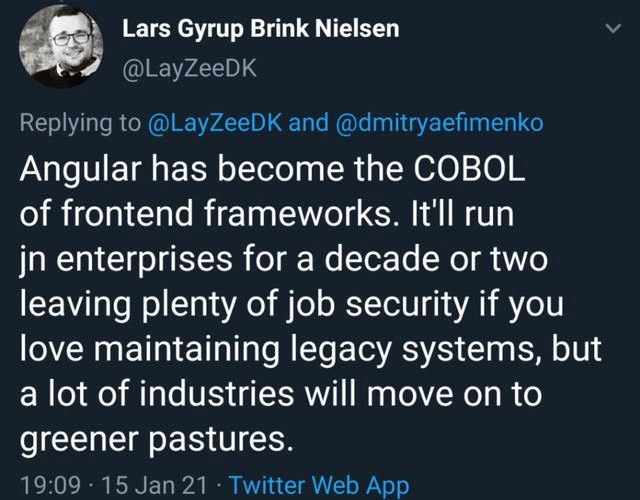
Finally, it’s worth noting the meme format: it’s literally a screenshot of a tweet (a Twitter post) presented as a meme. Tech jokes often spread on Twitter, where one developer makes a witty remark and the community shares it. So this image is a dark-mode Twitter UI showing Lars’s tweet and the replies. This format is common in tech humor memes – a tweet with a funny hot take about programming gets turned into an image that circulates on forums or group chats. So if you see the profile picture, the handle @LayZeeDK, and the timestamp, that’s all part of showing it’s a real tweet (or at least looks like one). The humor doesn’t come from a picture or cartoon in this case, but from the sarcastic text and the relatable comparison. For a junior developer, the takeaway is: technologies can have very different lifespans depending on context. What’s new and exciting in the startup scene might become “legacy” in a few years at a big company. And yes, even something as modern as Angular could be tomorrow’s “old code” that you might end up maintaining. It’s a funny way to remind us that tech moves fast, but big companies often move slowly – and that mismatch creates some ironic situations, like the one joked about in this tweet.
Level 3: COBOL of the Web
The angular vs COBOL analogy in this tweet meme strikes a chord with battle-worn developers. It’s comparing Angular – a modern frontend framework introduced in the 2010s – to COBOL, a 60-year-old programming language that stubbornly runs the world’s banks and insurance systems. On the surface, it’s an absurd juxtaposition: Angular’s all about web apps and fancy JavaScript (well, TypeScript), while COBOL dates back to punch cards and mainframes. But the joke taps into a real industry trend: once a technology burrows into big corporations, it can live far beyond its hype cycle. Enterprise IT has a notorious habit of turning yesterday’s hot framework into tomorrow’s legacy system.
Senior engineers reading this are nodding knowingly (or rolling their eyes). They’ve seen it happen before. Remember how Java applets or Visual Basic 6 GUIs from the ‘90s hung around in internal tools forever? Or how some government offices still run on Internet Explorer because a critical app only works there? Angular might be relatively new, but it’s already ubiquitous in large enterprises – and that’s exactly why it could stick around for “a decade or two.” The tweet jokes that Angular is the COBOL of frontend frameworks, implying it’s destined to become a legacy frontend framework that refuses to die. COBOL’s design dates to 1959, yet here we are in the 21st century with COBOL code still clearing your credit card transactions. Likewise, Angular (first released by Google in 2010 2016 in its modern form) was the shiny new framework for building rich web apps. Entire enterprise portals and internal tools were built on Angular. It had corporate backing, long-term support schedules, and a comprehensive structure – all attractive for big teams. Fast-forward a few years, and some devs now consider Angular a bit “heavy” or old-fashioned compared to hipper libraries like React or Vue. But guess what? Those massive Angular applications at Fortune 500 companies aren’t getting rewritten overnight. They work, they’re mission-critical, and they have decades of business logic baked in. As the meme suggests, Angular may not be the cool kid on the block anymore, but it’s moved into that unglamorous, permanent role – the reliable workhorse quietly powering back-office software.
Why is this funny? It’s a mix of hyperbole and truth. Calling Angular the new COBOL is an exaggeration – COBOL is ancient and notoriously uncool, while Angular is still a modern, actively maintained product. But in the frontend humor ecosystem, devs often joke that any tool older than five years feels like legacy. Frontend tech moves fast: frameworks rise and fall within a few JavaScript package cycles. So comparing Angular to a half-century-old language pokes fun at how quickly web developers label something “outdated.” It’s an inside joke about our own short attention spans. Yet there’s truth underneath: Enterprise software challenges often mean that once a technology is entrenched, companies stop chasing the latest shiny tools. They have other priorities – stability, support, minimizing risk. In those environments, Angular could absolutely persist until 2030 and beyond, long after many devs have moved on to “greener pastures.” We’ve seen similar patterns: banks still running Mainframe applications in COBOL or Fortran, telecom systems running on C from the 1970s, or big-box retailers with .NET WinForms apps from 2005. Rewriting these systems in the newest framework is expensive and risky – why fix what isn’t broken (even if it’s a bit creaky)?
For senior developers, there’s also a wry punchline about job security maintaining legacy code. Seasoned devs know that while junior colleagues chase the hottest new framework, someone has to keep the old systems running. And those someones can make a good living! COBOL contractors, for example, famously earned big bucks saving the day during the Y2K crisis and still do when legacy financial systems need tweaks. In the same way, the tweet hints that if you become an Angular expert, you might be fixing Angular 8 apps in 2035 for a nice paycheck, because not many others will remember or want to. It’s a tongue-in-cheek career tip: specialize in tech that isn’t trendy anymore, and you’ll always have a maintenance gig. Of course, it’s a bit sarcastic – working on ancient codebases isn’t every developer’s dream (“Legacy Land” can be both a gold mine and a tar pit). But it rings true enough to be humorous. The phrase “greener pastures” acknowledges that a lot of the industry will have moved on to newer and perhaps more exciting technologies – maybe some futuristic web paradigm or whatever framework supplants React – while Angular devs in big companies soldier on with their tried-and-true stack. It’s a tech humor way of saying “Hey, Angular might not be cool later, but it ain’t going away in enterprises.”
In essence, this meme combines tech history with current frontend trends. It’s saying that in the grand cycle of technology, Angular could become a sort of modern legacy: widely used, critical, but no longer hip – much like COBOL. For a senior developer who’s lived through framework fads, that idea is both funny and plausible. It’s the “everything old is new again” cycle: Today’s cutting-edge front-end tool might become tomorrow’s cobweb-covered enterprise standard. Angular creators probably didn’t foresee their baby being compared to COBOL, yet here we are. The meme’s darkly amusing message: if you bet your career on Angular, you might end up as one of those wise old programmers keeping archaic systems alive— and laughing all the way to the bank (perhaps literally, since banks love COBOL… and soon maybe AngularJS 😉). This mix of exaggeration, truth, and shared understanding of legacy systems makes the joke land for anyone who’s seen how technology choices can haunt (or sustain) a company for ages.
Description
A screenshot of a tweet from user Lars Gyrup Brink Nielsen (@LayZeeDK) dated January 15, 2021. The text of the tweet makes a provocative comparison: 'Angular has become the COBOL of frontend frameworks. It'll run in enterprises for a decade or two leaving plenty of job security if you love maintaining legacy systems, but a lot of industries will move on to greener pastures.' This statement humorously critiques the Angular framework by likening it to COBOL, a famously old and verbose language primarily found in legacy mainframe systems. The joke resonates with experienced engineers who have witnessed the lifecycle of various technologies, suggesting Angular is now the 'safe' but uncool choice for large corporations, while newer, more agile frameworks represent the future ('greener pastures'). It touches upon themes of technological obsolescence, the slow pace of change in enterprise environments, and the career trade-offs between stability and working with cutting-edge tools
Comments
14Comment deleted
Calling Angular the COBOL of frontend is an insult to COBOL. At least COBOL developers know their system is legacy; some Angular teams are still having sprint planning meetings about which new module to import to solve a problem that React developers solved with a hook five years ago
Angular’s my 401(k): when the last Fortune-500 finally budgets for “the big rewrite,” I’ll be the only one who still remembers why ngOnInit never fired - billing COBOL-grade contractor rates from a beach VPN
The real irony is that both Angular and COBOL developers will retire wealthy while React devs are still debating whether to use hooks, class components, or whatever new paradigm drops next Tuesday - job security through framework fatigue resistance
Ah yes, the classic 'Angular is the new COBOL' take - because nothing says 'legacy' like a framework that's still actively maintained by Google and used by Fortune 500 companies. Sure, it might not be the hipster choice at your local startup accelerator, but when you're debugging a React hooks closure issue at 2 AM or explaining to your PM why your Next.js app needs server-side rendering for SEO, those Angular developers are sleeping soundly with their dependency injection, strong typing, and actual architectural patterns. Give it another decade and we'll be hearing how React became the new COBOL while everyone's moved on to writing frontends in Rust WASM or whatever the 'greener pastures' are by then
Enterprise Angular: the front-end mainframe - quietly clearing transactions while the “React rewrite” waits on its 27th CAB approval. Engineers call it legacy; finance calls it uptime
Angular's real DI is 'Deferred Investment': it guarantees a decade of modernization gigs - every 'ng update' ends with a React RFC and a brownfield migration plan
Angular: Where enterprise architects trade innovation for the sweet job security of herding 10-year-old directives forever
Actualy it is the only framework with MVC. Comment deleted
"А что с вами знакомиться, вы каждый год новые" Comment deleted
Ха. Хоть каждый раз для одного и того же библиотеки не выбирать как с реактом этим вашим. А уж цсс ин джс вообще чума. Comment deleted
что на последнем посте? на маке не показывает телега ( Comment deleted
Если ты про следующий после этого, там жопы сделанные из скобок разными шрифтами ) ( ( )( ) Comment deleted
спасибо Comment deleted
. ) ( ( )( ) Comment deleted