Vulnerability Disclosure Reward: A Lousy T-Shirt
Why is this Security meme funny?
Level 1: Big Help, Small Prize
Think of it like this: imagine you notice your neighbor’s door is left unlocked and wide open. Instead of ignoring it, you decide to be helpful – you close the door and let your neighbor know so that their home stays safe. The neighbor fixes the problem (locks the door) and wants to thank you. You’re not expecting anything, but later they hand you a little gift: a T-shirt that says, “I saved my neighbor’s house and all I got was this T-shirt.”
It’s a funny and warm situation. You did something important by preventing a possible bad thing (like a burglary), and in return you got a simple, silly prize. The T-shirt itself even jokes that it’s “lousy,” meaning it’s not a big reward – but it’s given with a smile. In the meme’s story, the “house” was a ship’s computer system that was left open with a weak password, the helper was an ethical hacker who reported it, and the grateful “neighbor” was the Dutch security team. In the end, everyone is happy: the problem is solved, no one got in trouble, and our helpful hero gets a playful T-shirt to remember the good deed. It’s funny because the reward is so small compared to the good deed – and that’s exactly the charm of the story.
Level 2: Default Password Perils
Let’s break down the story in simpler terms. A default password is the preset login that comes with a device – think of it like the manufacturer’s built-in key. For example, a new router might ship with username "admin" and password "password" as the default. It’s meant to be changed by whoever sets it up. If you don’t change that default password, it’s like leaving the master key under the welcome mat: anyone who knows the default (and these defaults are often widely known or easily guessable) can unlock the device. In the context of this meme, a satellite router on a Dutch ship was left with its default credentials and was accessible from the internet. In plain terms, that means potentially anyone in the world could connect to that ship’s network because the “door” was still using the factory key. That’s a big security risk! Imagine if a bad actor discovered it – they could snoop on or disrupt the ship’s communications, which might have serious consequences.
Enter the ethical hacker (also known as a “white hat” hacker). Ethical hackers are good-guy hackers; they look for vulnerabilities (weak points in security) in order to get them fixed, not to exploit them for wrongdoing. In this case, the hacker noticed the ship’s router was using a default password and was open online. Instead of using that to do damage, he chose to help. He disclosed the vulnerability to the proper authorities. Because this involved a Dutch ship and potentially government-related systems, he contacted the Dutch CERT. CERT stands for Computer Emergency Response Team. Think of CERT as a special team that responds to cybersecurity problems much like firefighters respond to fires. The Dutch CERT, specifically, is responsible for handling and coordinating responses to computer security issues in the Netherlands, especially for important infrastructure or government systems.
So, the hacker sends them a report: “Hey, I found this hole in one of your ship’s routers – it’s using a default password and is exposed to the internet. You might want to fix that.” The CERT replies to let him know, “Thanks, we’ve mitigated the vulnerability,” which means they took action. Mitigation here likely involved securing that router – maybe by changing the password to something strong, or disconnecting it from public access. In short, they closed the hole. They also ask for his mailing address to send a token of appreciation. At this point, the hacker was a little nervous. It’s understandable – if you’ve been poking around a system that relates to a government, you might worry about getting in trouble (even if your intentions were good). But his concern turned to relief (and amusement) when a package arrived containing a T-shirt.
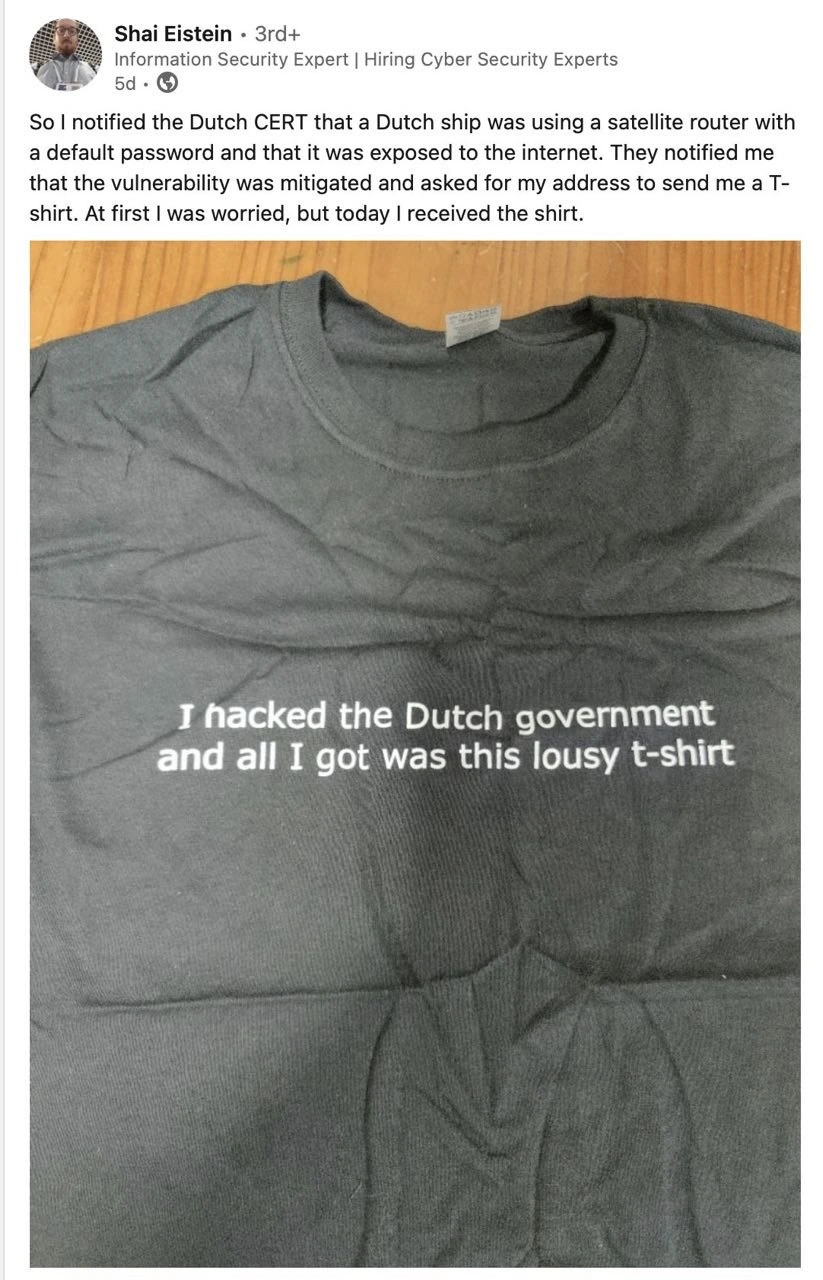
Now, this isn’t just any promotional tee. Printed on the shirt is the phrase: “I hacked the Dutch government and all I got was this lousy t-shirt.” This is a playful joke. It’s riffing on an old cliché T-shirt slogan that usually goes like, “I went to XYZ place and all I got was this lousy T-shirt.” People use that phrase to humorously complain about a underwhelming souvenir. Here, the “souvenir” is for hacking (well, ethically hacking) the Dutch government’s system. Calling the T-shirt “lousy” is part of the joke – it’s said with a wink. The government (through the CERT) is basically saying, “We acknowledge you ‘hacked’ us (helpfully), and here’s your not-so-fancy prize.”
This might seem odd if you’re new to this world: someone finds a serious security problem and just gets a T-shirt? But in the context of security culture, it’s actually kind of sweet and funny. There’s a whole economy of bug bounty programs where companies pay hackers money for finding bugs. However, not every organization can or will shell out cash. Some give swag (free merchandise) as a thank you. A T-shirt, a sticker, a mug – these are common tokens of appreciation. What’s great here is the sense of humor. The Dutch CERT could have just sent a plain “Thank You” letter, but instead they made a custom shirt with that comedic line. It shows they have a friendly relationship with the hacker community – they’re saying, “You helped us out by spotting this vulnerability, and we’re grateful (and we also have a sense of humor about it!).”
The story was shared on LinkedIn by the researcher, which is why we have that screenshot. On LinkedIn, professionals often share interesting or proud moments from their work. You can imagine the hacker posting a photo of the shirt, essentially saying: “Look what I got for helping secure a Dutch ship’s router!” It’s both a brag and a laugh. Other people in the cybersecurity and IT field find it relatable because many of them have had similar experiences – maybe not the exact same scenario, but the idea of doing something technically important and getting a modest reward. It’s a feel-good story: a security problem was fixed, the hacker didn’t get in trouble (quite the opposite, he got thanked), and he got a funny T-shirt to remember the event. In communities focused on DeveloperHumor or CyberSecurityMemes, this kind of tale spreads to remind everyone that sometimes the most priceless thing you get from hacking responsibly is a story worth telling (and a bit of swag to show off).
Level 3: Lousy T-Shirt Bounty
This meme spotlights a classic scenario in Security culture: an ethical hacker uncovers a serious bug but ends up with a cheeky token reward. In the LinkedIn post, a researcher found that a Dutch ship’s satellite router was protected only by a default password – the kind of glaring vulnerability that makes seasoned penetration testers shake their heads. Using a default password (like the infamous admin/admin) on an internet-exposed device is a well-known security no-no. It’s essentially an open door for attackers, and here it was on a critical system (a ship’s communications router!). The researcher did the right thing through responsible vulnerability disclosure: he alerted the Dutch CERT (Computer Emergency Response Team – the Netherlands’ official cyber incident handlers) about the issue. CERTs act as intermediaries to coordinate fixes for such bugs, especially in important infrastructure. They got the problem fixed – presumably by working with whoever managed that ship’s router to change the password or secure it – and then they offered a thank-you.
Here’s where the humor kicks in. Instead of a hefty bug bounty payout or public recognition, the good Samaritan hacker was asked for his address so they could send him a reward. He admits, “At first I was worried,” which hints at a senior dev’s dark joke – anyone who’s done uninvited penetration testing on a government system knows that giving your address could be scary (Will they send legal papers or the police? 😅). But instead, he receives a package containing a dark-grey T-shirt emblazoned with the text: “I hacked the Dutch government and all I got was this lousy t-shirt.”
For experienced folks, this hits on multiple levels of humor. First, the T-shirt’s message itself is a tongue-in-cheek twist on an old joke souvenir (“My friend went to <tourist spot> and all I got was this lousy T-shirt”). It self-mockingly acknowledges that the reward is just swag. Security professionals often joke about accumulating piles of conference T-shirts and hacker hoodies – as if every serious accomplishment just adds another cotton tee to the collection. This shirt is like the ultimate inside joke merch for the BugBounty community: “I did a big hack for the government, and all I got was… well, you know.” The word “lousy” is sarcasm – the hacker isn’t truly upset; it’s a playful jab at the modest prize.
Secondly, it’s highlighting the reality of VulnerabilityDisclosure culture. In an ideal world (or at big tech companies), finding a critical vulnerability might earn you a fat check or at least a spot on a “Hall of Fame” page. But many government agencies and smaller organizations don’t have bounty budgets. At best, you get acknowledgment or maybe some swag. This Dutch CERT chose humor and gratitude over cash – arguably a positive outcome, because it means they treat ethical hackers as friends, not foes. Veteran security researchers laugh because they’ve been there: you spend nights hacking away to help someone, and the “payment” might be a thank-you email, a coffee mug, or a T-shirt. It’s a mix of pride and pragmatism – you’re happy you made things safer, but you joke about the meager reward.
There’s also an element of relief and relatable humor. The hacker’s initial worry about giving his address hints at the darker side of disclosure: sometimes, companies or governments respond to unsolicited help with cease-and-desist letters or worse. In this case, the Dutch authorities handled it in the best possible way – they fixed the issue and showed appreciation with a bit of friendly humor. That outcome is developer humor gold because it subverts the typical fear with a happy ending. It says: Hey, we’re cool with you finding that bug. Here’s a fun T-shirt to prove it. In the world of CyberSecurityMemes, this story became an instant hit. It perfectly combines a serious default_password fiasco (so common it’s meme-worthy on its own) with the absurdly underwhelming prize. It’s the kind of war story security folks tell over beers: “Remember that time I saved a government ship from hackers and basically got a free shirt?” Everyone laughs, not because the issue wasn’t serious, but because the contrast between impact and reward is just so ironically RelatableDevExperience.
Importantly, for senior devs, there’s an underlying commentary: why do such basic vulnerabilities still exist? Default credentials are listed in guides and OWASP Top 10 as trivial to fix – change the password! Yet here we are, with critical equipment exposed. It’s a gentle reminder that even “simple” security practices get overlooked in the real world, often due to negligence or assuming “oh, who’s gonna find that?” The ethical hacker did find it, and thankfully disclosed it responsibly. The lousy T-shirt is a funny footnote, but the real win was preventing a potential breach. The humor doesn’t undercut the value of the work; it celebrates the culture where doing good often has its own reward (plus a snarky T-shirt for style). This resonates with experienced devs and security engineers who take pride in making systems safer, even if the only prize is a pat on the back and something goofy to wear at the next hacker conference.
Description
A screenshot of a LinkedIn post by Shai Eistein, an Information Security Expert. The post text reads: "So I notified the Dutch CERT that a Dutch ship was using a satellite router with a default password and that it was exposed to the internet. They notified me that the vulnerability was mitigated and asked for my address to send me a T-shirt. At first I was worried, but today I received the shirt." Below the text is a photo of a black t-shirt with white text that says, "I hacked the Dutch government and all I got was this lousy t-shirt". The joke centers on the practice of vulnerability disclosure and the often underwhelming rewards or "swag" that security researchers receive for their work. It's a humorous take on bug bounty programs and responsible disclosure
Comments
7Comment deleted
Most bug bounty programs offer cash rewards, but some government agencies prefer to pay in high-quality cotton-based authentication tokens
CVSS v4 proposal: (impact × exploitability) ÷ swag. I reported a default-password satellite router, scored a 9.8, and the Dutch CERT paid me in a T-shirt - ROI ∞. Good luck justifying next year’s AppSec budget to finance
The Dutch CERT's t-shirt game is strong - they've mastered the art of turning potential international maritime incidents into wearable memes. Nothing says 'we take security seriously' quite like acknowledging you got pwned by someone checking Shodan while having their morning coffee
The cybersecurity equivalent of 'exposure doesn't pay the bills' - you find a critical vulnerability in maritime infrastructure that could have enabled complete vessel compromise, go through proper responsible disclosure channels, and your reward is a self-deprecating t-shirt. At least the Dutch CERT has a sense of humor about their swag budget. Meanwhile, the black market would've paid five figures for that zero-day, but here we are, wearing our principles on our sleeves - literally. The real treasure was the CVE we made along the way
Fix a ship’s internet‑exposed satellite router running admin/admin, and your bug bounty is a wearable threat model - a T‑shirt with SSO to airport secondary screening
Shodan to nmap to admin/admin; CVD closes fast and the bounty arrives as wearable cotton - finally, an MTTR you can literally wear to standup
Bug bounties: where a default-password RCE on gov sat-gear nets you swag that won't cover your next Wireshark license renewal