Skip to content
DevMeme
3571 of 7435
Software Development Roles as Squid Game Characters
CorporateCulture Post #3908, on Nov 8, 2021 in TG

Software Development Roles as Squid Game Characters

Why is this CorporateCulture meme funny?

Level 1: Tag, You’re Out

Imagine you and your friends are playing a big game at school, kind of like a high-stakes playground contest. One friend is the referee who makes sure everyone follows the rules – if you mess up, they’ll blow the whistle and you’re out of the game. That friend is like the QA tester in the meme, who checks for mistakes and “catches” anyone who slips up. You and a couple of buddies are the players trying to win the game – that’s like the coders writing the software, trying hard to get things right without “getting out.” Now, the game was organized by your teacher and the principal. The teacher (like HR in the meme) was super nice inviting you to join the contest, giving you the entry card and explaining the rules. The principal (like the Project Manager) is overseeing everything with a serious face, making sure the game runs on time and everyone plays by the rules. Meanwhile, a few important guests (imagine the school’s big sponsors or maybe some parents and officials) are sitting on the side bleachers watching you all play. Those guests are like the investors – they’re not playing or refereeing, they’re just watching eagerly to see who wins because they have a prize at stake for the winner.

Now, because everyone is watching and the rules are strict, you feel nervous. You really want to do well, but if you make one mistake, the referee friend will call you out, and you’ll have to leave the game. It makes the whole thing feel as intense as a do-or-die challenge, even though it’s really just a school contest. This is exactly why the meme is funny: it takes a normal work situation (people building and testing a product) and imagines it as this crazy life-or-death game show. In reality, writing software isn’t actually like fighting for your life – nobody’s actually getting “shot” if their code has a bug! But when deadlines are tight or pressure is high, it feels really serious. So the meme uses a make-believe game scenario to joke about those feelings. It’s like saying, “Making this app felt as intense as a playground battle where everyone was watching and I could get kicked out at any moment!” By showing something so extreme in a silly way, it makes us laugh and remember that, hey, it’s not actually that bad – we’re just making software, not literally dodging paintballs on the playground.

Level 2: Cross-Functional Crossfire

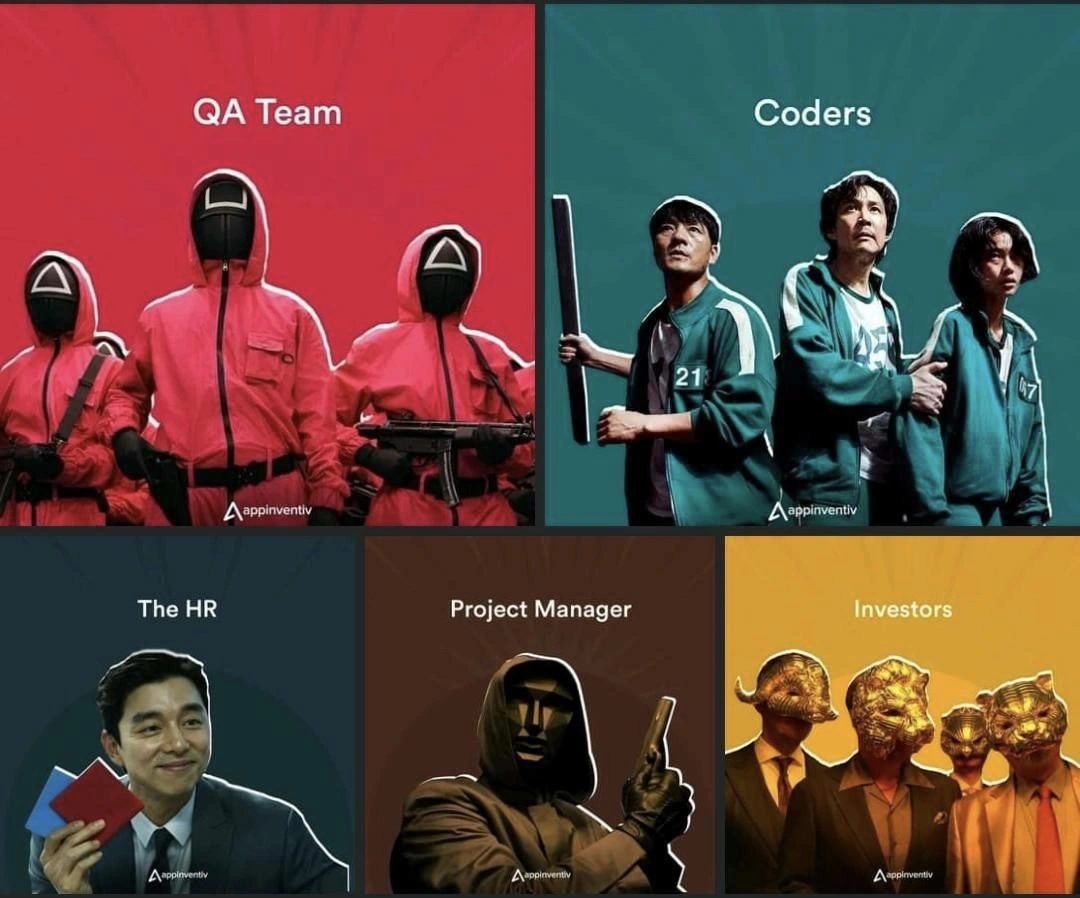
For someone newer to the software world, this meme takes characters from Squid Game and maps them onto a tech company’s team to poke fun at how different groups can clash. In Squid Game (a popular Netflix series), desperate players in green tracksuits compete in deadly children’s games, watched by masked guards and VIPs. Here, those characters are replaced with office roles to create a crazy software_team_dynamics scenario. Let’s break down each panel and what each role does in real life:

  • QA Team (Quality Assurance): These are the software testers. Their job is to find bugs and make sure the product works correctly. In the meme, they’re depicted as armed Squid Game guards in pink suits aiming rifles. Of course, in reality QA engineers don’t have guns – their “weapons” are bug reports and test cases. But to a coder, it can feel intimidating when QA is rigorously testing your work. If you’re a junior dev, the first time QA files a bug against something you coded, it might feel like getting shot down. Don’t worry, that’s normal! The QA team isn’t out to get you; they’re trying to catch issues early so customers won’t hit those problems. The humor is that QA sometimes gets jokingly portrayed as the enemy of developers in office jokes (hence the qa_vs_devs tag), since they’re the ones who bring bad news about your code. In truth, you ultimately both want a good product – it just can feel like a cat-and-mouse game when they keep finding flaws you have to fix.

  • Coders (Developers): “Coders” are the programmers – the people writing the actual code to build the software. In the meme, the developers are the players in green tracksuits, looking scared and holding makeshift weapons (like bats). This mirrors how, in Squid Game, players were vulnerable and at the mercy of the game’s controllers. In a tech team, developers can sometimes feel under fire when there’s a lot of bugs or pressure. Early in your career, you might relate to that nervous look: for example, when you deploy your first big feature, you’re hoping nothing goes wrong because you know QA (and eventually users) will come back with any issues. The bats in their hands are a funny touch – perhaps symbolizing that developers try to “fight back” against bugs or defend their code (though it often feels like bringing a bat to a gunfight when bugs are everywhere). This panel captures that developers_under_fire feeling: being a bit anxious that something you wrote might break under scrutiny. It’s dramatized here as a life-or-death vibe, but on the job it just means fixing bugs or, worst-case, doing a rollback of your code.

  • The HR (Human Resources): HR is the department that manages hiring, onboarding, benefits, and sometimes firing – basically all the people-related processes at a company. In the meme, HR is shown as a smooth-looking guy in a suit holding out red and blue cards, identical to the mysterious recruiter character from Squid Game who gives contestants the invitation to join the deadly games. This is a witty analogy: HR are the ones who give you the “invitation” to join the company (a job offer, represented by the card). The red and blue cards might also hint at options or decisions (in the show they played a game involving red/blue tiles, but here it could double as a metaphor: blue card = you’re hired, red card = you’re fired). For a junior developer, HR might mostly be the folks you talked to during your interview process, the ones who helped with your paperwork, or who you ask about company policies. They’re generally not involved in day-to-day coding or testing, but they set the stage by recruiting the team and maintaining company rules. The meme humorously casts HR as a gatekeeper to the “game” – friendly when inviting you in, but potentially part of the system that can escort you out. It’s a play on the idea of hr_gatekeeping: HR controls who enters and leaves the company. Don’t worry though, in real life HR isn’t secretly plotting like a movie villain; they’re just making sure the company has the right people and that everyone follows the rules.

  • Project Manager (PM): The project manager coordinates the work. They create timelines, assign tasks, track progress, and make sure the project stays on schedule and within scope. Think of them as the team’s organizer. In the image, the PM is portrayed as the Front Man – the overseer in Squid Game – wearing a dark hood and pointing a pistol. This symbolizes the authority a PM can have in a project. Of course, a real PM won’t wear a mask or carry a gun (at least we hope not!), but they do often set the rules of the game in a project. For example, a PM might say, “All code for this release must be done by Friday, no exceptions,” and they monitor if the team is on track. To a junior dev, a project manager might be the person reminding you about deadlines or asking for updates in stand-up meetings. They can sometimes feel strict because they’re answerable to higher-ups about delivery. The meme exaggerates this project_manager_authority – implying the PM “calls the shots.” If you’ve ever felt stress because your PM said a feature must be finished ASAP, you’ll get why seeing a PM depicted with a gun is a tongue-in-cheek joke. It’s highlighting how a PM’s orders can feel do or die during a crunch. In reality, good PMs try to remove blockers and help the team, not just enforce rules. But when schedules slip, even a kind project manager might suddenly seem as daunting as that masked Front Man, at least in the team’s jokey imagination.

  • Investors: These are individuals or organizations that have put money into the company or product, expecting it to succeed and yield returns. They could be venture capitalists, shareholders, or the company’s executives representing the stakeholders’ interests. In this meme’s final panel, the investors are depicted as the VIP characters from Squid Game – wealthy folks in fancy suits and exotic gold animal masks, who watch the games for entertainment. This parallels how investors or top executives might be somewhat removed from the day-to-day work, yet they’re very interested in the outcome. As a junior dev, you probably won’t interact with investors directly (you might just hear things like “the investors want to see more user growth” passed down from your CEO or manager). But their presence looms in the background because they set high-level goals and expectations. The meme shows them as literally watching the “game” from fancy seats. That’s a sarcastic way of saying sometimes it feels like those with money treat the success or failure of a project as a spectacle – they’re concerned with results (winning or losing), not how many late nights the team put in. It’s a commentary on investor_pressure: the team feels pressured to perform because they know some big bosses or investors are expecting a win. In a real company, investors want the product to do well and the business to grow, and that pressure often trickles down to every team member. The joke here is that from a coder’s viewpoint, it can seem like the investors are just “along for the show,” asking for results while not seeing the blood, sweat, and tears it takes to deliver a software project.

Overall, each part of this meme uses a Squid Game reference to highlight a common feeling in tech teams: that building software under pressure can feel like an intense competition or cross_functional_roles conflict. Of course, day-to-day work isn’t actually deadly! But if you’ve ever been on a project where testing, deadlines, and stakeholder expectations all collide, you know it can be stressful. This meme takes that stress and turns it into something we can laugh at. Each role (QA, devs, HR, PM, investors) has its own motivations and quirks, and when they’re at odds, it’s like a chaotic game where everyone’s just trying to survive to the product release. The images and labels are an exaggerated metaphor that any dev team member can recognize, even if real life is (thankfully) much more cooperative and safe than a Netflix thriller.

Level 3: The Testing Gauntlet

In this meme, a familiar scene from Squid Game is repurposed to depict the brutal reality of corporate software development. It’s an exaggerated parody from the perspective of a battle-hardened dev who has seen one too many release scrambles. Quality Assurance (QA) is cast as the well-armed enforcers in pink jumpsuits, training their rifles on trembling coders in green tracksuits. To a veteran engineer, this dark humor rings true: the QA team can feel like a firing squad for buggy code – one critical defect and they shoot down your deployment. And even though everyone knows QA’s job is to help ship a better product, in those moments it definitely feels like they’re out for blood (like when a tester drops a critical bug report on your desk at 5 PM Friday – bullseye, there goes your weekend).

Experienced developers smirk at this scenario because they’ve lived versions of it. Under tight deadlines and investor pressure, the relationship between devs and QA often turns adversarial. The meme captures a common anti-pattern: an us vs. them mentality where QA is perceived as “out to get” developers by catching every mistake. That sense of dread when QA files a last-minute showstopper bug that threatens your release – it can feel like being eliminated in a deadly game. It’s a DeveloperHumor staple that when testers go hunting for bugs, they always seem to find the ones you least expect, right when you thought you survived the sprint unscathed. As the tongue-in-cheek saying goes in crunchy release cycles: “Deploy or die.”

The other panels drive the point home with biting satire about CorporateCulture and power dynamics. HR, smiling with those red and blue invitation cards, symbolizes how Human Resources draws you into the “game” – hiring you with bright promises (blue card) or handing out termination slips (red card) when things go south. There’s a sly joke here: HR brings you into this high-stakes arena but might also be the one to escort you out if you fail repeatedly. Seasoned devs recall that uneasy feeling when HR suddenly schedules a “quick meeting” during a project crisis – it’s like receiving that ominous Squid Game invitation all over again, wondering if you’re about to get red-carded.

Meanwhile, the Project Manager stands like the Front Man, hooded and holding a pistol. This is no coincidence: the Front Man in Squid Game oversees the deadly contests, just as a PM orchestrates a project’s many trials. In real dev life, PMs enforce deadlines and scope changes with steely resolve. The meme suggests that a PM can “pull the trigger” on tough decisions – cutting features, crunching timelines, or reassigning tasks – which sometimes feels as harsh as elimination. A veteran developer has sat through those grim project meetings where a PM decrees, “We have to drop everything and fix this now,” with the cold authority of a masked overseer under investor_pressure. It’s classic ProjectManagementHumor: the PM isn’t literally pointing a gun at you, but when they say jump, you jump – or your project gets it.

Finally, the Investors appear as gilded VIPs in animal masks, casually enjoying the spectacle from the sidelines. This hits on the truth that those funding the project are often detached from the day-to-day struggle. To the dev team, investors (or upper management) can seem like mysterious overlords who only see metrics and outcomes. They cheer for success and are quick to frown at failure, but they’re not in the trenches with you fixing bugs at 2 AM. The meme’s portrayal makes seasoned engineers chuckle bitterly: it imagines investors treating product development as high-stakes entertainment, watching velocity charts and user growth like a betting game. In a sense it is a game to them – if the product fails (the contestants fall), the money is lost. But the VIPs with champagne only witness the thrill of victory or agony of defeat, not the nights of debugging and deployments behind the scenes.

The humor here cuts deep: each role – QA, Developer, HR, PM, Investor – has mismatched priorities that can turn a collaborative process into a lethal game. Ideally, building software is a team effort where everyone works together to deliver quality. In reality, tight schedules, miscommunication, and office politics often pit these groups against each other in a blame showdown. The software_team_dynamics can degrade into survival mode under pressure. The meme is funny because it exaggerates a truth many of us know too well: working in a software company sometimes feels like fighting for your life in a bizarre contest orchestrated by bureaucracy and business interests.

Why not just “fix” this dynamic? Seasoned pros know it’s not so simple. These power imbalances are baked into many organizations. QA and developers are sometimes set up with opposing incentives – devs rush to release features, QA is rewarded for not letting anything faulty slip through. Project managers are tasked with hitting deadlines no matter what, even if it means pushing people to their limits. HR focuses on policies and may inadvertently create a fear of failure (nobody wants that red card meeting). Investors demand growth and ROI, which trickles down as high expectations for every sprint. Each role is doing its job, but without trust and communication, it turns into a zero-sum game. Over the years, methodologies like Agile and DevOps have tried to break these silos – encouraging cross-functional_roles where QA vs dev transforms into QA + dev, working side by side. Yet even with stand-ups and retrospectives, many of us have still experienced that nightmarish crunch: QA finds a critical bug at the 11th hour while the PM and execs hover anxiously, and the whole team scrambles like it’s life or death. It’s practically a rite of passage in this industry.

The meme resonates especially with the jaded crowd because it takes a pop-culture phenomenon and uses it to capture the absurdity of tech life. It’s the kind of inside joke (DeveloperInJokes) you appreciate more with experience: if you haven’t survived a death-march project, you might just see a goofy Netflix parody, but if you have, this hits uncomfortably close to home. By casting the office as a deadly arena, the meme acknowledges with a smirk that sometimes being a developer really does feel like being a contestant in a cruel game. You’re just trying to write code and make it to the next release, but there are so many ways to get knocked out – a bug you missed, a requirement that changed, a higher-up who suddenly moves the goalposts. And lurking at every turn are those holding the power: QA ready to blow up your build, PM ready to enforce “the rules,” and big bosses watching, ready to celebrate a win or dole out a red card. It’s dark corporate comedy, but when you’ve been around long enough, you laugh so you don’t cry. After all, at least when QA “shoots” you in the meme, you respawn to fix the bug another day – hopefully with a lesson learned and a story to share at the next stand-up.

Description

A five-panel meme that uses characters from the Netflix series 'Squid Game' to satirize roles within a tech company. The top-left panel, against a red background, is labeled 'QA Team' and shows the masked guards in pink jumpsuits, one holding a gun. The top-right panel, on a teal background, is labeled 'Coders' and depicts the show's protagonists as contestants in green tracksuits, looking weary and embattled. The bottom-left panel, labeled 'The HR', shows the charismatic recruiter character smiling while holding game cards. The central bottom panel, labeled 'Project Manager', features the ominous, black-masked Front Man holding a pistol. The final bottom-right panel, labeled 'Investors', shows the wealthy, detached VIPs wearing golden animal masks. The humor derives from the cynical but relatable analogy for corporate hierarchy and team dynamics, comparing the high-pressure tech environment to the deadly games from the show. A small watermark for 'appinventiv' is present on each panel
Comments

12
Anonymous ★ Top Pick In this version of Squid Game, failing the unit tests is 'Red Light, Green Light,' and the project manager is the Front Man, reminding you that the high burn rate is a feature, not a bug
  1. Anonymous ★ Top Pick

    In this version of Squid Game, failing the unit tests is 'Red Light, Green Light,' and the project manager is the Front Man, reminding you that the high burn rate is a feature, not a bug

  2. Anonymous

    ‘Sprint Game’: QA’s automated sniper tests keep staging blood-red, the masked PM drops “just one more AC” every stand-up, HR waves red-or-blue severance cards, investors bet on the MTTR chart - and the dev squad’s only weapon is a Friday 5 p.m. force-push to main

  3. Anonymous

    The real plot twist is when you realize the QA team's regression suite is more brutal than any elimination game, and unlike Squid Game, there's no prize money - just a Jira ticket marked 'Done' that gets reopened three sprints later

  4. Anonymous

    In this organizational Squid Game, the QA team enforces the rules with ruthless precision, developers are the expendable contestants desperately trying to survive sprint after sprint, HR smiles while recruiting the next batch of players, the PM holds all the cards (and the gun) to eliminate scope creep, and investors watch from their golden thrones - only caring about the ROI, not who gets eliminated in the process. The real twist? Unlike the show, there's no prize money at the end, just another sprint planning meeting

  5. Anonymous

    Every sprint feels like Squid Game: QA guards the release gate with weaponized acceptance criteria, the PM changes rules mid-round, and masked investors swap OKRs faster than we can hit our SLOs

  6. Anonymous

    QA as red guards with bats: because nothing survives their test suites unscathed, turning every PR into a deadly game of red light, green light

  7. Anonymous

    Release day as Squid Game: devs sprint, PM points the scope, QA calls red light with a flaky E2E, HR flips offer-or-PIP, and investors bet on vanity metrics

  8. @a_sulf 4y

    imagine get that much money at the and of project. alone😲👍

  9. @qqqrrrjjd 4y

    bruh

  10. Deleted Account 4y

    It do be like that

  11. @ZgGPuo8dZef58K6hxxGVj3Z2 4y

    Lol

  12. @Gleb_Ikonnikov 4y

    Not HR. Recruiter.

Use J and K for navigation