Skip to content
DevMeme
1499 of 7435
The Bug Fix Dream: A Developer's Hope and Despair
Bugs Post #1678, on Jun 9, 2020 in TG

The Bug Fix Dream: A Developer's Hope and Despair

Why is this Bugs meme funny?

Level 1: Just a Dream

Have you ever had a dream that felt so real, you woke up thinking it actually happened? Imagine you went to bed upset about a big mess in your room that you just couldn’t clean up before sleep. Then you dream that you cleaned the whole room perfectly – all the toys and clothes are put away, everything is neat. In the dream you feel happy and relieved because the problem is gone. But then you wake up and look around, and uh-oh… the room is still a huge mess. None of that cleaning actually happened! You’d feel super disappointed, right? Maybe you’d even want to pull the covers back over your head and groan.

That’s exactly what’s going on in this meme. The “messy room” is like a bug in a computer program – basically a problem that was making the developer upset. In his dream, the developer thought he fixed the bug (like you thought you cleaned your room). He was really happy in that moment because yay, problem solved! But then he woke up and realized it was just a dream. The bug was still there in real life, just like the mess would still be on your floor. So he went from feeling awesome to feeling terrible. The last picture shows him crying under the blanket because he’s sad and frustrated that the issue wasn’t actually fixed. It’s a funny-sad joke because everyone knows the relief of a nice dream and the sadness when reality isn’t as good. Just like you might laugh a little later thinking, “I can’t believe I actually dreamed about cleaning my room,” programmers laugh (with a few tears) and say, “I can’t believe I dreamed I fixed that bug!”

Level 2: Works in My Dream

Let’s break down what’s happening in this meme in simpler terms. A software bug is a mistake or error in a program that makes it behave in unexpected or wrong ways. Fixing a bug (also called bug fixing) usually means finding what’s causing the issue in the code and correcting it so the program runs correctly. Debugging is the process of tracking down those bugs and getting rid of them. It can be a straightforward task for simple bugs, but for really tricky ones it’s like being a detective searching for a tiny clue in a huge codebase. Developers often use tools like a debugger (which lets them run code step by step and inspect variables) or they add extra logging (console.log("here") or print statements) to see what’s going on. Despite all these tools, some bugs are so stubborn that you can spend days trying different fixes. It’s not uncommon to get frustrated or extremely tired when a bug just won’t go away.

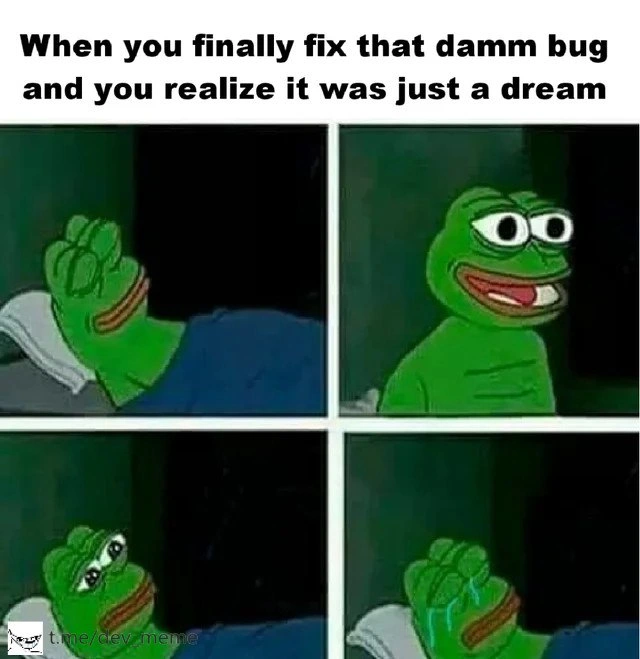
In this comic, we see four panels of the character Pepe the Frog lying in bed at night. Pepe is a popular meme character often used to show strong emotions – in this case, the emotions are happiness turning into shock and then sadness. The text on the meme says: “When you finally fix that damn bug and you realize it was just a dream.” This sets the stage: our developer (represented by Pepe) dreamed that he finally fixed a very annoying bug. In panel 1, Pepe is smiling peacefully under the blanket – that’s the moment in the dream where the code is working and all tests are passing. In panel 2, he’s sitting up, still looking pleased and proud, as if he’s thinking “Yes! I did it! The bug is gone.” This reflects how a programmer feels after solving a tough DebuggingTroubleshooting problem: relieved and happy.

Now, panel 3 is where reality kicks in. Pepe’s eyes go wide, and you can almost hear the record scratch: this is him waking up and realizing, “Wait… I’m not at my desk, I’m in bed… that success never happened!” In other words, he wakes up and remembers that the bug isn’t actually fixed in the real world; it was only fixed in his dream. That’s a huge letdown. By panel 4, Pepe is lying back down with tears in his eyes – he’s utterly devastated. The bug is still unsolved, and now he’s lost that warm, fuzzy feeling of triumph. The phrase “it was just a dream” is something we say when we wake up from a dream that felt real, only to realize none of it actually occurred. Here it’s being applied to the bug fix. The developer thought he had finally conquered this error, but nope, nothing has changed in reality. The code still has the issue, and he’s back to square one, probably feeling even more exhausted. It’s a feeling of DebuggingFrustration that many programmers find all too familiar (hence those blue cartoon tears – a bit of exaggeration to show the inner crying).

Why do developers find this meme so relatable and funny? For one, it exaggerates a real experience: being so deep in a problem that you dream about solving it. When you spend a long day (and maybe night) trying to fix a bug, your brain can carry that task into your sleep. You might literally dream of code. Sometimes, people actually dream up the solution! (There are anecdotes of engineers waking up with a great idea to try.) But in a case like this, the dream simply gives the feeling of success without the actual answer. It’s like your brain said, “Hey, you’ve suffered enough, let me give you a fake victory so you can relax,” which is a bit of a cruel trick when you wake up and realize it wasn’t real.

This scenario is basically a sharedExperience among many developers. The specifics might differ – maybe someone dreamed they passed all unit tests or that their app stopped crashing – but the core emotion is the same. You go from the high of “Yay, I solved it!” to the low of “No, I didn’t, it’s still broken.” That swing is huge, and when it happens at your desk it’s bad enough (like thinking you fixed a bug, but then the next run or the CI pipeline shows it’s still failing). But to have it happen through a dream feels extra cruel, and that’s where the dark humor comes in. It emphasizes just how much this bug is haunting the developer. (We sometimes actually call persistent bugs “nightmares” informally, e.g., “That memory leak was a nightmare,” meaning it was really hard to deal with.)

Let’s also talk about the caption wording: “that damn bug”. The developer is so frustrated that they’re using a curse word to describe the bug. It’s not polite language, but it’s very common among programmers when a bug has been really painful. It shows the emotional charge behind it – this isn’t a tiny glitch; it’s a bug that drove the person up the wall. Perhaps it caused crashes in production (the live environment where real users are affected), which is a big deal. A production bug can be extremely stressful, as you might have your boss and users waiting for a fix. The meme doesn’t explicitly say it’s in production, but the intensity suggests it might be. Even if it’s not, any bug that sticks around long enough to invade your sleep is clearly a tough one.

The little watermark “t.me/dev_meme” in the corner tells us that this image came from a developer meme channel on Telegram. It implies that a lot of other developers saw this and said, “oh man, I know that feel.” It’s basically group therapy via meme – we laugh because we’ve cried those same tears. The DeveloperHumor here is bittersweet. On the one hand, it’s funny to picture someone literally dreaming about a bug fix (it sounds absurd to non-programmers). On the other hand, every developer remembers their first DebuggingNightmare or that time they were really stuck on a bug. It’s practically a rite of passage in software development to dream about code at least once, usually when you’re overworked or hyper-focused on a problem. So the meme resonates with junior devs as a “watch out, this can happen” and with senior devs as “yep, been there, not fun, but we survived.”

Another subtle thing: notice how Pepe’s expressions guide us through the story without any words in the panels themselves. It relies on us knowing that top caption. In the first two images, anyone can tell Pepe is happy and satisfied. In the third, he looks alarmed, and in the fourth, he’s crying. Even without text, that sequence is recognizable as good dream -> bad reality. It’s almost like a mini comic strip solely about the feelings. The text ties it specifically to a bug-fixing scenario, which makes it programmer-specific. If you removed the tech context, it could be a more general “happy dream turned sad awakening” comic. But as developers, we plug in that context of a BugFixing victory. That makes it instantly more specific and hilarious to us, because we fill in the blanks: we imagine the lines of code, the error messages, the eureka moment… and then the morning coffee spilling as we realize, “oh no, I still have to deal with that bug.” It’s a bit of a DebuggingNightmare turned into a joke we can share.

So, in summary, this meme falls under Bugs and Debugging_Troubleshooting humor because it dramatizes the troubleshooting process in a very exaggerated way. It takes the internal emotional journey of a developer and makes it visual and cartoonish. For a junior engineer or someone new to coding, it’s a sneak peek at the kind of agony and absurd situations you might later chuckle about. Yes, programming can invade your dreams! And yes, you might actually wake up upset because something you thought you solved is still unsolved. It’s funny when it’s not happening to you – and when it is, well, at least you know even the frog people on the internet have been through it too. Keep calm and keep debugging (preferably while awake)!

Level 3: Schrödinger’s Fix

Every experienced developer immediately recognizes the dark humor here: the joyful high of a bug fix followed by the gut-punch realization that it never really happened. The meme nails a shared relatable developer experience – one that blends DebuggingFrustration with sleep-deprived delirium. Why is this combination of elements so funny (and painful)? Because it’s true. We’ve all been Pepe the Frog in that bed at 3 AM, chasing a nasty BugsInSoftware that just won’t die. In the comic’s first panels, Pepe’s smiling under the blanket, mirroring that euphoric moment when you finally think you’ve solved the bug that’s been making your life hell. Maybe you located the misbehaving function, fixed the off-by-one error, or vanquished the null pointer causing a crash. Victory at last! In the second panel, he’s practically grinning – that’s the developer mentally celebrating, perhaps composing a triumphant commit message in his head.

Then comes the twist: panel three’s wide-eyed stare. This is the instant our hero realizes something’s horribly off. It dawns on him (literally waking dawn) that nothing’s actually fixed. All that success was in a dream. In panel four, Pepe lies back down with tears streaming – the face of pure despair. It’s the wake-up realization that the production issue is still very much alive, and all the comfort of the “solution” was just nightly hallucination. This emotional whiplash is both tragic and comically exaggerated – exactly the kind of developer humor that makes you laugh while moaning “oh no, I’ve been there.” The term “it works on my machine” is a classic joke for when code only functions in the developer’s environment but fails elsewhere. This meme ups the ante: “Well, it worked in my dream…” – a perfect metaphor for a phantom fix. In other words, it never truly worked anywhere real, just in a personal fantasy world conjured by exhaustion.

Digging deeper, there’s an implied commentary on debugging nightmares and the psyche of an overworked developer. When you’re stuck on a stubborn bug, you think about it day and night – sometimes to the point of literally debugging in your sleep. The brain doesn’t stop just because you went to bed; it keeps churning on the problem subconsciously. Many of us have experienced that weird moment of waking up with a sudden idea or dreaming about code. Occasionally, a dream might give a useful insight, but more often it’s like this meme: your sleeping mind pretended to solve it, giving you false hope. It’s almost a coping mechanism – your brain rewards you with an imaginary success to relieve stress, only to double-cross you later. This is the somberly comedic side of DeveloperFrustration: we care so much about squashing that bug that even our dreams troll us.

There’s also a nod to the toll of debugging troubleshooting marathons. That “damn bug” might have been consuming the developer for days. Perhaps it’s a production defect causing user complaints or failing every nightly test run – the kind of issue you cannot ignore. Under such pressure, developers often work late, fueled by caffeine and desperation, replaying log files and stack traces mentally on a loop. No wonder Pepe is depicted in a dark background in bed; it suggests a late-night or very early morning struggle. The only respite he got was falling asleep, and even then his DebuggingNightmare followed him. The phrase “Finally fix that damn bug” itself is telling – it implies this wasn’t a quick or easy fix, but something that had been a thorn in his side for a long time. That bittersweet moment of triumph in the dream is so sweet precisely because the battle was so arduous. And then it turns bitter immediately, as reality sets in with the cruel message: Nope, the code is still broken.

From a senior engineer perspective, this meme also wryly highlights how tricky some bugs can be. Certain classes of bugs (like concurrency issues, race conditions, or integration mismatches in production) can masquerade as fixed under some conditions but not truly be solved. For instance, you might think you found the cause of a crash and put in a patch that works in a test environment. You’re ecstatic – until you deploy and the system still crashes because the real root cause was elsewhere. That’s a waking version of the “just a dream” fix: a false positive resolution. Seasoned devs have learned (the hard way) to be a bit skeptical of anything that feels too easy. We know the victory dance isn’t official until the bug is dead in all environments, for all users, and it stays dead. Until then, that fix lives in a quantum state – could be real, could be illusion – much like Pepe’s dream. In fact, you could call his situation Schrödinger’s Fix: it “existed” successfully in the dream world, and only by waking up (observing reality) do we collapse the outcome and find out the bug is actually still alive.

The humor here also comes from recognition of the shared experience. Developers posting “Finally some depressive memes” are half-jokingly saying: this is painful, but at least we’re not alone. Misery loves company, and in software engineering, that means we bond over war stories of all-night debugging sessions, hallucinating solutions, and the heartbreak of undone work. The use of Pepe the Frog – an internet-famous character often associated with sadness or melancholy humor – amplifies the mood. Pepe’s tearful final panel is basically the “feels bad, man” expression incarnate. It’s exaggerated for comic effect: bright blue cartoon tears for a very real-world adult frustration. This irony (silly frog cartoon illustrating a very real developer pain) lets us laugh at something that otherwise might make us actually cry. It’s a coping mechanism wrapped in a meme.

In the end, the meme is poking fun at the optimism that lives in every programmer’s heart. No matter how jaded you are, when you think you’ve solved that unsolvable bug, you feel pure joy – even if it turns out to be a dream. The fall from that joy back into the pit of debugging is dramatic and all-too-familiar. The comic timing (four quick panels from bliss to devastation) perfectly captures this roller coaster. It’s a cautionary tale and a commiseration all in one: don’t celebrate too early, and if you’ve ever punched the air in victory at 2 AM only to discover later you were mistaken, well, you’re in good company. This meme lives under DeveloperPainPoints for a reason – it’s a tongue-in-cheek tribute to every coder who’s had to double-check, rerun the test, or pinch themselves and ask, “Did I actually fix it, or did I just dream that?” The laughter it evokes is the kind that comes with a knowing groan, bonding us in the eternal struggle against bugs… and reminding us to maybe get some real sleep once in a while.

Level 4: Halting Problem Hangover

At the most theoretical level, debugging can brush up against unsolvable problems. In computer science, determining if a program will ever reach a correct end state (without hitting errors) is related to the Halting Problem – a problem that is provably undecidable. In simpler terms, there's no general algorithm that can guarantee to find every bug or prove a complex program is 100% bug-free. This mathematical reality creates a backdrop where elusive bugs can feel infinite. Our poor developer's brain attempted a kind of formal verification by dream – subconsciously "proving" the code works during REM sleep – but that was a mirage.

Real-world debugging of hard issues (like a tricky race condition or memory corruption) often feels like searching an enormous state-space of possibilities. It’s almost like an NP-hard problem, where the number of potential causes and states explodes combinatorially. When you’re chasing a Heisenbug (a bug that seems to vanish or change behavior when you probe it), the act of observing or logging can alter timing just enough to hide the bug. In a dream, your mental debugger might assume ideal conditions that don't hold in reality – the ultimate observer effect. The code in dreamland had no quantum uncertainty: the bug was confidently "fixed" in that imagined execution. But upon waking and actually rerunning the program, the wavefunction collapses: the fix ceases to exist, and the bug’s still there, laughing at your feeble grasp of reality. Schrödinger's bug fix escaped the box the moment it was observed in daylight.

In academic terms, this scenario highlights why software correctness is so hard. We have techniques like model checking, unit testing, static analysis, and even formal proofs for critical systems – yet for everyday code, developers mostly rely on incomplete methods. The brain’s dream of a bug-fix was an attempt at a total solution without real-world constraints (no actual code or data to stop it). Unfortunately, unless you develop superhuman formal reasoning while asleep, that dreamt solution has no guarantee of correctness. This leads to the cruel hangover of realization: you don’t get to bypass reality’s complexity by solving the problem in your sleep. The deep truth is that bugs aren’t vanquished by wishful thinking or even sheer logic alone – they yield only to actual changes in code and thorough verification. Until then, BugsInSoftware continue to obey the laws of computation (and mis-computation), not the fantasies of our subconscious. So our groggy engineer awakens to a fundamental truth of computer science: you can’t escape the grind of debugging, not even in your dreams, because there’s no free pass around the theoretical limits underlying our craft.

Description

A four-panel comic meme featuring Pepe the Frog, capturing the emotional rollercoaster of debugging. The caption at the top reads, 'When you finally fix that damm bug and you realize it was just a dream.' In the first panel, Pepe is sleeping peacefully. In the second, he wakes up with a wide-eyed, happy expression of realization. The third panel shows his face falling into disappointment. In the final panel, he is crying, with tears streaming down his face. A watermark for 't.me/dev_meme' is in the bottom left corner. The meme humorously illustrates a common developer experience: the subconscious mind works on a problem during sleep, leading to a 'eureka' moment in a dream, which is immediately followed by the crushing despair of waking up to the reality that the bug still exists
Comments

7
Anonymous ★ Top Pick My subconscious is a great debugger, but it only pushes solutions to a dream branch that gets force-deleted on wake-up. Zero chance of recovery
  1. Anonymous ★ Top Pick

    My subconscious is a great debugger, but it only pushes solutions to a dream branch that gets force-deleted on wake-up. Zero chance of recovery

  2. Anonymous

    I dreamt I fixed the distributed race condition with a single `volatile`; woke up and remembered the memory-barrier fairy isn’t in the JVM spec

  3. Anonymous

    The only place where your race conditions resolve themselves, memory leaks seal up, and that Heisenbug you've been chasing for three sprints actually has a reproducible stack trace - your REM cycle's development environment, where unfortunately, git commits don't persist to reality

  4. Anonymous

    The most devastating production incident isn't when your code breaks - it's when you wake up and realize that elegant fix you architected at 3 AM was just your brain's desperate attempt at REM-driven development. Bonus points if you actually tried to git commit from your dream state

  5. Anonymous

    In the dream, verbose logging fixed it; awake, I remember it’s a timing bug that only reproduces when logging is off - the ultimate Heisenbug observability tax

  6. Anonymous

    Ah, the classic 'works on my dream machine' - where Heisenbugs finally stay fixed until the wakeup merge conflict with reality

  7. Anonymous

    Dreamed I fixed the bug; makes sense - REM is the only environment with synchronized clocks, cache invalidation that actually works, and feature flags that agree

Use J and K for navigation