The Ultimate, Unbiased Code Reviewer
Why is this CodeReviews meme funny?
Level 1: Kitty Says It’s Perfect
Imagine you just finished a big school project and you’re a bit nervous about how it will be graded. Normally, a teacher might take a red pen to mark some corrections or suggestions, right? Now picture instead that your pet kitten is the one “grading” your work. You show your homework to the kitten, and the kitty simply gives you a happy purr and a thumbs-up (if cats had thumbs!). It’s as if the cat is saying, “This is the best work ever – no changes needed!” That’s exactly the feeling this meme is joking about, but with computer code. In the picture, a cute little cat looks at some code on a laptop and basically tells the programmer, “Yup, it’s perfect!” This is funny and adorable because in real life, cats can’t review homework or code – they don’t understand it at all. And usually when a person checks your work (like a teacher or a senior developer), they almost always find something to improve. Getting only praise and nothing to fix is pretty much a dream scenario. So the meme makes us laugh by showing that dream come true in a very cute way. The cat acts like a super friendly teacher or boss who has absolutely no critiques, only a big seal of approval. For anyone who’s ever worked hard on something and hoped for pure praise, this image is both heartwarming and humorous. Essentially, it’s saying: wouldn’t it be lovely if every review of our work was as sweet and simple as a kitten saying “It’s perfect”?
Level 2: Paws of Approval
Let’s break down the humor in simpler terms. In the programming world, a code review is when another developer examines your code changes before they become part of the main project. Think of it like writing an essay and having a friend or teacher read it over – they might catch spelling mistakes or suggest better ways to phrase a sentence. In coding, reviewers look for bugs (problems that might make the program act wrong), check that the code follows the team’s style rules, and verify it’s clear and maintainable. The goal of code review is to maintain high code quality – meaning the code is reliable, clean, and works as intended. Usually, this process is pretty thorough. Reviewers leave comments, ask questions, and request changes if they spot anything off. It’s rare for them to say nothing but praise, especially on a big chunk of code. There’s even a jargon term “nit” which means a very small suggestion or nitpick – reviewers will often find at least one tiny thing to comment on, even if the code works well. For example, they might say, “Nit: rename this variable to be more descriptive,” or “Nit: add a line break here for readability.” These reviews help catch mistakes and improve the code before it’s shared with everyone.
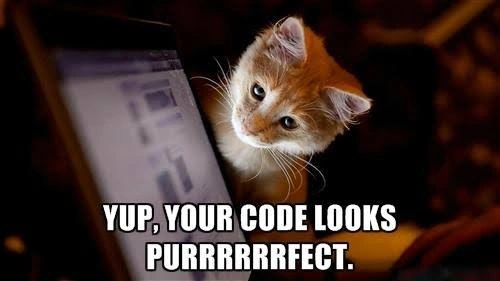
Now, imagine that whole serious process but with a kitten as the reviewer. That’s exactly what this meme shows! The photo has a curious orange kitten peeping from behind a laptop, as if it’s scrutinizing the code on the screen. The big caption text says: “YUP, YOUR CODE LOOKS PURRRRRRFECT.” This is a playful cat-themed way to say, “Yes, your code looks perfect,” with “purrrrfect” stretched out to imitate a cat’s purring sound. It’s a cute pun – combining the word “perfect” with “purr,” the sound cats make when they’re content. The humor comes from the fact that in real life, code reviews almost never call code perfect. There’s always something to improve or fix. But here we have a cat boldly giving a 100% positive review, no notes, no criticism at all. It’s the ultimate pawsitive feedback! 🐾
Why is that funny to developers? Well, if you’ve ever submitted code for review (often via a pull request on platforms like GitHub or GitLab), you know the anxious feeling of waiting for feedback. You might brace yourself for comments pointing out mistakes or asking you to rewrite something. Getting a response that everything is perfect is super rare – so rare it’s basically a fantasy. The meme takes that fantasy and makes it extra fun by using a kitten as the reviewer. Cats are famously picky in other contexts (like being finicky eaters or batting at things they don’t like), so a cat approving code without any complaints is doubly silly. It’s like the least likely reviewer giving the most generous approval.
The caption’s style is also a nod to typical meme formatting. It uses big white Impact font (the classic meme text style) with a black outline, and the language is short and punchy. By saying “YUP, YOUR CODE LOOKS PURRRRRRFECT,” it mimics how a confident, perhaps slightly irreverent reviewer might talk. In developer slang, when a reviewer likes your code, they might simply say “LGTM” (short for “Looks Good To Me”). That’s basically a quick thumbs-up. The cat in this meme is doing an over-the-top version of LGTM – it’s not just good, it’s purrrfect! The extra R’s in “purrrrfect” emphasize the cat theme and excitement. It’s as if the cat is purring while delivering the compliment, really laying it on thick.
This scenario is relatable humor for people who write code because it flips expectations. Usually a code review, even a friendly one, results in a list of things to change. But deep down every coder would love to hear “No changes needed, you nailed it.” It’s a bit like a student secretly hoping to get an A+ with no corrections on their essay. The meme indulges that wish in a comical way. The kitten is essentially giving the developer a “seal of approval,” or we might say a "paws of approval." In the image, the cat even has wide, attentive eyes, as if it really did examine the code carefully. Of course, a real cat has no idea what’s on the screen – that’s part of the joke. The feline consultant doesn’t actually understand programming; it just feels like everything is great.
We also have the comedic contrast between how code reviews normally feel and this lighthearted take. Real code reviews can sometimes be tense. If you’re new, you might worry about a senior engineer finding mistakes in your code. Even if you’re experienced, a thorough review can be time-consuming and detail-oriented. It’s an essential part of improving CodeQuality, but let’s face it, it’s not usually cute or fun. By comparison, this meme’s scenario is warm and comforting. The cat reviewer isn’t pointing out any errors at all. It’s like a friend who only says, “Awesome job!” without any “By the way, you missed a spot.” That kind of unreserved praise can be both funny and heartwarming to someone who’s used to more critical feedback.
Another layer to the humor is simply developers and cat memes – there’s a long history there. Many programmers enjoy cats and have cats as pets, or at least appreciate cat pictures on the internet. There’s something about the stereotypical programmer lifestyle (staying up late coding with a cat on the keyboard, perhaps) that makes this image extra fitting. Seeing a cat involved in a coding scenario, even jokingly, just fits the internet culture. We often say things like “code has bugs.” Here, we could imagine the cat looking for bugs (bugs are problems in code, but also what cats might literally chase, like insects). The punchline is that the cat finds none – no “bugs” in the code – and so it’s purrfect. In fact, one could say the cat found no fleas in the code at all (a silly way to tie together the idea of bugs and what cats might have). It’s this blend of technical context with pet humor that makes the meme charming to those in the know.
So, to sum up the Level 2 understanding: This meme shows a kitten acting as a code reviewer who declares the code flawless. It’s funny because real code reviews almost never go that ideally, and the cat pun “purrrrfect” makes it extra cute and memorable. It gently pokes fun at the idea of perfect code (which is practically nonexistent) and gives a warm, fuzzy twist to a normally detail-critical process. Even if you’re new to coding, you can appreciate the silliness of asking a kitten to validate complex computer code. And if you are a coder, you likely know the relief and surprise that such high praise would bring – which is exactly why the joke hits home.
Level 3: The Purrrfect Pull Request
At a senior engineering level, this meme is hilariously ironic. Any experienced developer knows that no code is ever truly “perfect.” In real-world CodeReviews, hearing “your code looks perfect” is almost mythical. There's always something – a bug to squash, a variable name to tweak, or a corner case missed. Yet here we have an adorable orange tabby acting as the code reviewer, boldly proclaiming the code is “purrrrfect.” This juxtaposition is pure DeveloperHumor: it takes the painstaking process of code review and gives it a CatMemes twist, delivering the ultimate (and highly unlikely) compliment. The caption’s elongated “PURRRRRRFECT” is a classic purrrrfect_pun – blending a cat’s purr with the word “perfect” – to exaggerate how flawlessly the code has been judged. It’s a playful nod to the idea of feline_approval in a domain where scrutiny is normally as sharp as cat’s claws.
In a typical code review for any non-trivial change, a reviewer would leave a trail of comments and questions:
- Nitpicks on style: “Please use camelCase for this function name.”
- CodeQuality critiques: “This block is doing a lot – can we refactor for clarity?”
- Bug spotting: “What if
countis null here? This might throw an exception.”
Even the most elegant pull request rarely escapes without at least one “nit.” Perhaps a loop could be simplified, or a magic number replaced with a named constant. Maybe the logic works but isn’t following the team’s coding standards. Seasoned reviewers are meticulous; they’ll sniff out any tiny imperfections like a cat sniffs out a stray bit of catnip. That’s why the meme triggers knowing chuckles – it’s depicting the polar opposite of a real code review. Instead of a colleague meticulously combing through your diff hungrily looking for improvements, here a kitty just gives a paws-up and says everything is fine. It’s the ultimate rubber-stamp approval, literally with a furry rubber stamp. Rubber-stamp reviews (approvals given without proper inspection) are normally frowned upon because they defeat the purpose of a review. But when the “reviewer” is a kitten, the absurdity is obvious and laughable. The cat isn’t going to catch that off-by-one error or notice the missing unit tests – and that’s exactly the point of the joke.
This meme cleverly satirizes our quest for flawless code. Developers talk a lot about writing clean code and achieving high CodeQuality, but the truth is every code change has trade-offs or potential issues. The phrase “Looks Good To Me” (LGTM) is often used in reviews to signal approval – sometimes sincerely, sometimes just to be done with it. Here, the cat’s “Yup, your code looks purrrrfect” is like the most exuberant LGTM imaginable. It’s beyond just “good” – it’s “purrfect,” with an extra dose of cute enthusiasm. For a jaded engineer who’s used to code review feedback ranging from helpful suggestions to borderline nit-picking, the idea of getting such unconditional praise is both dreamy and comical. It’s like the meme is whispering to every coder’s soul: “Wouldn’t it be nice if code reviews were this easy?” – accompanied by a soft purr.
There’s also an undercurrent of truth in the humor: many developers have a bit of imposter syndrome and worry about harsh code critiques. A review that finds “no issues at all” is incredibly rare – sometimes suspiciously so. (If a teammate ever says your 1000-line commit is “perfect”, you might actually worry they didn’t read it!) The cat reviewer embodies a scenario where code review isn’t a stress trigger but a feel-good formality. It exaggerates the positivity to highlight how unusual that is. This contrast resonates especially with seasoned developers – the ones who have been on both sides of tough code reviews. They remember being junior and hoping their code was flawless, only to get a page of review comments back. They’ve also been reviewers who want to be nice but have a duty to uphold quality. So the notion of a cuddly “consultant” that declares everything is purrrfect pokes fun at the fantasy of totally perfect code. It’s a gentle reminder that in the cat world (and only in the cat world), code has no bugs.
On the technical side, the meme hints at the difference between superficial checks and real quality control. Nowadays, teams use tools like linters and static analyzers (automatic code reviewers) to catch common mistakes. Even these tools rarely call code perfect; they’ll flag an unused variable or a formatting issue. We run continuous integration pipelines with dozens of tests to ensure nothing’s broken. A cat, on the other hand, isn’t running your test suite or doing static analysis. 🐱 It’s just peeking at the screen with wide, non-judgmental eyes. In fact, if code were truly “purrrfect,” one could joke that it passed all tests, had 100% coverage, zero lint warnings, and met all style guides – in other words, a near-impossible ideal. The cat’s comical approval shines light on how high that ideal is. It’s saying, “Relax, your code is as flawless as can be,” which every developer knows is tongue-in-cheek.
Culturally, combining coding with a cat meme hits a sweet spot for the tech crowd. The internet and programming culture have a long-standing affinity for cats – from the old I Can Has Cheezburger? days to GitHub’s Octocat mascot, feline imagery is beloved in nerdy circles. This meme taps into that: it’s instantly recognizable as RelatableHumor for developers. By tagging a scenario as serious as code review with something as lighthearted as a kitten’s purr, it creates a jarring but funny contrast. It reminds us not to take ourselves too seriously. After all, if a feline consultant says your code is good, maybe you can take a brief break from worrying about perfections and enjoy the moment. For one blissful second, your code has no bugs, no TODOs, no stylistic infractions – it’s certified by the cat_code_review_meme as “purrrrfect.” And seasoned devs find that both endearing and absurd, because they know the messy reality. It’s a harmless wish-fulfillment joke wrapped in a pun. In short, the meme is chuckle-worthy because it flips the script: instead of a colleague handing you a list of changes, a kitten gives you an ego-boosting thumbs-up (or rather, a paws-up) with zero scrutiny. It’s the code review we all wish we could get, delivered by the last creature you’d expect to understand your code.
Description
A heartwarming and humorous image macro featuring an adorable orange kitten peering over the top of a laptop screen, looking directly at the viewer. The screen itself is out of focus, suggesting code or a webpage. Bold white text at the bottom of the image reads, 'YUP, YOUR CODE LOOKS PURRRRRRFECT.' The humor comes from the play on words, substituting 'perfect' with 'purrfect,' and the amusing idea of a cat performing a code review. It's a universally relatable meme in the developer community, representing the desire for a simple, positive affirmation on one's work, especially after a difficult coding session. The kitten's innocent and approving gaze offers a moment of light-hearted validation
Comments
7Comment deleted
This is the ideal senior engineer review: no unsolicited refactoring suggestions, just a silent, judgmental stare that confirms your code runs. Or at least that the laptop is warm
The office cat’s review workflow: `git diff | cat > /dev/null && git merge`, and somehow the 2 AM pager is still your problem
After 15 years of rigorous code reviews, I've finally found the perfect reviewer: doesn't nitpick semicolons, never debates tabs vs spaces, and their approval rating correlates directly with how recently you've refilled their food bowl. The only downside is they keep pushing commits at 3 AM that just say 'meow'
This perfectly captures the dreaded 'LGTM' culture where code reviews become rubber-stamping exercises. We've all been that kitten - glancing at 500 lines of refactored business logic at 4:45 PM on Friday and thinking 'yup, looks purrfect, ship it.' Bonus points if the PR description just says 'minor changes' and touches 47 files across 12 microservices. The real question: is this the reviewer who actually caught that race condition in your distributed lock implementation, or the one who approved your accidental `DROP TABLE users` migration?
Only two entities ever say “purrrrfect” on a PR: the office cat and the reviewer who skimmed the diffstat (-1,243 +2) and hit LGTM
The only reviewer who skips bike-shedding and approves without demanding a monad refactor
“Purrrrfect” is the LGTM you get right before discovering the N+1 queries, non-idempotent retries, and that your “simple” cron job quietly became a distributed system