Linked Lists Explained with Pointing Leonardo DiCaprios
Why is this CS Fundamentals meme funny?
Level 1: End of the Line
Imagine you have a line of friends sitting in a row, and they’re playing a pointing game. The first friend turns to the second friend and points at them as if to say, “Tag, you’re it!” The second friend then points to the third friend. The third points to the fourth, and so on down the line. Eventually, you get to the last friend. Now, when the last friend tries to point, there’s no one there – they’re at the end of the line! So the last friend just points at nothing or maybe shrugs because there’s no next person to continue the game.
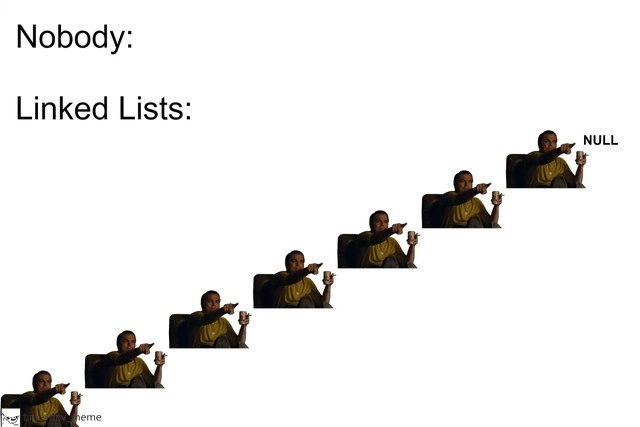
This is exactly what’s happening in the meme. Each pointing man is like one friend passing along a message or tag to the next friend. The very last man is pointing at “NULL,” which is just a fancy programming word for “nobody” or “nothing.” It’s the meme’s funny way of showing that the chain has to stop somewhere. We find it funny because it takes a normal programming idea – a list of things that ends with nothing – and shows it in a simple, goofy way that anyone can visualize. It’s like watching a group of people go “You look at the next person… okay, now you look at the next person…” until the last person goes, “Uh, there is no next person!” Seeing the guy literally pointing at nothing (NULL) makes us chuckle because it’s a playful reminder: every chain, whether friends pointing or a list of data, has to end somewhere. And in programmer language, that somewhere is called “NULL.”
Level 2: Next in Line
Let’s break down the joke in more straightforward terms. In computer science, a linked list is a fundamental data structure that resembles a chain: each element in the list (we call it a node) contains some data and a reference (called a pointer) to the next node in the sequence. A singly linked list means each node only points one-way, forward to the next node (unlike a doubly linked list which has pointers both to next and previous). Now, how do we know when we’ve reached the end of the chain? That’s where NULL comes in. NULL is a special pointer value that basically means “nothing” or “nowhere.” We use it as a marker to say, “This is the end; there’s no next node.” In many languages, you’ll see the last node’s next set to NULL (or null/None depending on the language) to signify the list terminates there.
In the meme, the text “Linked Lists:” is followed by a series of six images of a man pointing to the right, each one positioned a bit higher and to the right of the previous, forming a staircase-like chain. Think of each of those pointing men as a node in a linked list. The man’s pointing finger visually represents the node’s pointer to the next node. So the first man is the head of the list, pointing to the second man (the next node), who points to the third, and so on. This continues until the last man in the chain, who is pointing at the word “NULL.” That “NULL” label is exactly what a programmer would use in code to mark “there’s no further node here.” It’s the meme’s way of saying “this is the end of the list.” If you were writing this out in pseudocode, it’s like:
- Node1 points to Node2
- Node2 points to Node3
- ...
- Node6 points to NULL (no Node7, we stop here)
The top-left text “Nobody:” is part of a common meme format where it implies that nobody said or did anything (complete silence), and yet Linked Lists (personified) go ahead and do their routine anyway. It’s highlighting a kind of running joke: even without context or prompting, of course a linked list will keep traversing from one node to the next until it hits null — that’s just what linked lists do! For many of us who learned programming, this format playfully mocks how we often explain things that seem obvious. No one explicitly asked “How do linked lists work?”, but the meme jokily “answers” it: they just keep pointing along.
From a newcomer’s perspective, it’s also a lighthearted introduction to how pointer-based lists operate. Each “pointer finger” demonstrates the concept of pointer chaining: you follow the chain one link at a time. If you’ve ever written a loop to print out all elements of a linked list, you know the pattern: start at the head, then go to head.next, then head.next.next, etc., until you encounter NULL. The meme basically acts out that loop in a visual form. The repetition of the pointing man six times drives home that step-by-step traversal. And that little “NULL” at the end is a teaching moment: it shows explicitly that the chain doesn’t go on forever; it ends when there are no more nodes to point to. For someone learning, it’s crucial to remember that trying to follow another pointer after NULL is a no-go — in real programs, using NULL like a real pointer leads to errors (like a NullPointerException in Java or a segmentation fault in C).
The humor here is pretty gentle and nerdy: it’s funny because it’s so literal. We usually draw linked lists with arrows, but here a meme character’s pointing gesture replaces the arrow. It’s as if the linked list itself came to life and said, “Hey, let me show you how I work!” For a junior developer or a student, it’s a handy mental picture: you won’t forget that image of Leo pointing to NULL the next time you write a while (node != NULL) loop to traverse a list. And if you’re familiar with internet meme culture, the “Nobody: ... Linked Lists:” setup just adds a layer of silly relatability — it’s the meme’s way of saying this is a default behavior, almost like Linked Lists have a mind of their own in the world of ComputerScienceHumor. In short, this meme uses a funny format to teach and remind us of a straightforward concept from computer science. It’s the data_structure_humor equivalent of a knock-knock joke about pointers – simple, a bit absurd, but effective!
Level 3: Stairway to NULL
This meme is a clever nod to CS fundamentals that has seasoned developers smirking in recognition. It uses the popular “Nobody: ... X: ...” meme format to humorously illustrate how a singly linked list works: each node inexorably points to the next node until the chain terminates at NULL. The repeated image of the man in the yellow shirt (Leonardo DiCaprio’s iconic pointing meme from Once Upon a Time in Hollywood) serves as a stand-in for the pointer in each node, effectively turning the usual data structure diagram into a bit of developer humor. The diagonal “staircase” arrangement isn’t just for style—it symbolizes the step-by-step traversal through memory as you follow pointers from one node to the next.
For those of us who’ve wrestled with low-level data structures, this visual gag hits home. It’s pointing out (pun intended) the exact mechanism that we implement in code:
struct Node {
int data;
Node* next;
};
// Creating a simple linked list manually:
Node* head = new Node{1, nullptr};
head->next = new Node{2, nullptr};
head->next->next = new Node{3, nullptr};
// ... and so on until:
Node* tail = new Node{6, nullptr};
head->next->next->next->next->next = tail;
tail->next = NULL; // The last node points to NULL (terminator)
Just like in this code, each Leo node in the meme points to the next Leo node, with the final one pointing at NULL – the universally recognized end-of-list sentinel. Seasoned devs know that forgetting to set this null terminator is asking for trouble: without that NULL to mark the end, traversal could wander off into random memory (cue the dreaded null pointer bugs or infinite loops). The meme playfully reminds us of that inevitable terminus. We’ve all been there: tracing a pointer chain in the debugger node-by-node, yelling “Where’s my null?!” when things go awry. The humor here comes from the absurd literalism: even though “nobody” asked for an explanation, the linked list is always going to do its thing — point relentlessly onwards until it hits the brick wall of NULL. It’s a fundamental truth of data structure humor that feels both obvious and satisfying, much like an inside joke among programmers. And admit it, seeing a meme character physically enacting what we usually depict with arrows in a textbook diagram tickles the ComputerScienceHumor part of our brains.
On a deeper note, this meme format also pokes fun at how Linked Lists seem to pop up everywhere in programming discussions even when unprompted (that “Nobody:” line). It’s like the collective joke that no one asked, but here we are revisiting pointer 101. The veteran coders in us chuckle because we recall how crucial (and sometimes painful) this concept was in our learning journey — from managing memory manually in C/C++ to avoiding NullPointerExceptions in Java. There’s even a bit of historical irony: the idea of a NULL pointer was once dubbed “the billion-dollar mistake” by its inventor Tony Hoare due to all the bugs and crashes it caused, yet we still rely on NULL as a simple, effective null sentinel to terminate lists. In essence, the meme is jovial proof that even the most elementary data structures can spark joy (and jokes) in the developer community. It’s a pointer (😄) to our shared experiences: no matter how advanced we get, we all remember that simple linked list that keeps pointing until it can point no more.
Description
A meme using the 'Nobody:' format to humorously illustrate the concept of a linked list. The top text reads 'Nobody:' and 'Linked Lists:'. Below, there is a diagonal chain of six identical images of Leonardo DiCaprio from the movie 'Once Upon a Time in Hollywood,' where he is sitting in a chair, holding a drink, and pointing at something off-screen. Each image in the sequence points to the next, visually representing a node pointing to the subsequent node in a list. The very last image at the top-right points to the word 'NULL', signifying the end of the list. This meme provides a simple and funny visual metaphor for the fundamental computer science data structure, where each element (node) contains a value and a reference (pointer) to the next element, until the final element, which points to nothing (null)

Comments
7Comment deleted
A linked list is just an array that's really bad at cache locality. It's the data structure equivalent of sending a colleague to another building for the next slide of your presentation
Linked lists: the academic promise of O(1) inserts - paid for with an amortized infinity of cache misses until you finally dereference NULL
After 20 years in tech, I've finally accepted that every "simple" linked list operation in production eventually becomes a distributed systems problem with eventual consistency requirements and a Kafka topic for node updates
This perfectly captures the linked list experience: you start at 'me', follow the chain of next pointers through O(n) identical nodes, and just when you think you've found what you're looking for, you hit NULL. At least it's not a circular linked list - then we'd be stuck in this meme forever, burning CPU cycles until the heat death of the universe or a segfault, whichever comes first
Linked lists: the data structure that turns 3 GHz into 300 MHz via L1 misses - great on whiteboards, banned from hot paths
Linked lists: because sometimes the bottleneck isn’t Big‑O, it’s 64‑byte cache lines - enjoy your O(1) inserts, O(n) pointer‑chasing, and an inevitable rendezvous with NULL
This linked list: perfect singly-linked traversal, no cycles - unlike my last merge conflict resolution