Skip to content
DevMeme
2873 of 7435
A Maliciously Compliant Salary Negotiation
Interviews Post #3175, on May 31, 2021 in TG

A Maliciously Compliant Salary Negotiation

Why is this Interviews meme funny?

Level 1: Same Candy, Fancier Wrapper

Imagine you have one candy, and you ask for double the candy because you want more. You expect that you’ll get two candies. Instead, your friend takes your one candy, wraps it in a shiny new wrapper, and says, "Here you go, now it's 1.00 candies!" You look at it and it's still just one candy — they just changed the way it’s packaged and labeled, not the amount.

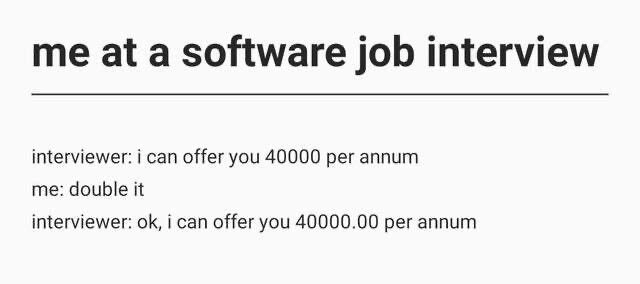
This meme is joking about that kind of trick. The person in the interview asked for double the salary (like asking for two candies instead of one), but the interviewer just wrote the same number in a more fancy way (turning 40000 into 40000.00) and acted like that was an increase. Of course, 40,000 point zero zero is the same as 40,000. It's just like giving the same candy back in a prettier wrapper. The funny part is how literal the interviewer was: the candidate wanted more money, but the interviewer pretended that adding “.00” — basically adding nothing of real value — was the same as doubling. It’s a silly misunderstanding that makes us laugh because one side is taking the words very literally instead of doing what was actually meant.

Level 2: Just Add .00

Let’s break down why this situation is funny to people in tech. In a typical software job interview, you eventually talk about salary. Here, the interviewer says, "I can offer you 40000 per annum," meaning a salary of 40,000 (units of currency) per year. The candidate boldly replies, "double it," which normally means "please increase that offer to twice the amount." They were hoping for 80,000 per year. This is where the misunderstanding (and the joke) happens.

In the programming world, the word "double" has another meaning besides "twice as much." Double is the name of a data type used in many languages (like C, C++, Java) to represent numbers that can have a fractional part (decimal points). It's short for "double-precision floating-point number." For example, an int (integer) might hold the number 40000, while a double could represent 40000.0 (and if you format it to two decimal places, it would display as 40000.00). Converting an integer to a double is called type casting, and it doesn’t change the number’s value at all — it only changes how it's stored or displayed. Often, if you print a double value that has no fractional part, it might show up with a trailing .0 or .00 because of the decimal formatting, whereas an int would just print as a whole number with no decimal.

So in the meme, when the candidate says "double it," the interviewer pretends (or perhaps genuinely misunderstands in a jokey way) that this is an instruction related to data types or formatting, not money. The interviewer says, essentially, "Sure, I'll make it a double," and comes back with 40000.00 instead of 40000. By adding the “.00”, they've technically changed the representation of the number but not the number itself. It’s as if the interviewer ran the salary through a computer program that did something like this:

  • Take salaryOffer = 40000 (treat this as an integer value).
  • Convert it to a double data type (now internally it’s 40000.0, a floating-point number).
  • Format that number to two decimal places, getting "40000.00".
  • Offer that to the candidate as the "new" salary. (It’s visually different but financially the same 40,000.)

To a programmer, this looks just like a classic numeric casting/formatting prank. It reminds us of a coding scenario where a developer might mistakenly format or cast a number without actually doing the math to change its value. If you've ever had a bug where you meant to double a value but only changed its type or its display, this will ring a bell.

The meme is also poking fun at the interview process itself. Salary negotiation can be awkward, and sometimes when you ask for more, the counter-offer you get is disappointingly small. In this extreme joke case, the "increase" was literally zero — just decorated with extra zeros after a decimal point. It’s a form of developer humor that combines a real-life feeling ("I asked for more and got nothing") with a programming joke (treating the word "double" as code). This combination makes tech folks laugh because it’s both relatable and nerdy.

Level 3: Typecasting the Offer

The meme sets up a classic negotiation scenario with a developer twist. In the text, the candidate says "double it" expecting the salary offer to jump from 40000 to 80000. However, the interviewer responds by offering 40000.00 per annum – essentially the same number, just with two decimal places. This is a clever play on words: in programming, double is a data type (meaning a double-precision floating-point number). Performing a type casting of an integer to a double would produce a value like 40000.00 without changing the magnitude. The humor comes from the interviewer treating "double it" not as multiply by two, but as convert the number to a double type and add a decimal point. It's a literal, code-like twist that makes the scenario absurd and funny.

For seasoned developers, this joke resonates on multiple levels. First, it highlights a bit of tech InterviewHumor around salary negotiations: asking for a big raise and getting a trivial or purely cosmetic change. It's a tongue-in-cheek nod to real experiences where companies or HR might try to make an offer seem better without actually increasing it (like phrasing compensation in an annual sum to sound larger, or adding fancy titles instead of more money). Here, adding “.00” is literally just a formatting change with no real value increase. It feels like the kind of devious trick an overly literal engineer might pull.

On the technical side, the meme references how numeric representation works in code. For example, consider this pseudo-code:

int offeredSalary = 40000;
double newOffer = (double) offeredSalary;
printf("Offer: %.2f per annum", newOffer);  // Output: Offer: 40000.00 per annum

Casting the integer 40000 to a double and formatting it with two decimal places yields "40000.00". The value hasn’t been doubled; only its representation has changed. In essence, the interviewer in the meme executed that exact operation in real life. They complied with the request in a purely technical sense (changing 40000 to 40000.00) while ignoring the real-world intent (an actual raise to 80000). This deadpan literalism is what makes developers smirk. It’s a prime example of a salary negotiation misunderstanding being illustrated through a decimal formatting gag. The meme perfectly merges real-world frustration with a geeky in-joke, capturing that mix of laughter and facepalm all developers know well.

Description

This is a text-based meme presented on a plain light gray background. At the top, there is a title in bold black font that reads, 'me at a software job interview'. Below a thin horizontal line, a short dialogue is presented in a monospaced font. The conversation unfolds as: 'interviewer: i can offer you 40000 per annum', 'me: double it', 'interviewer: ok, i can offer you 40000.00 per annum'. The humor is a classic programmer pun that plays on the ambiguity of the word 'double'. The interviewee intends for their salary to be multiplied by two, but the interviewer interprets 'double' as the double-precision floating-point data type. Instead of increasing the salary to 80000, they simply change the integer 40000 to its floating-point representation, 40000.00, which is numerically identical. This joke resonates with developers who understand the strict distinctions between data types in programming
Comments

14
Anonymous ★ Top Pick This is why you should always specify your desired salary in IEEE 754 format during negotiations. It avoids ambiguity and shows you're serious about precision
  1. Anonymous ★ Top Pick

    This is why you should always specify your desired salary in IEEE 754 format during negotiations. It avoids ambiguity and shows you're serious about precision

  2. Anonymous

    Pro tip: if HR stores comp as float32, “double it” just promotes the field to float64 - same value, twice the disappointment

  3. Anonymous

    After 20 years in tech, I've learned that asking for 'double' in a salary negotiation is like using == with floats - technically correct but you're never getting the result you expected

  4. Anonymous

    Classic case of undefined behavior in salary negotiation - the interviewer clearly compiled with -O0 optimization flags. Should've been more explicit: 'multiply by 2' instead of 'double it'. Next time, use a strongly-typed contract with explicit casting: `static_cast<uint32_t>(offer * 2)`. Though honestly, at 40K, even with proper type promotion to uint64_t, you're still in the 'legacy codebase maintenance' compensation tier

  5. Anonymous

    Asked for 2x comp; they did a widening cast from int to double - more precision, same value

  6. Anonymous

    Asked to “double” the offer; they cast it to DECIMAL(10,2) and called it a raise - classic schema change with no data migration

  7. Anonymous

    Recruiter heard 'double it' and cast the salary from int to double precision - mantissa unchanged

  8. @ZgGPuo8dZef58K6hxxGVj3Z2 5y

    Looool

  9. @grandpa_the_kid 5y

    Old but gold)

  10. @adhdnigga 5y

    funny

  11. @adhdnigga 5y

    Channel("dev_meme").funnyposts+=1;

  12. @spiritualattunement 5y

    Normalin, finally funny

  13. @Vanilla_Danette 5y

    He literally did ¯\_(ツ)_/¯

  14. @callofvoid0 5y

    😂😂

Use J and K for navigation