Skip to content
DevMeme
3803 of 7435
The Developer's Classic Time Sink Choice
Debugging Troubleshooting Post #4145, on Jan 31, 2022 in TG

The Developer's Classic Time Sink Choice

Why is this Debugging Troubleshooting meme funny?

Level 1: Asking for Directions

Imagine you got a new toy or a complicated LEGO set. There’s a little booklet with instructions that would take just a few minutes to read and show you exactly how to put it together. But instead of looking at that guide, you toss it aside and spend hours trying to figure it out by yourself. You connect pieces in all sorts of ways, take them apart, and try again over and over. Eventually, after a long time being stuck, you finally open the booklet and realize the solution was clearly written there the whole time. You could have saved so much time if you had just read those instructions first!

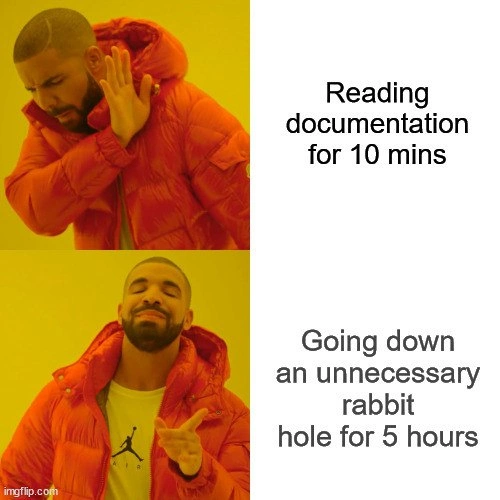
This meme is like that story. It shows a person (Drake) who doesn’t want to spend 10 minutes reading the instructions (he’s saying “No thanks” to that) but is happy to spend 5 hours struggling on his own (he’s saying “Yes, this is great!” to doing it the hard way). It’s funny because it’s backwards from what you’d expect – reading the guide is easy and quick, while wandering on your own is hard and slow. The joke highlights how people (especially those writing code) sometimes do silly things like avoiding a little help and then taking much longer to solve the problem. Essentially, it’s a playful way of laughing at ourselves for not wanting to ask for directions (or read instructions) even when it would clearly save us time.

Level 2: Docs vs Rabbit Hole

The meme uses the popular Drake Hotline Bling template, where the rapper Drake first rejects one thing (top image) and then approves another (bottom image). Here’s how it breaks down in this context:

  • Drake says “No” to reading documentation for 10 minutes: In software, documentation (or “docs”) is the official guide or manual that explains how to use a tool, library, or API. It could be a README file, a website with an API reference, or a user manual. Reading documentation for 10 minutes means taking a short time to consult these official instructions or examples. This is usually the recommended way to learn how something works or how to fix a problem. In the meme, Drake is shown turning away from this idea, as if it’s unpleasant or uncool. Many developers can relate to feeling a bit impatient about reading docs – sometimes we skip them because we think we already know enough, or we assume it will take too long to find the answer in those pages.

  • Drake says “Yes” to going down an unnecessary rabbit hole for 5 hours: “Going down a rabbit hole” is a phrase meaning getting lost in a long, winding exploration. It comes from the story Alice in Wonderland, where Alice follows a rabbit into a hole and ends up in a very strange and complicated place. In a developer’s world, a rabbit hole often means an deep dive into debugging or researching where one thing leads to another and another, and you stray far from your original question. It often starts innocently – you get an error, you search the web for that error, then read a forum post, which links to a blog, which leads you to try a different tool or inspect internal code… before you know it, hours have passed. The meme’s text calls this “unnecessary” because it probably could have been avoided. Drake smiling and pointing at this caption implies the developer prefers this convoluted path. It humorously suggests that the developer is eager to do a 5-hour investigative journey rather than a quick 10-minute read. This is a time management fail because it wastes a lot of time that could have been saved by reading the docs in the first place.

Why is this scenario so relatable? Developers (especially those new to a problem) sometimes avoid reading documentation for a few reasons:

  • They might find official docs boring or hard to navigate. (It’s text-heavy, maybe too much detail when they just want a quick answer.)
  • They might not realize the answer is in the docs, so they immediately search elsewhere (like on Stack Overflow or Google) for quick help.
  • There’s a bit of procrastination involved – diving into code or searching the internet feels more interactive and adventurous than sitting and reading a manual. It feels like you’re “doing something” productive, even if it’s going in circles.
  • Sometimes documentation in some projects is poor or outdated, so developers become conditioned to assume “docs won’t help” and instead try to figure things out themselves.

However, often the documentation is actually quite helpful. The meme is making fun of the times when the docs did have the answer or would have prevented the wild goose chase. It’s an inside joke among developers because most of us have experienced a moment where, after hours of struggling, we finally open the official guide or FAQ and find the solution in moments. It’s that “I should have just read this first!” facepalm moment.

The tags like DocumentationHumor and DocumentationAversion refer to this idea of developers joking about how they avoid documentation. Documentation aversion is basically shying away from reading the manual or official guides. And it ties into DeveloperProductivity: choosing the 5-hour rabbit hole is clearly not productive, even though it feels like work while you’re doing it. It’s a well-known funny habit – so much so that “RTFM” (Read The Fine Manual) is a common refrain when someone asks a question that is answered in the docs. Instead of spending 10 minutes to RTFM, the person might spend hours reinventing the solution.

Let’s put it in a simple example: imagine you’re using a new library to handle images in your code. You need to resize a photo. The documentation for that library likely has a section that says, “To resize an image, call the resize(width, height) function.” Reading that page might take a few minutes. But if you don’t read it, you might try to write your own resizing code from scratch, search online for code samples, or experiment with various functions you discover by guessing. You might spend all afternoon and still have a buggy result. In the end, you might stumble upon the resize() function or finally check the docs and realize it was there all along. You spent 5 hours on something that a quick read would have solved in 10 minutes. That’s exactly the irony the meme is pointing out. It’s funny to developers because we’ve all caught ourselves doing this – it’s an easy trap to fall into when we’re feeling stubborn or overly adventurous.

In short, this meme humorously contrasts the sensible approach (read the docs, save time) with the tempting but inefficient approach (dive in blindly, waste time). The Drake format makes it clear which option the “typical developer” is choosing, to our own detriment. It’s a gentle poke at our habits and a reminder that sometimes the quickest way to solve a problem is to take a brief pause and read the instructions.

Level 3: RTFM Resistance

This meme highlights a classic developer anti-pattern: avoiding the official documentation and instead plunging into a time-consuming deep dive. In the top panel (the infamous “Drake no” image), the caption “Reading documentation for 10 mins” is something Drake – representing the developer – dramatically rejects. In the bottom panel (“Drake yes”), the caption “Going down an unnecessary rabbit hole for 5 hours” gets an enthusiastic thumbs up. It’s poking fun at how developers often shun a quick read of docs (which might take only minutes) and prefer a 5-hour debugging odyssey that could have been avoided. The humor lands because it’s so relatable: we’ve all seen (or been) that engineer who spends half a day on trial-and-error rather than skim a few pages of official guide.

Why do smart developers do something so seemingly irrational? Part of it is a mix of overconfidence and documentation aversion. Reading docs can feel “slow” or tedious, especially when you’re eager to jump in and start coding. There’s also a certain pride and thrill in figuring things out yourself – it feels like real work as opposed to “just reading.” Unfortunately, this can lead to a productivity nightmare where you chase false leads, fix the wrong problem, or reinvent the wheel. The meme exaggerates it as 10 minutes vs. 5 hours to underscore the absurd mismatch: a tiny investment in reading could prevent a massive time sink, but in the moment developers often choose the latter. It’s a form of procrastination dressed up as productivity – instead of doing the “boring” prep (RTFM), we distract ourselves by digging into code, searching random forums, and exploring tangents (the proverbial rabbit hole).

This scenario is so common there’s even a tongue-in-cheek term for it: RTFM – “Read The Friendly Manual” (with Friendly being a polite substitution for a stronger word). The joke is that many of us stubbornly refuse to RTFM until we’re utterly stuck. Seasoned engineers will chuckle (or groan) at this because they’ve lived it. For example, imagine spending an afternoon debugging a library only to discover a FAQ section in the docs had the exact answer. The meme’s Drake format perfectly captures that irrational decision-making: turning away from the straightforward solution and happily embracing the convoluted detour. It’s a light-hearted jab at our worst developer instincts.

In practice, this anti-pattern can lead to real consequences: missed deadlines, technical debt from hacked-together solutions, and plenty of frustration. Teams might end up with messy workarounds simply because someone skipped the manual and didn’t realize a clean solution already existed. It reflects a broader cultural habit in tech of valuing experimentation over preparation. While tinkering and exploration are core to learning, the meme points out the comedic extreme: when exploration becomes inefficient wheel-spinning. It resonates with experienced devs because we’ve all been there – eyeing the nicely organized docs in one browser tab while drowning in dozens of Stack Overflow tabs instead.

To put it simply, the meme is funny because it’s true. It’s a satire of that time-management fail nearly every coder has committed. The Drake template drives the point home with a visual punchline: the dev knows the right approach (reading docs) but emotionally prefers the wrong one (a five-hour rabbit hole). It’s a knowing wink to all developers: sometimes, the shortest path to a solution is the one we avoid due to impatience or ego. In the end, we laugh because we recognize ourselves in Drake – choosing the long way around and then facepalming later.

# Pseudo-code timeline of documentation avoidance:
if problem_encountered:
    print("Searching the hard way...") 
    search("random error message on StackOverflow")   # dive into community forums
    run(experiment_after_experiment)                  # trial-and-error for hours
    chase(obscure_side_issue)                        # follow a tangent down the rabbit hole
    print("...still no solution after 5 hours.")
    
# Eventually, in desperation:
open("official_documentation.pdf")  # Finally read the docs
print("Solution found in 10 minutes. 🤦")

The code above humorously represents the situation: instead of calling open("official_documentation.pdf") from the start, the developer tries everything else first. Drake’s approval of the 5-hour detour is pure irony – a wink at the collective developer folly of doing things the hard way. It’s a gentle reminder (wrapped in a joke) that the quickest fix is sometimes just to stop and RTFM.

Description

This is a classic 'Drake Hotline Bling' two-panel meme that humorously depicts a common developer behavior. In the top panel, the artist Drake is shown with a gesture of disapproval next to the text 'Reading documentation for 10 mins'. In the bottom panel, Drake is smiling and pointing in approval at the text 'Going down an unnecessary rabbit hole for 5 hours'. The meme satirizes the tendency for developers to avoid the straightforward, albeit sometimes tedious, task of reading documentation, which could solve a problem quickly. Instead, they often prefer to dive into a lengthy, complex, and often unnecessary investigation, fueled by a mix of curiosity, stubbornness, and the belief that they can figure it out on their own. It's a relatable commentary on developer productivity and problem-solving anti-patterns
Comments

14
Anonymous ★ Top Pick Reading the docs is O(1), but debugging a rabbit hole is O(n!) where n is the number of undocumented features you discover and feel compelled to 'fix'
  1. Anonymous ★ Top Pick

    Reading the docs is O(1), but debugging a rabbit hole is O(n!) where n is the number of undocumented features you discover and feel compelled to 'fix'

  2. Anonymous

    Docs: “set --sync=true.” Me with 20 years in: clone the repo, trace the commit from 2014, benchmark three kernels, whiteboard a CAP proof, write a post-mortem draft - then set --sync=true

  3. Anonymous

    The real rabbit hole starts when you decide to write your own documentation parser because the existing one doesn't support that one edge case you'll never actually encounter in production

  4. Anonymous

    Why spend 10 minutes reading the docs when you can independently reverse-engineer them with five hours and three abandoned mental models?

  5. Anonymous

    Every senior engineer knows the real architecture decision isn't choosing between microservices and monoliths - it's choosing between reading the three-paragraph API doc or spending your entire sprint reverse-engineering the library's source code, writing a custom wrapper, and ultimately discovering the exact solution was in the 'Quick Start' section you skipped. We call it 'exploratory development' in standup, but we all know it's just weaponized curiosity with a side of documentation allergy

  6. Anonymous

    RTFM takes 10 mins; RTFS confirms it after 5 hours of 'just checking'

  7. Anonymous

    20 YoE: instrument Envoy, tcpdump ALPN, bisect five releases to “validate assumptions” - then set the config flag the README mentioned on line 1

  8. Anonymous

    Architect brain: add distributed tracing, implement a bespoke backoff with jitter, skim two RFCs - then read line 1 of the README: set enable_legacy=false

  9. @dsmagikswsa 4y

    Working as a IT dev in a nutshell

    1. @trainzman 4y

      +

  10. @trainzman 4y

    absolutely fucking true

  11. @phpzapecanus 4y

    Docs are writing by a psyco on cocaine , without any context in it. Most of them I mean. All.

  12. @beton_kruglosu_totchno 4y

    i've seen so few good docs in my life i actually somewhat struggle to see the joke

    1. @slnt_opp 4y

      Indeed, real thing is usually under issue created and closed before christ, having nothing related to the problem in the title

Use J and K for navigation