Documentation-Driven Cable Management
Why is this Documentation meme funny?
Level 1: Following the Instructions
This is like building a big toy set and sorting every piece before you start. If you read the instructions first, everything lines up neatly and you can find parts later. If you ignore them, it may still stand, but fixing one piece later becomes a headache.
Level 2: Neat Cables Save Time
A network rack holds equipment such as switches, patch panels, servers, and cables. The cables connect devices so data can move through the network.
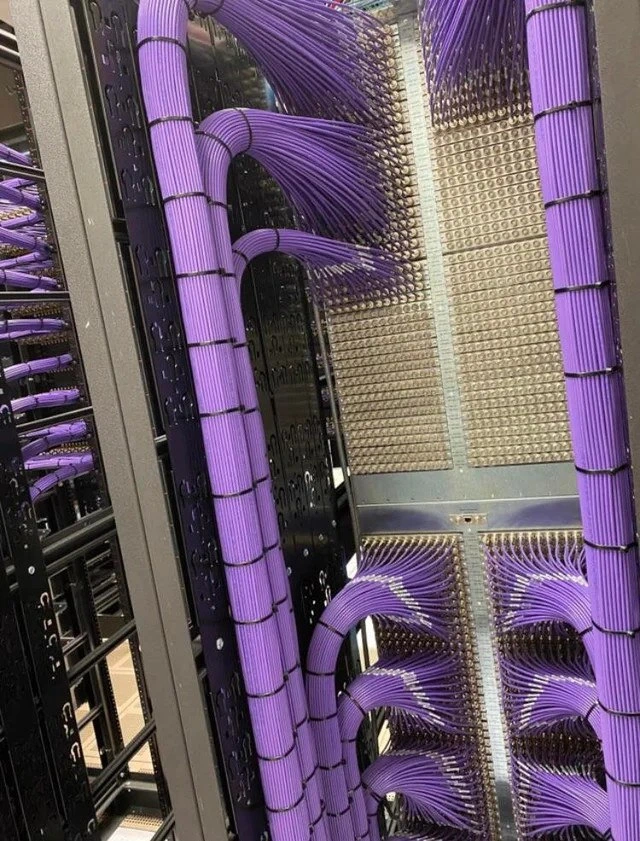
The purple cables in the image are carefully organized. They are bundled into straight sections, curved cleanly toward the ports, and separated in a way that makes the layout easier to follow. That is what cable management means: arranging cables so they are understandable and maintainable.
The caption jokes that this is what happens when someone reads the documentation first. In real infrastructure work, documentation can include:
- Which port connects to which device.
- Which cable color means what.
- How cables should be routed.
- How much bend or strain is acceptable.
- Where labels and patch-panel records should match.
For junior admins or developers who rarely touch hardware, this picture shows why "just plug it in" is not enough. A messy rack may work today, but it becomes hard to repair tomorrow. A clean rack is easier to inspect, easier to change, and less likely to turn maintenance into a guessing game.
Level 3: Runbook Meets Rack
The image shows an unusually clean rack installation: dense rows of ports, purple cables grouped into smooth vertical trunks, tight repeated curves, and bundles held in place instead of collapsing into the usual rack-side spaghetti. The post message supplies the punchline:
When you actually read the documentation before starting
That is funny because in infrastructure work, documentation is often treated like something you consult after the outage, when the rack is already a fossil record of emergency decisions. Here, the cabling looks like the opposite: someone planned the paths, respected the layout, knew where the ports were going, and did not discover the cable-management strategy halfway through with a flashlight in their teeth.
The joke is not merely "neat cables look nice." Good cable management has operational consequences. In a network rack, physical order affects traceability, airflow, maintenance time, failure isolation, and the stress placed on connectors. When every cable follows a predictable route, a sysadmin can find a connection without turning a five-minute task into a ritual of unplugging the wrong thing and learning new vocabulary.
Documentation matters because network infrastructure is a physical expression of decisions: port maps, patch-panel numbering, rack elevations, cable lengths, color conventions, labeling rules, redundant paths, and maintenance access. If those decisions are made before installation, the result can look like this image. If they are made during a late-night hardware migration, the result becomes a warning poster in a future onboarding deck.
The deeper SystemsAdministration humor is that everyone agrees this is best practice, but incentives usually reward speed until the bill arrives. The person who reads the docs and plans the rack looks slow at the start. The person who improvises looks fast until someone has to replace one failed link without disturbing forty neighbors. Then suddenly the documentation reader becomes a prophet, and the improvisor becomes "the previous team."
Description
The image shows a data-center rack or patch-panel installation filled with perfectly organized purple network cables. The cables are bundled into smooth vertical trunks, split into precise arcs, and terminate cleanly across dense rows of ports, with no visible spaghetti wiring or accidental tangles. The accompanying post caption says, "When you actually read the documentation before starting," turning the unusually pristine cabling into a joke about planning, documentation, and disciplined infrastructure work.
Comments
7Comment deleted
This is what happens when the runbook survives first contact with the rack.
So beautiful 🤩 Comment deleted
When you actually read the documentation AND tried several times before) Comment deleted
This pic is better than porn! Comment deleted
imagine title: server room gets overflowed with cables Comment deleted
2edgy4docs Comment deleted
Это фотошоп Comment deleted