DNS Records or Battery Sizes: A Tech Acronym Quiz
Why is this Networking meme funny?
Level 1: Context is Everything
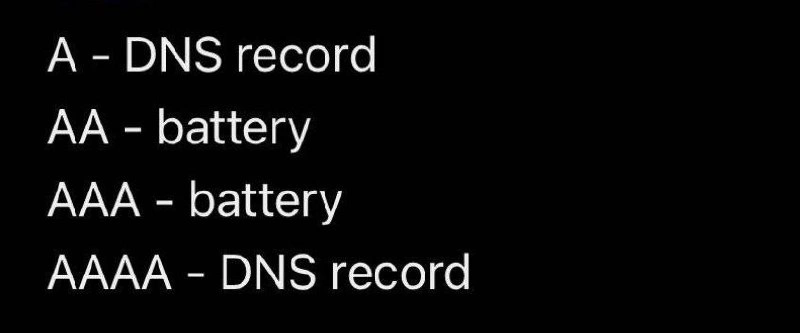
Imagine you have two secret codes with your friends. In one secret code, the symbol “A” means “I need an apple.” In a different game you play, the card “A” actually means something else, like “this is a magic spell.” Now picture writing both codes on the same sheet of paper:
- A – means apple (in your lunch code)
- AA – means a type of battery for your toy (from another list)
- AAA – still a battery size for an even smaller toy
- AAAA – means a special address for computers to talk to each other
It looks pretty confusing, right? You keep seeing the letter A, but sometimes it’s about apples or toys, and other times it’s about computers. The same letters repeated end up meaning totally different things depending on which world you’re in. That’s exactly why this meme is funny! It’s playing with the idea that one little letter (or a few of them in a row) can have two completely separate meanings.
Even if you don’t know anything about DNS or batteries, you can sense that the pattern in the list is broken in a silly way. It’s like if someone said, “One cat, Two candy bars, Three candy bars, Four cats.” Wait, what? 🐱🍫🍫🐱 You’d laugh because the pattern suddenly switches themes. In the meme, the theme flips between computer stuff and battery stuff with each step. It reminds us that to understand something, we always need to know the context. One letter by itself isn’t funny, but when you line up A vs. AA vs. AAA vs. AAAA with those labels, your brain goes “Hey, that doesn’t follow the usual order!” That little surprise makes it amusing. It’s a simple reminder that words (or letters) can mean different things in different places – and noticing that mix-up makes us smile.
Level 2: DNS vs Duracell
For a newcomer, let’s break down the two sides of this joke. DNS stands for Domain Name System, which is like the internet’s phonebook. It translates human-friendly website names (like www.example.com) into numeric network addresses that computers use. In DNS, an A record is one type of entry that links a name to an IPv4 address. IPv4 addresses are the classic kind (think something like 192.168.0.1 – four numbers separated by dots). An AAAA record is another DNS entry that links a name to an IPv6 address. IPv6 is the newer, much larger pool of addresses (they look like 2001:0db8::1 with hexadecimal numbers and colons). The funny part is that the DNS records are literally called “A” and “AAAA” – the letter A repeated. So in summary: A means an IPv4 address record, and AAAA (pronounced “quad A”) means an IPv6 address record. There’s no "AA" or "AAA" record in DNS; those letter counts exist only in the world of batteries.
Now the other half: AA and AAA refer to battery sizes. You’ve definitely seen these in real life. A AA battery is the standard small cylindrical battery – for example, the ones you put in TV remotes, wall clocks, or wireless game controllers. A AAA battery is the even smaller version (thinner and a bit shorter); those often go into things like mini flashlights, wireless headphones, or pocket calculators. The letters themselves don’t really “stand for” words; they’re part of an old battery naming system. Long ago, batteries were labeled with single letters (D batteries are the big ones in flashlights, C are medium, and there was an A size battery at one point). As battery tech evolved, “AA” (double A) was designated for a new smaller size, and “AAA” (triple A) for an even smaller one. It’s just a labeling convention, kind of like T-shirt sizes (S, M, L) but using letters and repeats to denote different dimensions.
So, in the meme’s text:
- A – DNS record: “A” here is referring to the DNS A record (linking a domain to an IPv4 address).
- AA – battery: “AA” means the battery size (the typical one in many gadgets).
- AAA – battery: “AAA” means the smaller battery size (used in tinier devices).
- AAAA – DNS record: “AAAA” goes back to DNS, the AAAA record (linking a domain to an IPv6 address).
Reading it straight down, it jumps from a DNS term to a battery term, then another battery, then back to a DNS term. It almost feels like the pattern got “out of sync.” If you aren’t aware of these contexts, it looks like someone just wrote “A, AA, AAA, AAAA” and randomly labeled them “DNS record, battery, battery, DNS record.” But there’s actually logic behind each item individually; it's only when you mash them together that it becomes a tech inside joke.
For a junior developer or someone new to networking, the humor comes from that sudden switch in context. You’re thinking about one letter A as a technical thing (a DNS address record), but then “AA” and “AAA” yank you into thinking about batteries in your household devices. Then “AAAA” throws you back into network engineering talk with IPv6 addresses. It highlights how context is king. The same sequence of letters can mean very different things depending on what world you’re talking about.
It’s actually a relatable situation if you’re just starting out in IT. Imagine you’re setting up a personal website and you learn you need to create an A record so your domain name points to your home server’s IPv4 address. Later that day, your wireless mouse dies, so you replace its AA batteries. That evening, you read about modern best practices and decide to add an AAAA record so your site works with IPv6 too. As you jot down tasks, you’ve written “Set A and AAAA (for the website), buy AA and AAA (for gadgets).” Seeing those all together might make you do a double-take and chuckle. The meme is basically showing exactly that kind of mash-up note.
The takeaway is that “A” vs “AA” vs “AAA” vs “AAAA” aren’t part of one single system; they belong to two different systems that just happen to share some naming patterns. Once you know what each one means – DNS records for A/AAAA and battery types for AA/AAA – you can appreciate why listing them in one place is funny. It’s a little quirk of our tech world that those letter codes overlap, and once you spot it, you’re in on the joke!
Level 3: Quadruple-A Quandary
At first glance, those four lines A, AA, AAA, AAAA look like a cryptic checklist, but any seasoned engineer will decode the pattern immediately. It’s a clever play on namespaces colliding: the exact same letter sequence is used in two completely different tech contexts. On one side, we have DNS records named A and AAAA – the fundamental address pointers of the internet. (In the Domain Name System, an A record maps a domain name to an IPv4 address, and an AAAA record maps to an IPv6 address.) On the other side, we’ve got battery sizes AA and AAA – the household power sources in your TV remote and wireless mouse. The meme cheekily alternates between them, making a ladder out of these terms. It’s as if someone merged a networking cheat-sheet with a hardware shopping list, and the result is both logically inconsistent and oddly satisfying.
In the DNS world (the internet’s distributed address book), an A record links a domain name (like example.com) to an IPv4 address – those familiar 32-bit numbers separated by dots (e.g. 192.168.0.1). When the internet expanded to IPv6 (128-bit addresses that look like 2001:0db8::1), DNS added the AAAA record (pronounced "quad A") to point domain names to these much larger addresses. Why four A’s? Partly because an IPv6 address is four times the length of an IPv4 address, so they jokingly went with four A letters. It’s a naming convention that stuck: one A record for the old addresses, and four A’s (AAAA) for the new.
Meanwhile, in the electronics world, AA and AAA are standard sizes for cylindrical batteries. A AA battery (double-A) is the common one powering gadgets like game controllers or wall clocks, while a AAA battery (triple-A) is the thinner version you find in things like TV remotes or mini flashlights. These letter designations come from an old battery sizing standard – originally there were single-letter batteries (A, B, C, D for different sizes). As engineers developed smaller cells, they started using double letters (AA) for a new size and triple letters (AAA) for an even smaller size. It’s pure coincidence that this battery naming scheme ended up creating “AA” and “AAA” labels that line up with DNS’s “A” and “AAAA.” The meme exploits that coincidence perfectly.
What makes engineers smirk here is the context-switching brain teaser. If you’re deep in network ops and someone says “We need an A record,” you’re configuring DNS entries for IPv4. But if you hear “Grab some AA and AAA,” you switch mental gears to the supply closet for batteries. Then it’s back again to “Configure the AAAA record” for an IPv6 deployment. The one-letter increments completely flip the subject each time. It’s the ultimate example of how a single extra character can change the meaning fourfold. We’re dealing with a namespace collision of the funniest kind – no actual bug or outage here, just our vocabulary playing tricks on us.
This alternating pattern also pokes at a subtle reality: many of us juggle both old and new tech in parallel. IPv4 vs. IPv6 adoption is a classic saga in networking. The AAAA record (for IPv6) has been around for decades, but plenty of systems and devs still primarily deal with A records (IPv4) because full IPv6 rollout has been slow. Seeing A vs. AAAA next to AA vs. AAA is like a tiny reminder that legacy tech and modern tech coexist, often awkwardly. It’s humorous visual proof that the industry moves forward (to IPv6) at roughly the same pace as it takes to replace all your battery-powered gadgets with USB-chargeable ones – slowly and inconsistently.
Tech folks also love this because it highlights our field’s penchant for acronyms and overloaded terms. We often have collisions like this: the same shorthand can mean two completely different things depending on context. In a cross-disciplinary team, asking for an “AAAA” might prompt a moment of confusion:
Network Engineer: “We should add an AAAA.”
Hardware Tech: “Sure, how many volts does it need?”
That little imaginary exchange captures the meme’s essence. Out-of-context, "AAAA" could either be a high-tech DNS configuration or an extra-small battery to power a gadget. Both are valid in their own realms! So when we see the meme’s list jump from DNS to batteries and back to DNS, it feels like a mini “gotcha” for those of us who’ve had to learn which alphabet soup applies where.
Naturally, the nerd humor didn’t stop at just four A’s. One clever commenter quipped that “AAAAA” might stand for the American Association for the Abolition of Acronyms and Abbreviations — a tongue-in-cheek jab at our industry’s love of multi-letter acronyms. Alternatively, “AAAAA” could simply be the onomatopoeic “AAAAA!” of a panicking engineer realizing prod is down. That’s the kind of punchline that resonates with anyone who’s been on call at 3 AM. We cope with this stuff by laughing at the absurdity.
In short, this meme hits a sweet spot for senior devs and ops folks. It’s a nod to the weird overlaps in our daily work, where a tiny detail (like the number of letter “A”s) can completely change the conversation. It’s a playful reminder that understanding context — whether it’s the domain name system or the domain of battery packs — is everything in tech. And honestly, who doesn’t appreciate a good IPv6 inside joke that involves a trip to the hardware drawer?
Description
A simple, minimalist image with white text on a solid black background. The text is arranged in four lines, creating a list. The first line reads "A - DNS record". The second line reads "AA - battery". The third line reads "AAA - battery". The fourth and final line reads "AAAA - DNS record". The font is a clean, sans-serif type. This meme is a clever wordplay joke for network engineers, sysadmins, and backend developers. It juxtaposes DNS record types (A for IPv4 and AAAA for IPv6) with common battery sizes (AA and AAA). The humor lies in the overlapping nomenclature and the absurdity of the pattern. It's a niche joke that resonates with those who have dealt with DNS configurations and the often confusing world of technical acronyms. The joke highlights how context is everything in the tech world

Comments
30Comment deleted
Dev 1: 'The site is down!' Dev 2: 'Is it DNS?' Dev 1: 'No, I checked the AAAA records.' Dev 2: '...and the AAA batteries?'
Proof that the only real upgrade path from IPv4 to IPv6 is two extra batteries
The only time "we need more As" means completely different things to the infrastructure team versus the facilities manager during a datacenter outage
This perfectly captures the moment when you're explaining DNS records to a junior dev and they ask 'wait, so do AAAA records last longer than A records?' The real tragedy is that both IPv6 adoption and finding AAA batteries when you need them seem equally impossible in production environments
A and AAAA scale addresses exponentially; batteries with extra A's just shrink your grip on productivity
Filed a ticket: "Need AAAA in prod." Facilities closed it by delivering AAA batteries - hence the continued NAT44
When we said “cut over to AAAA tonight,” procurement bought AAA batteries; SREs bought coffee, and only DNS actually switched to IPv6
AAAA is for Ubisoft games Comment deleted
AAA is high grade games made by the famous greedy game companies Comment deleted
AAAA is also a battery lmao Comment deleted
So is AAA Comment deleted
Unary alphabet? Comment deleted
https://youtu.be/O04H-z1z1T0 Comment deleted
AI cult carrying out schemes to prepare the world for AI governance Comment deleted
Well this is an old system. It works by counting axles going in and out of a segment to keep track of free tracks. You can overflow or underflow the counter. Just make sure its never 0 else it will falsely signal that there are no axles on the tracks and free for other trains to enter. I guess the assumption was back then that 255 is enough. Also my first thought was 512 would cause the same "bug". Yes it does but do so many axles even fit on a segment?💀 Comment deleted
so devs just consciously left such a trivial, yet dangerous bug and government just let it be? Comment deleted
Its not a bug Comment deleted
I believe axlecounters are still how most train control systems work, they're just not 8-bit limited Comment deleted
By old I meant that version that used 8 bits Comment deleted
Anti-Aircraft Artillery battery Comment deleted
Isn't it the evacuation plan? Comment deleted
4 A-s Comment deleted
Yes, this makes all the difference. No evac for five As Comment deleted
I believe this rule was removed from the ruleset a couple of years ago Comment deleted
what about this one? Comment deleted
NOT AGAIN Comment deleted
stop Comment deleted
Fortunately there are no trains with 16384 axles. Comment deleted
not yet… Comment deleted
US folks have a problem with the use of acronym Comment deleted