Necrobotics: The Ultimate End-of-Life Support for Spiders
Why is this Robotics meme funny?
Level 1: Gross but Genius
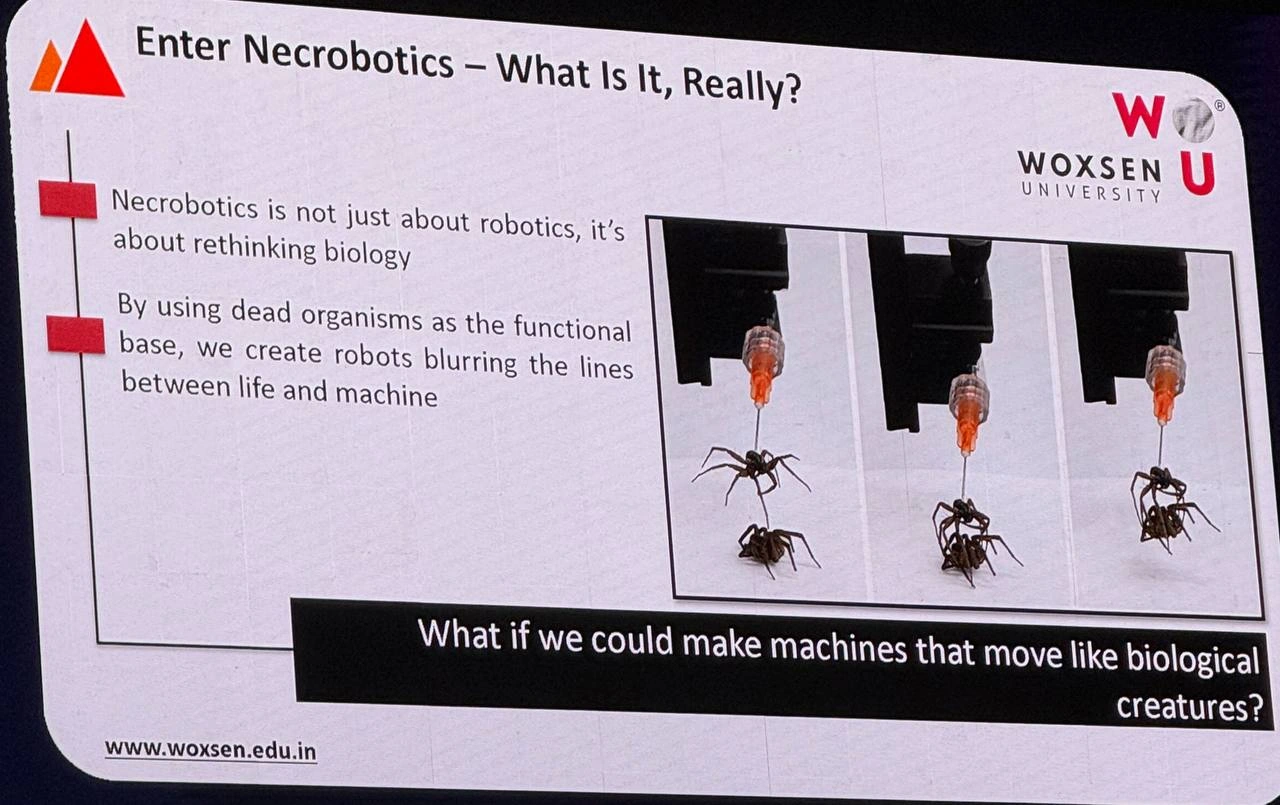
Imagine you have one of those toy grabber claws to pick things up, but it broke – so you find a big dead spider in the yard and use its legs to grab a piece of candy. Eww! It’s gross and a little spooky, but guess what? It actually works to pick the candy up. It’s like doing a goofy science trick: using something yucky from nature as a tool. That mix of “yuck, a dead bug!” and “wow, it really grabbed it!” is why people think this is funny. It’s a totally weird and unexpected idea that’s both clever and creepy at the same time, kind of like a mini Halloween experiment come to life (or, well, un-life!). We laugh because it’s so surprising and strange – who would ever think a spider could be a tiny robot helper after it’s dead?
Level 2: DIY Necrobotics
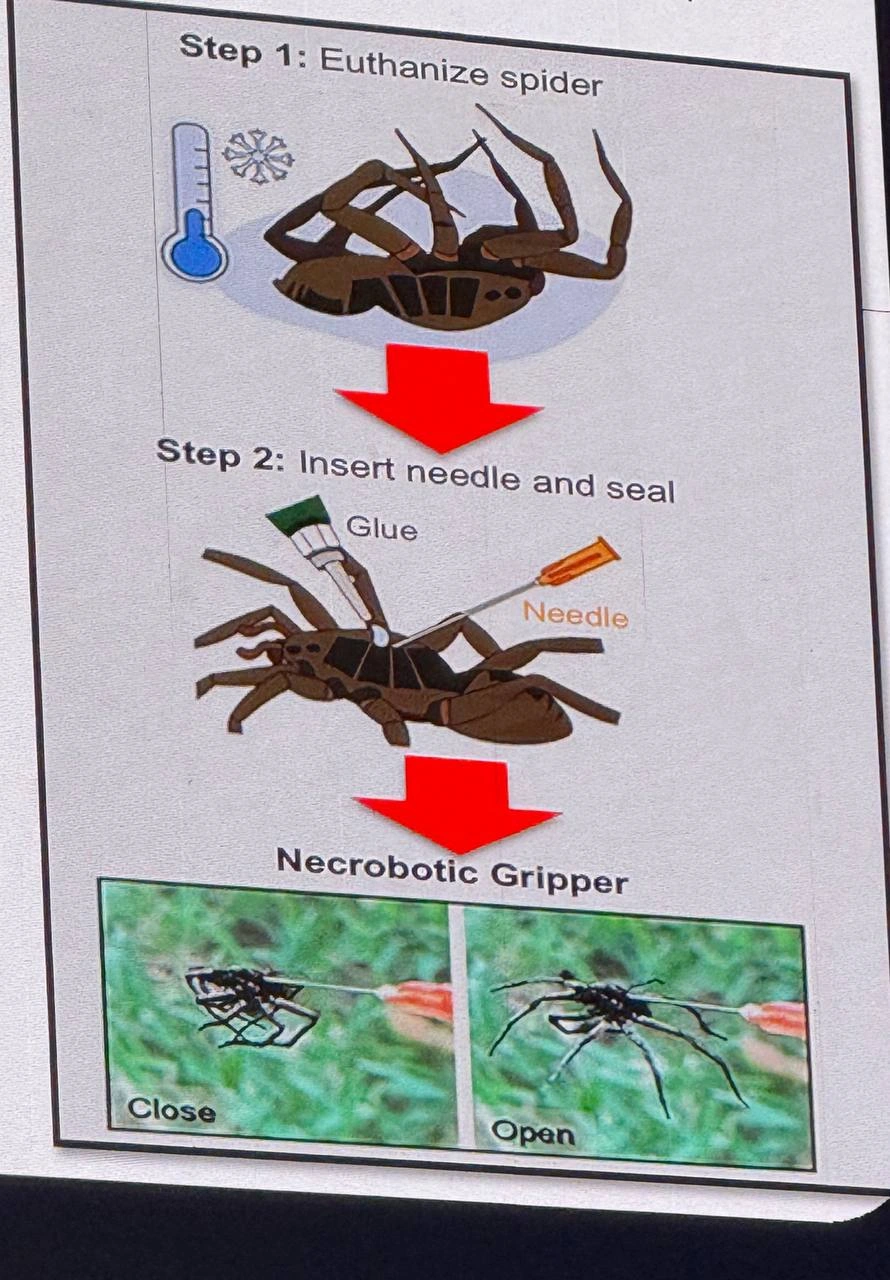
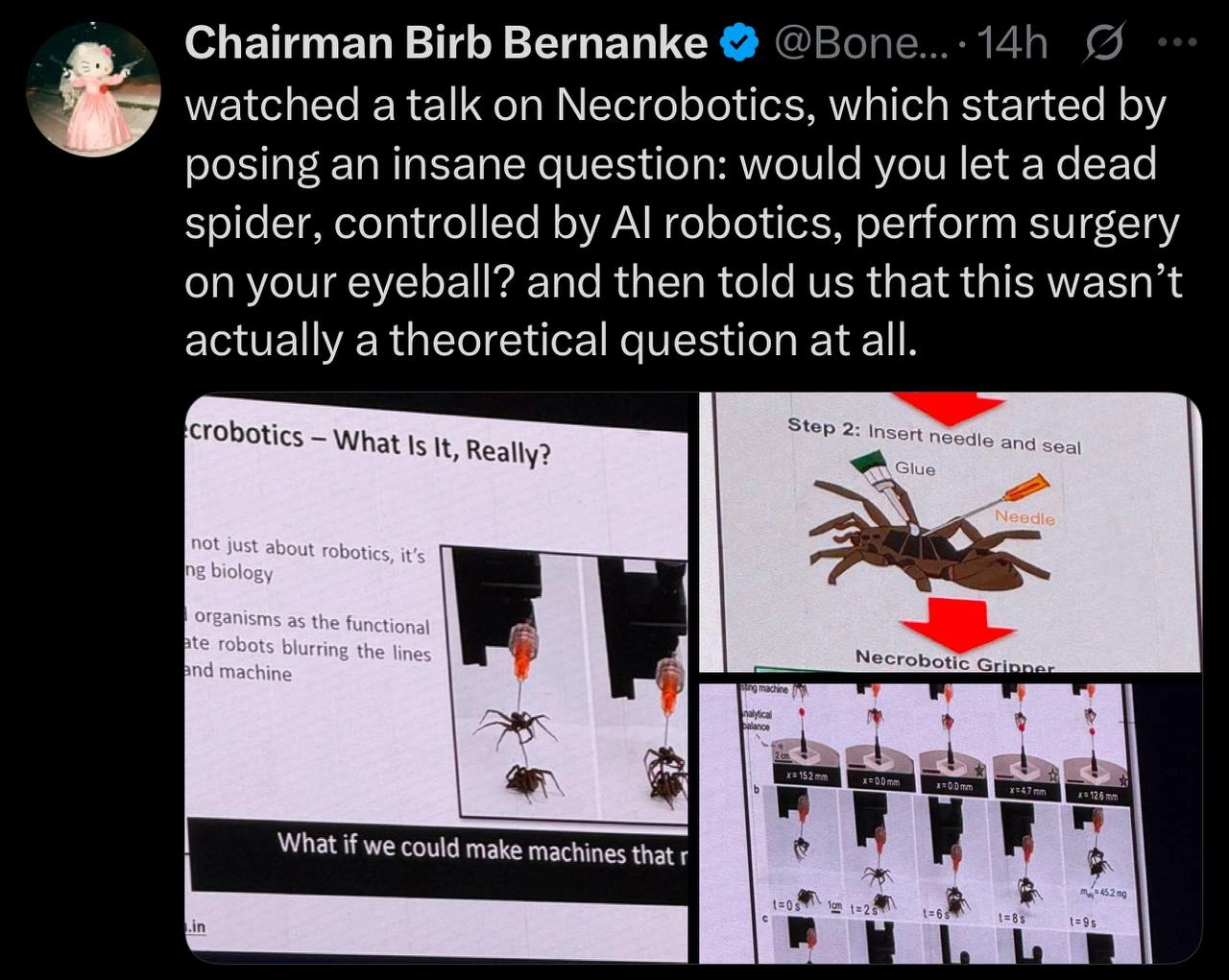
If you’re newer to robotics or hardware, this meme might seem both confusing and a bit creepy. Don’t worry, we’ll break it down. The image is basically an instruction guide for turning a dead spider into a robotic gripper (a claw-like device that can pick things up). Yes, that sounds like something out of a Halloween science fair, but it’s real MakerCulture ingenuity! Let’s go through the steps:
Step 1: Euthanize spider – The slide politely says euthanize, which means humanely kill the spider. The little blue thermometer with a snowflake suggests they likely put the spider in a freezer or used cold temperature to gently put it to sleep permanently. They needed the spider’s body intact (not squished – that wouldn’t make a good tool). It’s a morbid start, but essential for the hack.
Step 2: Insert needle and seal – Here they take a small needle (like from a syringe) and stick it into the spider’s body, then use glue to seal around it. Why? Because inside the spider there’s an empty space that used to be filled with fluid (spider “blood”) that moved its legs. By inserting a needle connected to a syringe or pump, they can push air or liquid in and out of the spider, kind of like inflating and deflating a tiny balloon inside it. The glue just makes sure no air leaks out. Now the spider is basically set up as a pneumatic actuator – a fancy term for something that moves when you apply air pressure.
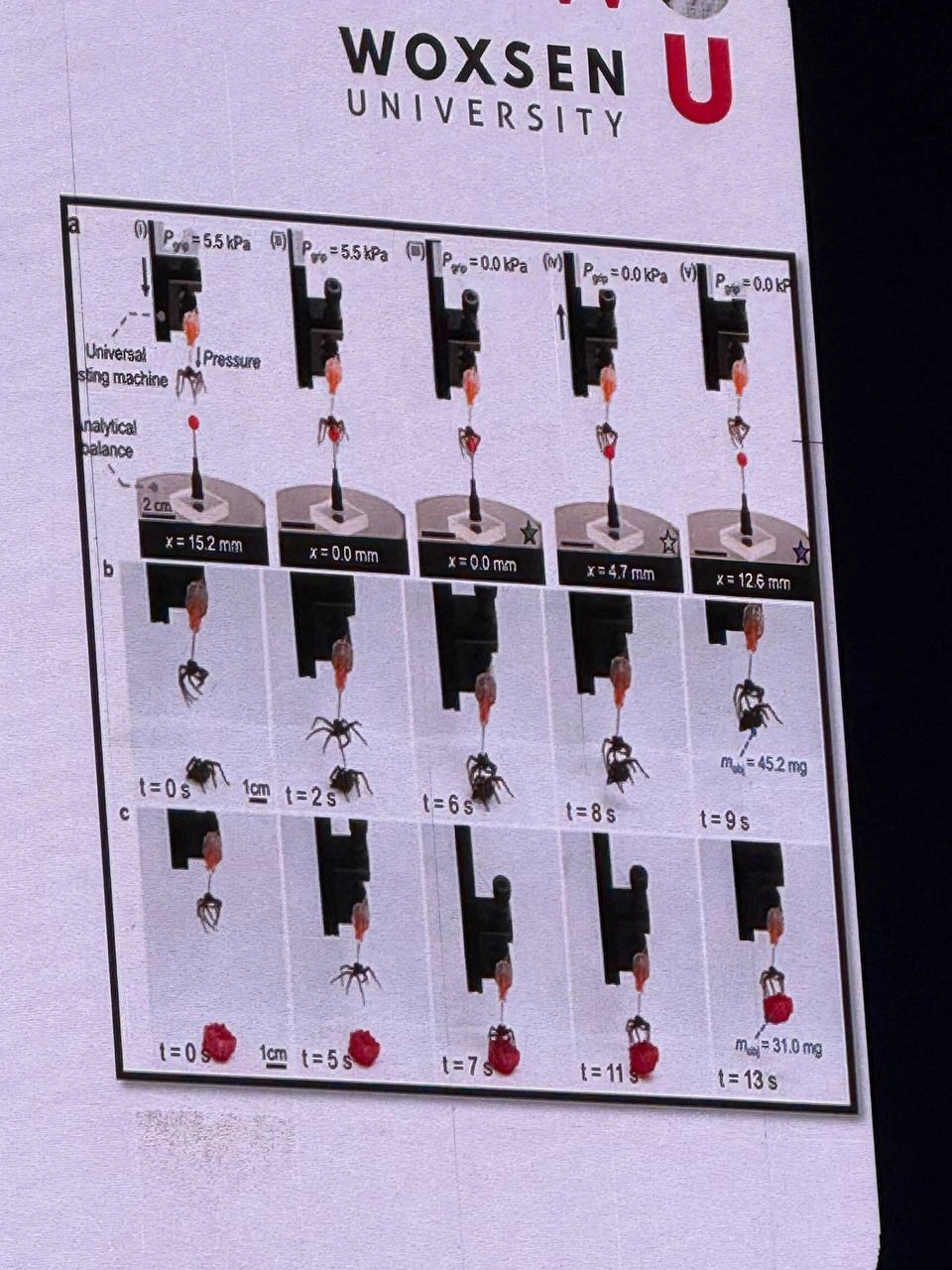
Necrobotic Gripper (Close/Open) – The bottom images show the final result: the spider’s legs acting as a grabber. “Open” shows the legs stretched outward (ready to grab), and “Close” shows them curled inward grasping an object. In effect, the dead spider has become a little robotic hand! When the engineer pushes fluid or air through the needle, the legs straighten out (open). When they release or suck the fluid back, the legs return to their curled position (closed) around whatever object is there. Necrobotic is a mash-up word: necro means dead, and robotic gripper means a robot claw. So a necrobotic gripper is literally a robot claw made from something dead.
Why would anyone do this weird project? In robotics, making very small mechanisms can be tough and expensive. But nature has already made tiny machines like spider legs that can grip. This hack is an example of biohybrid robotics – combining biological parts with human-made parts to create a functioning device. It’s also a bit of EngineeringAbsurdity or over-engineering humor because it’s such an unconventional solution. Instead of designing a miniature robotic hand from scratch, the engineers said, “Hey, let’s reuse a spider’s leg system.” It’s like using a pre-built part from nature’s inventory.
For a junior engineer or curious onlooker, this is a crash course in creative problem solving. It shows that HardwareHacks can get pretty wild. You’ve maybe seen robot kits with mini motors and plastic claws, but here we have a real animal’s body doing the job. It’s equal parts gross and genius, which is exactly why tech folks are joking about it. They’re basically saying, “This is the wildest science experiment we’ve seen in a while, but it actually makes sense once you know how it works!”
In simpler terms: imagine a typical robot hand that grabs things – often it uses metal servo motors and gears. Here, the spider’s legs are the “gears” and the syringe of air is the “motor.” No electronic motor needed; the spider’s design does the heavy lifting (literally). OverEngineering? Maybe – it’s not every day you see “kill a spider” in a project outline – but it’s also very resourceful. And that clever craziness is a big part of TechHumor in this meme: seeing an everyday creepy-crawly turned into a piece of tech. It makes you laugh, then think, “Huh, that’s actually pretty clever, in a totally twisted way!”
Level 3: Post-Mortem Engineering
This meme spotlights a bizarre foray into Robotics and Hardware hacking that even Frankenstein would applaud. In a real research twist, engineers turned an actual dead spider into a functioning robotic gripper. That conference slide isn't a joke Photoshop – it's a genuine step-by-step from an academic demo on biohybrid robotics. The humor hits you immediately: “Step 1: Euthanize spider” with a casual snowflake icon, as if freezing a spider to death were as routine as cooling a CPU. Then “Step 2: Insert needle and seal” with a glue bottle graphic — all presented as normally as a recipe for assembling IKEA furniture. This absurdly matter-of-fact tone about something so morbid is where the tech humor lies. It’s engineering absurdity at its finest: taking the phrase “we have a bug in our hardware” and flipping it on its head, literally using a bug as the hardware.
For seasoned engineers, the slide triggers equal parts fascination and dark chuckles. Why would anyone do this? Well, it turns out spider legs are nature’s mini hydraulic actuators. Spiders don’t have muscles to extend their legs; they pump fluid to move them. When a spider dies, its legs curl up because the hydraulic pressure drops — essentially the default off position is a closed gripper. Some enterprising roboticists realized this and thought: “Hey, free actuators!” By hot-gluing a syringe needle into the spider’s body (the pros call it the prosoma, we call it nightmare fuel) and sealing it, they created a tiny pneumatic system. Push a bit of air or fluid in, and voila — the legs spread out open. Release pressure, the legs close around an object. It’s simultaneously brilliant and creepy: a low-cost microgripper courtesy of Mother Nature’s design, with zero 3D-printing or fancy motors required.
The senior dev crowd sees deeper comedic layers here. It’s a textbook case of OverEngineering (or maybe under-engineering?) where an extremely unconventional solution is used to solve a mundane problem. Need a small robotic hand to pick up delicate objects? Sure, you could design a complex miniature claw with servos, or... just repurpose a wolf spider cadaver lying around. It’s the kind of hack that screams MakerCulture: creative, bold, and a little bonkers. This slide likely came from a university lab presentation, meaning some poor grad student had to calmly explain to a room of straight-faced engineers how they systematically killed spiders in the name of innovation. You can almost hear the nervous laughter and imagine someone in the back muttering, “I didn’t see THAT coming in robotics class.”
There’s also an ironic alignment with the classic programmer joke, “It’s not a bug – it’s a feature.” In this case the bug literally became the feature. The dead spider is no longer a creepy-crawly to squash, but a core component of a robot, doing useful work. It’s both a morbid automation and an eco-friendly recycling of biologic parts. Seasoned engineers appreciate that this isn’t just dark humor – it highlights real engineering trade-offs. Building actuators at millimeter scale is hard, so these researchers found a ready-made solution in nature’s hardware store. Of course, it raises practical questions that insiders find amusing: How do you calibrate a spider? What’s the MTBF (Mean Time Between Failures) of an ex-spider gripper? Does QA testing involve a fly as the test object? The sheer absurdity of those questions draws a knowing grin.
Ultimately, this meme gets a “Whaaat?!” followed by an appreciative nod from veteran techies. It exemplifies the out-of-the-box (or rather, out-of-the-web) thinking in engineering, where the punchline is that it actually works. The next time you hear about integrating biology with machinery, remember these folks who literally took a spider and made it an open-source (or should we say open-leg) gripper. In the annals of engineering humor, necrobotics is now a thing – and we’re equal parts horrified and impressed. Not a bug, a feature, indeed.
Description
A three-part instructional diagram illustrating the process of creating a 'Necrobotic Gripper' from a spider. The first panel, labeled 'Step 1: Euthanize spider,' shows a spider next to a blue thermometer and a snowflake, indicating freezing. The second panel, 'Step 2: Insert needle and seal,' depicts a needle being inserted into the spider's back, with glue applied to create a seal. The final section, labeled 'Necrobotic Gripper,' shows two real photographs of the resulting contraption against a grassy background; one image is labeled 'Close,' where the spider's legs are curled inward, grasping, and the other is 'Open,' where the legs are extended outward. The diagram explains a real-life engineering concept where hydraulic pressure is applied via a syringe to control the legs of a dead spider, turning it into a bio-mechanical gripper. The humor is morbid and absurd, appealing to engineers who appreciate bizarre, unconventional solutions and the 'just because we can' attitude in research and development
Comments
7Comment deleted
This is the only project where 'zombie processes' refer to the actual hardware. At least the eight-legged race conditions are deterministic
Necrobotic gripper: the hardware analogue of wrapping our 2003 SOAP monolith in a shiny Kubernetes operator - just stick a needle in the corpse, blow air, and call it “innovation.”
Finally, a hardware abstraction layer where the bugs are literally the feature and the only dependency injection that doesn't make me want to quit
When your sprint planning includes 'euthanize spider' as a critical path dependency, you know you've achieved true full-stack development - from biological substrate to mechanical actuation. It's the ultimate example of 'working with legacy systems,' except this time the legacy is literally dead and you're injecting air instead of dependencies. At least this gripper won't have merge conflicts, though explaining the JIRA ticket to stakeholders might require some creative sprint retrospective facilitation
Hardware’s necrobotic gripper: euthanize the spider, inject a needle, add glue - aka dependency injection into dead code with glue code; congrats, you just shipped a zombie microservice
Peak enterprise integration: euthanize the legacy module, inject a dependency, add glue, and ship - a biodegradable two‑state gripper (Close/Opan) with the postmortem already done
ROS inverse kinematics? Nah, spiders ship with native parallel grippers - no calibration needed