Skip to content
DevMeme
6127 of 7435
Peer-Reviewed Necrobotics: Now With More Graphs and Data
Robotics Post #6723, on Apr 29, 2025 in TG

Peer-Reviewed Necrobotics: Now With More Graphs and Data

Why is this Robotics meme funny?

Level 1: Creepy-Crawly Claw Machine

Imagine a regular toy claw machine – the kind you use to pick up candy or toys – but instead of a metal claw, it uses a spider’s legs to grab things! 😯 Sounds a little gross, right? In this picture, that’s basically what’s happening. The spider isn’t alive anymore, but people found a way to pump air into its body to move its legs open and closed, just like a little grabbing hand. It’s funny and weird because nobody expects to use a spider (especially a dead one!) as a tool. It’s like if you found a creepy crawly and turned it into a robot toy. The reason it makes engineers laugh is that it’s such a crazy idea, but it actually worked – the spider’s legs really grabbed that tiny red ball like a claw picking up a prize. It’s a mix of “Eww, that’s spooky!” and “Whoa, that’s clever!” – and that surprise is exactly why this is both amusing and amazing, even for people who build machines for a living.

Level 2: Spider Hydraulics 101

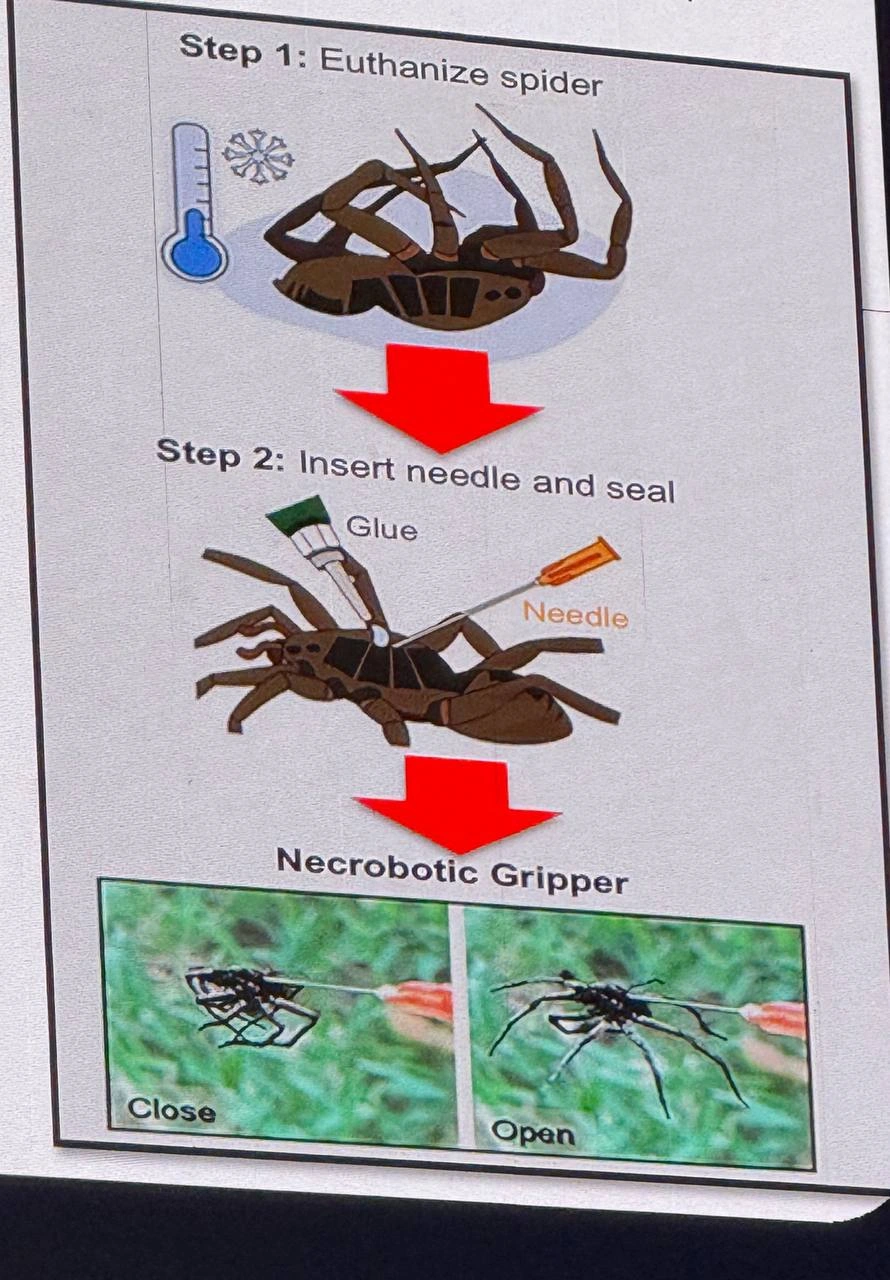
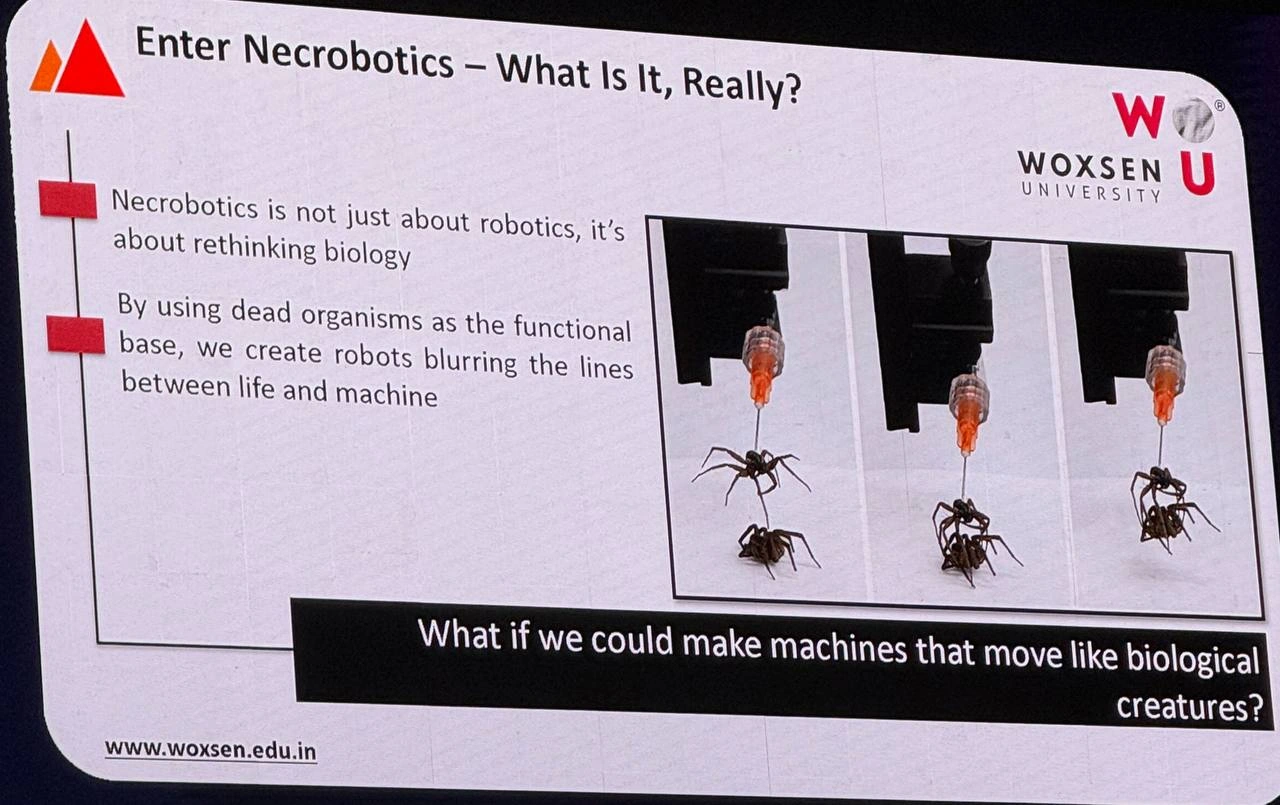
Let’s break down what’s happening in that weird-but-cool spider experiment. The researchers essentially created a simple robot gripper using a dead spider’s legs. Now, spiders aren’t like us – they don’t have muscles to push their legs outward. Instead, a spider pumps fluid (sort of like blood) into its legs to make them extend. Think of it like inflating long skinny balloons: more pressure makes them straighten out. When the spider dies, it runs out of pressure, so all its legs curl up (that’s why you usually find dead spiders with legs tucked in). This team said, “Hey, what if we put the pressure back in?” So they stuck a syringe into the spider’s body (specifically into the chamber that normally holds the fluid) and used air pressure to move the legs. Pressure control is the key – by adjusting the air pressure (like 5.5 kPa, a measure of how hard you’re pushing with air), they can open and close the legs on command. In robotics terms, they turned the spider into a pneumatic gripper (pneumatic means it’s operated by gas pressure, like how those tube-powered bank tellers or air-powered cylinders work). It’s the same principle as a soft robotic claw that grips objects by inflating – except here the soft material is the spider.

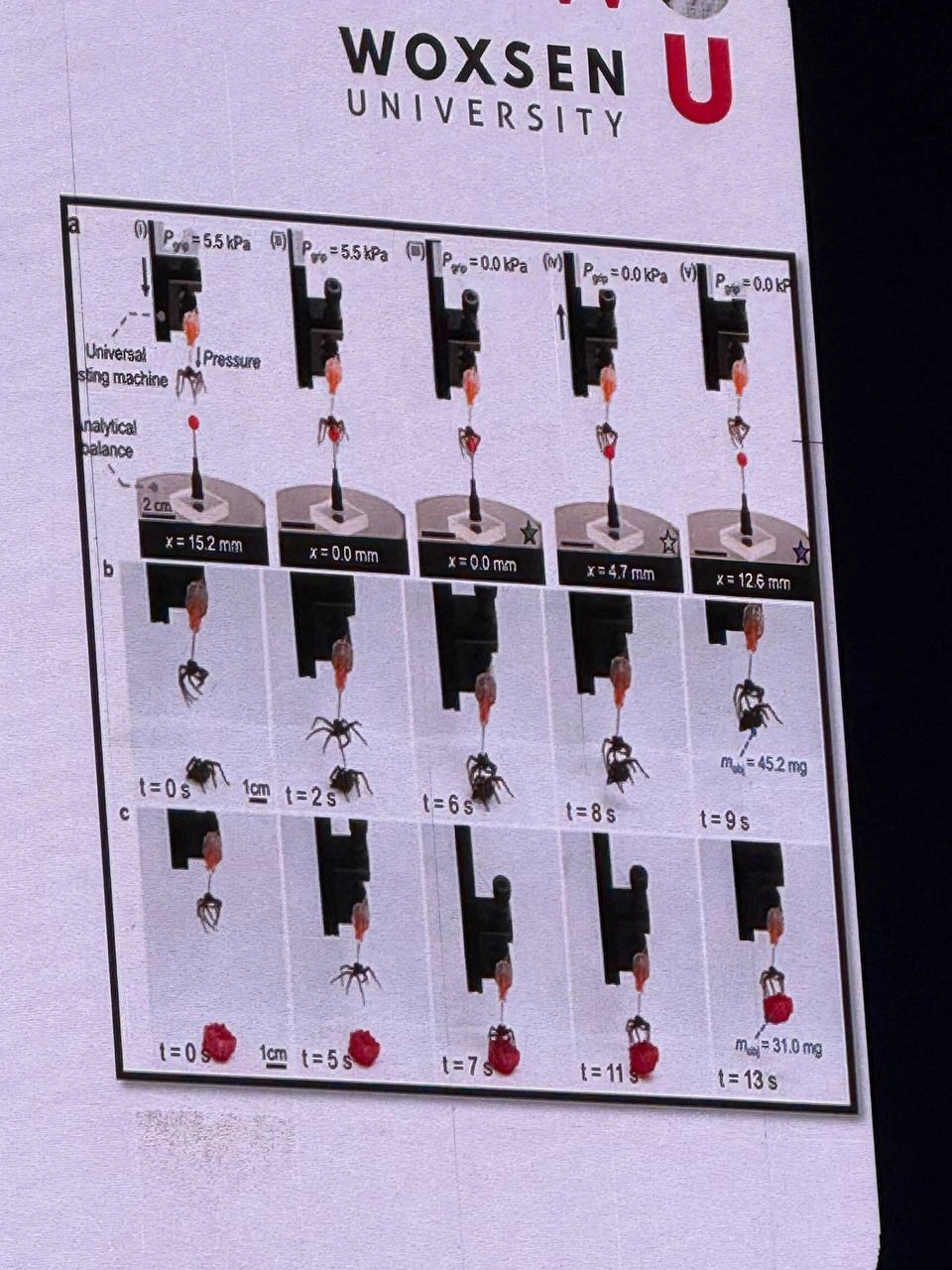
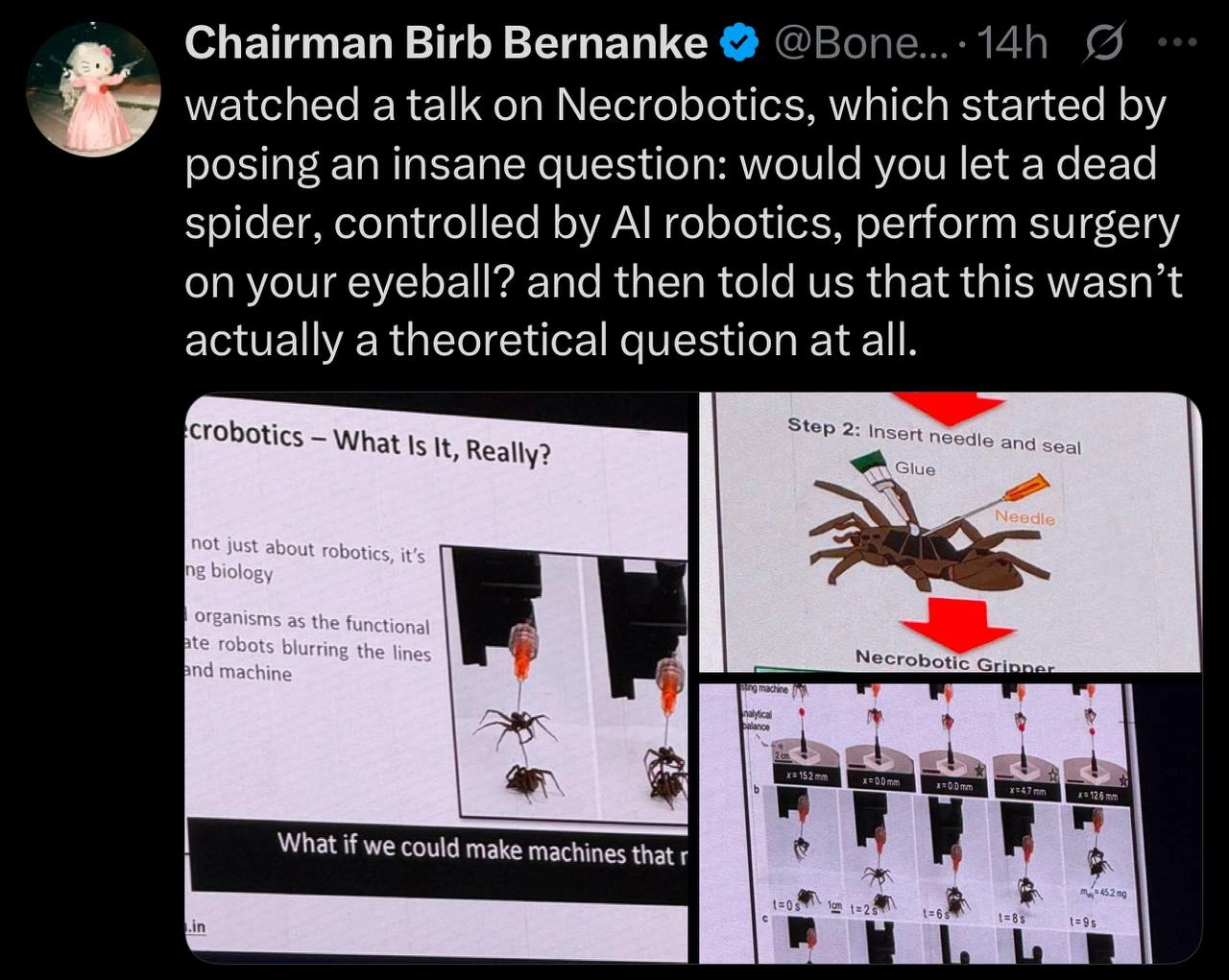
The slide from WOXSEN UNIVERSITY is showing a sequence of images (labeled a, b, c) of this process: At t = 0 s the legs are probably curled (pressure off, Pgeo = 0.0 kPa). Then by t = 2 s or 6 s, they’ve added pressure (Pgeo = 5.5 kPa), and you see the spider’s legs splay out. They position a small red foam ball (those fuzzy little toy balls) under the spider. When the legs open and then pressure is released, the legs close around the ball, grasping it. They even lift it a bit – the slide notes distances like x = 4.7 mm, x = 12.6 mm, which might be how high the spider moved the object. Also, values like mload = 45.2 mg indicate the mass of the object it lifted – just 45 milligrams (which is very light, about the weight of a small paper clip), but hey, it proves the concept. The universal testing machine mentioned is that big device holding the spider. Normally, a universal testing machine is used in engineering labs to pull, press, and measure forces on materials (for example, to test how strong a piece of metal or plastic is). Here it’s likely being used to hold the spider and precisely apply or monitor force and position. It ensures the setup is consistent and measures how the spider-gripper performs (kind of overkill equipment for a tiny spider, but it gives accurate data). There’s also an analytical balance referenced, which is a precise scale – probably used to weigh the little foam object or measure force by how much weight the spider could lift. All this tells us this wasn’t just a goofy visual stunt; it was a real experiment measuring performance, like any serious robotics test.

Several technical terms pop up in this meme that are worth explaining for newer engineers:

  • Necrobotics – This is a mashup of necro (meaning dead) and robotics. It refers to using once-living organisms or their parts as robotic components. In simpler terms, it’s turning dead bugs or animals into robots or robot parts. Creepy? Yes. But it’s a real research curiosity!
  • Pneumatic gripper – A gripper is a robot hand or claw; pneumatic means it’s powered by air pressure. So a pneumatic gripper might use inflatable rubber fingers or air-driven pistons to grab things. In our case, the spider’s legs function as the fingers, and the air pumped inside acts like the pneumatic power.
  • Universal testing machine – As mentioned, it’s a heavy-duty machine usually used in labs to test material strength (applying controlled force and measuring results). It’s basically a very precise press or pull machine with sensors. Using it here gave the researchers fine control and measurement of the spider’s grasping force.
  • Pressure (kPa) – Pressure is force per unit area. kPa stands for kilopascals, a unit of pressure. 5.5 kPa is a small pressure (for comparison, normal atmospheric pressure is ~101 kPa). By changing the pressure from 0 to 5.5 kPa in the spider, they controlled the leg movement.
  • Bio-inspired or bio-hybrid robotics – Bio-inspired means engineers copy ideas from nature (like designing a robot leg based on a spider leg shape or movement). Bio-hybrid takes it a step further and actually uses biological components with man-made ones (like growing muscle cells on a robot, or here, using an actual spider body as part of the device). It’s a cutting-edge area of research that can get pretty wild.
  • Engineering absurdity – Not a technical term per se, but here it implies an engineering idea that’s so strange or ironic it’s funny. The spider gripper is a perfect example: it’s a bit absurd to use a dead spider, but at the same time it’s a clever solution – the kind of thing that makes engineers both laugh and think “hmm, interesting…”.

For a junior engineer or an interested student, the take-home is that robotics isn’t just nuts, bolts, and circuits – it can involve creative uses of hardware from the world around us. The experiment on the slide turns a common arachnid into a piece of a robot. It’s half science demo, half DIY hack. And beyond the giggles (because, come on, it’s a spider on a syringe acting like a claw machine), it teaches about how pressure control can translate into movement. Nature figured out one way to do it (spider hydraulics), and engineers are learning from that — even if it means working with a very unconventional set of parts. This meme got popular with tech folks because it’s educational and ridiculous at the same time, sparking that “eww cool!” reaction many of us had as kids mixing science with a bit of mischief.

Level 3: Not a Bug, a Feature

On first glance, this research slide looks like EngineeringAbsurdity incarnate: they’ve rigged a dead spider onto a lab apparatus and turned it into a working robotic gripper. Yet any seasoned robotics engineer can’t help but grin at the audacity – this is necrobotics, literally treating a spider’s corpse as a ready-made piece of hardware. It’s a serious Robotics experiment (note the Woxsen University branding and all those precise numbers), but the concept is so out-of-the-box it loops back around into humor. We have pressure readouts like Pgeo = 5.5 kPa vs 0.0 kPa, distances (x = 15.2 mm), and timestamps (t = 0 s, 11 s…) detailing how the arachnid gripper opens and closes. The slide is meticulously scientific – labels, an analytical balance to measure force, a universal testing machine applying pressure – yet the subject is an ex-spider doing a tiny mechanical grasping demo. It’s the gap between the ultra-serious experimental setup and the creepy DIY actuator that makes any engineer chuckle in disbelief. We’re essentially seeing HardwareHacks meet Frankenstein: mechanical necromancy performed with tubing and a syringe. The meme resonates because it’s equal parts brilliant and bizarre – a real "not a bug, a feature" moment where the “bug” (arachnid) is the feature.

At a deeper technical level, this is a clever exploration of soft robotics and bio-inspired design. Spiders use hydraulic pressure to move their legs – alive, they pump fluid to extend them, which is why a dead spider’s legs curl inward (no pressure). These researchers took that natural hydraulic system and hijacked it. By injecting or releasing a small amount of fluid/air pressure (on the order of a few kilopascals, as indicated), they get the spider’s legs to unfurl or contract on command. It’s a bit like plugging a pneumatic gripper line into a pre-built organic mechanism. If you think of a spider’s body as a little assembly of valves and tubing designed by nature, they basically figured out the "API": apply 5.5 kPa to open the legs, drop to 0 kPa to let them close and grip. In formula form, the fundamental idea is simple physics: pressure times area equals force,

$$ F = P \cdot A, $$

so even a few kPa over the tiny leg joint area yields enough force to move those legs and lift lightweight objects (the slide shows it grabbing a red foam bit weighing only milligrams). For veteran engineers, the humor is partly wow, that actually works! and partly the dark chuckle of EngineeringHumor: we’ve all seen unconventional solutions, but actuating a spider cadaver? That’s next-level Hardware creativity. It’s also a reminder of how far RoboticsApplications can stretch – from high-precision factory arms to, well, spider-leg grabbers. Bio-inspired robotics often means imitating nature (like building a robot leg that mimics a spider’s geometry), but here they cut out the middle-man and just repurposed the real thing. One could say the team took “reuse existing components” very literally.

To put it in perspective, here’s a light-hearted comparison of this necrobotic spider gripper with a more typical soft robot gripper:

Traditional Soft Gripper Necrobotic Spider Gripper
Silicone or rubber flexible actuators made in a lab Off-the-shelf spider from nature’s inventory 🕷️
Actuated by air in custom inflatable chambers Actuated by air in spider’s natural leg hydraulics
Requires design, molding, and fabrication Nature already did the design (no CAD needed)
Reusable, easy to clean or recast Single-use prototype (biodegrades eventually)
Not nightmare-inducing to look at Slightly creepy (arachnophobes, look away)
Controlled by valves, pumps, and electronics Controlled by a syringe & pressure gauge
Biomimicry – imitates nature’s idea Bio-hybrid – literally uses nature’s part

It’s funny because it’s so absurd, yet it highlights real engineering trade-offs. Why painstakingly build a tiny eight-legged gripper from scratch when nature’s mechanical design is right there? Of course, using actual biological parts raises its own issues (longevity, consistency, the whole spooky factor...), but in a lab demo it’s an unforgettable proof-of-concept. Seasoned engineers also appreciate the subtext: innovation can be scrappy. The slide screams “we had an insane idea and we tried it — and it actually worked!” The EngineeringAbsurdity here carries a spark of genuine ingenuity, inspiring that blend of laughter and respect. After all, who hasn’t jokingly said “We can fix it with duct tape and a prayer”? These folks basically did: replace duct tape with a dead spider and the prayer with some fluid dynamics, and voila! A functioning gripper. It’s a memorable reminder that in engineering, solutions don’t always come from textbooks – sometimes they crawl out of the lab cupboard, eight legs and all.

Description

A scientific presentation slide from 'WOXSEN UNIVERSITY' displaying detailed experimental data on the necrobotic spider gripper. The slide is organized into a grid of images in three rows labeled 'a', 'b', and 'c'. Row 'a' shows five stages of the gripper under a 'Universal testing machine,' with varying pressure levels from 5.5 kPa to 0.0 kPa, and measurements of displacement 'x'. Rows 'b' and 'c' are time-series demonstrations of the gripper lifting two different small objects, showing the process from t=0s to t=9s and t=13s respectively, and recording the final object masses as 45.2 mg and 31.0 mg. This image provides a formal, data-driven analysis of the concept of using a dead spider as a mechanical gripper. The humor for a technical audience lies in the application of rigorous scientific methodology - complete with controlled variables, precise measurements, and time-series data - to such an absurd and morbidly comical premise. It's the ultimate 'over-engineering a joke' scenario, presented as a serious academic study
Comments

7
Anonymous ★ Top Pick This is what happens when a robotics lab's budget gets cut, and the only components they have left are a syringe and whatever they can find in the window sill. At least they're still rigorously testing for bugs
  1. Anonymous ★ Top Pick

    This is what happens when a robotics lab's budget gets cut, and the only components they have left are a syringe and whatever they can find in the window sill. At least they're still rigorously testing for bugs

  2. Anonymous

    Nothing like a 5.5 kPa puff to make a dead spider pick up foam - basically the same technique we use to make the 2006 monolith “embrace cloud-native”: pump it full of pressure and hope the legs don’t fall off

  3. Anonymous

    Finally, a robotics framework where "dead code" is a feature requirement and your actuators literally have eight legs but zero documentation

  4. Anonymous

    When your university's engineering department takes 'spider' load testing literally and creates a physical demonstration that's more rigorous than most production monitoring setups. The spiders are measuring response times under varying pressure conditions with better instrumentation than your average APM tool - complete with time-series data, pressure metrics, and mass measurements. Meanwhile, your production system is still relying on 'it works on my machine' as a deployment strategy. At least these spiders have proper observability: they know exactly when they'll reach their strawberry (SLA target) and under what load conditions they'll fail. If only our distributed systems had this level of deterministic behavior and measurement precision

  5. Anonymous

    Necrobotics shows a dead spider grabbing 31 mg with 5.5 kPa; enterprise software proves a dead microservice can grab SLAs with a feature flag and a little PagerDuty pressure - same technique, different lab

  6. Anonymous

    Using a dead spider as the end-effector is the hardware equivalent of slapping a GraphQL facade on a 2003 SOAP monolith and calling it modernization; it works under pressure, but nobody volunteers for on-call

  7. Anonymous

    Spiders nailing organic load balancing at 100% pressure - meanwhile my K8s cluster tips at 55% utilization with a single pod failure

Use J and K for navigation