Skip to content
DevMeme
3004 of 7435
On the Eighth Day, God Debugged JavaScript
Languages Post #3318, on Jun 23, 2021 in TG

On the Eighth Day, God Debugged JavaScript

Why is this Languages meme funny?

Level 1: The Day Off That Wasn't

Imagine your dad finally sits down on the couch after a long week of chores, ready to relax on Sunday. He’s just about to close his eyes when suddenly you come running in and say, “Dad, the Wi-Fi isn’t working!” There goes his relaxing afternoon — now he has to get up and figure out what’s wrong with the internet. This meme is playing with that same idea. It shows that even someone who’s supposed to be resting (in the comic, it’s God taking a break after creating the world) can get pulled back to work by an unexpected problem. It’s funny because we all know the feeling: just when you think you’re done and can finally have some peace, a small issue pops up and you have to deal with it. In other words, no matter who you are, you might not get a true day off if something you made starts breaking. Even God couldn’t escape a quick “tech support” request on his day of rest — and that surprise disturbance is what makes the situation so comically relatable.

Level 2: undefined is not a function

For a newer developer (or someone just learning about coding), the error message undefined is not a function might sound puzzling. Let’s break down those words in the context of JavaScript. In JavaScript, undefined is a special value that basically means “there’s no value here.” For example, if you create a variable but don’t give it anything to store, that variable’s value will be undefined by default. It’s like an empty placeholder indicating “nothing” or “not set.” A function, on the other hand, is a block of code designed to do something, and you can “call” or execute it by using parentheses (like myFunction() runs whatever code is inside myFunction). So, when you see an error that says undefined is not a function, it literally means “you’re trying to use undefined as if it were a function, but it isn’t one.” In simpler terms, the program expected something useful (like a real function) to be there, but instead it found nothing, and then you told it “Hey, go do your job!” — and it’s complaining that it can’t, because that “nothing” isn’t callable.

Here’s a quick example to illustrate:

let greet;
greet(); // Uncaught TypeError: greet is not a function
// (greet is undefined because we never assigned a function to it)

In this code, we declared a variable greet but didn’t assign any value to it. That means greet is undefined at runtime. The next line tries to execute greet() as if it’s a function, but JavaScript throws a TypeError instead. The message might read something like “greet is not a function,” effectively telling us that greet isn’t a function at all (it’s undefined in this case). This is exactly what “undefined is not a function” conveys: the thing you attempted to invoke doesn’t actually exist as a function. This kind of error is called a runtime error because it doesn’t show up until you actually run the program. If everything is written correctly, the program starts running, but as soon as it hits that problematic line, it halts and throws this error message. The code was syntactically okay (so the computer started running it), but logically something was missing, and the program crashed at that point.

Now, why would this happen in practice? There are a few common causes that beginners (and even experienced devs) run into:

  • Forgotten Definition: Maybe you intended to write a function or include a script that defines it, but forgot. For instance, you call makePizza() in your code, but there’s no function makePizza(...) defined anywhere. JavaScript doesn’t find any definition for makePizza, so the variable makePizza remains undefined and calling it fails.
  • Wrong Order: In web development, order matters. If you try to use a function before the file or code that defines it has loaded, you’ll get this error. Imagine <script> tags in HTML: if the one that calls doThing() runs before the one that defines doThing(), you’ll be calling something that isn’t there yet.
  • Typo or Mismatch: JavaScript is case-sensitive and literal. If you defined myCoolFunction but then try to call mycoolFunction() (lowercase c), those are two different names. The call will refer to a non-existent thing, yielding undefined. Or maybe you expected an object to have a method (say, you thought user.printName() exists because you wrote it in one place), but maybe the object was missing that method due to a coding mistake. The result is, again, trying to call something that isn’t present.

When you encounter undefined is not a function, the way to debug it is like solving a little mystery: find out what the code was trying to call, and then figure out why that thing isn’t defined. The error message will usually tell you the exact variable or property that was undefined (for example, someObject.doTheThing is not a function would hint that either someObject wasn’t what we expected or doTheThing isn’t defined on it). As a developer, you’d go back to your source code and trace where that function or variable is supposed to come from. If it’s a function that should exist, did you include the file or module that provides it? Did you spell the name correctly everywhere? If it’s meant to be a function on an object, did you create that property before using it? Often, the fix can be as simple as adding the missing function definition, correcting a filename in an import, or moving a script tag so the code loads in the correct order. It can be a bit frustrating (especially the first few times you see it), but it’s a very common bug in JavaScript, and every developer learns to handle it with practice. In fact, tools like linters or TypeScript can warn you about these issues before you run the code, but if you’re writing plain JavaScript without those, you have to rely on testing and careful ordering to avoid it.

In the context of this meme, a developer from the community effectively posted a bug report saying they encountered undefined is not a function. Instead of sending this issue to a normal project maintainer though, they’re (jokingly) sending it to God! It’s as if they’re saying, “Hey Lord, something in creation code is broken — please fix it.” 😅 Of course, in real life, a JavaScript developer wouldn’t file a ticket with a deity; they’d probably go on a site like Stack Overflow or GitHub and describe the problem to get help from the developer community. The comic is exaggerating this process for humor. The take-away for a junior dev is: “undefined is not a function” is a standard error that means you tried to use something that wasn’t there. It’s part of normal life in JavaScript programming. Don’t worry — it happens to everyone, and once you identify what’s missing or misnamed in your code, you can fix it and move on. The meme just imagines that even God has to deal with that kind of issue report, which is a funny way to show how universal these programming problems can feel!

Level 3: Divine Comedy of Errors

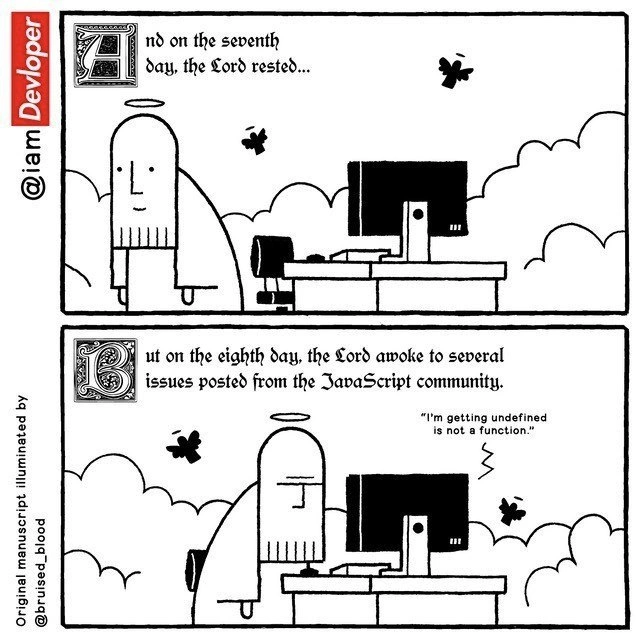
In this clever two-panel comic, even the all-powerful Creator isn’t spared from the mundane woes of modern programming. The first panel (drawn in the style of a medieval illuminated manuscript, complete with ornate capital letters) shows a peaceful God with a halo, enjoying a well-deserved rest at his desk on the clouds. It captions the famous line, “and on the seventh day, the Lord rested…” Everything looks serene. But the joke escalates in the second panel: on the “eighth day,” God awakens to find a backlog of bug reports from the JavaScript community! The caption reads that he awoke to “several issues posted from the JavaScript community,” and a speech bubble on God’s monitor pleads, “I’m getting undefined is not a function.” You can practically imagine the Almighty letting out a weary sigh as his divine day off is cut short by yet another pesky issue. Seasoned developers immediately chuckle at this scenario because they’ve all been there — you finally take a break, and suddenly an urgent bug rears its head. It’s a playful twist on the on-call nightmare: even God’s restful Sunday gets interrupted by a critical issue in the code.

The humor here blends developer humor with biblical narrative and highlights a classic JavaScript quirk. The error message undefined is not a function is infamous among web developers. It’s the kind of runtime error that has triggered countless facepalms and late-night debugging sessions. By tossing this very modern programming problem into an ancient, sacred setting, the meme creates a ridiculous contrast. It’s like reading a gospel passage about bug fixing. The grand, solemn style (fluttering angels, medieval drop caps, formal language) is used to describe something as trivial and frustrating as a JavaScript error. That contrast is inherently funny. Essentially, the comic is treating a common coding problem as if it were a momentous event recorded in scripture. The phrase “and on the eighth day” isn’t actually in the Bible — it’s a tongue-in-cheek addition that suggests the act of maintenance that comes after creation. This is instantly relatable to developers: after you’ve “created” your software and taken a breather, the next thing you know, it’s deployment Monday and the bug reports start rolling in. The Lord resting on the seventh day only to be met with a bug on the next is a perfect metaphor for how software creation is never truly finished. There’s always an unexpected ticket in the queue as soon as you relax.

Crucially, the choice of bug is spot on. "Undefined is not a function" is a language quirk that epitomizes JavaScript’s sometimes thorns. It typically crops up when you try to call something that wasn’t defined — for example, calling a method that doesn’t exist or using a variable that hasn’t been initialized as a function. Every JavaScript programmer has encountered this at some point, making it a kind of inside joke and a shared battle scar. The meme gives this trivial yet ubiquitous error almost cosmic importance, which is hilarious. It hints that even an omnipotent coder (God) might forget to handle a pesky edge case in the divine codebase. (Did God perhaps skip writing unit tests on the sixth day? 😜) The debugging frustration encapsulated in that single error message is something devs bond over. In a statically-typed language, you’d catch such mistakes earlier (or the code wouldn’t compile), but in JavaScript’s dynamic world, you often don’t discover the problem until it blows up at run-time. That’s why "undefined is not a function" has become a running gag — it’s the quintessential JavaScript error that seems to pop up out of nowhere. The comic exaggerates this to cosmic proportions: even the universe’s architect has to do some divine debugging when confronted with an undefined value.

For experienced engineers, there’s an extra layer of knowing humor here. The scenario parodies the life of an overwhelmed software maintainer or project lead. God in this comic could be seen as the original developer or maintainer of a massive project (Creation 1.0, if you will). The JavaScript community posting issues is like users filing bug tickets on an open-source repository. If you’ve ever maintained a popular library or been the go-to person for a project, you know that issues and bug reports can appear at any hour — often right after you think everything is stable. The line “undefined is not a function” in the speech bubble represents the kind of support request that maintainers dread yet see all the time: a user runs into a common error and cries out for help. So the comic strikes a chord with anyone who’s been in a fire-fighting role, especially in web development. It’s laughing at the fact that no matter how “godlike” your coding powers are, you can’t escape the occasional runtime error. Bugs in software spare nobody. Even an omnipotent being, relaxing on Sunday, might have to roll up his sleeves on Monday to patch a glitch. That shared reality — that seemingly absurd inevitability — is what makes this meme so funny and relatable to developers. It’s a lighthearted reminder that in programming, no day of rest is guaranteed, and even the Lord has to deal with an unresolved JavaScript bug on his day off.

Description

A two-panel comic strip styled like an illuminated manuscript with ornate drop caps. The art is minimalist, black and white, featuring a god-like figure with a halo at a computer desk in the clouds. The first panel's text reads, 'And on the seventh day, the Lord rested...'. In this panel, the figure has a calm, content expression. The second panel's text begins, 'But on the eighth day, the Lord awoke to several issues posted from the JavaScript community.' The divine figure now looks tired and annoyed. A speech bubble from the computer monitor shows a classic error message: '"I'm getting undefined is not a function."'. The image humorously applies the biblical creation narrative to software development, suggesting that even a perfect creator couldn't escape the immediate and frustrating bug reports that come with releasing a language as widespread and quirky as JavaScript. The joke resonates with any developer who has created something only to be immediately inundated with support requests and error reports, particularly the infamous 'undefined is not a function' error that plagues JS developers
Comments

7
Anonymous ★ Top Pick And on the ninth day, the Lord pushed a commit with the message 'fixed typo' that introduced a new bug where `this` became mysteriously rebound, at which point he considered just flooding the whole repo and starting over
  1. Anonymous ★ Top Pick

    And on the ninth day, the Lord pushed a commit with the message 'fixed typo' that introduced a new bug where `this` became mysteriously rebound, at which point he considered just flooding the whole repo and starting over

  2. Anonymous

    Turns out the Big Bang was just a Friday deploy with no TypeScript - seven days later the pager goes off: “undefined is not a function,” and even the architect upstairs can’t hot-patch cosmic runtime

  3. Anonymous

    After 20 years in this industry, I've come to believe JavaScript wasn't created on the seventh day - it was clearly rushed out on a Friday afternoon before a long weekend, which explains why typeof null === 'object' and why we're still dealing with the consequences of automatic semicolon insertion in production systems that handle billions in transactions

  4. Anonymous

    Even the Almighty couldn't escape JavaScript's 'undefined is not a function' on the eighth day - proof that some bugs transcend divine intervention. Turns out the real original sin was trying to call a method on an undefined object, and we've been paying for it in production ever since

  5. Anonymous

    Day eight commit: enable strictNullChecks in universe.ts - omniscience still can’t coerce undefined into a callable

  6. Anonymous

    On the eighth day, God triaged “undefined is not a function” - ESM/CommonJS interop plus a default‑import typo - so He invented TypeScript; we set strict: false and shipped

  7. Anonymous

    Even the Creator couldn't strict-mode away JavaScript's eternal 'undefined' - talk about original sin in prototype chains

Use J and K for navigation