Untested Last-Minute Change Ignites Production
Why is this OnCall ProductionIssues meme funny?
Level 1: Little Fix, Big Fire
Imagine you’re helping out at a big school play. The backdrop on stage has a tiny tear in it just before the show. You’ve got a brilliant last-minute idea: grab some tape and patch it up real quick. You’re in such a rush to fix it before anyone notices that you don’t bother to check if the tape will actually hold. The play begins, all your classmates and teachers are watching. Suddenly, with everyone looking, the taped-up backdrop comes crashing down. Maybe it even knocks over a stage light, which starts a small fire on the set! 🔥 Everyone is gasping and running to fix the mess. And there you are, standing to the side with a little “oops” smile, because deep down you know your rushed tape job caused this whole disaster.
This meme is exactly that scenario, but in software. A programmer made a quick change to a live app without checking it properly – like trying to fix something in a hurry without testing – and the whole thing broke in front of all the users (just like the audience at the play saw the backdrop fall and burn). It’s funny in that “oh no!” way because the person who tried to help quickly actually ended up causing a much bigger problem, and now everyone can see the chaos. The little girl smirking in front of the burning house is like that student with the tape: she’s kind of smiling at the camera like, “Heh, whoops, that might’ve been my fault.” We laugh because we’ve all had moments like that – maybe not as huge as a house on fire – but little times when a quick fix goes spectacularly wrong while everyone is watching. It’s a reminder that sometimes when you rush and skip the safety steps, you end up with a big old public mess… and a sheepish grin because you learned your lesson the hard way.
Level 2: What Could Go Wrong?
Let’s break down what’s happening here for those newer to the chaos of deployments. In software development, production (or prod) is the live environment where real users interact with your application – like the actual house where people live, in contrast to a model house you test things on. A deployment means releasing new code or changes into that production environment. Ideally, any change you plan to deploy goes through a series of safety checks: you write tests for your code, you run those tests in a CI (Continuous Integration) pipeline, maybe you try the change in a staging environment (a test server that’s a lot like production) to see if everything works, and you have teammates do a code review to catch mistakes. A well-run deployment is boring – nothing catches fire because any bugs were caught in the tests or staging.
Now, a hotfix is a whole different beast. The term “hotfix” means a quick, urgent patch to fix a problem in production. It’s called hot because it’s applied to a “live” system that’s currently running (think of a mechanic fixing a car while the engine’s still running – it’s tricky and potentially dangerous). Hotfixes often happen when there’s an emergency bug or outage and you need to get a solution out ASAP. But because they’re rushed, they might skip the usual testing process. “Untested code” is exactly what it sounds like: code that the developer hasn’t verified with tests or maybe hasn’t even run in a safe environment. It’s like throwing a new ingredient into a recipe while cooking for guests without tasting it first – you hope it makes things better, but you might accidentally poison the stew. 😅 In software terms, untested code can contain a bug (an error or flaw) that you didn’t catch, which could do anything from causing a minor glitch to crashing the whole system.
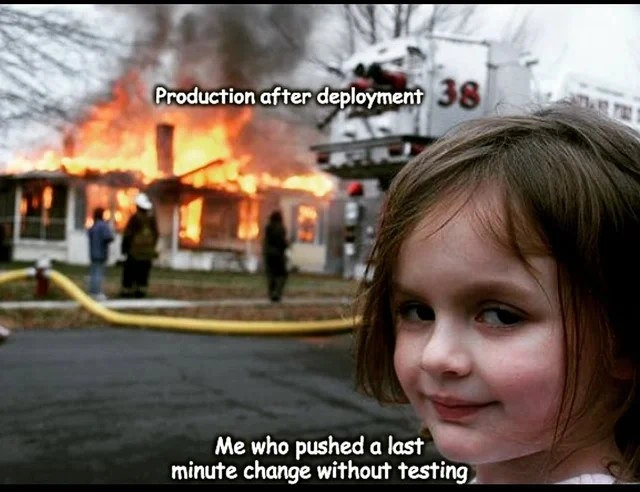
In the meme, the production after deployment caption written over the burning house tells us that as soon as the new code was deployed, the live system started “burning down.” Of course, nothing literally caught fire in a computer – “on fire” is a metaphor meaning everything is failing spectacularly. Maybe the website is totally unresponsive, or users are seeing error messages everywhere, or data is getting corrupted. We often refer to major outages or incidents as “fires” in tech slang, hence terms like ProductionFirefighting for scrambling to fix an emergency. The firefighters in the image perfectly represent the developers and ops engineers rushing to control the damage. They’re essentially debugging and patching the system in real-time to get things back to normal – that’s the firefighting.
The bottom caption, “Me who pushed a last minute change without testing,” is pointing at the little girl smirking in the foreground. She stands for the developer (or DevOps engineer) who deployed that hotfix-type change at the very last minute, skipping the safety steps. “Last minute change” implies it was done impulsively or under deadline pressure, maybe right before a release cutoff or even late in the evening when everyone else was winding down. This is generally a risky move. There’s a common saying in IT: “No deploys on Friday.” Why? Because if you deploy right before the weekend (or at the end of the day) and something goes wrong, you’ve just ruined your night or weekend with emergency work. Here the meme doesn’t explicitly say it was Friday, but the scenario fits that same what could possibly go wrong? careless vibe. Well, as we see, everything can go wrong!
So the developer in question bypassed the usual routine – maybe they thought the change was trivial (“just a one-line fix, no need to waste time testing!”). Perhaps they were overconfident or in a hurry to push a fix for a bug before anyone noticed. Unfortunately, that one-line change might have had unintended consequences. For example, imagine that code was supposed to check if a value is null (empty) before using it, but the developer removed that check in the hurry. On their own machine with limited data, it seemed fine (“Works on my machine!” they might say). But in production, where thousands of users and all sorts of data situations occur, that missing check could cause a cascade of errors – like thousands of requests all hitting a bug and overwhelming the system. Suddenly, the live site goes down or becomes super slow – that’s the house catching fire in the meme. Everyone from your team to your users can see the “flames” (the errors and downtime). It’s highly visible and very embarrassing.
Now the developer who did this (the smirking kid in the picture) obviously didn’t intend to cause harm – in reality they’re likely feeling developer regret and panic. The smirk in the meme is just for dark humor, because it’s funnier to imagine them as a tiny arsonist looking oddly pleased. The truth is, when such a DeploymentFailure happens, that developer would probably be sweating, saying “Oh no… oh no…” as they realize their rushed change is the culprit. They might be digging through logs (the record of what the program did) trying to find that error stack trace, or scrambling to revert the change (rollback to the previous version). Meanwhile, the on-call engineer (if it’s not the same person) is paged by the monitoring system because it detected the outage – many tech teams have a rotation where someone is always on duty to handle these emergencies, called on-call duty. Being on-call means if production breaks at 2 AM, you get the phone call or alert to fix it. That’s why this scenario is a nightmare: no one wants to be woken up (or stuck late at the office) because of an avoidable bug.
The meme’s scenario is all about DeploymentAnxiety and its justification. Deployment anxiety is that nervous feeling you get every time you hit the deploy button, especially if you’re not 100% sure everything’s okay. This picture basically says, “See? That anxiety is real – if you skip testing, you might set the world on fire!” It’s humorous now, but it’s also a gentle lesson: Always test your changes, even if they’re small and even if you’re in a hurry. Use your QA environments, trust your CI pipeline, double-check that “tiny fix”. Because nothing feels worse than realizing you are the reason production is down and everyone knows it. This meme resonates with a lot of developers precisely because it’s a shared learning moment – many of us have had a close call or a full-blown disaster from an innocent last-minute tweak. The picture just exaggerates it to drive the point home in a funny way.
In summary, the burning house = broken production system; the firefighters = the team scrambling to fix the issue; the smirking kid = the guilty developer who caused it by bypassing process. It’s a comical take on a serious DevOpsHumor scenario. Next time you’re tempted to push untested code to production, remember this image of the house on fire and that little “I messed up” smirk. It might save you from becoming the star of the next disaster meme!
Level 3: Deployment Arsonist
In the world of DevOps, this meme hits like a war story everyone’s heard. The image repurposes the classic Disaster Girl meme – a little girl smirking at the camera while a house blazes in the background – to depict a ProductionIncident of epic proportions. The top caption labels the inferno as “Production after deployment,” and oh boy, every seasoned engineer recognizes that burning house as a metaphor for a production environment catastrophically failing right after a code deploy. The bottom caption reads “Me who pushed a last minute change without testing,” directly calling out the developer as the inadvertent arsonist. It’s a darkly comic twist: the person who caused the disaster (the coder with the hotfix) is represented by a mischievously smiling child, as if they lit the match and are smirking through the smoke. This absurd juxtaposition is cringe-inducing and hilarious because in real life that developer would be sweating bullets, not smiling – yet internally, every experienced dev has a bit of that “😬 whoops, I did that” feeling when things go ablaze.
Why is this so relatable? Because there are two kinds of developers: those who have broken production, and those who will. Pushing a last-minute hotfix directly to prod without tests is the classic rookie mistake – except it’s not just rookies! Even battle-hardened engineers under pressure have gambled on a quick fix. We’ve all experienced that gut-drop moment when a DeploymentFailure unfolds: you merge a change at 5 PM (thinking “It’s just one line, what could go wrong?”), hit git push, and moments later monitoring dashboards and Slack channels light up like a Christmas tree on fire. The website is down, error rates are through the roof, customer support is frantically calling, and your on-call pager is screaming. It’s ProductionFirefighting time – literal firefighters in the meme, and frantic engineers in reality. The meme nails the irony that the very person who caused the blaze (the developer bypassing the safety checks) is now watching the conflagration alongside everyone else, implicitly responsible. In practice, that developer isn’t calmly grinning – they’re panicking and scrambling to douse the flames they ignited – but the humor comes from portraying them as the only calm (almost proud) figure in the chaos. It’s a tongue-in-cheek way to visualize the dreaded scenario every DevOps veteran knows too well.
From an industry perspective, this image mocks the anti-pattern of rushing untested code to production. There’s a whole DevOps philosophy built around preventing these nightmares: automated tests in a CI/CD pipeline, code reviews, staging environments, canary releases, feature flags – you name it. Skipping all that is like flicking a lit match into a dry forest. The meme’s “last minute change without testing” is basically a taboo horror story told around the Campfire of On-Call Horror. Why do such DeveloperMistakes happen? Often crunch time, manager pressure, or that one critical bug right before a deadline. Someone yells, “Ship it now, we’ll fix forward!” and in the adrenaline of deployment anxiety, best practices fly out the window. Continuous Integration becomes Continuous Ignition. That tiny code change you were so sure about ends up being the butterfly that causes a hurricane — maybe it introduced a memory leak that only blows up under production load, or it disabled an important validation check that let bad data start a fire in the database. DebuggingNightmares like this usually trace back to a single innocent-looking commit. It’s the kind of post-mortem story that starts with, “We thought it was a minor tweak…” and ends with, “…and that’s how the entire system went down for 6 hours.”
The humor has a cathartic edge: it’s funny because it’s true. The firefighting crew in the photo represents the harried DevOps team and SREs trying to contain the damage (rolling back the release, applying a real fix, updating status pages, apologizing to users), while the “disaster child” represents that developer who now has to live with the oh-so-public consequences. The meme is basically a rite-of-passage visualization. Seasoned engineers laugh (maybe a bit bitterly) because they’ve survived this chaos before. They might even quip, “At least it wasn’t DNS this time,” since this time it’s clear who set the spark. The RelatablePain is real – deploying untested code is like playing Russian roulette with your production environment, and sooner or later, you land on a live bullet. The meme’s dark comedy turns that painful lesson into a visual punchline that every OnCall_ProductionIssues veteran can appreciate (once they’ve had a coffee or three to recover).
Description
This meme uses the popular 'Disaster Girl' format, which shows a young girl smirking mischievously at the camera while a house burns in the background. In this version, the burning house is labeled 'Production after deployment,' representing a catastrophic failure in a live software environment. The girl in the foreground is labeled 'Me who pushed a last minute change without testing,' humorously taking credit for the disaster. The joke resonates with developers of all levels, but especially seniors who understand the immense pressure and potential consequences of rushing code to production. It highlights the critical importance of adhering to testing protocols, no matter how small the change seems, and serves as a cautionary tale against cowboy coding in a team environment
Comments
8Comment deleted
The fastest way to get the entire engineering team on a call at 3 AM is to push a 'minor' change directly to main on a Friday afternoon
Prod’s ablaze, but I did merge with “[ci skip]” in the commit - if the pipeline never ran, the RCA clearly points to infrastructure, right?
The only difference between a junior pushing untested code and a senior doing it is that the senior already has their resume updated and knows exactly which monitoring dashboard to close before anyone notices
The real tragedy isn't the burning production environment - it's that the rollback script was in the same commit you just deployed, and now the CI/CD pipeline is timing out because the health checks can't reach the servers that are metaphorically (and in this meme, literally) on fire
“Just a one-line hotfix, no canary” - two minutes later we discovered rollback doesn’t undo irreversible migrations or remove the CEO from the incident bridge
Last-minute 'simple' change to prod: because who needs staging when you can optimize for post-mortem storytelling?
That one-line hotfix skipped CI, flags, and canary - compressing MTTR to Mean Time To Regret while spending the entire error budget before standup
It's DevOps engineer's problem that tests are not run before deployment Comment deleted