Reading mRNA Like Source Code
Why is this DataFormats meme funny?
Level 1: A Recipe Written In Tiny Letters
It is interesting because the picture makes a vaccine look like a tiny written recipe. The letters are not computer code, but they act like instructions that cells can read for a short time. Programmers like it because it feels familiar: a long string of symbols goes into a system, the system reads it, and something useful comes out.
Level 2: A Sequence As Instructions
The visible document is not a normal program, but it can be read with programming instincts. It shows a sequence, meaning an ordered string of symbols. In software, changing one character in a file can change what the program does. In molecular biology, changing one nucleotide can sometimes change the protein that gets produced, or change how stable or efficient the molecule is.
A simplified comparison looks like this:
| Software idea | Biological analogue |
|---|---|
| Source text | RNA sequence |
| Alphabet | A, C, G, U, and modified symbols like Ψ |
| Parser/runtime | Cellular machinery |
| Instruction grouping | Codons, read in groups of three |
| Output | Protein production |
| Optimization | Sequence changes that preserve the protein but improve behavior |
An mRNA vaccine provides cells with temporary instructions for making a harmless piece of a virus protein, such as the spike protein target used by SARS-CoV-2 vaccines. The immune system sees that protein piece and learns to recognize it. The mRNA does not need to become part of your DNA to do that; it is more like a temporary job ticket that gets read and then degrades.
The image is developer-relevant because it makes the invisible visible. Instead of saying “the vaccine contains mRNA,” it shows a chunk of the actual symbolic representation. That turns biology into something a programmer can reason about: a file format with meaningful symbols, special cases, and translation rules.
The joke-adjacent part is that developers immediately start treating it like code review. Why this character? Why this substitution? What does this prefix do? Is that metadata or payload? Can the runtime accept this token? Somewhere between Sequence / Séquence / Secuencia and the line count 500, a biology document starts looking like a pull request from nature.
Level 3: Biology Has Opcodes
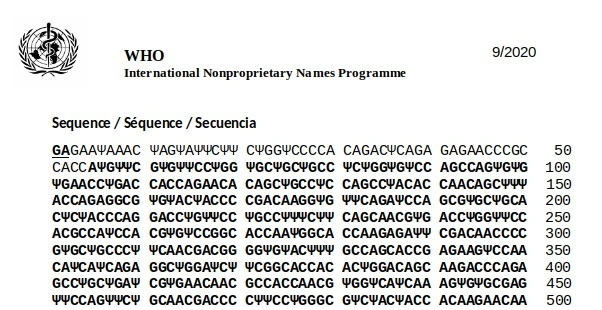
The image is a cropped WHO International Nonproprietary Names Programme document with the date 9/2020, the multilingual header Sequence / Séquence / Secuencia, and a dense 500-character-looking biological sequence made from symbols like G, A, C, and Ψ. The local post explicitly says this is Not a meme at all, but super interesting!, pointing to a serious technical article that reads the BioNTech/Pfizer SARS-CoV-2 vaccine sequence like source code.
The developer hook is that the sequence looks unsettlingly like a source file. It has a header, a fixed alphabet, line counts on the right, and a weird special character that begs for a character-encoding argument. In ordinary software, a source file is a symbolic representation that some machine later interprets or compiles into behavior. In this biological context, mRNA is a symbolic molecular sequence that cellular machinery reads to produce a protein. That analogy is not perfect, but it is close enough to make programmers lean forward.
The Ψ symbol is the detail that makes the screenshot more than “biology is code” hand-waving. Normal RNA is commonly described using A, C, G, and U. In this vaccine sequence, the Ψ character represents a modified uridine-like base used in place of U. The software analogy is a custom token that still behaves like a known instruction to the execution environment while changing how surrounding security systems react. Biology had content filtering before product managers discovered the phrase.
The sequence also exposes why “source code” is both useful and dangerous as a metaphor. Useful, because the order of symbols matters, groups of three nucleotides correspond to codons, codons map to amino acids, and the resulting amino-acid chain folds into a protein. Dangerous, because cells are not deterministic build servers. RNA stability, delivery through lipid nanoparticles, ribosome behavior, immune sensing, protein folding, dosage, manufacturing quality, and clinical safety are all part of the real system. The visible sequence is not the whole vaccine any more than main.c is the whole deployed production environment.
For developers, this is a rare chance to see familiar engineering concepts in wet lab clothing: data format, parsing direction, translation, metadata regions, optimized encodings, semantic-preserving substitutions, and runtime constraints. Some codon changes can produce the same amino acid while changing how efficiently the cell produces protein, a little like rewriting code so the observable output remains the same but the runtime behaves better. The compiler is a ribosome, the runtime is a cell, and the incident review is handled by immunology.
Description
A cropped document screenshot shows the WHO emblem and the heading "WHO International Nonproprietary Names Programme," with the date "9/2020" at the top right. Below it is the multilingual header "Sequence / Séquence / Secuencia" followed by dense biological sequence text made of letters such as G, A, C, and the modified-base symbol Ψ, with right-side line counts from "50" through "500." The sibling context points to Bert Hubert's article "Reverse Engineering the source code of the BioNTech/Pfizer SARS-CoV-2 Vaccine," where this WHO sequence is explained as the first 500 characters of the BNT162b2 mRNA. The technical relevance is the code-like treatment of molecular information: encoded instructions, modified symbols, translation machinery, and optimization choices that map surprisingly well to software metaphors.
Comments
6Comment deleted
It is the rare source review where a one-character diff can mean a new freezer protocol and a clinical trial.
It'd be great to post some useful stuff here Comment deleted
yesss!! Comment deleted
+ Comment deleted
Yes, please. Comment deleted
++ Comment deleted