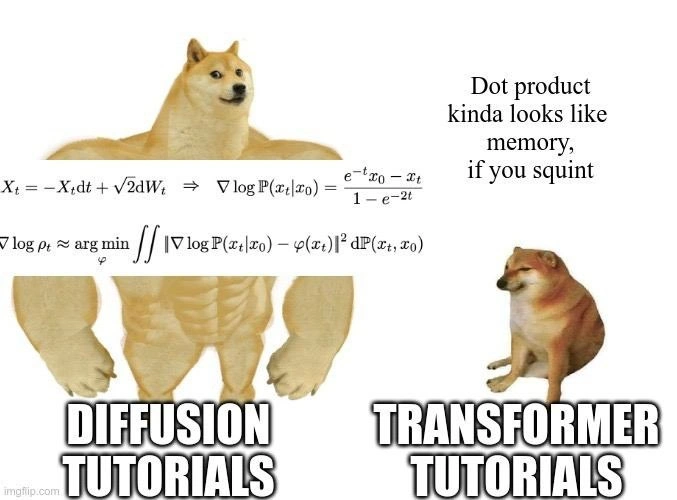
The learning curve for modern AI architectures
Why is this AI ML meme funny?
Level 1: Professor vs Friend
Imagine you want to learn about a new magic trick. You go to two people for an explanation. The first person is like a professor – they pull out a chalkboard and start writing a ton of equations and big words. They’re basically saying, “Here’s the full physics and math of how the trick works,” and pretty soon your head is spinning with formulas. That’s our big Buff Doge: he represents the teacher who gives you every complicated detail and expects you to keep up. The second person is like your friend who says, “Ah, it’s simple! It’s kinda like, you know, just doing this one little thing,” without much detail. That’s the Cheems dog: a friend who gives you a quick, simple idea of the trick but doesn’t really explain everything. In the context of the meme, the “professor” is explaining an AI method with a wall of math (so heavy it’s funny), and the “friend” is explaining a different AI method with an overly simple one-liner.
Why is this funny? Because the difference is so extreme! It’s like asking two people for directions and one gives you GPS coordinates and traffic patterns, while the other just says, “Go that way, you’ll see it, can’t miss it.” The big dog (Buff Doge) is super serious and super smart-looking with all the fancy math – that makes us chuckle because it’s overkill for a “tutorial.” The little dog (Cheems) is using a tiny, casual explanation – we laugh because it’s oversimplified to the point of being a bit silly. People who try to learn complicated things often meet both types of explanations. The meme uses the dogs to exaggerate how we feel: sometimes we’re overwhelmed by a teacher who gives too much detail, and other times we’re underwhelmed (or slightly confused) by a friend who skips the details. The emotional core here is relatability: it’s poking fun at how learning can be either too hard or too easy, and finding the balance is tough. Even if you’re not into AI, you can get the joke – it’s like a big strong character speaking technobabble versus a small shy character giving a half-baked explanation. It’s cartoonish and universal: big dog says “VERY COMPLICATED STUFF!!!”, little dog says “uh, it’s kinda like this simple thing…”. That contrast is what makes the meme amusing and charming.
Level 2: Diffusion vs Transformer Basics
Let’s break down what’s going on in simpler terms. We have two characters from a meme: Doge (the Shiba Inu dog famous in memes) in two forms. On the left is Buff Doge, super muscular and confident, labeled “DIFFUSION TUTORIALS.” On the right is Cheems (another Shiba Inu character who looks meek or clueless), labeled “TRANSFORMER TUTORIALS.” These labels tell us we’re comparing two kinds of learning materials or guides in the field of AI/ML (Artificial Intelligence/Machine Learning).
Diffusion models are a type of generative AI model. They’re used, for example, to generate images (like those AI-generated art systems you might have heard of). The core idea of a diffusion model is to start with some random noise and gradually “denoise” it into a coherent image (or conversely, start with an image and gradually add noise). To explain this properly, many tutorials introduce some heavy mathematics. They talk about stochastic differential equations – which is basically a fancy way of describing how something changes over time with a random element involved. In the meme, the Buff Doge is literally showing one of these equations ($dX_t = -X_t,dt + \sqrt{2},dW_t$) along with other math about probability (those ∇ symbols denote gradients, like slopes, of probability distributions). This is not easy stuff; it’s the kind of math you’d encounter in an advanced statistics or physics class. The term score_matching appears in the text (implied by that arg min formula) – that’s a specific method used in training diffusion models, where the model learns to guess the “score” (think of it as the direction to move to make data less noisy). For a newcomer, seeing this in a tutorial is daunting. Buff Doge represents that intense, super-technical style of tutorial. Imagine a tutorial that starts with: “First, assume $(X_t)_{t\ge0}$ is an Itô process with drift and diffusion coefficients…” – most beginners’ eyes would glaze over! That’s the joke: Diffusion_model tutorials tend to be very math-heavy, to the point of intimidating readers who are not already comfortable with these concepts. This is sometimes called an equation intimidation factor, where the sheer presence of dense equations can scare learners away. Buff Doge (strong and scholarly) embodies those rigorous guides that assume you have a strong math background.
On the right, we have transformers – specifically the tutorial style for transformers. What is a transformer? It’s a type of neural network architecture that’s behind many breakthroughs in AI, especially in language (for example, GPT-4 and other large language models are built on transformers). The key innovation in transformers is the self-attention mechanism. Now, self-attention involves computing something called dot products between vectors (which represent words or image parts) to figure out how much they should influence each other. In more concrete terms, a dot product is an operation you do on two lists of numbers (vectors) – you multiply pairs of numbers and add them up, yielding a single number. If the vectors are similar (pointing in similar directions in some high-dimensional space), the dot product is larger. Transformers use this to let each word pay “attention” to other words that are relevant. For example, in the sentence “The cat sat on the mat because it was tired,” when interpreting “it,” the model would use dot products to figure out that “it” probably refers to “the cat” and not “the mat.”
Now, how do tutorials explain this? Many transformer_architecture tutorials, especially beginner-friendly ones, avoid diving into hard math. Instead, they use analogies. They might say something like: “Think of the model’s memory: each word looks around and finds which other words are important by basically doing a similarity check (a dot product) – kind of like how you’d scan your memory for relevant facts.” The meme’s Cheems says, “Dot product kinda looks like memory, if you squint,” which humorously captures this style. It’s implying that some tutorials reduce the complex process of self-attention to simply, “It’s like the network has a memory of words, and it checks memory by a dot product.” Cheems is portrayed as small and unsure, matching the idea that these explanations are weaker or watered-down. In reality, transformers have a lot going on (matrix multiplications, multiple attention heads, nonlinear activation functions, etc.), but a newbie tutorial might skip those details. This makes transformer guides much easier to digest initially – no scary formulas, just a conceptual idea you can visualize.
So, putting it together: the meme contrasts two extremes in learning materials. The left side (Diffusion Tutorials with Buff Doge) is very hard: it expects you to handle advanced math and really understand the theory behind the AI model. The right side (Transformer Tutorials with Cheems) is very easy: it almost oversimplifies the idea so much that you’re not getting the full picture, but you’re also not overwhelmed. If you’re new to DeepLearning, you might prefer the Cheems-style explanation at first, because it feels more accessible (it’s like someone telling you a story or an analogy). But as you advance, you realize that the Buff Doge-style tutorials, while challenging, give you the precise and deep understanding needed to truly master the topic. The meme resonates with the learning_curve we all go through: at first we appreciate the easy analogies (so we don’t get scared off), and later we often have to grapple with the hard equations to really get what’s happening under the hood. It’s a funny exaggeration of how differently the same subject can be taught. If you’ve ever found an “Intro to AI” blog that makes things sound trivial and also tried to read an academic paper that felt like another language, this meme is basically depicting that experience with two dogs for comic effect.
Level 3: Rigor vs Hand-Waving
The humor really clicks for experienced folks in Machine Learning because it exaggerates a truth about learning advanced AI topics. Diffusion model papers and tutorials (like those on generative models for images) often feel like reading a physics textbook – you’re hit with differential equations, probability densities, and integrals on day one. Anyone who’s waded through Jonathan Ho’s Denoising Diffusion Probabilistic Models or Song & Ermon’s score-based generative modeling paper will recognize the Buff Doge vibe: these resources assume you’re comfortable with math-heavy concepts. There’s an unspoken badge of honor in slogging through those equations. In contrast, transformer guides – especially many blog posts or video tutorials that popped up during the AI research hype around GPT-3 and large language models – tend to be far more approachable (sometimes to a fault). They often say things like, “Think of the attention mechanism as the network searching through a memory bank,” and then they simplify the mechanics to a dot product example. As Cheems puts it, “kinda looks like memory, if you squint.” Seasoned developers see the irony: transformer_architecture is itself a complex beast (with multi-head attention, positional encodings, layer norms, and so on), but popular tutorials sometimes reduce it to one core trick (the dot product attention) without diving into why it works.
Why is this funny? Because both diffusion models and transformers are complex, state-of-the-art deep learning techniques – yet the way they’re taught can be night-and-day. The meme captures that tutorial_complexity_gap perfectly. On one side, you have equation_intimidation_factor turned up to eleven: the Buff Doge “Diffusion Tutorials” practically dares the reader to keep up with derivations of Brownian motion and score_matching losses. If you’ve ever had to pause a tutorial video or re-read a paper just to recall your calculus or linear algebra, you know the pain (and eventual pride) of those rigorous explanations. The Buff Doge energy screams, “No pain, no gain – here’s the entire derivation of the diffusion process, enjoy!”
On the other side, Cheems’s “Transformer Tutorials” represent the opposite learning experience – almost too friendly. It’s the kind of AI humor that makes an experienced engineer smirk, because we’ve seen how transformer hype led to countless explainer articles that try to make transformers sound easy as pie. Sure, comparing dot products to memory lookup is a neat intuition: queries and keys in attention are like a question and a set of answer indices, and the dot product tells you which answer is most relevant. It’s a handy mental image, and calling it “just a dot product” lowers the barrier for newcomers. But we insiders know that this glosses over a lot. It’s a bit like saying a rocket launch is “just lighting a candle, scaled up” – technically, there’s fire involved in both, but boy, is that an understatement. The Cheems side of the meme pokes fun at how learning materials for popular architectures can sometimes oversimplify reality to the point of being almost cartoonish.
For a senior developer or researcher, this disparity triggers a knowing laugh (or maybe a groan). We’ve been in meetings or journal clubs where someone new excitedly says, “I read that attention is like a dictionary lookup with dot products!” and an old-timer chimes in, “Well, that’s a bit of a simplification….” The meme’s joke is essentially about pedagogy in AI: one style believes in full rigor (even if it scares off half the readers), and the other believes in intuition pumps (even if it sacrifices precision). Neither approach is inherently wrong – in fact, both serve a purpose – but seeing them side by side in extreme form is hilarious to those of us who’ve traversed the entire learning_curve. It recalls those times we struggled through a dense math blog to implement neural_networks properly, versus times we breezed through a fluffy article and later discovered there was a lot more under the hood. This Buff Doge vs Cheems format has become a popular meme framework for exactly such contrasts in tech: buff_doge_vs_cheems usually means “one thing explained with extreme strength or complexity vs the same thing explained weakly or oversimplified.” Here it’s applied to AI tutorials, and it strikes a chord because inconsistent teaching styles are something every developer has encountered. As an industry in-joke, it also reflects how rapidly ML has grown: early on, researchers wrote tutorials for other researchers (hence all the math), but as AI hit the mainstream, explainers for everyone became the norm (hence the hand-wavy dot product metaphor). This meme brilliantly exaggerates that contrast, and if you’ve lived through it, you’re probably smiling (and maybe rubbing your temples remembering that one diffusion equation you tried to derive at 2 AM).
Level 4: Score-Matching Sorcery
On the left side of this meme, Buff Doge is flexing with a full-blown stochastic differential equation (SDE) and an integral-based loss function. The notation is intimidating:
$$ dX_t = -,X_t,dt + \sqrt{2},dW_t, $$
which describes an Ornstein–Uhlenbeck diffusion process. In plainer terms, this SDE says the data $X_t$ is being gradually pulled towards zero (the $-X_t,dt$ drift term) while random noise ($dW_t$ is Wiener process noise) is continuously added. This is the kind of equation you find in advanced generative models literature – it formalizes how to add noise in continuous time. From this, the meme shows the derived conditional score:
$$ \nabla \log \mathbb{P}(x_t \mid x_0) = \frac{e^{-t} x_0 - x_t}{,1 - e^{-2t},},. $$
This is essentially the gradient of log-likelihood (the score function) for the noised data $x_t$ given the original data $x_0$. Buff Doge isn’t done yet: there’s another heavy formula about minimizing the difference between this true score and some function $\phi(x_t)$ (our model’s predicted score). That double integral
$$ \nabla \log \rho_t \approx \arg\min_{\phi} \iint \Big|\nabla \log \mathbb{P}(x_t|x_0) - \phi(x_t)\Big|^2 d\mathbb{P}(x_t, x_0) $$
is the score-matching objective in training diffusion models. In practical terms, the neural network tries to approximate the true score $\nabla \log \rho_t(x_t)$ by solving a giant least-squares problem over all possible noisy data pairs $(x_0, x_t)$. This mathematical sorcery comes straight from academic papers on diffusion models, where every step of the denoising process is grounded in rigorous theory. The Buff Doge side of the meme captures how diffusion_model tutorials often dive into deep waters: Itô calculus, Fokker–Planck equations, and integrals over probability spaces. The humor here is that the diffusion tutorial is effectively a graduate-level lecture crammed into a meme – the kind of tutorial that bombards you with equations to ensure no detail is omitted.
Now contrast that with the timid Doge (Cheems) on the right: he quips, “Dot product kinda looks like memory, if you squint.” This is a tongue-in-cheek simplification of the transformer architecture. A seasoned ML engineer knows that transformers rely on a mechanism called self-attention, which computes attention scores using dot products. In formal math, a single-head attention is something like:
$$ \text{Attention}(Q, K, V) = \mathrm{softmax}!\Big(\frac{Q K^T}{\sqrt{d}}\Big) V,, $$
where $Q$, $K$, $V$ are matrices of query, key, and value vectors. There’s linear algebra and even some probability (the softmax is essentially making those dot products into a probability distribution). But Cheems’s point is that many transformer tutorials reduce this to: “Hey, it’s basically just a bunch of dot products to figure out what to pay attention to.” The phrase “like memory, if you squint” references a common analogy: treating the transformer’s key–value pairs as a memory system. The dot-product attention is likened to checking “How much does this query vector resemble each key vector?” – a simplistic memory lookup metaphor. For an expert, this oversimplification borders on hand-waving. There’s no rigorous derivation or integrals here, just a casual one-liner. The humorous juxtaposition is that a Transformer tutorial in popular media often spares the theoretical proofs and math, whereas the diffusion tutorial goes all-in with derivations. It’s as if the left side demands you understand advanced topics like Gaussian processes and stochastic_differential_equations, while the right side says, “Relax, it’s just some linear algebra — nothing to be scared of, trust me.” This disparity itself is a commentary on ML education: two equally cutting-edge topics (diffusion models for image generation and transformers for language models) are taught with completely different levels of mathematical intensity. For those of us who know both, the meme lands as a clever jab: we see the underlying complexity being either fully exposed or glossed over. It highlights an inside joke among researchers and engineers: depending on the tutorial, you either get a buff dose of theory or a cheems-level simplified story.
Description
A two-panel meme in the 'Swole Doge vs. Cheems' format, comparing the complexity of tutorials for Diffusion and Transformer models. On the left, a muscular, powerful Doge represents 'DIFFUSION TUTORIALS' and is accompanied by complex mathematical equations from stochastic calculus and probability theory, such as `Xt = -Xtdt + sqrt(2)dWt` and optimization formulas. On the right, a small, meek Cheems represents 'TRANSFORMER TUTORIALS' and is paired with the simple, hand-wavy explanation: 'Dot product kinda looks like memory, if you squint'. The meme humorously contrasts the perceived mathematical depth and rigor required to understand diffusion models with the often oversimplified analogies used to explain the core attention mechanism of transformers
Comments
7Comment deleted
A diffusion model derives its intelligence from the first principles of statistical mechanics. A transformer derives its intelligence from a trillion dot products and the misplaced belief that if you squint hard enough, similarity is the same as understanding
Sure, transformers are “just” scaled dot-products - right up until you try to fit the KV-cache in VRAM and realise the diffusion math was the easy part
The real diffusion process is watching your will to live slowly denoise into resignation as you realize the 'simple' tutorial assumes you have a PhD in stochastic differential equations, while transformer tutorials just say 'attention is all you need' and somehow that's enough to build ChatGPT
This perfectly captures the cognitive dissonance of modern ML: diffusion papers read like you need a PhD in stochastic calculus just to understand the abstract, while transformer tutorials are like 'attention is basically just fancy weighted averaging, trust me bro.' Both architectures are equally complex under the hood, but somehow the community decided diffusion deserves Navier-Stokes equations while transformers get away with 'it's like memory but squishy.' The real kicker? Both explanations are technically correct, just operating at wildly different altitudes of mathematical honesty
Diffusion tutorials: 20 minutes of SDEs to justify one Euler step; transformer tutorials: call Q*K^T/sqrt(d) “memory,” slap a KV cache on it, and ship
Diffusion tutorials: deriving ELBOs in your sleep. Transformers: 'Dot products are memory, trust the squint test.'
Diffusion: derive ∇log p from the Fokker - Planck, discretize the SDE, fit φ by score matching; Transformers: call dot-product ‘memory’, ship it, and let KV cache turn the O(n^2) line item into a quarterly budget review