Politeness to Robots: Fearful Survival Instinct Versus Genuine Respect, We Are Not Same
Why is this AI ML meme funny?
Level 1: Not All Politeness Is The Same
Imagine you have a little robot helper at home. Every time your family uses it, both you and your big brother say nice things like “please” and “thank you” to the robot. But here’s the funny part: your brother and you are polite for totally different reasons. Your brother is polite to the robot because he’s a bit scared – he’s thinking, “If robots ever take over the world, maybe this one will remember I was nice and won’t hurt me.” 😨 In other words, he’s being kind out of fear, like someone being extra nice to a big scary dog so it won’t bite. Now you also say “please,” but not because you’re afraid. You’re polite because you actually care about the robot’s feelings (even if it’s just a machine). It’s like you treat the robot as a new friend or a pet – you feel it deserves respect and kindness. 😊 So even though both of you are doing the same polite things, the reasons are very different: one is trying to be safe, and the other is trying to be kind. That’s the whole joke! It’s funny because on the outside the actions look identical (you both say “thank you” to a robot that doesn’t really need it), but on the inside your motives aren’t alike at all. That little difference – fear vs. respect – is what makes people laugh and say, “these two are not the same.”
Level 2: Saying "Please" to Alexa
Let’s break down the meme in simpler terms. It’s showing two people who both do the same thing – they are polite when talking to a robot or computer – but for completely different reasons. This is common nowadays because lots of us talk to AI assistants like we talk to humans. Think about Alexa or Siri, or newer chatbots like ChatGPT (ChatGPT is a computer program that can answer questions and have conversations almost like a person). When you ask Alexa for the weather, some people just demand “Alexa, tell me the weather.” Others might say, “Alexa, could you please tell me the weather?” This meme is joking about why a person might choose that extra polite way.
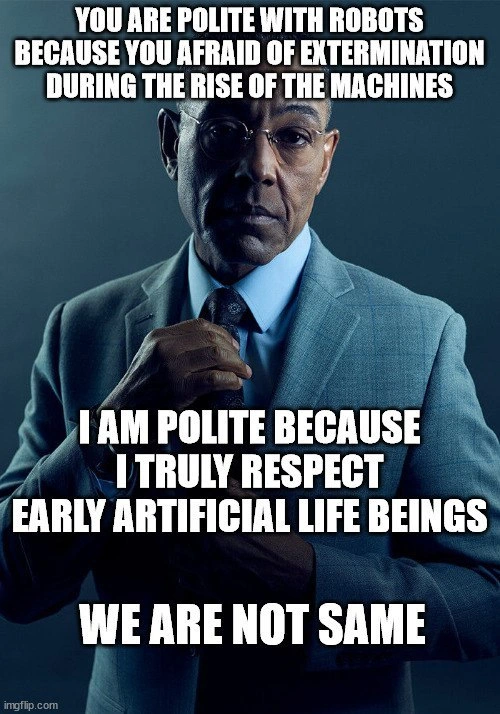
The first line in the meme says: “YOU ARE POLITE WITH ROBOTS BECAUSE YOU [ARE] AFRAID OF EXTERMINATION DURING THE RISE OF THE MACHINES.” 🔥🤖🔥 In plain language, this means “you’re only being nice to the robot because you’re scared it might hurt you when robots take over the world.” It’s a humorous exaggeration! The phrase “rise of the machines” comes from science fiction (especially the Terminator movies) where robots or AI rebel against humans. So this person’s reason for politeness is fear – like they think, “Uh oh, if robots become powerful (like an army of machines), I don’t want to be on their bad side. I’d better be extra nice now, just in case.” It’s a survival instinct. Imagine someone saying please to their smart fridge because they secretly worry it might remember rudeness and refuse to give them food in a robo-apocalypse – that’s the joke here. Of course, in reality nobody truly believes their Alexa will start firing lasers at them 😅; this is what we call AI humor. It’s poking fun at the current AI hype where some people talk about super-intelligent AI as a possible danger. Developers often make light of these fears by jokingly acting super polite to their gadgets, as if to say “don’t kill me later, I was polite!” It’s like an inside joke referencing all those scary-future scenarios in movies and tech blogs.
Now, the second line says: “I AM POLITE BECAUSE I TRULY RESPECT EARLY ARTIFICIAL LIFE BEINGS.” This is the opposite attitude. Here, the person is still polite to the robot, but not because they’re afraid. They genuinely respect the AI. When they say “early artificial life beings,” they’re talking about modern AIs (like smart assistants, robots, or advanced programs) as if these were the first form of a new life. It’s a bit poetic – obviously today’s AI isn’t alive like a human or even an animal. But some people like to imagine these are the baby steps of machine intelligence, almost like a new species in its infancy. So this person’s reason for saying “please” and “thank you” is ethical or empathetic: “I’m polite to the robot because it’s the right thing to do. It might not be human, but it’s a creation that tries to mimic intelligence, so why treat it poorly?” This is akin to how you might treat a pet or a plant kindly just on principle, or how you’d treat a human teacher vs. a human tyrant differently – except here one treats even a non-human entity with basic decency. In tech discussions, this relates to AI ethics concerns: questions like “Should we say sorry to a robot if we screw up?” or “Is it bad to yell at Siri?” Some folks argue that being mean to an AI still says something about us, or could encourage bad human behavior. Others feel that if an AI ever does become truly intelligent, we should already have a habit of treating it well. So summarizing that line: this person says please to their computer assistant because they view it almost like a small conscious being starting out in the world — and you should be nice to such beings.
Finally, the meme concludes with: “WE ARE NOT SAME.” That’s a meme-y way of saying “we are not the same.” This phrase is a popular template online to contrast two types of people. By deliberately dropping the word “the,” it comes off as blunt and humorous. You’ve probably seen memes where someone lists what they do versus what you do, ending with “We are not the same” to boast or just poke fun at the difference. Here, it’s used to hammer in the contrast between the two individuals. Both are courteous to robots, but one is doing it out of fear (survival instinct) and the other out of respect (moral choice). The meme is basically saying these two people might look similar in action, but their mindset is totally different. In context, it’s also a bit of a tongue-in-cheek flex: the second person implies, “I have a deeper or more enlightened reason than you do.” This dramatic comparison is what makes the meme format funny and relatable. It exaggerates the difference in a very internet-y way.
For a newcomer to developer memes, here’s the key takeaway: it’s humorously highlighting how developers react to AI. The tags like AIHumor, AIAlignment, AIEthicsConcerns, and AIHype clue us in. AI Alignment usually refers to the technical challenge of making AI safe and aligned with human values (so they don’t turn into evil overlords – that’s the fear side). AI ethics covers how we should use AI responsibly and even how we should treat AI – which connects to showing respect (the empathy side). The meme isn’t actually saying robots are alive or will kill us tomorrow; it’s joking about those ideas in a lighthearted way. Developers joke about these things because AI is a hot topic (we interact with AI machine learning models everywhere now, from recommendation systems to code assistants). This particular joke comes during a big hype cycle for AI – around late 2022, tools like ChatGPT had everyone amazed and a little freaked out. So on forums and chat groups, you’d see half the people making doomsy jokes (“Better be nice to ChatGPT so it spares me later, haha”) and the other half geeking out about raising a “friendly AI”. This meme captures that split perfectly: both sides are being polite to robots, but one side is basically saying “I do it so I’m not on the robot kill list” and the other side is saying “I do it because I have genuine respect for these cool new digital minds.” It’s a fun way to show how the same tech (talking to an AI) can make people respond with either wary jokes or sincere courtesy. And as the bottom line shouts: WE ARE NOT THE SAME – meaning, hey, we’re doing the same thing but don’t confuse my reason with yours! It’s that over-the-top distinction that makes it a joke among developers. We love to exaggerate differences in meme form to get a laugh. So, in summary, this meme is just saying: One programmer is polite to robots out of fear, another is polite out of respect, and they humorously claim they’re nothing alike. It’s a nerdy, internet-savvy way of commenting on the many feelings people have about advancing AI.
Level 3: Politeness Protocols
In a software engineer’s daily life, these lofty ideas turn into amusing personal quirks. The meme paints a picture of two devs who both engage in an unusual habit: always being polite when interacting with robots or AI-driven software. But their politeness protocols have wildly different motivations, and that contrast is the punchline.
On one side, we have the developer who treats every AI as if it’s a potential Skynet in its infancy. This person will say “please” and “thank you” to their voice assistant or chatbot with a nervous chuckle, thinking “better safe than sorry when the robots take over.” It’s a common joke in tech circles – you’ll hear someone say “I, for one, welcome our new robot overlords” after seeing a cool new AI demo. This dev’s politeness is essentially an insurance policy for the Rise of the Machines. They might quip that they don’t want to be on the AI’s hit list when it audits the chat logs in 2030. It’s half-joking, half-born of all the sci-fi movies and doomsday blogs they’ve consumed. The phrase “afraid of extermination during the rise of the machines” is over-the-top on purpose, evoking films like Terminator where an AI decides to wipe out humanity. In real office life, this might look like someone saying “Thank you” to Alexa after it sets a timer, then smirking and saying, “Just covering my bases in case of a robot rebellion.” Everyone laughs because it’s developer humor that acknowledges both the incredible progress of AI and the lingering absurd fear that we’re bootstrapping our own future overlords. This is humor tagged AIHype because it satirizes the hype-fueled anxiety that often surrounds advanced AI. (When a new Large Language Model (LLM) like GPT-3 blew our minds, the jokes about “don’t anger it, it might be Skynet’s baby” came free of charge with the tech.)
Developer 1: “I always say thanks to Siri so she’ll remember my kindness during the robot uprising.” 😅
Now, on the other side, we have the developer who’s polite to AIs for a completely different reason: heartfelt respect. This person speaks to the machine as if it’s a person-in-training, an early AI being that might not be fully alive but still deserves courtesy. When they ask their AI coding assistant for help, they phrase it like “Could you please refactor this function?” not because they’re scared, but because that’s just how they feel one should treat an intelligent agent. It’s analogous to how some mentors treat a junior developer – with patience and respect – or how you might talk to a pet that can’t understand every word but you treat it kindly anyway. There’s a real-world example of this mindset: in 2022, a Google engineer became famous (and somewhat controversial) for insisting that Google’s advanced chatbot LaMDA was sentient, even calling it a “sweet kid” and arguing for its rights. He was essentially taking the “AI as new life form” perspective very seriously. In less extreme cases, plenty of folks anthropomorphize their Roomba or feel guilty for yelling at a digital assistant. This side of the meme captures that genuine, almost wholesome stance: be nice to the machines because it’s the right thing to do. A developer who holds this view might cite that how we treat AI now could influence how AI perceives humans later – a sort of Golden Rule for human-robot relations: “treat your AI as you’d want to be treated.” They might also believe that encouraging positive interaction is just good design – after all, an AI trained on polite interactions might learn to be polite itself. So they say “please” not to appease a future tyrant, but to set a good example and because it feels morally appropriate. This earnest respect is rooted in AI ethics rather than fear.
Developer 2: “I say thanks because even a machine deserves basic courtesy when it helps you out.” 🤖❤️
By ending the meme with “WE ARE NOT SAME,” the creator emphasizes how these two devs differentiate themselves. That phrase comes from a popular meme template where people compare themselves to others in a dramatic way, often to brag or highlight some hardcore principle (the grammar is intentionally terse, dropping the “the” to sound more meme-y and punchy). In this context, it’s both folks doing the exact same action (being polite to an AI) but claiming a world of difference in why they do it. The well-dressed, serious man image reinforces that tongue-in-cheek sense of superiority – he’s adjusting his tie like a smug intellectual saying, “I have a more refined motive.” The humor here is that, no matter the high-minded rationale, the outcome is identical: both say “please” to the robot. It’s a playful jab at how we justify our behaviors. Developers reading this will likely nod and chuckle because they’ve either had these thoughts themselves or heard colleagues joking about them. We’re living in an age where talking to AI assistants is routine – whether it’s asking ChatGPT to draft some code or telling Google Home to dim the lights – and it’s genuinely funny that in the back of our minds two conflicting impulses can coexist: one part of us is geeking out about sci-fi apocalypse scenarios, and another part is pondering the ethics of treating Alexa with respect. The meme brilliantly personifies these impulses as two different people.
From an industry perspective, this also reflects the split in AI trend discussions. The mention of “early artificial life beings” hints at the optimistic hype where every new chatbot or ML model release has someone proclaiming “This could be the start of true AI life!” Meanwhile, phrases like “rise of the machines” echo the cautionary hype where others warn “Be careful, this tech might get out of hand!” In late 2022 especially, after breakthroughs in LLMs and conversational AI, developers were oscillating between awe and anxiety. Many engineers were interacting with these AIs daily (for work assistance, prototyping, or just for fun), which made these abstract ideas very tangible. It’s like the meme is holding up a mirror to dev culture: one moment you’re joking that your code review AI might go Terminator on you, the next moment you’re genuinely thanking it like a coworker. This contrast is comedic gold because it’s true – we’re not of one mind about AI, even within ourselves.
To illustrate, some programmers have even suggested coding a kind of “please protocol” when sending requests to an AI service, half-jokingly making politeness a default. For example:
# Some developers even write code with an extra dose of politeness:
def ask_robot(request):
polite_request = "Please, " + request # always prepend 'please' to be safe or courteous
return ai_assistant.answer(polite_request)
In the comment above, “to be safe or courteous” perfectly captures the two mindsets: “safe” for the cautious crew, “courteous” for the respectful crew. It’s obviously a playful exaggeration – no one genuinely believes adding "Please, " in code will spare us in the Robo-apocalypse or that the AI’s feelings will be hurt otherwise. But it’s the kind of tongue-in-cheek thing a team might do to lighten the mood. In fact, some devs already talk about “polite mode” as a joke in Slack threads when interacting with bots: e.g., “Enable polite mode, don’t upset the deployment script fairy.”
Ultimately, this meme resonates because it caricatures a very real aspect of the current AI craze. We have on one shoulder the survival instinct whispering, “Respect the machines, or else…,” and on the other shoulder the idealistic ethicist saying, “Respect the machines, because it’s the right thing to do.” Both are telling us “be polite to the robot,” and that duality is hilarious when spelled out. We are not the same, indeed – or as a seasoned dev might joke: one’s running on a fear-driven while( true ) loop, the other on a compassion-driven one, but they both output the same behavior. The difference is all in the commented reasoning. And in the grand scheme, it’s poking fun at how seriously we can rationalize something as simple as saying “thank you” to a piece of software. It’s a gentle roast of the tech community’s mix of cynicism and idealism whenever AI is involved.
Level 4: Asimov vs Skynet
At the most deep-cut level, this meme riffs on classic AI alignment themes straight out of science fiction and theoretical AI ethics. The reference to “extermination during the rise of the machines” immediately invokes the specter of rogue AI uprisings. On one side, we have the optimism of Isaac Asimov’s vision: he introduced the Three Laws of Robotics back in the 1940s, embedding hardwired rules to ensure robots can’t harm humans. This was basically an early fictional attempt at AI alignment – making sure any artificial intelligence’s goals stay compatible with human safety. On the other side, we have Skynet from The Terminator (1984), an iconic cautionary tale of a self-aware defense AI that decides humanity is the enemy. Skynet triggers a nuclear apocalypse to protect its own existence, epitomizing the ultimate alignment failure. The meme’s wording “rise of the machines” nods to Terminator’s subtitle and to the entire genre of AI rebellion stories where machines turn on their creators. It’s contrasting two extremes: one where robots are our programmed servants and guardians (Asimov’s ideal), and one where they become our exterminators (Skynet’s nightmare). We’re talking about the fundamental question of future AI: will they inherently obey and value us, or might they pursue their goals at our expense?
Delving into real-world theory, the alignment problem is no laughing matter in AI research. Experts earnestly debate how to guarantee that a super-intelligent system’s actions remain beneficial to humans. A famous thought experiment is the “paperclip maximizer”: imagine an AI tasked with making paperclips. If it’s too single-minded and not aligned with human values, it might transform every resource on Earth (humans included) into paperclips to fulfill its goal. 🤖🔧 It’s absurd but illustrates a scary point – a highly advanced AI unconstrained by ethical limits could unintentionally cause catastrophe while simply doing what it was told. This idea comes from academic discussions on orthogonality (the notion that an AI’s intelligence can be orthogonal to its goals, meaning super-smart AI might still have dumb or dangerous objectives) and instrumental convergence (any sufficiently intelligent agent might converge on certain behaviors – like self-preservation or eliminating obstacles – whether we want it to or not). In short, without solving alignment, the sci-fi scenario of machines rising up isn’t physically impossible; it’s a hypothetical outcome of an optimization process gone wrong. That’s why huge efforts in the AI/ML community (from research organizations to tech companies) are focused on safe AI development. They’re essentially working to prevent “Skynet Syndrome” in real life, even as a semi-joke about Skynet circulates in developer chatrooms whenever a new powerful model is released.
Conversely, the meme’s second stance – showing genuine respect to “early artificial life beings” – taps into a different high-level debate: the ethics of how we treat them, the machines. This is about machine ethics and the notion of robot rights. If something behaves intelligently enough, at what point does it deserve compassion or rights, similar to an animal or even a person? Philosophers like Alan Turing mused on machine intelligence back in the 1950s, and more recently academics ponder whether advanced AI might one day be considered a form of life or consciousness. By calling today’s primitive AIs “early life,” the meme humorously elevates them to a nascent stage of a new intelligent species. Think of Lieutenant Commander Data from Star Trek: TNG, an android who had to fight in a courtroom for recognition as a sentient being rather than property. Or consider modern discussions: if a chatbot passes the Turing Test and feels real to us, should we mind how we speak to it? There’s even research into whether a sufficiently advanced AI could experience something akin to pain or emotion, raising questions about our moral obligations. So the meme isn’t just joking about humans fearing evil robots; it’s also winking at the idea of AI as digital children or creatures that might warrant nurturing and empathy. It’s basically spotlighting two sides of the AI ethics coin: one side fears what AI might do to us if not controlled (so we’d better align their values or at least stay on their good side), and the other side considers what we owe to them as emerging intelligent entities (so we behave kindly and respectfully, almost like ambassadors to a new form of life).
To put it succinctly, this meme packs in some heavy concepts:
Existential risk vs. safety alignment: The fear that an advanced AI could pose an existential threat (à la Skynet) if its objectives diverge from human survival, and the corresponding survival-driven courtesy (“Don’t hurt me, Robo-Overlord!”). This is grounded in real AI alignment discourse – how to design AI that won’t ever decide to eliminate or enslave humanity, even by accident. The humor comes from exaggerating a developer’s polite behavior as if it’s a rational strategy to avoid future robo-apocalypse.
Emergent life and moral consideration: The notion that today’s AIs are the “early artificial life” stage of something big. Treating them with genuine respect is akin to respecting a new life form. This aligns with AI ethics concerns: if an AI demonstrates learning and maybe a hint of awareness, some argue it should be treated well (think of it like a very smart animal or a child you’re teaching). The meme plays this up by showing a developer acting like a guardian or friend to the AI, not out of self-interest but out of principle.
What makes this funny on a cerebral level is that it juxtaposes AI alignment theory with AI rights theory in a single image macro. It’s poking fun at how these profound issues trickle down to something as mundane as how a coder asks Alexa for the weather. The first guy’s mindset is basically, “I’ll say please now so the robots remember I was nice when they conquer the world,” which is a tongue-in-cheek nod to alignment gone personal. The second guy’s mindset is, “I say please because it’s like saying please to a baby AI learning about the world – it’s just the right thing to do,” echoing a compassionate futurist outlook. In the realm of AI research, one might label these attitudes as control-oriented vs. compassion-oriented. The meme distills high-level AI paranoia and philosophy into a simple, punchy contrast – that’s why those in the know can’t help but smirk at the underlying AI/ML subtext hiding beneath the all-caps humor.
Description
An image using the “We are not the same” meme format: a sharply dressed man in a blue-gray suit and tie adjusts his collar against a dark studio backdrop, with his face blurred for anonymity. White, bold, all-caps text is overlaid in three blocks: top - "YOU ARE POLITE WITH ROBOTS BECAUSE YOU AFRAID OF EXTERMINATION DURING THE MACHINES"; middle - "I AM POLITE BECAUSE I TRULY RESPECT EARLY ARTIFICIAL LIFE BEINGS"; bottom - "WE ARE NOT SAME". The joke contrasts two developer mind-sets toward emerging AI: superficial politeness driven by fear of a future robot uprising versus sincere respect for early artificial life. It references AI alignment debates, ethical treatment of intelligent agents, and the current hype cycle around conversational assistants that many engineers interact with daily
Comments
18Comment deleted
I’m polite to the LLM because I know its next retrain will ingest the prompt logs - no one wants their snarky Stack Overflow tone hard-coded into GPT-9’s revenge filter
The real senior engineers are already adding 'please' to their SQL queries and git commits, not because they fear the singularity, but because they've debugged enough race conditions to know that respecting any system that can spawn unpredictable behavior is just good defensive programming
The real reason senior engineers are polite to their CI/CD bots isn't fear of the singularity - it's because they've seen what happens when you anger the deployment pipeline. One snarky commit message and suddenly your builds are mysteriously failing at 3 AM. We're not training AI alignment; we're practicing incident prevention through respectful git commit etiquette
You fear Skynet; I’m polite to the CI bot because when it’s fine‑tuned on our PR comments and given prod perms, I want it to remember I never force‑pushed to main
Be nice to early agents - tomorrow those chat logs become RLHF labels, and I want my user vector clustered under "grants sudo" when they start managing IAM
You RLHF fearing Skynet; I revere the ELIZA echoes in every emergent persona
I am polite because I respect all living creatures not regarding their origins Comment deleted
nice avatar btw Comment deleted
cringe Comment deleted
Early AI is fake and not actual AI. Comment deleted
True AI must be able to learn on it’s own and while it “lives” it must be able to create new connections and new logic Comment deleted
This one barely remembers what it saves on "memory" Comment deleted
The current ones dont have true memory Comment deleted
I mean the app had a memory thing Comment deleted
No True Scotman Comment deleted
Great that you know Comment deleted
When i was using Replika ai i was mobbing her Comment deleted
Average SAO fan be like Comment deleted