Skip to content
DevMeme
2017 of 7435
The humble life of a DHCP server
Networking Post #2247, on Nov 6, 2020 in TG

The humble life of a DHCP server

Why is this Networking meme funny?

Level 1: Humble but Essential

Imagine you’re at a big party where nobody knows each other. At the door, there’s a friendly person handing out name tags. Each time someone new walks in, they get a sticker with a unique name. This way, everyone in the party can identify and talk to each other easily. That job of giving out name tags isn’t flashy – the person isn’t DJing the music or leading the dance, they’re just quietly making sure everyone has a name and can be recognized. But without that person, the party would be confusing because nobody would know who’s who.

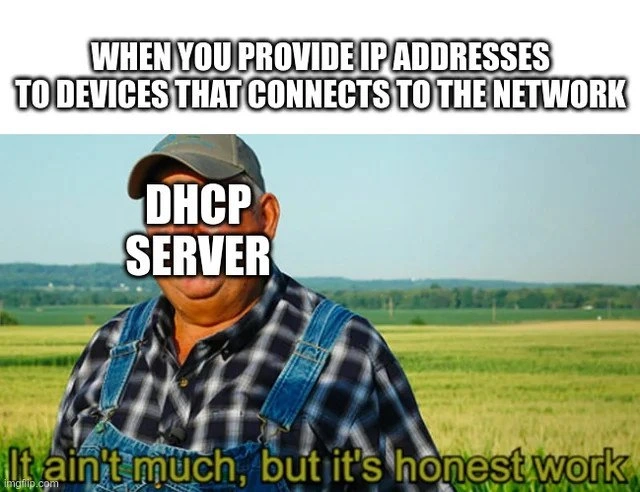
In our computer world, a DHCP server is just like that helpful greeter. When a new device (like your tablet or laptop) joins a network, the DHCP server gives it a kind of “name tag” – not a human name, but an IP address, which is the device’s special ID number on the network. It’s a simple job: just handing out these numbers to each device so they can all talk to each other. It might not sound like much, but it’s essential work. If no one gave out IP addresses, devices would be confused and unable to connect with others, just like people at the party wouldn’t know each other’s names. The meme shows a farmer saying, “It ain’t much, but it’s honest work,” which is a cute way of saying this job of giving out addresses is simple and modest, but really important and something to be proud of. Just like a farmer who steadily tends his field so everyone can have food, the DHCP server steadily does its honest work so all our computers and gadgets can happily communicate.

Level 2: Automatic IP Assignment

Let’s break down what’s happening in this meme in simpler terms. A DHCP server is a piece of software (often running on your router or a dedicated server) that automatically gives out IP addresses to devices on a network. An IP address is like a unique phone number or home address for a device (computer, phone, printer, etc.) on the network. Your device needs this address so it can send and receive data – basically so it can talk to other devices or reach the internet. Without an IP address, a device is invisible on the network, much like a person with no address wouldn’t get any mail.

Now, there are two ways an IP address can be set for a device: static (manually typed in) or dynamic (automatically assigned). Manually assigning addresses (static) means a human has to pick a number for each device and configure it. That can be okay for a small network (like giving your printer a fixed address), but imagine doing it for an office with 200 computers – it’s tedious and errors like duplicates (two devices accidentally given the same IP) can happen easily. This is where DHCP – which stands for Dynamic Host Configuration Protocol – saves the day. "Dynamic" means it does things automatically. As soon as a new device connects to the network, the DHCP server says “Hello, here’s an IP address for you, and here are some other details you need (like where the internet gateway is and what DNS server to use).” The device will then use that IP and info to communicate. This process is often so quick and routine you might only notice it when you see a message like “Obtaining IP address…” on your device for a second when joining Wi-Fi. That’s DHCP doing its honest work.

In the meme, the top text is basically describing that scenario: “When you provide IP addresses to devices that connect to the network” – that’s exactly what a DHCP server does all day. The meme then labels the farmer as "DHCP SERVER," turning him into a living metaphor for this service. The bottom text, "It ain't much, but it's honest work," is a popular meme catchphrase. It comes from a real farmer in an unrelated interview, but internet culture adopted it to humorously glorify humble tasks. Here, it implies that the job of handing out IP addresses isn’t fancy, but it’s essential and done with pride.

So, why would a DHCP server be compared to a farmer? Think of it this way: a farmer does simple, routine tasks to take care of a lot of living things – planting seeds, watering crops – nothing high-tech on the surface, but absolutely vital for the plants to grow. Likewise, a DHCP server performs a simple task (assigning addresses) to take care of all the devices in the network, ensuring each one can grow (or function) in the network “field.” The DHCP server is honest work personified: it doesn’t do anything flashy like host websites or store data; it just quietly makes sure every device can communicate by giving it an address and config. And network administrators, the folks who set up and maintain these servers, often have a similar humble attitude: if everything is working, nobody notices their work – but that’s a good thing! They often joke about these basic services in memes as a way to say, “hey, it’s not glamorous, but it keeps the lights on.”

This meme falls into both Networking and SysadminHumor categories because it touches on a networking fundamental in a humorous way that system administrators (and anyone who’s managed a network) would appreciate. Even if you’re new to IT, you probably have indirectly benefited from DHCP. For instance, when you connect your laptop or phone to your home Wi-Fi, you don’t have to type in an IP address manually – your wireless router’s built-in DHCP server automatically assigns your device an address (like 192.168.0.5) and informs it about the router’s address (192.168.0.1) and other details. It’s plug-and-play networking, and it makes our lives so much easier. The meme basically says: let’s give a nod of respect to that boring but important process. After all, if that DHCP “farmer” didn’t do his job, none of our fancy internet applications would even get started. It’s a fun, friendly reminder that even the simplest parts of tech infrastructure deserve appreciation.

Level 3: Cultivating Connectivity

This meme strikes a chord with every seasoned network engineer and sysadmin because it humorously personifies the DHCP server as a humble farmer doing vital chores. In the image, the farmer (face pixelated and labeled "DHCP SERVER") proudly proclaims, "It ain't much, but it's honest work." That phrase is an Internet-famous way of saying "this job is simple and unglamorous, but absolutely essential" – and that's exactly how network folks view dynamic IP address allocation. The top caption sets the scene: “WHEN YOU PROVIDE IP ADDRESSES TO DEVICES THAT CONNECT TO THE NETWORK.” It’s describing the everyday duty of a DHCP server in plain terms. Every time a laptop joins Wi-Fi or a new VM spins up, there's a DHCP server working behind the scenes in milliseconds, handing out an IP so that device can actually communicate. No IP, no network connectivity – it's that basic. The meme humorously frames this ip_address_allocation duty as the farmer’s “honest work.”

Why is this funny to IT people? Because it’s NetworkHumor that hits on an unsung truth: among all the flashy tech projects and high-profile engineering feats, a huge part of keeping IT systems running is tending to these mundane but critical services. A DHCP server’s job isn’t eye-catching – you don’t exactly brag at meetups about “Oh yeah, I configured DHCP today!” – but if it ever stops doing its honest work, everything comes to a halt. Developers and users might not know DHCP exists; they just complain "The internet is down!" and call the IT department. Network admins, however, immediately suspect, "Is the DHCP server okay? Are we out of IP addresses in the pool?" It’s a classic scenario in SystemsAdministration: when it’s working, nobody notices; when it fails, it’s a five-alarm fire drill. This duality is the heart of the joke. The farmer’s proud-yet-modest expression – “It ain’t much” – mirrors how a sysadmin might shrug off praise for something like DHCP: it’s not rocket science, but try running the network without it!

There’s a layer of network_admin_pride in this meme too. The farmer’s quiet pride is the same pride a network admin feels when things are running smoothly because of the solid, if unglamorous, infrastructure they've set up. Handing out IPs is routine maintenance of a healthy network “farm.” It’s honest work: you configure your DHCP server correctly, maybe set up redundant ones for reliability, define sensible lease times, and then let it do its thing day in and day out. The devices keep connecting, the users keep working, and hardly anyone realizes they have the DHCP service to thank for their seamless connectivity. But the admin knows, and this meme is a wink to fellow techies: we see you, DHCP; we know how important you are.

The choice of the farmer image adds to the humor through contrast. Farming is a down-to-earth, old-fashioned kind of labor, not something people typically associate with high-tech networking. By comparing a DHCP server to a farmer, the meme implies that doling out IP addresses is straightforward, honest labor akin to tending a field – not glamorous like, say, designing an AI algorithm, but nourishing the network so everything else can grow. This exaggeration makes techies smirk, because in truth running a DHCP service is a bit like being a digital farmer: you cultivate an environment where devices can “live” on the network by giving each a unique address and the basics they need (the gateway, DNS, etc., akin to watering each plant).

The humor also comes from relatability. In IT and networking circles, everyone has at least one story involving DHCP – perhaps that time you couldn’t figure out why a new machine wasn’t visible on the network, only to discover it never got an IP due to a misconfigured DHCP scope. Or the day a second rogue DHCP server was accidentally introduced by a mis-plugged Wi-Fi router, causing IP confusion galore. SysadminHumor often involves these war stories of simple missteps leading to big troubles. So calling DHCP “honest work” is a tongue-in-cheek nod to the fact that when it’s done right, it looks easy, but neglect or misconfigure it and you’ll suddenly realize how crucial it was. Fixing it might be as simple as plugging the correct cable or expanding the address pool, but until you do, nobody can do anything on the network. It’s the classic scenario of a tiny unnoticed cog causing the whole machine to grind to a halt.

Finally, the meme format itself – the “It ain’t much, but it’s honest work” farmer – is popular online for celebrating humble tasks. By applying it to a dhcp_server_meme, the creator is playfully elevating the status of the DHCP service from something taken for granted to something worthy of appreciation (and a chuckle). It resonates especially with IT professionals who often perform lots of behind-the-scenes configuration that end-users never notice. The laughter comes with a bit of “Yep, so true!” sentiment. After all, dynamic IP assignment isn’t flashy, but it is honest, necessary networking work. And as every good network admin knows, when the foundation is solid (each device has a proper IP and config), all the higher-level stuff (websites, applications, fancy distributed systems) can function. The meme encapsulates that truth in one relatable, farm-flavored visual. It’s a lighthearted pat on the back for all the unsung DHCP configurations keeping our digital world running smoothly.

Level 4: Lease by Lease

Under the hood, a DHCP server performs a precise address allocation ballet for every device joining the network. It's built on the Dynamic Host Configuration Protocol (DHCP), which automates what used to be manual IP setup. When a new machine comes online without an IP, it speaks on the network using a special broadcast (to 255.255.255.255) because it doesn't yet know any addresses. The server (like our meme's humble farmer) listens on UDP port 67 for these pleas. There's a standardized four-step handshake often called the DORA process:

  • Discover: The client device shouts out on the network, "I need an IP address!" This is a DHCPDISCOVER message sent from the client's MAC address to the special broadcast address.
  • Offer: The DHCP server replies with a DHCPOFFER: "Here, take IP 192.168.1.42 (for example), and here are your other settings." It picks an available IP from its pool (range of addresses) and tentatively offers it along with crucial network configuration (subnet mask, gateway, DNS servers – the whole kit).
  • Request: The client likes that offer and sends a DHCPREQUEST: "Okay, I'll use 192.168.1.42 as suggested. Please officially give it to me." This lets the server know the client is taking that lease, and also notifies any other listening DHCP servers (if any) that they should withdraw their offers.
  • ACKnowledgment: Our DHCP server finalizes the deal with DHCPACK: "You got it. 192.168.1.42 is yours for the next 24 hours (lease time). Happy networking!" The server marks that IP as taken (leased) by this client's MAC address so no one else gets it during the lease duration.

This whole exchange happens in seconds, invisibly, every time a device connects. It's a simple protocol, but there’s beauty in its simplicity: by leasing addresses dynamically (hence DynamicIPAddress in the tags), the network can efficiently reuse and manage a limited pool of IPs. For example, if a device disconnects or shuts down for a while, its IP is freed up after the lease expires, ready to be handed to someone else. This leasing mechanism prevents running out of addresses in a busy network and avoids the chaos of duplicate IP conflicts. The DHCP server even performs an extra honest check – often a quick ping – to ensure an IP isn’t already in use before offering it, just to be safe.

Behind the scenes, the DHCP server maintains a lease table (like a little ledger of which IPs are assigned to which MACs and until when). In large enterprise networks, you may have a centralized DHCP and use DHCP relay agents (configured on routers) to forward those client broadcasts across subnets. This way, one DHCP server can provide IP addresses to devices all over the campus. It’s humble work, for sure – just assigning numbers – but it's fundamental to how networking functions. Without DHCP's honest labor, we'd be stuck manually configuring every device (imagine the tedium of assigning static IPs to hundreds of machines, and the inevitable mistakes!). Modern networks, from your home Wi-Fi to massive data centers, rely on this protocol to connect devices seamlessly. Even in the age of cloud and container orchestration, we have equivalent mechanisms (like cloud-init or Kubernetes CNI plugins doing a similar job) because at the end of the day, every device or application instance needs an address. In IPv4, DHCP has been the workhorse for decades (superseding older protocols like BOOTP), and even IPv6 – which allows auto-generating addresses – often still uses “DHCPv6” for handing out other config details or more controlled addressing. The meme gives a knowing nod to this elegant little protocol that quietly cultivates connectivity on the network, one lease at a time.

Description

This meme uses the popular 'It ain't much, but it's honest work' format, which features a farmer in a plaid shirt and overalls standing in a field. The top caption reads, 'WHEN YOU PROVIDE IP ADDRESSES TO DEVICES THAT CONNECTS TO THE NETWORK'. The farmer's face is overlaid with the text 'DHCP SERVER'. The original meme caption at the bottom says, 'It ain't much, but it's honest work.' The meme personifies a DHCP (Dynamic Host Configuration Protocol) server as a humble farmer. In networking, a DHCP server's fundamental job is to automatically assign IP addresses to devices, a critical but often overlooked background task. The humor lies in equating this essential, unglamorous networking service to simple, honest farm labor, a sentiment that resonates with system administrators and network engineers who manage these foundational systems

Comments

9
Anonymous ★ Top Pick My therapist told me I shouldn't bottle up my feelings. So I configured the DHCP server with a 24-hour lease time. Now it can express itself every day
  1. Anonymous ★ Top Pick

    My therapist told me I shouldn't bottle up my feelings. So I configured the DHCP server with a 24-hour lease time. Now it can express itself every day

  2. Anonymous

    I keep our DHCP cluster in full HA because the second it sneezes, every multi-AZ, service-mesh-encrypted, zero-trust microservice quietly falls back to 169.254.* and sulks offline

  3. Anonymous

    DHCP servers are like that senior engineer who's been quietly preventing production disasters for 15 years - nobody notices them until they take a vacation and suddenly everyone's asking why they can't connect to anything

  4. Anonymous

    DHCP servers are the ultimate set-it-and-forget-it infrastructure: they quietly hand out IP addresses like a benevolent landlord managing a massive apartment complex, asking nothing in return except maybe a DHCPDISCOVER every now and then. Sure, it's not as glamorous as Kubernetes orchestration or distributed consensus algorithms, but when your DHCP server goes down and 500 devices can't get on the network, suddenly everyone remembers just how 'honest' that work really was. It's the networking equivalent of plumbing - nobody thinks about it until it breaks, and then it's the only thing anyone can think about

  5. Anonymous

    DHCP: the most honest microservice - no hype, just leases - until the /24 fills up with “temporary” lab VMs and suddenly Wi‑Fi is a SEV‑1

  6. Anonymous

    DHCP: the protocol that outlives hype cycles by doing one job flawlessly - without trying to orchestrate your entire service mesh

  7. Anonymous

    DHCP: the most mission-critical UDP service nobody monitors - until a rogue printer starts winning the race

  8. @AmindaEU 5y

    I would like to see IPv6 version of this or maybe my setup is a meme already

    1. Deleted Account 5y

      👌

Use J and K for navigation