Skip to content
DevMeme
2018 of 7435
When the QA tester is too good at their job
QA Post #2248, on Nov 6, 2020 in TG

When the QA tester is too good at their job

Why is this QA meme funny?

Level 1: Stop Counting My Mistakes

Imagine you’re doing your homework, and your friend keeps pointing out every little mistake you make. You correct one math problem, and then they immediately say, “Oh, here’s another error,” and then “Oops, another one here!” After a while, you’d probably throw up your hands and say, “Please, just stop counting my mistakes!” You’re not saying the mistakes aren’t real — you just feel frustrated and tired of hearing about them. In this meme, the developer feels the same way. The tester is like that friend, finding one bug after another in the developer’s work (their code). The developer jokingly yells “STOP THE COUNT!” which means “I’ve heard about enough bugs, no more, please!” It’s funny because, of course, simply stopping counting doesn’t make the problems go away. But when we’re overwhelmed, we sometimes wish we could just ignore the rest. This meme is a playful way for programmers to laugh at that wishful thinking: deep down we know we have to fix the mistakes, but for a moment it feels good to say “No more! I can’t take it!” and have a good chuckle about the whole situation.

Level 2: Bug Tracker Blues

Let’s break down what’s happening in this meme in simpler terms. The scenario is a software developer dealing with a flood of bugs found by a tester. In software, a bug is any mistake or error in the code that makes the program act in ways it shouldn’t — maybe it crashes when you click a button, or shows the wrong total on an invoice, etc. Quality Assurance (QA) testers are the folks whose job is to use the software in all sorts of ways to find those mistakes. When they find something wrong, they raise a bug – meaning they file a report about the issue so it can be fixed. These reports are tracked in a bug tracking system (like Jira or GitHub Issues). Think of it like a big to-do list of problems: each bug gets an entry, an ID, a description of what’s wrong, steps to reproduce it, and so on.

Now, when a developer sees tons of new bug entries popping up for their code, it can be overwhelming. Early in your career, the first time you hand your code over to QA can be a shock. You might have tested it a bit yourself and thought “Looks good to me!” — only to have the QA team find five crashes and ten weird glitches you never even considered. 😅 This can be humbling! Each bug report basically says “Here’s something that isn’t working right.” It’s necessary feedback (we want to catch these issues before real users see them), but it can feel like a barrage if there are many. DeveloperFrustration is a natural human reaction here: “Oh no, not another bug… can’t it just be done already?”

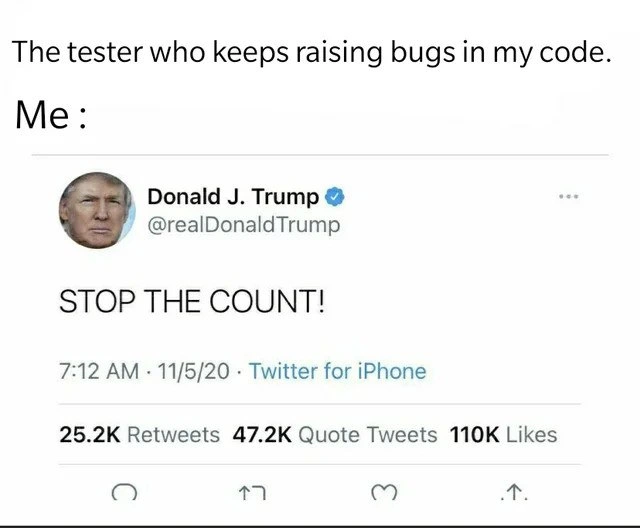
That’s exactly the sentiment this meme jokes about. The text at the top says, “The tester who keeps raising bugs in my code. Me:”. So picture a tester methodically testing your software and every few minutes saying, “Found another issue!” The “Me:” part is how the developer responds. Instead of a normal response, the meme shows a screenshot of a tweet saying “STOP THE COUNT!” — famously tweeted by Donald Trump. So the developer is essentially yelling, “Stop counting!” at the tester who is counting up all their code’s bugs. In plain terms, the developer wants the tester to stop finding more problems. It’s like they’re saying, “Enough already, I can’t handle knowing about any more bugs!”

Why use that tweet? A bit of context: around the date of this meme (early November 2020), there was a big global news event — the US presidential election. As votes were being counted, Donald Trump tweeted “STOP THE COUNT!” because he was ahead in some counts and further counting could cost him the lead. It quickly became a well-known quote. Meme creators in tech love to take popular phrases or images and give them a programming twist. This meme literally takes the tweet (with Trump’s name and all) and repurposes it as if the developer is the one tweeting it at the tester. It’s a tweet_screenshot_meme format — using the actual look of a Twitter post to make it feel real and instantly recognizable. This crossover is funny on two levels: even if you’re not super familiar with the election, the idea of someone shouting “STOP COUNTING!” at a diligent counter is just a comically futile request. If you do know the election reference, it’s even funnier because you recognize the parallel of someone trying to deny a reality by literally calling for the counting process to end early.

Let’s talk about the process being depicted: QA vs Developer or the quality_assurance_conflict. In truth, testers and developers are on the same team with the same goal – make good software – but they have different roles that can put them in a bit of a face-off. The tester’s job is to find as many issues as possible; the developer’s job is to fix issues and deliver features. When the tester is very thorough (which is good!), they might keep finding bugs continuously. The developer, on the other hand, might start feeling like they’ll never get to finish the project because new bugs keep coming in. This can create tension: the developer maybe feels “Can’t you cut me some slack? You’ve found 20 bugs already, do we really need to log 5 more small ones?” Meanwhile, the tester is thinking “If it’s a bug, I have to report it, that’s the job!” It’s a bit of a tester_overload situation for the developer – they’re overloaded by the sheer number of defect reports.

Another piece here is bug_count_anxiety. In many projects, especially towards a deadline, people actually track the number of open bugs closely. You might hear things like “We have 10 open bugs left, we’re almost there.” It’s almost like a score: fewer bugs means you’re closer to done. So when a tester keeps opening new tickets, that count goes up and up. For a developer, seeing that number climb induces anxiety because it means more work and possibly a delayed launch. Sometimes managers set a target like “We can ship when we have zero Severity-1 bugs and less than 5 Severity-2 bugs.” If the tester keeps finding new ones, it can feel like moving goalposts. You fix one, but the goal (zero bugs) isn’t any closer because a new bug appeared. That’s why the developer in the meme is basically pleading, “please stop adding more issues to the list, we have to finish!”

Now, it’s important to note – this meme is lighthearted. In reality, BugFixing is a critical part of software development, and good devs appreciate thorough testers (even if it’s a love-hate relationship at times). A junior developer might initially feel attacked by bug reports, but over time you learn it’s about the code, not you personally. The meme exaggerates the emotional reaction for comic effect. No developer would seriously tell a tester to ignore bugs (that would be bad!). But every developer has felt a tiny bit of that wish at 2 AM after fixing the tenth bug in a row: “Ugh, can we just pretend it’s perfect now?” It’s a form of DeveloperHumor and TestingHumor that helps vent the stress.

In summary, at Level 2 understanding: this meme shows a programmer jokingly acting like a politician who wants to stop votes from being counted — except instead of votes, it’s software bugs. It’s poking fun at the conflict where a tester’s thoroughness meets a developer’s exhaustion. By referencing a real tweet, it makes the joke even more dramatic and timely. But don’t worry, in real software teams this all results in a better product — after the developer facepalms and says “Okay, okay, what’s the new bug?”, they’ll eventually fix everything (or almost everything 😇). Until then, memes like this are our therapeutic way of saying “Testing is tough, coding is tough, but at least we can laugh about it!”

Level 3: Bug Recount Anxiety

In the real world of software teams, this meme highlights the tense dance between developers and QA testers. The top text sets the stage: “The tester who keeps raising bugs in my code.” Then “Me:” followed by the screenshot of Donald Trump’s infamous tweet: “STOP THE COUNT!”. This is a savvy mashup of tech and current events. The meme was posted on November 6, 2020, right when the phrase “Stop the count” was a viral headline from the US presidential election. In that context, one party (like a panicked candidate) wanted to halt the vote counting because the more votes counted, the more the tide turned against them. In our software twist, the developer is humorously cast as that panicked figure, pleading for the counting of bugs to stop before their code quality reputation completely tanks.

Why is this so funny (and painful) for developers? Because it’s relatable. Every experienced dev has had a build they thought was ready, only to have a relentless tester (or an entire QA team) find a torrent of issues. Each new bug report is like another vote against the idea that the code is “ready to ship.” This meme nails that feeling of bug count anxiety: as the bug list grows, the developer’s hope of on-time delivery fades. It’s a comedic exaggeration of the DeveloperFrustration that creeps in when you’re fixing one defect, only to get three new bug tickets in your inbox by the time you resolve it. It starts to feel like a never-ending debugging_troubleshooting whack-a-mole game. If bugs were ballots, the developer sees themselves losing the election of “whose code is flawless,” one issue at a time.

From a senior perspective, we also recognize some deeper patterns here. In many teams, there’s a phase where testing is in full swing — perhaps a QAProcess during a sprint or before a release freeze — and the number of logged bugs spikes. It’s common to use BugTrackingSystems (like Jira, Bugzilla, or GitHub Issues) to track each defect. Waking up to a dozen new Jira tickets labeled URGENT can give any dev a minor heart attack. The meme’s “STOP THE COUNT!” echoes that very human reaction: “Please, no more bug tickets, I can’t keep up!” It’s a playful jab at the adversarial dynamic that can form between devs and testers under pressure. Testers, of course, are just doing their job: ensuring quality by logging every problem they find. But to the coder who wrote that code, each bug report can feel like a personal critique (even though it’s really the code under fire, not them). As the bug count climbs, so does the developer’s stress, hence the tongue-in-cheek plea to make it stop.

Historically, this dynamic has been around as long as software teams have had dedicated testers. In the old waterfall days, developers might throw code “over the wall” to QA towards the end of a project. Testers would then unleash a deluge of bug reports, and developers would be stuck in a late-game scramble. That “big bang” testing at the end often led to crunch time and plenty of DebuggingFrustration. Modern agile practices seek to integrate testing continuously (catch bugs earlier, not all at once at the end), but even so, the final stretch of a feature or release often sees a flurry of last-minute bug findings. No matter how senior you are, seeing a bug tracker counter go up instead of down can induce a special kind of dread. It’s the tech equivalent of watching election results flip the outcome overnight – you thought you were ahead (on schedule with few bugs), but a new batch of results (testing rounds) says otherwise.

There’s also an element of DeveloperHumor here that seasoned devs appreciate: sometimes, half-jokingly, teams do behave in ways similar to “stop the count.” Ever heard of a bug cap or a defect deadline? In some crunch situations, management might say “Okay, no more logging of minor issues after this date, we have to ship.” It’s said with a wink – obviously the bugs still exist, we’re just choosing to ignore new ones temporarily. This meme takes that absurdity and personifies it as a developer literally begging the tester to ignore further problems. It’s satirical because stopping testing to pretend the software is ready doesn’t actually fix anything – it’s like covering the smoke alarm so you don’t hear the fire, totally counterproductive except to calm one’s nerves.

Lastly, consider the cultural savvy: using a Trump tweet screenshot adds an extra layer for those in the know. It’s a bit of memetic alchemy – blending TestingHumor with one of 2020’s most meme-able moments. Developers often communicate in memes, and repurposing a political catchphrase (“Stop the count!”) to describe a day in the office is both nerdy and hilarious. In true meme fashion, it uses a very serious real-world reference to dramatize a common workplace situation. The blue-check Twitter layout, the metrics below (“110K Likes” etc.), all make it visually clear and instantly recognizable. We’ve all seen tweets like that across our feeds, so formatting the developer’s desperate cry as if it were a tweet by a (formerly) powerful figure is comedic exaggeration. It’s essentially saying: “I’m so desperate about these bugs, I’m pulling a Trump-level move here.” And any battle-hardened dev who’s been swamped by bug tickets might chuckle (or groan) in sympathy.

Level 4: Bugs All The Way Down

At the most theoretical level, this meme touches on the endless nature of software bugs. In computer science, it's practically impossible to prove a non-trivial program is completely bug-free — this is akin to an undecidable problem. There’s a reason formal verification (mathematically proving a program correct) is so rare outside of aerospace or health tech: the number of possible states and inputs for real software grows combinatorially. Verifying every path can be as intractable as the Halting Problem. In simpler terms, a complex app has an astronomically large space of behaviors, so SoftwareBugs are almost inevitable. Each new test or scenario can reveal a new defect, theoretically without end. The developer’s desperate “STOP THE COUNT!” is a darkly comic nod to this reality — you could keep counting bugs ad infinitum. If you tried to test every possible case (every “vote” in the election of code quality), you’d never finish. As Edsger Dijkstra famously noted, testing can show the presence of bugs, but never their absence. In other words, no matter how many issues QA finds (or doesn’t find), you can never prove you caught them all. So from an academic perspective, the developer’s plea to halt further bug tallying humorously echoes a truth: perfect software is a myth, and if you let testing run forever, it might well find infinite issues. The meme brings this lofty concept down to earth with a laugh — joking that maybe the only way to have 0 bugs is to stop looking for more!

Description

A meme that humorously expresses a developer's frustration with a diligent tester. The top text reads, 'The tester who keeps raising bugs in my code,' followed by 'Me:'. Below is a screenshot of a real tweet from Donald J. Trump, posted on November 5, 2020, which exclaims in all caps, 'STOP THE COUNT!'. The joke draws a parallel between a developer wanting to halt the discovery of more bugs in their code and the political controversy surrounding the 2020 U.S. presidential election vote count. This resonates with any developer who has felt overwhelmed by bug reports from a thorough QA engineer, especially when a release deadline is looming

Comments

7
Anonymous ★ Top Pick Some developers treat the bug tracker like Schrödinger's cat: if QA doesn't open the ticket, the bug both does and doesn't exist
  1. Anonymous ★ Top Pick

    Some developers treat the bug tracker like Schrödinger's cat: if QA doesn't open the ticket, the bug both does and doesn't exist

  2. Anonymous

    QA logged defect #512 and I instinctively shouted “STOP THE COUNT!” - then Jira reminded me the counter lives in an eventually-consistent shard, so by the time my rant replicated we were already at 515

  3. Anonymous

    When QA finds their 47th bug on the last day of the sprint, suddenly you're advocating for the same statistical methodology you criticized in that post-mortem about insufficient test coverage

  4. Anonymous

    When your QA engineer discovers their 47th edge case this sprint and you're desperately trying to close the Jira board before they file another P1. At this point, you're not arguing about code quality - you're negotiating a ceasefire in a war of attrition where every bug report feels like another recount in a county you thought you'd already won

  5. Anonymous

    QA's bug recount turns every release into a contested election - fraudulent defects or just hanging chads in prod?

  6. Anonymous

    QA keeps filing defects and leadership yells “stop the COUNT()” - classic Goodhart’s Law; we rate-limited Jira’s POST /issues to 0 RPS. Metrics green, users screaming

  7. Anonymous

    Nothing exposes a broken incentive model like OKRs tied to open-bug count - suddenly WONTFIX becomes our highest-throughput compression algorithm

Use J and K for navigation