The True Purpose of a CS Degree
Why is this DevCommunities meme funny?
Level 1: The Secret Code of Funny
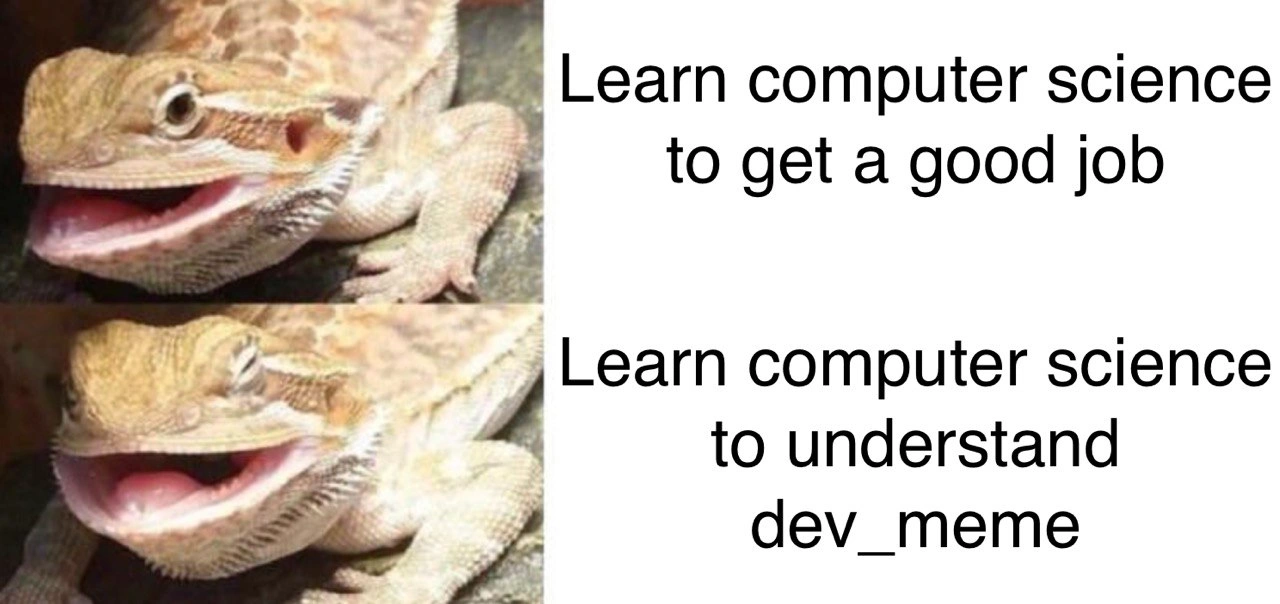
Imagine you spend a long time learning a really complicated secret language. Most people learn it to do important jobs and earn money. But guess what else you can do once you know that language? Laugh at the secret jokes told by the people who also know it! This meme is like saying: “I learned computer science not just to work, but so I can understand the funny stuff my programmer friends post.” It’s comparing a computer science degree to a special decoder ring or a magic dictionary. Just like the Rosetta Stone helped decode a mystery language, studying computer science helps decode silly programmer jokes that would sound like gibberish to anyone else. The little lizard in the pictures shows the feeling: a small happy smile when thinking about the normal reason (getting a good job), and then a HUGE excited smile when thinking about the real bonus reason (finally understanding those goofy tech jokes!). In simple terms, the meme is funny because it flips a serious goal (get a job) into a playful one (get the joke), making us laugh at how true it can feel for folks in the coding world.
Level 2: Jargon Decode for New Devs
Let’s break down what this meme is talking about in simpler terms. It’s contrasting two reasons someone might study Computer Science (CS). The first reason is the obvious one: to get a good job in tech. The second reason, and the funny one, is: to understand programmer memes on the internet (like those on the dev_meme page). Essentially, it’s saying “I went through tough CS classes not just to work in the field, but so I can finally laugh at these super nerdy jokes.”
Why would you need a whole CS education to get jokes? Because many developer memes are full of technical references. They assume you know certain concepts from ComputerScienceFundamentals. Here are a few examples mentioned:
Big-O notation – This is a way to describe how efficient (or slow) an algorithm is as the input grows. If someone says “that code is
O(n^2),” they mean if you double the amount of work (n), the runtime roughly quadruples (n^2). It’s standard in CS courses to analyze algorithms with Big-O. Memes might joke about bad code beingO(n!)(factorial time, insanely slow) to exaggerate how awful it is. If you know what that means, it’s funny; if not, the joke might confuse you.Red-black tree – A red-black tree is a type of balanced data structure, specifically a kind of binary search tree that automatically keeps itself balanced by coloring nodes red or black and following certain rules. It’s taught in algorithms classes, and it’s pretty complex to implement correctly. In the real world, average devs don’t write red-black trees from scratch (they use libraries). But memes love to mention them, often mocking coding interviews or CS curriculum: “Sure, you’ll never actually use a red-black tree at work, but hey, it helps you understand this meme!” If you’ve never heard of a red-black tree, that meme would be gibberish.
Consensus algorithm – In distributed computing (where many computers/servers have to work together), a consensus algorithm helps all the machines agree on something (like the state of a database) even if some of them or the network is unreliable. Names like Paxos or Raft might come up – these are famous (and notoriously tricky) consensus algorithms you’d learn in an advanced CS course or a specialized job. A meme might make a joke like “I’ll use Paxos to decide what to have for lunch,” which is silly because Paxos is total overkill for something simple. If you know Paxos as this heavy academic thing, that absurdity is hilarious. If you don’t, the joke falls flat.
All these are examples of inside jokes in the programming world. An inside joke means you need to be “inside” a certain group (in this case, people who know these CS concepts) to get the humor. Developer communities (on Reddit, Twitter, forums, etc.) have lots of these. They’ll joke about things like pointers, recursion, the Python GIL, or the latest JavaScript framework, assuming the readers have background knowledge. It creates a sense of community – like a bunch of friends who all know the same references.
Now, why a bearded dragon lizard? This particular meme format uses two photos of the same bearded dragon (a type of lizard) with different expressions to show a change in emotion or attitude. In the top photo, the lizard’s smile is moderate, and in the bottom photo, it’s much wider and more gleeful. Meme creators often use this format to say “X is good, but Y is even better!” Here, X = “studying CS for a job” and Y = “studying CS to get the jokes.” It’s a playful way to exaggerate that second reason as if it’s the lizard’s secret true happiness. The lizard’s goofy grin helps sell the silliness of the idea.
The title calls a CS degree a “dev_meme Rosetta Stone.” The Rosetta Stone was an ancient stone slab that had the same message inscribed in multiple languages (Egyptian hieroglyphics and Greek). It was crucial for researchers to finally decipher Egyptian hieroglyphs because they could compare it with the known Greek text. In modern usage, calling something a “Rosetta Stone” means it’s a key to understanding a previously incomprehensible language or code. So here, the joke is that a Computer Science degree is like the key to decode the mysterious language of developer memes. Those memes might look like random symbols or jargon to someone else, but if you have that CS background, you can translate and enjoy them. Basically, your CS education is paying off in laughs!
So, in simpler terms: This meme is saying people usually go to college for computer science to get a nice tech job (true), but also one of the funniest benefits is now you can hang out online with other programmers and actually understand all their nerdy jokes. It’s highlighting the fun side of being well-educated in CS – you’re part of the club that speaks “meme.” For newer devs or students, it hints that beyond just studying for exams or that future paycheck, you might end up appreciating the quirky culture of developers. After trudging through tough topics like algorithms, it’s oddly satisfying to finally get why a joke about, say, “divide by zero” is so amusing to everyone.
Level 3: Insider Language of Devs
For a seasoned developer, this meme hits on a relatable humor: the contrast between the practical reason to get a CS degree (landing a good job) and the cultural payoff (getting all the weird jokes on developer forums). It’s poking fun at how dev communities have a slew of running gags that only make sense if you know certain technical lore. The two-panel format sets up a classic expectation vs. reality gag. In the top panel, the bearded dragon lizard is fairly cheerful, captioned with the conventional wisdom: “Learn computer science to get a good job.” That’s the advice everyone hears – study CS for the solid career prospects in tech. But the bottom panel flips the script: now the same lizard looks absolutely ecstatic, eyes squinting in delight, next to the line “Learn computer science to understand dev_meme.” The lizard’s huge grin says it all: finally, the real prize! It humorously suggests that decoding those niche community in-jokes feels even more rewarding than employment.
Why is that funny to a developer? Because it rings true in an exaggerated way. Many experienced devs jokingly lament that all those tough college courses (like Advanced Algorithms or Operating Systems) rarely come up in everyday programming jobs. You might spend more time in real life using frameworks or writing API endpoints than calculating the runtime of a sorting algorithm. Yet, ironically, those same obscure topics pop up all the time in developer humor. Have you ever sat in a tech talk where someone jokes “O(n^2)? Yeah, ship it!” or references a binary tree in a pun? If you have the background, you get to be in on the joke and share that knowing laugh. If you don’t, you’re left scratching your head while everyone else is cracking up. The meme is playing on that feeling—suddenly those late nights mastering theory have an unexpected perk: internet inside jokes start making sense. It’s like being part of an exclusive club.
There’s a strong element of meta humor here too: this meme lives on a dev meme feed, joking about understanding dev memes. It’s self-referential. The community is laughing at itself: “We’ve built an entire library of jokes so convoluted that you practically need a B.S. in Computer Science to fully appreciate them.” It’s a gentle ribbing of how tech communities can sometimes be a bit insular or elitist. After all, not everyone in the industry has a formal CS degree—plenty of amazing developers are self-taught or came through coding bootcamps. But the meme winks, “Hey, if some of these references go over your head, now you know why: we’re basically joking in academic tongue.” A senior engineer will recognize this dynamic from real life. Think of water-cooler chatter or threads on Stack Overflow laden with references to things like the Halting Problem, or a pun about “null pointers” (which, if you’ve ever debugged a segmentation fault, is painfully funny). These jokes create a sense of camaraderie among those who have been through the proverbial fire of a CS curriculum or equivalent experience.
The use of the bearded dragon lizard images amplifies the punchline. In the first image, the lizard looks pleased but fairly normal — like, “Yeah, getting a good job is nice.” In the second image, the lizard’s grin is ear-to-ear, practically laughing. That visual exaggeration tells us the second scenario (understanding dev memes) is the unexpectedly sweeter deal. It’s an absurd comparison, which is exactly why it’s amusing. As a long-time developer, you’ve probably experienced the thrill of finding a meme that speaks directly to an obscure struggle you went through (maybe an IPv6 joke right after you debugged an IP networking issue, or a recursion joke that echoes an in-joke from class). That feeling can weirdly rival the joy of actual achievements because it means you’re truly “one of the gang.” This meme is basically tech folks laughing at ourselves for how much we value these shared giggles. We all know the CS degree is mainly for the career – but shhh, the secret joy is when you can also scroll through your feed and think, “Ha! I totally get why that Distributed Systems comic is hilarious.”
In essence, the meme resonates with the tech community experience. It tells a tongue-in-cheek truth: beyond the salary bump and the fancy job title, one of the best perks of being a computer science nerd is the humor. Those late-night study sessions and brain-melting textbooks have culturally equipped you to chuckle at anything from a stack overflow (not the website, the actual error) joke to a play on the word “cache.” It’s a badge of honor and a source of bonding. The next time a colleague forwards a comic about two threads deadlocking over a piece of data, you’ll grin not just at the joke but at the thought, “Yup, my four years of CS schooling were totally worth it for this moment.”
Level 4: Big-O to Big LOL
At the most esoteric level, this meme hints at the Computer Science fundamentals that hide behind many developer jokes. To truly appreciate those jokes, one often needs a background in theory—things like algorithmic complexity, advanced data structures, or distributed consensus protocols. For instance, a meme might casually mention Big-O notation (e.g. calling an absurd solution O(n^n)) as a punchline. If you’ve studied computational complexity, you’ll recognize O(n^n) as comically inefficient—an explosive growth rate that no sane program would ever implement. The joke lands because you understand the math: an exponential-time algorithm is hilariously impractical, so using it as a solution in a meme is pure sarcasm.
Likewise, consider a meme referencing a red-black tree. A red-black tree is a classic self-balancing binary search tree taught in algorithms courses—famous for its strict rules (nodes colored red or black, balancing properties, etc.) that ensure roughly O(log n) lookup times. It’s a brilliant data structure, but also a kind of rite of passage for CS students due to its complexity. A dev joke might quip, “Interview question: implement a red-black tree… from memory,” expecting laughter (or groans) from those who remember wrestling with pointer flips and color swaps at 2 AM. Only someone who’s slogged through that data structure chapter gets why that scenario is both absurd and painfully real. In other words, knowledge of the intricate balancing rules becomes the Rosetta Stone for deciphering the humor.
Then we have distributed systems jokes. Terms like consensus algorithm (think Paxos or Raft) and the infamous Byzantine Generals problem sneak into memes. These are deep theoretical concepts: how do multiple computers agree on something despite unreliable networks and possible failures? In academia, you learn such algorithms are complex, often described in dense pseudo-code with proofs of correctness. Within dev humor, you might see a joke like, “We’ll just use Paxos for our team lunch order” – an absurd overkill scenario that’s funny if you know Paxos is an famously complicated way to get agreement. The laugh comes from recognizing that solving a trivial problem with a PhD-level algorithm is like using a rocket engine to power a bicycle. Without that distributed systems theory background, though, the reference would fly over your head.
Essentially, the meme is saying that the CS degree arms you with a decoder ring for these kinds of insider jokes. All those formal concepts—Big-O, graph theory, finite automata, pointer arithmetic, CAP theorem (Consistency, Availability, Partition tolerance)—become part of a hidden language of humor. It’s meta: you learn the rules of computing so you can laugh at breaking or exaggerating those rules. In a way, it’s a celebration of that aha! moment: the dragon (a bearded one, in the image) smiling wider once it “speaks” the secret language. The title dubs the degree a dev_meme Rosetta Stone, alluding to the artifact that decoded Egyptian hieroglyphs. Here the hieroglyphs are arcane code jokes, and a formal CS education is what lets you decipher them.
required_concepts = ["Big O notation", "red-black tree", "Paxos consensus"]
for concept in required_concepts:
if concept not in user.knows():
raise KnowledgeError("404: Joke Not Found – missing " + concept)
laugh_at_meme("Understanding achieved!") # You may now safely find it funny
In summary, the meme works on this high plane of humor theory: it’s highlighting that behind the DeveloperHumor and InsideJokes of our industry lie very real academic ideas. The more theoretical knowledge you have (say, mastering the Y-Combinator or monads in functional programming), the more layers of jokes you can unpack. It’s a playful nod that the true ROI of mastering tough CS topics might just be the ability to chuckle at an XKCD strip or an inside joke on r/ProgrammerHumor—laughing along with the elite who also paid their dues in algorithm analysis class.
Description
A two-panel meme format featuring a bearded dragon lizard. In the top panel, the lizard has a neutral expression, and the text next to it reads, 'Learn computer science to get a good job'. In the bottom panel, the lizard appears to be smiling or more excited, and the text reads, 'Learn computer science to understand dev_meme'. The meme humorously contrasts the practical, career-oriented motivation for studying computer science with a more enlightened, culturally-driven one: being able to understand the niche, in-group humor of the 'dev_meme' platform. This is a self-referential or meta-joke, suggesting that the content on 'dev_meme' is so intellectually stimulating that it's a worthy goal in itself for developers
Comments
7Comment deleted
Sure, a CS degree helps you pass the whiteboard interview, but its real value is finally understanding why a race condition joke is funny and not just a Jira ticket
Sure, your CS101 professor said big-O matters for interviews, but it’s mostly so you can laugh when a meme drops an ‘O(n log n) but emotionally O(∑ burnout)’ punchline
Spent four years studying Dijkstra's algorithm to optimize career paths, ended up using it to calculate the shortest distance between me and understanding why someone thought naming a framework 'Kafka' was a good idea
The real ROI of a CS degree isn't the six-figure salary - it's finally understanding why 'it works on my machine' is both a meme and a legitimate architectural pattern, and being able to laugh knowingly when someone posts a screenshot of production going down at 3 AM with the caption 'who deployed on Friday?'
CS teaches asymptotics; dev_meme teaches why your org’s dependencies grow faster than n log n
CS gets you the job offer; only Big O mastery decodes why that merge conflict meme slaps
By year 15 you realize Big‑O, CAP, and idempotency aren’t interview prep - they’re the cipher for reading the comments under dev_meme