Skip to content
DevMeme
883 of 7435
DevOps decoded: when the acronym is a post-mortem in disguise
DevOps SRE Post #998, on Jan 26, 2020 in TG

DevOps decoded: when the acronym is a post-mortem in disguise

Why is this DevOps SRE meme funny?

Level 1: Opposite Day at Work

Imagine a waiter carrying a towering stack of plates at a busy restaurant. Right before he walks out to serve them, he jokes with a grin, “Alright, time to drop every single plate!” Everyone knows he doesn’t actually want to drop anything. He says that because he’s a little nervous – it’s his way of joking about the worst thing that could happen, just to get it off his mind. If he laughs about it, it feels a bit less scary.

Now think of someone whose job is to keep a big website running (kind of like how the waiter’s job is to deliver plates safely). Their work can be stressful because a lot of people depend on those computers working. The meme is like that person saying, “Haha, I’m totally going to break everything!” even though they really mean the opposite. It’s an Opposite Day joke: saying the one thing you must not do, as if it were the plan, just to make everyone chuckle. Of course, in reality they’re working very carefully to make sure nothing breaks. They joke about “destroying everything” the same way the waiter jokes about dropping the plates – it’s a silly way to make light of their responsibility. People find it funny because it’s so over-the-top and obviously not what you’re supposed to do. It’s a small wink that says, “I’m a bit scared of messing up, so I’ll joke about it.” And sharing that laugh helps everyone feel a little less worried.

Level 2: Production Panic 101

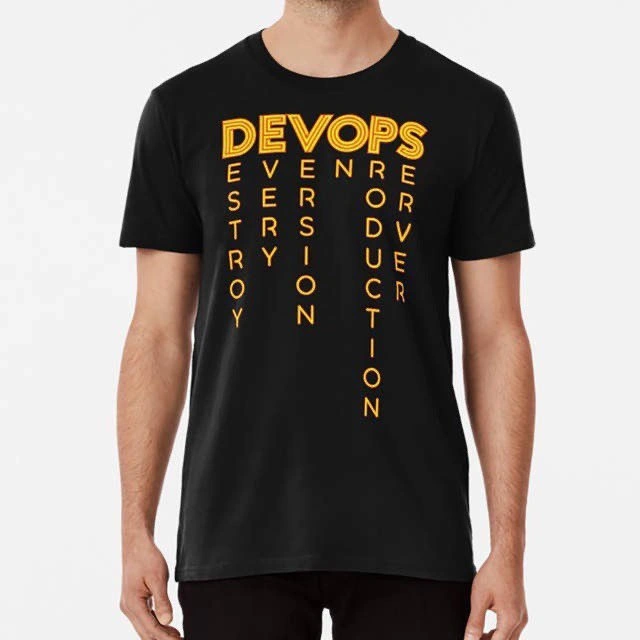
This meme takes the term DevOps and turns it into an acrostic – a word puzzle where each letter of a word starts a new word vertically. In this case, DEVOPS becomes “Destroy Every Version On Production Server.” In other words, the six letters of "DEVOPS" are used to begin a phrase that spells out a scary instruction: destroy every version on the production server. It’s basically turning the DevOps name into a mock mantra for wreaking havoc on all the live servers. The humor is that it’s saying the exact opposite of what DevOps engineers actually aim to do. DevOps normally means Development + Operations working together to deploy code smoothly and reliably. In reality, nobody in DevOps wants to destroy anything on a production server! Production servers are the real machines (or cloud instances) that run your application for users. “Destroying every version on production” would mean taking down all the running instances of your software – essentially a total outage where your website or service goes completely offline. That’s one of the worst nightmares in this field.

Let’s break down the phrasing in that acrostic:

  • Destroy – to wipe out or remove completely. Not a gentle word; it implies major damage.
  • Every Version – in production, there might be multiple versions of services or multiple application instances running (for example, version 1.2 and 1.3 of a microservice might both be live during a transition). “Every version” suggests not sparing a single one; it means everything.
  • On Production – the production environment is the live system that end-users interact with. It’s where “the real thing” runs (as opposed to a test or staging environment). If something breaks in production, real customers are affected.
  • Server – this refers to the computers or virtual machines that host the application. So a “production server” is a live server running the app. Modern infrastructure might have many servers or containers, but the idea is the same.

Put together, “Destroy Every Version On Production Server” implies shutting down every live instance of the app on all servers. In plainer terms: crash the entire live site, with no survivors. Obviously, that’s not what any engineer intends to do – it’s what they fear doing by accident.

The reason DevOps folks find this funny is because it’s a stress-relief joke about their biggest fear. Deploying new code to production (a.k.a. making a release) can be nerve-wracking. This feeling is sometimes jokingly called release anxiety. Even with lots of safeguards, there’s always that tiny worry: “What if this update accidentally breaks everything?” The T-shirt basically says that out loud in a darkly humorous way. It’s like a form of reverse psychology or an “Opposite Day” joke – stating the worst-case scenario as if it’s the plan, even though the real plan is to avoid it at all costs. By joking, “Haha, DevOps stands for destroying all of prod,” engineers are really acknowledging the risk and saying, “We definitely do not want to do that!” Turning the fear into a silly slogan takes a bit of the power away from it. It’s easier to face a scary idea when you’re laughing at it.

Now, let’s talk about some of the terms and practices referenced in the meme and its description:

  • DevOps – a culture and set of practices where software developers (Dev) and IT operations (Ops) work closely together. The aim is to shorten development cycles, deploy more frequently, and maintain high reliability. In traditional setups, developers wrote code and a separate ops team deployed and maintained it. DevOps combines these roles: the same team (or a closely collaborating team) both builds the software and runs it in production. This shared responsibility means developers are more aware of operational concerns (like stability, monitoring, on-call duties), and operations folks are involved earlier in development. The hope is to catch problems early and ensure smooth deployments, so there’s less chance of a big production surprise. DevOps is all about automation, communication, and avoiding the old “it works on my machine, ops will handle it in prod” scenario.
  • SRE (Site Reliability Engineering) – a role related to DevOps, pioneered at Google. SREs are engineers who focus on keeping services reliable, automating operations tasks, and responding to incidents. They apply software engineering principles to system administration. For example, an SRE will create tools to automate server management or write code to handle failovers, rather than doing everything manually. They also measure reliability in terms of SLAs/SLOs (service-level agreements/objectives). SREs definitely never want to “destroy production” – their mission is the opposite: ensure production is stable and quickly recoverable if something goes wrong.
  • Deployment – the process of releasing new code or a new version of an application into an environment (like pushing an update to production). A deployment pipeline (part of what’s called CI/CD, Continuous Integration/Continuous Deployment) is a series of automated steps that take code from source control, run tests, and then push it out to servers. The pipeline is meant to catch issues and make deployments routine. However, if there’s a flaw in the pipeline or a mistake in configuration, it can end up deploying a bad change to production. In a worst-case scenario, a deployment could inadvertently remove or shut down the running application – which is exactly the disaster the shirt jokingly describes.
  • Blue-Green rollout – a deployment strategy designed to avoid downtime and reduce risk. Imagine you have two identical sets of servers: Blue (the current live version) and Green (the new version you want to release). In a blue-green deployment, you deploy the new version to the Green servers while Blue continues serving customers. Once the Green environment is verified to be working properly, you switch all user traffic to Green – making it live – and Blue becomes idle (or a backup). If something goes wrong with the new Green version, you can immediately switch back to Blue, since it’s still there, untouched. This strategy ensures that you always have one working version live, thereby not “destroying every version” at any given time. The meme pokes fun at the idea that even with fancy strategies like this, things can still go sideways. For example, if your deployment automation itself has a bug (say, the code that switches Blue to Green has a mistake), you might accidentally take both Blue and Green offline. It’s rare, but it can happen – and that scary “what if everything goes down?” thought is at the heart of the joke.
  • Helm chart – Helm is a package manager for Kubernetes, which itself is a platform for running and orchestrating application containers across clusters of machines. Think of Kubernetes as an operating system for the cloud: instead of running one app on one server, you have a cluster of servers that can run many instances of your app in containers. A Helm chart is like a recipe or a bundle of configuration files that describes how to install or deploy an application onto Kubernetes. It might specify “run 5 copies of this service, use this container image version, use these environment variables,” and so on. Because Helm charts are powerful, a tiny mistake in one can have big consequences. For example, if you accidentally set the number of copies (replicas) to 0 in the chart, Helm would obediently tell Kubernetes to shut down all instances of your application. Or if you point a Helm chart to the wrong database connection, it could start overwriting or deleting data in the wrong place. The meme mentions a “mis-configured helm chart” vaporizing prod, which is a shiver-inducing thought for Kubernetes users. It basically means a bad setting in these config files could delete or disable everything in the production cluster, very quickly.
  • kubectl – (pronounced “cube-cuddle” or “cube-control”) this is the command-line tool for interacting with a Kubernetes cluster. With kubectl you can deploy apps, inspect resources, and, importantly, delete things. For instance, kubectl delete pod my-app-123 would delete a specific running instance of an application. The meme specifically references kubectl delete ns – here ns stands for namespace. Namespaces in Kubernetes are a way to group resources; you might have a namespace called “production” that contains all the objects (services, pods, databases, etc.) for the prod environment. If someone runs kubectl delete ns production, they are telling Kubernetes to delete the entire production namespace. That means Kubernetes will wipe out every object labeled as production: all your microservices, databases, configs, everything associated with that environment. It’s basically pressing the big red self-destruct button for your live system. It’s not a command anyone would run lightly, but the joke is that a bad deployment might as well have done that. In fact, a flawed automation might effectively do something just as drastic without the engineer realizing it until it’s too late.
  • Infrastructure as Code – the practice of managing infrastructure (servers, networks, load balancers, etc.) using code and declarative files, rather than manual setup. Tools like Terraform, CloudFormation, or Kubernetes YAML files are examples of infrastructure as code. The idea is that if you treat your servers and configurations like code, you can version control them, test changes, and rebuild environments more reliably. It brings a lot of consistency and repeatability. However, the phrase “infra_as_code_illusions” (from the context tags) hints at the false sense of security this can give. Even though everything is scripted and consistent, mistakes in those scripts can have very wide impact. If an operations manual has a typo, one person might misconfigure one server. If an automation script has a typo, it might misconfigure dozens of servers before you catch it. In other words, Infrastructure as Code makes things fast – both fast to build and fast to break. The “illusion” is thinking that just because a process is automated, nothing will go wrong. In reality, you have to be just as careful with that automation code as you are with application code (if not more). The meme is a reminder that even with everything defined in code, a single wrong line (* in the wrong place in a script, or a == that should have been !=) can lead to a scenario where you inadvertently deploy a catastrophe.
  • On-call – many DevOps and SRE teams have what’s called an on-call rotation. This means that outside of normal working hours, there is always someone designated to respond if something breaks. Being “on call” typically involves carrying a pager or phone that will send an alert (through systems like PagerDuty or OpsGenie) if monitoring tools detect a serious issue (like a website going down or a server overheating). The person on call must quickly investigate and fix the problem, even if it’s 2 AM. This is why you hear jokes about engineers being paged in the middle of the night. It’s a stressful part of the job, and teams often share war stories about being bleary-eyed, fixing a live site at absurd hours. OnCallHumor is all the memes and jokes that come from those experiences (like showing up to work with a coffee IV drip after a rough on-call shift). In the context of this meme, an on-call engineer might chuckle (or wince) at the phrase “Destroy Every Version On Production Server,” because that’s the kind of thing that would trigger every alarm and wake them up at 3 AM. It’s referencing the very scenario on-call folks dread.
  • Post-mortem / RCA – after a major outage or incident, DevOps and SRE teams do a post-mortem. This is a retrospective analysis of what went wrong and how to prevent it in the future. An RCA (Root Cause Analysis) is a key part of the post-mortem, where the team identifies the root causes that led to the failure (often it’s multiple factors in sequence). The important thing about post-mortems in modern DevOps culture is that they are typically blameless. This means the goal isn’t to single out and punish a person who made a mistake, but rather to improve the system and processes so the mistake doesn’t happen again. The title of the meme says “when the acronym is a post-mortem in disguise” because the phrase Destroy Every Version On Production Server sounds like a summary line you’d find in a post-mortem report for a big incident. It’s as if someone asked, “So what happened during the outage?” and the answer was, “Well… we kind of destroyed every version on every production server.” By framing the DevOps acronym as if it were that catastrophic Root Cause summary, the meme turns an earnest term (DevOps) into a dark joke. The humor (especially for those in the field) comes from thinking, “Heh, let’s hope I never write that in a post-mortem!”
  • Friday deployments – this is a cultural thing in tech circles: many developers avoid deploying new code on a Friday. Why? Because if you deploy on Friday afternoon and something goes wrong, you might ruin your weekend (you’ll be stuck fixing an outage Friday night or Saturday). It’s become such a common cautionary practice that it’s almost superstition. People tweet jokes like “Friends don’t let friends deploy on Fridays.” The tag FridayDeployments and ReleaseAnxiety both touch on this. Release anxiety spikes a bit more on a Friday because you know support is thinner on weekends and everyone’s looking forward to time off. The T-shirt’s phrase, in a cheeky way, represents exactly the kind of nightmare scenario that the “no Friday deploys” rule is trying to avoid. It’s basically saying, “Do this terrible thing (take down everything) on prod,” which is the disaster you risk if a Friday deployment goes bad. The joke is a nod to all those engineers who have said, “Let’s wait until Monday to release, just in case.”

For someone newer to this field, the key takeaway is: DevOps engineers actually work very hard to make sure nothing goes wrong in production. They automate testing, use safe deployment strategies, monitor systems, and have rollback plans. They definitely do not want to break anything. But because they deal with high stakes – if they mess up, the product could go down – they’ve developed a bit of dark humor around it. It’s a coping mechanism. No one wearing this shirt actually intends to “destroy every version on production server.” It’s just a sarcastic way to acknowledge the stress they’re under. Think of it as them teasing themselves: “Our job is to keep everything running, but wouldn’t it be hilariously awful if we did the opposite?” It’s DeploymentHumor born from real ProductionIssues. By joking about the worst-case scenario, they make it feel less ominous. It’s like whistling in the dark – if you can laugh at it, maybe it won’t be so scary after all. And of course, wearing the joke on a T-shirt is a classic tech-culture move: it’s a way to find fellow engineers who get the joke and to remind each other that we’re all human and mistakes (hopefully not that huge!) can happen. In summary, DevOps doesn’t really stand for “Destroy Every Version On Production Server” – it’s just a funny cautionary tale we tell ourselves so we’ll remember to be careful… and perhaps double-check that helm chart before hitting deploy.

Level 3: DevOops Manifesto

At first glance, it’s just a DevOps T-shirt with retro flair. Look closer and you realize each letter in the cheerful DEVOPS logo stands for a darkly comedic mantra: Destroy Every Version On Production Server. Yes, that’s the acrostic proudly emblazoned down the shirt. It reads like a disastrous deployment post-mortem bullet point – the kind of line you’d find in an incident report at 3 AM, after the dust (and your adrenaline) finally settles. For seasoned engineers in DevOpsCulture, the humor comes from how painfully plausible that phrase is. This meme is essentially a one-line horror story for anyone who’s lived through a catastrophic release, turning the beloved DevOps ideal into "DevOops" – a tongue-in-cheek acknowledgment that sometimes our best practices blow up in our faces.

The irony hits hard because DevOps was supposed to prevent production meltdowns, not cause them. The whole DevOps movement is about developers and operations working together, automating Deployment pipelines, and embracing continuous delivery to avoid human error. We preach things like “You build it, you run it” and set up elaborate safe release strategies (hello, Blue-Green rollouts and canary deploys) to make deployments boring and predictable. Site Reliability Engineers (SREs) and DevOps teams spend countless nights refining playbooks and monitoring dashboards, all in the name of never having to write “we destroyed prod” in an RCA (Root Cause Analysis) report again. And yet, here we are – acknowledging with a smirk that one bad kubectl command or misconfigured Helm chart can still vaporize prod faster than you can say “kubectl delete namespace”. This shirt is effectively the ReleaseAnxiety motto nobody asked for, a sardonic twist on the idea of Infrastructure as Code. We like to think automating everything makes us safe, but that’s partly an illusion. Sure, we’ve codified our infrastructure – which means a single bug in that code can instantly do what used to take an army of bumbling sysadmins. Progress!

Any veteran of Production deployments has a war story (or ten) that makes this joke land all too well. Maybe you’ve seen a CI/CD pipeline go haywire and deploy a bug to every environment simultaneously, like a sprinkler system of failure. Perhaps you recall that Friday 5 PM change that accidentally pointed the load balancer to nowhere, effectively taking down every version on every server in one go. (Rule number one of FridayDeployments: Don’t.) In the trenches of on-call rotations (OnCallHumor exists for a reason), you develop a morbid sense of humor. When you’re the poor soul woken up by pager alerts because some deployment script decided to run rm -rf on the wrong directory, you have to laugh somehow. Otherwise, you’d cry. So engineers turn these nightmares into inside jokes – wearing a slogan like this is a badge of honor, a way of saying “I’ve survived the kind of epic screw-up this shirt describes.” It’s camaraderie through catastrophe.

This meme also pokes at how DevOps blurs the line between dev and ops responsibilities. That’s great for speed – but when something goes wrong, everyone is now in the blast radius. The very practices that enable rapid releases (automated deploys, unified toolchains, full-stack ownership) also mean a mistake by one person can ripple out to destroy everything across dozens of services. In ye olden days (waterfall development, segregated Ops teams), a developer’s mistake might be caught before shipment or at least isolated to a single system. Now, with microservices and dynamic scaling, a wrong config can uniformly misconfigure hundreds of instances in seconds. It’s the ultimate “with great power comes great responsibility” scenario – except the responsibility sometimes feels like defusing a bomb you built. The meme wryly suggests that our prized DevOps pipelines can become self-inflicted denial-of-service machines if we’re not careful.

To top it off, the bold retro lettering of “DEVOPS” on the shirt is almost optimistic in style, reminiscent of upbeat tech conference swag. This contrast makes it even funnier: it’s like slapping a smiley face on a disaster. Nothing screams DevOpsHumor more than packaging dread in a playful design. It’s a coping mechanism – dress up your deepest fear (“Did I just nuke production?”) as a goofy graphic tee, and it stings a bit less. When you wear something like this to the office, every old-timer smirks and nods knowingly, while the new hire asks, “Haha, what does your shirt say?” – thereby initiating them into our haunted fraternity of prod outages and hard-earned wisdom.

This T-shirt meme is a form of gallows humor, capturing that gut-wrenching moment of panic when you realize your production servers are melting down. DevOps supposedly stands for collaboration, speed, and reliability – but as the cynical veteran in all of us knows, on a bad day it feels like it stands for Destroy Every Version On Production Server. We laugh, because the alternative is to recall the actual outage where it kind of happened for real. (Looking at you, that one time a “routine update” took out every container in the cluster.) This shirt effectively says: “Welcome to DevOps. Prepare for the worst, even as you strive for the best.” It’s funny because it’s true – uncomfortably true.

DevOps Means... ...But Sometimes It Means
Frequent, reliable releases Frequent, spectacular outages
Automated safe deployments Automated mass destruction (oops)
Infrastructure as Code Infrastructure as chaos
You build it, you run it You broke it, you fix it at 3AM

Description

The image shows a black crew-neck T-shirt worn by a standing person. In bold retro-style yellow-orange lettering, the word “DEVOPS” is printed horizontally across the chest. Each letter then becomes the start of a vertical word that drops straight down beneath it, forming an acrostic that reads: D - Destroy E - Every V - Version O - On P - Production S - Server. The design humorously reinterprets the DevOps movement as a catastrophic deployment mantra, poking fun at the all-too-familiar fear of accidentally wreaking havoc on live infrastructure. For engineers who spend their nights automating blue-green rollouts and drafting post-incident RCAs, the shirt lands as a darkly comic reminder that a single mis-configured helm chart can still vaporize prod faster than kubectl delete ns does
Comments

6
Anonymous ★ Top Pick Great, another definition of DevOps that my compliance auditor will quote right after we run terraform destroy in the wrong AWS account
  1. Anonymous ★ Top Pick

    Great, another definition of DevOps that my compliance auditor will quote right after we run terraform destroy in the wrong AWS account

  2. Anonymous

    The only crossword puzzle where solving it correctly means your pager goes off at 3 AM and the post-mortem writes itself - 'Root cause: We implemented continuous deployment but forgot the continuous part of continuous testing.'

  3. Anonymous

    This shirt perfectly captures the DevOps lifecycle: you deploy with confidence, watch servers mysteriously destroy themselves in production, frantically restore from backups, and repeat - all while your pager screams at 3 AM. It's not a bug, it's a feature of distributed systems at scale. The real word search is finding which microservice caused the cascade failure this time

  4. Anonymous

    DevOps isn’t an acronym for “Destroy Every Version On Production Server” - that’s what happens when kubectl’s current-context is prod, Terraform applies without a plan, and the only DORA metric you optimize is MTTR

  5. Anonymous

    DevOps: Where 'separation of concerns' melts faster than this font under shared on-call heat

  6. Anonymous

    Finally, a DevOps acronym that matches our RBAC: least privilege in dev, god-mode 'terraform destroy' in prod

Use J and K for navigation