Peak Automation: Engineering a Meme Bot
Why is this Automation meme funny?
Level 1: Build a Machine to Do It
Imagine you want to do something simple, like draw a funny picture with words on it. You have two choices:
Do it the easy way – Open a drawing app or a photo editor, pick the picture you like, and write the words on it yourself. It’s like making a poster by hand: you just add your text to the image. This doesn’t take too long and anyone can do it by clicking and typing.
Do it the “inventor” way – Instead of doing it by hand, you decide to build a little robot or machine to do it for you. This means you spend a lot of time at the start figuring out how to make this robot work. It’s much harder and takes longer initially. But once your machine (or computer program, in this case) is ready, creating a new funny picture is super quick. You just tell the machine “here are the words I want, go!” and it makes the picture automatically.
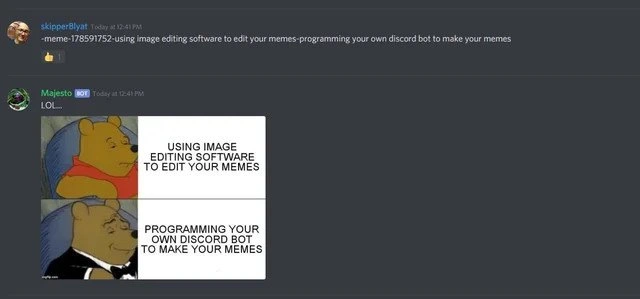
In the meme, the first way is shown with a normal Winnie the Pooh image — that’s the simple approach of just editing the picture yourself. The second way is shown with Winnie the Pooh wearing a tuxedo, looking very fancy — that represents the clever approach of programming a Discord bot (a kind of chat robot) to make the meme for you. It’s funny because the “fancy” method is actually a lot more work upfront! It’s like spending all day building a robot to clean your room instead of just cleaning the room by hand in 10 minutes. Silly, right? 😄 But it also feels cool, because once you have that robot, you can relax and let it do the job anytime.
So the joke is that programmers (people who write code) love to do this: they’ll work really hard to create a tool or machine so that they themselves don’t have to do a boring task repeatedly. It’s an extreme way of being lazy in a smart way. In the end, we find it funny and a bit awesome — the person in the meme skipped using regular tools and built their own helper, which is both over-the-top and genius. It’s saying, “Why just do it the normal way, when I can invent something to do it for me?” And that clever twist makes us smile.
Level 2: Coding Instead of Clicking
Picture a chat room in Discord (a popular community chat app) where people share jokes and images. In the screenshot, one person has typed a special command and a bot responded with a meme image. Discord bots are like little robot accounts programmed to do things automatically when you ask. Here the command looks like -meme:178597152-using image editing software to edit your memes-programming your own discord bot to make your memes 👍. That’s quite a mouthful, but it’s basically the user telling the bot: “Please make a meme using the Winnie-the-Pooh template, with the top text saying ‘using image editing software to edit your memes’ and the bottom text saying ‘programming your own discord bot to make your memes 👍’.” The bot (named Majesto, indicated by the BOT tag next to its name) sees this request and goes “LOL...”, then posts the generated meme image right into the chat.
So what is this meme about? It’s comparing two ways to create a meme:
First way (top panel): Use an image editing software (like Photoshop, GIMP, or even MS Paint) to manually edit your meme. That means you’d take the blank meme image (in this case, Winnie-the-Pooh pictures) and then click around to add text boxes with the captions. This is the normal, everyday method. It’s quick if you know the tool: you type the words, position them on the image, and save the picture. The top text in the meme says “USING IMAGE EDITING SOFTWARE TO EDIT YOUR MEMES” in plain white text, matching this idea of the simple approach.
Second way (bottom panel): Program your own Discord bot to make the memes for you. This means writing code to automate the process. Instead of you opening an app and adding text yourself, you create a script or program that does all that when you send a command. The bottom text of the meme (with Pooh in a tuxedo) says “PROGRAMMING YOUR OWN DISCORD BOT TO MAKE YOUR MEMES”. The joke is that this method is portrayed as the more sophisticated or fancy option (hence Winnie-the-Pooh is wearing a tuxedo, looking very high-class). It’s like saying “I’m too good to do it by hand; I’ll have my custom software handle it.” 😄
On the surface, writing a Discord bot to do something simple like meme creation is overkill. It definitely takes more time and technical know-how upfront than just typing text onto an image manually. But this is a very relatable dev experience: programmers often get a kick out of automating tasks, even the small, fun ones. If a task is repetitive or a bit tedious, a programmer’s mind immediately thinks, “Can I write a script to do this for me next time?” It’s part of the culture in programming and tech. There’s even a popular saying: “Automate All The Things!” which means if you can automate a process (make it run by itself), you should.
In this scenario, making memes might have become a repeat task in that community. Perhaps people frequently share the latest meme formats with custom captions. Doing it by hand each time (open editor, add text, save, upload) can feel tiresome or slow. By coding a bot, the person has streamlined the process. Now anyone on the server can create a meme by just typing one line, and the bot handles the heavy lifting in seconds. It’s faster for the users after the bot is made. And importantly, it’s fun for the coder to build something like that! There’s a sense of accomplishment in saying, “I taught a bot to do this.”
Let’s break down a few terms and what’s happening in simpler words:
Discord: An online platform where people can create communities (servers) and chat via text, voice, or video. It’s very popular among gamers, developers, and many hobby groups. You can add bots to a Discord server which behave like users but are controlled by programs.
Bot: A bot is an automated program that can respond to events or commands. In a Discord server, a bot can listen to messages. If it sees a message formatted in a certain way (like starting with
-meme:), it can trigger some code to run. Here, the bot’s code recognizes the user’s meme command and then generates an image accordingly.Meme template: The image of Winnie-the-Pooh (normal and tuxedo versions) is a known meme format, often used to compare a plain thing vs. a fancier, elegant version of that thing. The bot likely has this template image stored or knows an ID to fetch it (the number 178597152 could be referencing that template internally or via an API).
Automation: This refers to making a process operate automatically. Instead of manual human work each time, you do some setup (write code, configure a system) and then the task can run on its own. The Discord bot is an automation tool in this context: it automates meme creation. The user only has to supply the words, and the bot takes care of finding the image, placing the text, and sending back the final meme.
Now, why is the second way (programming a bot) depicted as the better or more “elite” way in the meme? It’s poking fun at how developers think. Many developers, even though the manual way is faster for one-off tasks, enjoy building tools and scripts. It’s satisfying to say, “I wrote a program to do that for me.” It’s a mixture of pride and convenience. Once the bot is working, making the next meme is incredibly easy — just one command. It’s the initial development that’s hard. This appeals to the idea of “work hard now, so you can be lazy later.” Programmers often call this being “productively lazy” – you put in extra effort upfront to save effort in the long run.
This particular instance might also just be for the fun of it. Coding a meme bot is a neat little project. It uses skills like calling web APIs or using an image processing library. For example, the person might have used a Python library such as discord.py (to interface with Discord) and Pillow (to edit images in code). The code flow would be: the bot sees the -meme command, splits the input text into two parts, finds the Pooh meme template image, writes the first part of the text at the top of the image and the second part at the bottom, then posts that image back to the chat. All of this can happen in a second or two after you hit Enter, which feels kind of magical if you think about it!
There’s also a term mentioned in the tags: yak_shaving_incident. This is a fun term describing a scenario where you end up doing a bunch of extra, possibly unrelated tasks in order to accomplish your original goal. Imagine you want to shave, but to do that you decide you need a better razor, which means you need to go to the store, but to go to the store you need your car, and your car needs gas, so you go to get gas but the gas pump is broken, so you end up fixing the gas pump... and so on. In the end, all you wanted was a shave, but you “shaved a whole yak” worth of tasks to get there. 😅 Here, the goal was just to create a meme image. But the person went down the path of coding a bot (setting up a mini software project) to reach that goal. It’s a comically long path to a simple result, which is why we find it amusing.
To someone without a programming background, writing a bot to do a meme might seem unnecessarily complicated. But in a developer community, this is very much on-brand. Developer humor often celebrates these little over-the-top solutions. It’s a mix of self-mockery (“haha, I really did all that just to avoid opening Photoshop”) and genuine satisfaction (“heck yes, I automated it!”). Plus, now everyone in that Discord server can use the command and generate memes easily — the tool might save collective time if they create memes frequently.
In summary, the meme is funny because it shows a contrast: doing something the easy way versus doing it the geeky way. The easy way is obvious and doesn’t require special skills, while the geeky way requires coding skills and extra effort — but makes you feel like a tech genius. The Winnie-the-Pooh in a tuxedo perfectly captures that “I feel fancy and accomplished” vibe of the second approach. It’s a playful nod to the fact that in tech circles, building your own solution (no matter how elaborate) often earns a thumbs-up 👍 and some laughs, because we all appreciate a clever bit of automation when we see it.
Level 3: Rube Goldberg Meme Machine
This meme highlights a beloved programmer habit: turning a simple task into a coding project just for the thrill of it. In the Discord screenshot, a user triggers a custom command to create a meme, and a bot (Majesto) obliges by generating the image. It’s the classic Winnie-the-Pooh tuxedo meme format: the top panel shows Pooh casually labeling the “normal” way — “Using image editing software to edit your memes”. The bottom panel shows Pooh in a tux (looking smug and sophisticated) with the caption “Programming your own Discord bot to make your memes”. The joke here contrasts two approaches to meme-making:
- Manual method (Pooh normal) – Open Photoshop, MS Paint, or some image editor and add text to the meme by hand. It’s straightforward, low effort each time, and pretty much anyone can do it with a few clicks.
- Automated method (Pooh in tux) – Instead of clicking around, you write a program (in this case a Discord bot) that takes your text and generates the meme image for you. It’s a one-time heavy lift (coding, debugging) but then becomes push-button easy for all future memes.
For seasoned engineers, the humor lies in recognizing ourselves in that tuxedo Pooh. Developers have a tendency to automate everything, sometimes to an absurd degree. Why perform a task manually twice if you can invest the time to script it once? Here, editing a meme is a trivial job, but the developer’s instinct is “I can automate this!”. It’s both hilarious and admirable. We’ve all experienced a form of this: spending an afternoon writing a script to avoid repetitive clicks. This often leads to seemingly over-engineered solutions that make us proud – even if, objectively, the “solution” took more effort than the original task.
In the Discord context, the user skipperBlyat typed a command (something like -meme:178597152-using image editing software...-programming your own discord bot... 👍). That command includes an ID for the meme template (178597152 might correspond to the Winnie Pooh template in a database or API) and the two chunks of caption text. The bot parses this and responds with the generated meme image. In essence, the person built a mini meme-generator service into their chat. This is a real thing developers do in DevCommunity servers: they create custom bots for fun and convenience. Discord’s API makes it possible to program bots that listen for specific commands (like -meme) and respond with dynamic content (like an image with your text). It’s automation culture meets humor – a perfect snapshot of programmer life.
What makes tech folks chuckle is the underlying yak shaving going on. Yak shaving is programmer slang for when you embark on a series of convoluted side tasks in order to accomplish a simple goal. Here, the goal was “make a meme image with text.” Yak shaving path: “set up a Discord bot project, integrate an image generation library or API, test it, deploy it, then use it to make the meme.” It’s a roundabout path — you had to figuratively shave a yak before getting your meme — and yet, it’s strangely satisfying. Every senior dev can recall a yak-shaving incident where a tiny requirement ballooned into writing new tools or systems. We laugh because we’ve been there, and deep down we love the creativity of it.
Another aspect is the virtue of laziness (in the Larry Wall sense). In programming, “lazy” often means you’ll work hard now to avoid work later. That’s what’s happening: the developer spent serious effort coding a meme-bot so that in the future, making memes would be one-second commands with no manual editing. It’s an investment. If making a meme by hand takes 5 minutes, and coding the bot took say 5 hours, then after the 61st meme, the automation actually saves time overall. 🤓 But jokes aside, it’s not just about efficiency; it’s about the cool factor. The meme’s bottom panel (tuxedo Pooh) implies the coder’s approach is intellectually classy. In a community of programmers, rolling your own bot to generate memes feels cooler than using off-the-shelf tools. It shows off skill and gives a sense of ownership (“I made this bot!”).
The Discord bot likely uses an image library or an API under the hood. For example, it might call an external meme-generation service or use a Python library like PIL (Pillow) to draw text on the Pooh image. The 👍 emoji in the command’s text was probably rendered onto the meme as well, emphasizing that the second method gets a thumbs-up of approval. The bot’s quick “LOL...” reply in the screenshot indicates it recognized the command and executed the task, posting the generated meme image in the chat. All this happens in a blink once set up, illustrating the power of automation scripts.
To visualize the code-generated meme process, imagine the bot’s code does something like this: it receives the command, splits the input into top and bottom text, loads a template image, and programmatically places the text on the image. It could be as simple as:
# Pseudo-code for how the Discord bot might handle the meme command
template = load_image("winnie_pooh_template.png") # Pooh meme base image
top_text = "Using image editing software to edit your memes"
bottom_text = "Programming your own discord bot to make your memes 👍"
add_text(template, position=TOP_PANEL, text=top_text) # draw top caption
add_text(template, position=BOTTOM_PANEL, text=bottom_text) # draw bottom caption
meme_image = generate_image_bytes(template)
discord_channel.send(image=meme_image) # bot sends the image back in chat
(In reality, there’s some fiddling with font sizing and line breaks to make it look right, but you get the idea.) The result: the meme is created automatically by the bot and shared with everyone, no Photoshop needed.
Ultimately, this meme resonates with developers because it celebrates that quirky “automate it!” impulse. It’s poking fun at ourselves: yes, we sometimes take the long route with code, but it’s done with a big grin (just like Pooh’s smug face). The table below humorously sums it up:
| Approach | Effort Required | Developer Satisfaction 😎 |
|---|---|---|
| Edit image manually (Photoshop) | Minimal per meme (a few clicks each time). No coding needed. | Low – gets the job done, but nothing fancy to brag about. |
| Write a Discord bot (Automation) | High upfront (coding the bot, one-time). Near zero per meme after that. | High – you built a tool! Feels clever, automates the boring stuff, impresses peers. |
In short, the meme is funny because it’s true: given the choice, many devs will choose the clever, complicated solution over the mundane one, especially if it means they can write some code. It’s both a self-deprecating joke and a celebration of developer creativity. We’re effectively saying, “Why just do it, when you can code it?” — and giving ourselves a 👍 for the effort.
Description
A screenshot from a Discord server in dark mode. A user named 'skipperBlyat' has invoked a bot command to generate a meme. A bot named 'Majesto Bot' responds with 'LOL...' and posts a 'Tuxedo Winnie the Pooh' meme. The first panel shows the standard Pooh with the text 'USING IMAGE EDITING SOFTWARE TO EDIT YOUR MEMES'. The second, more sophisticated panel shows Pooh in a tuxedo, accompanied by the text 'PROGRAMMING YOUR OWN DISCORD BOT TO MAKE YOUR MEMES'. The meme humorously contrasts a simple, manual approach with a complex, automated one, celebrating the developer's tendency to over-engineer solutions. The joke is layered with meta-humor, as the meme itself was generated by the very kind of bot it praises, demonstrating the concept in action
Comments
7Comment deleted
Why do a 5-minute task manually when you can spend 20 hours automating it? That's not procrastination, that's building infrastructure
Senior dev law #42: if a task takes five minutes, spend a weekend automating it - future you might need that time to fix the automation
Ah yes, the classic senior engineer move: spending 40 hours building a Discord bot with image manipulation libraries, CI/CD pipeline, and Kubernetes deployment to save 5 minutes of Photoshop work. Next step: training a GAN to generate memes based on your commit messages
Ah yes, the classic developer dilemma: spend 5 minutes in Photoshop, or spend 40 hours building a Discord bot with image manipulation libraries, CI/CD pipeline, error handling, rate limiting, and a database to track meme templates - because 'it'll save time in the long run.' Bonus points if you then spend the next week refactoring it to use microservices architecture and adding Kubernetes orchestration for that one meme you make quarterly
When your inner architect deems Photoshop insufficient, spin up a Discord bot microservice for meme deployment - because scale starts at silly
Why crop in an editor when you can ship a slash-command pipeline with node‑canvas, rate‑limit backoff, and an SLO for memes/sec - eliminating two clicks with three microservices
Nothing says senior like shipping a ChatOps meme pipeline with rate‑limited retries, idempotent commands, and a 99.9% SLA - just to avoid learning the crop tool