The Ultimate Form of Abstraction: A Pure Energy Selfie
Why is this DevCommunities meme funny?
Level 1: Invisible Selfie
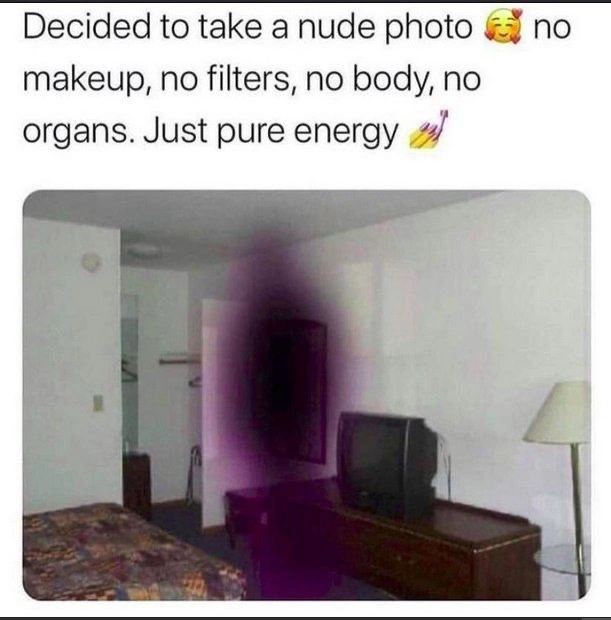
Imagine you tried to take a picture with your friend, but your friend is invisible. 😮 You snap the photo, and when you look at it, you see the room – the bed, the TV, the lamp – but no friend, just a kind of sparkly haze where they should be. That’s what this joke is about. The caption says the person took a “nude photo” with no filters or makeup, and even “no body, no organs – just pure energy!” Of course, in real life nobody can do that; if you have no body, you can’t be in a photo! It’s a silly, absurd idea. The picture shows an empty room with a purple ghost-shape instead of a person. It’s funny because the person is pretending that the purple fog is their true form (just energy!). In simple terms, it’s like taking a selfie when you’re not actually there. The humor comes from how ridiculous it is: we expect to see a person, but we only see nothing. It’s a playful way to say something went missing, kind of like an imaginary friend photo. Even if you’re not a programmer, you can laugh because it’s basically a picture of nothing being bragged about as if it’s something special.
Level 2: Null Pointer Portrait
So what’s actually happening here? In programming, a null pointer (or null reference) is basically a variable that is supposed to link to an object or data, but currently points to nothing (null). Think of it as a signpost that isn’t pointing at any house – it leads to an empty void. When you try to use a null reference in code, you usually get errors or unexpected behavior because there’s no actual object to work with. This meme imagines that scenario as a photograph: the camera tried to capture a person object, but since the pointer was null, the camera had no data (no body) to display. The result is an “empty” photo with just a mysterious purple blur where the person should be. It’s like the program said, “No object found, but here’s some leftover energy or outline.”
For a junior dev or someone learning coding, this is a dramatization of a common bug. For example, say you have a variable user that should hold a User object. If user is null (maybe the data didn’t load or was cleared), and your code does something like display(user.photo), the app won’t know what to show. In a web page, you might see a missing image icon or just an empty space. In our meme’s case, they humorously show a purple silhouette – as if the UI is trying to render something but only the “energy outline” came through. It’s the programming equivalent of an invisible avatar.
Let’s break it down with a mini-code analogy. Imagine this pseudocode for taking a selfie in an app:
let selfieSubject = null; // supposed to reference a Person object, but it's null
if (!selfieSubject) {
console.log("Error: nothing to photograph! Just pure energy remains...");
// The program finds no person object, so it can't display a body.
}
In a real application, failing to check for null could throw an error like TypeError: Cannot read property 'head' of null (since there’s no head or body to show!). That error message is basically the system saying “I tried to find the person’s head, but there was no person – oops.” As developers, part of debugging is figuring out why selfieSubject was null in the first place. Maybe the person object was never initialized, or it got garbage-collected because nothing was referencing it anymore. In managed languages (like Java, C#, JavaScript), if something is null or undefined and you try to use it, you usually get a clear error or just no output. In lower-level languages like C or C++, using a null or freed pointer can lead to undefined behavior – sometimes nothing happens, or the program crashes, or you get spooky glitches (imagine the program printing ghost data from memory).
The meme is tech humor and very relatable because almost every coder has run into a null reference problem. It’s practically a rite of passage: you run your code and some element is just…missing. You stare at the screen wondering if the app is haunted because everything else works except that one thing that’s invisible. Then comes the classic “Ah, I forgot to initialize that object” or “Oops, I didn’t check if that value was null.” Once you realize it, you facepalm and fix the code. This meme playfully visualizes that moment. The phrase “no makeup, no filters, no body, no organs” is an over-the-top way to say nothing is there at all, which in coding terms is a null/undefined value. And “just pure energy” is the joke – as if the app proudly shows some intangible placeholder instead of admitting an object is missing. It pokes fun at our developer experience (DX): we strive to build solid features, but occasionally we end up with an embarrassing empty result, and all we can do is laugh and screenshot it (before fixing it!).
Level 3: No Object, Only Energy
At first glance, this meme is channeling a classic null pointer bug through a cheeky social media twist. The top caption “no makeup, no filters, no body, no organs. Just pure energy” reads like an influencer post gone off the deep end, but to a senior developer it screams “object reference not found.” In the photo, we see a drab motel room with all the expected UI elements (walls, bedspread, dresser, old CRT TV...), except the most important one: the person! Instead, a hazy purple-black aura stands roughly where a human should be, like a glitch in reality. This is basically a void pointer portrait – the camera tried to capture an object (the person), but the pointer was null, so we got a nude null photo. The result: an invisible subject, leaving behind only a ghost artifact of their presence (just “pure energy” in meme-speak).
For experienced devs, this hits on the absurdity of undefined behavior visualized. It’s reminiscent of debugging a UI where a missing DOM element leaves a weird blank space or glowing outline. Ever open a web page and see an empty frame with a faint shadow because an image failed to load? That purple-black aura is exactly that vibe – it’s the spooky silhouette of a component that isn’t there. In game development, missing assets often render as gaudy placeholders (ever seen those neon pink/black checkerboard textures when a model is missing?). Here the aura’s color even hints at that, a nod to how object_not_found_error visuals can look. It’s a literal invisible_bug_visualization: everything is normal except the one thing that’s vanished into the ether.
The humor digs into shared developer trauma: a bug where some object was supposed to be present but got garbage-collected or never initialized. Seasoned engineers have chased these phantom issues in countless debugging sessions. One minute you’re expecting a fully realized UI component; the next minute you’re staring at a blank space (or a funky purple haze) wondering “Where did it go?” 😅. This meme exaggerates that scenario to an engineering absurdity – “no body, no organs” as if every layer of abstraction (and even the concrete data) has been stripped away. It satirizes how we often feel when debugging deep issues: you peel back all the layers of the code (no makeup, no filters…), and sometimes you’re left with nothing tangible – just logs and pure energy (maybe an errant GPU glow?) where the feature should be.
On a more serious note, the meme winks at the notorious history of the null reference in programming. Sir Tony Hoare (who invented the null pointer concept in 1965) infamously called it his “billion-dollar mistake” because of how many bugs and crashes it’s caused. This image is basically that mistake in action – the program tried to take a “selfie” of an object that wasn’t there, and the output is literally nothing. In a robust system, you’d ideally check “if object is not null” before rendering, but we’ve all seen what happens when you don’t: blank UI components, NullPointerException errors, or apps crashing at the worst time. The meme’s relatable humor comes from recognizing this common pitfall and laughing at the ridiculous result here: a glamorized null value strutting like it’s an achievement. It’s developer self-deprecation at its finest – we laugh because we’ve written code that unintentionally produced something this nonsensical. In short, “no object, only energy” is a senior-level inside joke about how a simple debugging_troubleshooting oversight (like not handling a null) can lead to a scene straight out of a sci-fi comedy.
Description
The image displays a meme with a caption at the top followed by a photo below. The caption reads, 'Decided to take a nude photo 😉 no makeup, no filters, no body, no organs. Just pure energy 💅'. The photo is of a somewhat dated and generic room, possibly a motel room, with plain white walls, a patterned bedspread, and a dark wood dresser with an old CRT television on it. In the middle of the room, there is a large, blurry, amorphous dark shape surrounded by a vibrating purple aura, representing the 'pure energy' mentioned in the caption. The meme humorously subverts the social media trend of posting 'natural' or 'unfiltered' photos by taking the concept to an absurd, metaphysical extreme. For a technical audience, it serves as a visual metaphor for abstraction, where all physical implementation details are stripped away to reveal the core essence or logic, much like a serverless function, a piece of pure logic, or a disembodied AI existing without a physical form

Comments
10Comment deleted
This is what a serverless function's `this` context looks like during an existential crisis. No body, no state, just pure, ephemeral energy waiting for an invocation
Took a heap dump after enabling aggressive escape analysis - entire user entity got optimized away, leaving only this violet aura and a stack frame asking where its pointer went
This is what happens when you finally achieve 100% code coverage - you transcend physical form and become one with the abstract syntax tree, existing only as a purple runtime exception in the matrix of production
This is what happens when you take 'zero dependencies' literally - you end up with a deployment so abstract it transcends physical form. It's the architectural equivalent of that senior engineer who insists on rewriting everything from scratch in pure assembly 'for performance,' only to deliver a system that exists purely in the quantum realm of theoretical computer science. Ship it to prod; the users will never notice because technically there's nothing to break
Proof we went full serverless: no containers, no state, no body - just pure energy spikes on the AWS bill
HTML sans <body> tag: no CSS makeup, no JS filters, no renderable organs - just pure canvas energy haunting the void
Finally, a selfie that matches our prod path: a 204 serverless endpoint - no body, no dependencies, no traces; just cold‑start energy and a mysterious cloud bill
Body without organs Comment deleted
complete nudity, age restriction 24+ Comment deleted
noo you had to put spoiler on the image and add disclaimer caption Comment deleted