Skip to content
DevMeme
5980 of 7435
The Real-Life RPG: Turn-Based Combat in Microsoft Outlook
CorporateCulture Post #6549, on Feb 24, 2025 in TG

The Real-Life RPG: Turn-Based Combat in Microsoft Outlook

Why is this CorporateCulture meme funny?

Level 1: Taking Turns to Talk

Imagine you and your friend are playing a game where you can only make a move one at a time. You go, then you stop and wait. Then your friend goes, and they stop and wait. Sounds a bit slow, right? That’s exactly what communicating through email is like! Instead of just talking to each other or texting back instantly, people at work often send emails and then wait for a reply later. It’s like if you wrote your friend a question on a piece of paper, put it in their mailbox, and then a day later they wrote back with the answer. You can’t just keep talking; you have to take turns and be patient.

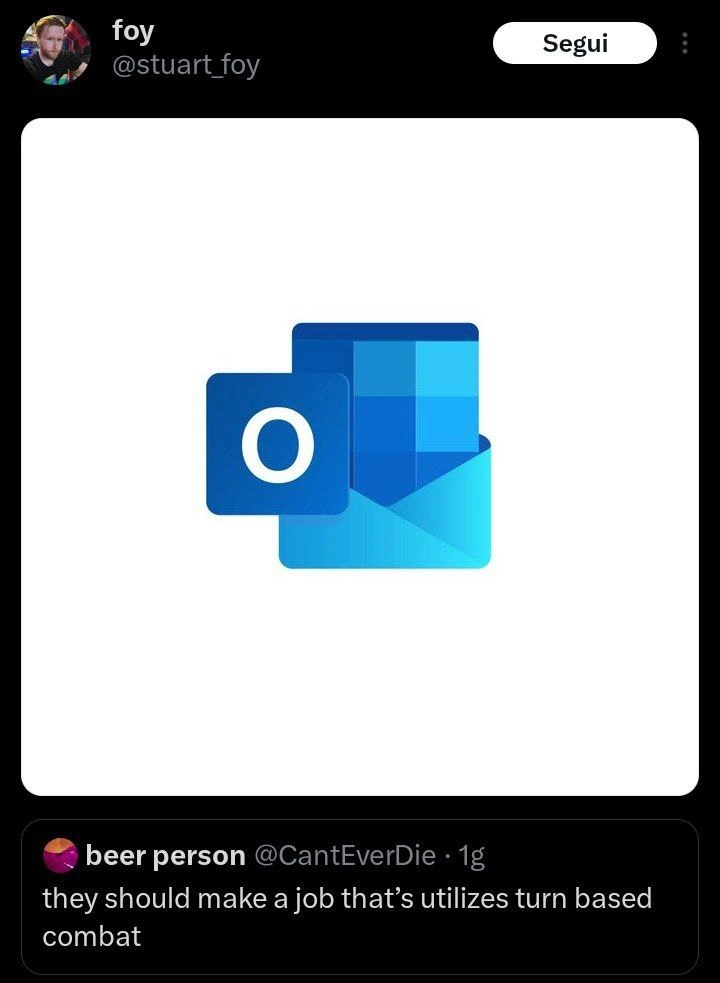
This meme is joking that working in an office and emailing coworkers is basically a turn-by-turn game. The big blue Outlook email logo is used as a funny hint. Outlook is the program many people use to send work emails, so seeing that logo makes us immediately think, “oh, emails at work.” When the person on Twitter says, “they should make a job that uses turn-based combat,” the joke is: well, millions of people already have that job — it’s called having to send emails all day! 😅 It’s funny because we don’t normally think of work as a game, but sometimes waiting for an email feels just like waiting for your turn in a game. In real life, if you need something from someone, you’d usually just ask and get an answer pretty quick. But with emails, everything slows down. So saying office email is like “turn-based combat” is a playful way to describe how slow and step-by-step office conversations can be. It makes us laugh because it’s a little true — work emails can turn a simple chat into a slow-motion match where everyone has to wait for their turn to speak.

Level 2: Email Ping-Pong

Let’s translate this meme for someone newer to the tech office scene. The image shows the Microsoft Outlook logo — that familiar blue envelope with an “O” on it — which represents email, especially in workplaces. Outlook is part of Microsoft’s Office suite, and it’s the program millions of people use every day for sending and receiving work email. Now, beneath that image is a Twitter post where someone says: “they should make a job that utilizes turn-based combat.” The joke here is that such a job already exists: it’s basically an office job where you spend all day dealing with emails. Corporate email communication often feels like each person is taking turns in a slow game, rather than having a quick, real-time conversation. So the meme is humorously implying, “Hey, working with email in Outlook is turn-based combat!”

First, some terminology in plain English:

  • Turn-based combat – This comes from video games (or board games) and means a style of play where you go in turns. Think of a game like Pokémon or chess: you make your move, and then you wait for the other player to make theirs. You can’t both move at the same time; you alternate. It’s orderly, but it can be slow because you have to stop and wait during each turn.
  • Asynchronous communication – A big phrase that basically means “not happening at the same time.” When communication is asynchronous, one person sends a message now, and the other person might respond later when they can. It’s not like a live chat where both people are present and talking simultaneously. Email is a prime example of asynchronous communication: you send an email and might get a reply in a few minutes, a few hours, or even the next day. There’s built-in delay.
  • Microsoft Outlook (corporate email) – Outlook is the email application many companies use for official communication. When someone says “I’ll send it to you in Outlook,” they mean an email is coming your way. It’s a staple of corporate life. People often have to keep an Outlook window open all day just to keep up with incoming messages from bosses, teammates, clients, etc. The Outlook logo showing up in a meme instantly signals “work email” or “office stuff.”

Now, why compare an office job to a turn-based game? Imagine you’re a junior developer and you need your manager’s approval to deploy some code. Here’s how that usually goes via email:

  1. Your turn: You write up an email to your manager: “Hi, can I deploy feature X to production? It’s ready to go.” Then you hit send.
  2. Their turn: You wait. Your manager might be in a meeting or focusing on something else, so an hour (or a day) later, they reply: “Can you also notify the QA team before deploying?”
  3. Your turn again: You see that reply, and now you send another email: “Sure, I will. Should I deploy after QA is notified, or wait for their confirmation?” Send, and wait again…
  4. Their turn: Some time passes, then your manager replies: “Wait for their confirmation. Also, did you get approval from security?”
  5. Your turn, once more: You email back: “I’ll get security approval now, thanks.” Then you go start that process... and so on.

Notice how at each step, you had to wait for the other person to do something before you could move on. That’s the “turn-based” feel. It’s like a game of ping-pong or tennis, but in slow motion: you hit the ball (send an email), then you stand there for a while until the other person hits it back (replies). If either of you gets busy or steps away, the ball just sits there. In a real-time conversation (like an in-person chat or a video call), you’d get those questions and answers sorted out in maybe 5 minutes of back-and-forth talking. But over email, the same interaction can stretch across a whole day or more. That delay and back-and-forth is what we call communication overhead – basically the extra time and effort it takes to coordinate and clarify things because you aren’t communicating instantly.

This meme is poking fun at that exact situation. It’s saying, if someone wants a job with turn-based combat, just work in an office with Outlook emails. 😄 A lot of office humor comes from exaggerating the little frustrations of work life. Here, the frustration (and comedy) comes from how ridiculously slow and formal email exchanges can be. Every professional has experienced waiting for a crucial email that never seems to arrive when you need it. By likening it to a turn-based game, the meme makes a clever observation: even though we’re all using high-tech computers and the internet, our communication can still feel like a snail’s pace battle. For a new developer or someone early in their career, it’s a heads-up wrapped in a joke — be prepared, because a simple conversation with a colleague might sometimes turn into an email chain that feels like an endless round-by-round duel! At least thinking of it as a game makes it a bit more entertaining when you’re hitting “Send” for the tenth time.

Level 3: Turn-Based Office Warfare

In the developer world, comparing corporate email to turn-based combat is both satirical and painfully accurate. The meme shows the Microsoft Outlook logo as a tongue-in-cheek answer to a tweet suggesting a job with turn-based battles. The implication? Such a job already exists — it’s called working in a corporate office and living in your Outlook inbox. Office email, especially in Microsoft-centric workplaces, often feels like a slow RPG battle: you make a move (send an email), then wait... and wait... for the other side to take their turn (reply). Every email thread becomes an exchange of blows in asynchronous time. For those of us who have survived endless email chains, it’s a daily grind that can be as exhausting as any boss fight. Outlook-as-turn-based-combat isn’t much of an exaggeration when you’ve spent more time waiting on replies than writing code. In fact, seasoned devs and project managers sometimes joke that Outlook should come with HP bars and mana potions, given how tactical and draining these email battles can be. Unlike a real game, there’s no epic music in the background — just the dull ping of new email notifications slowly chipping away at your sanity.

On a technical level, this meme highlights the communication overhead of asynchronous workflows. In a turn-based RPG (think Final Fantasy or a D&D campaign), each character must wait for their turn to act. Similarly, with email you can’t get instant feedback; every question or request lives in a queue, pending someone else’s action. This rigid back-and-forth is the opposite of real-time communication. Imagine a critical bug discussion playing out via a long email thread: Developer A sends a status update, waits hours for QA to respond with details, then waits again for the manager’s approval to deploy. It’s like a party of adventurers politely taking turns to attack the monster while the issue (the monster) sits there unfixed. Meanwhile, you’re watching the hours tick by, much as a gamer watches an enemy’s turn play out slowly. By the time everyone has taken their “turn” in the thread, the day is over and the simple fix that could have been resolved in a 5-minute stand-up is delayed until tomorrow. Corporate communication at its finest.

To seasoned professionals, the humor cuts deep because we’ve all been there. That one email thread with twenty people CC’d, spanning several days, just to schedule a meeting — it truly feels like an office boss battle with multiple phases. You start with optimism (“Initiate Project Proposal – Attack!”), then enter the waiting phase (“Boss is considering your move...”), then maybe a surprise counterattack (“Boss casts Reply-All with confusing questions!”) which you have to answer on your next turn. If you’re unlucky, someone goes AFK (away from keyboard) for days — the equivalent of a teammate getting stunned or KO’d. By the end, when the final “Approved, thanks.” email comes through, you’re so battle-weary that it genuinely feels like you slayed a beast. (If only Outlook played a little victory fanfare at that moment!)

Let’s break down the Outlook-as-RPG analogy in true nerdy fashion:

  • Initiative Roll: The first person to send an email essentially gets the first turn. Everyone else has to wait for that initial move before they can respond. Starting an email thread is like rolling highest initiative in D&D – you go first, for better or worse.
  • Turn Cooldown: Once you hit “Send” on your email (your action), you enter a cooldown period. You can’t do much but twiddle your thumbs (or do other work) until the other party uses their turn to reply. It might take minutes, hours, or days – just like waiting for your next turn in a slow turn-based game.
  • Status Effects: Real-life has stun spells too: ever get an Out of Office auto-reply? That’s the equivalent of your opponent being temporarily invulnerable – you’re not getting a reply until they return. You’ve essentially been paralyzed for 3 business days.
  • Area of Effect Attack: Hitting “Reply All” is the email equivalent of casting a giant fireball that hits the entire party. It can be useful (keeping everyone in the loop) or it can cause collateral damage (overflowing everyone’s inbox for no good reason). It’s the notorious AoE attack of office communication – once someone casts it, everyone feels it.
  • Summoning the Boss: Ever see someone loop in a high-level manager or director halfway through an email chain? It’s like a boss character appearing on the battlefield. Suddenly the stakes are higher. Everyone chooses their words carefully, and the tone of the battle shifts because the Big Boss is watching.
  • Critical Hits & Fumbles: An email that magically resolves the issue in one reply – that’s a critical hit. 🎯 Boom, done! Conversely, when someone misreads your email or doesn’t respond at all, it’s a critical miss. You basically have to start the turn cycle over again (“Sorry, let me clarify…”) while your project’s timeline takes the damage.
  • Victory (or Defeat) Screen: Finally, after countless replies, the email thread concludes. Ideally you get what you needed – the bug is fixed, the feature is approved, the meeting is set – victory! You might not get XP and loot, but closing that ticket or completing that task sure feels like leveling up. If things don’t go well (e.g. a misunderstanding leads to more confusion), it can feel like a defeat, sending you back to square one. And unlike a game, you can’t just reload from a save point – you have to live with the email history you’ve written.

By using the Outlook logo and the turn-based combat joke, the meme perfectly captures a piece of office humor that developers and office workers know all too well. It’s funny because it’s true: in many workplaces, trying to get things done through email really can feel like a turn-by-turn slog. Projects get drawn out not by technical complexity, but by the slow pace of replies. It’s the kind of dark humor you develop after waiting at your desk for that one crucial approval email that never seems to arrive. At a deeper level, the meme is nudging us to recognize how absurd this is — we have ultra-fast internet and fancy real-time collaboration tools, yet our daily workflow can still resemble a 90s JRPG battle screen. For the cynical veteran coder, it’s a way to laugh through the pain: embracing the idea that every day in the corporate email trenches is a new turn-based campaign, and you’ve just got to keep hitting “Send” and hoping for a critical hit.

Description

This image is a screenshot of a Twitter exchange. The first tweet, from a user named 'beer person' (@CantEverDie), says, 'they should make a job that's utilizes turn based combat'. Below it is a reply from user 'foy' (@stuart_foy), which consists solely of a large, centered image of the Microsoft Outlook logo. The visual is simple, set against the dark mode of Twitter. The humor comes from the juxtaposition of the gaming concept with a mundane corporate tool. The reply implies that managing an email inbox in a corporate setting, particularly with Outlook, is the real-world equivalent of turn-based combat. Each email is an incoming attack or move from an opponent, requiring a strategic response (reply, delete, forward, ignore). This deeply resonates with senior tech professionals who often feel their workday is a relentless battle against an ever-filling inbox, where prioritizing and responding to messages feels like a strategic, turn-by-turn game
Comments

11
Anonymous ★ Top Pick The most advanced turn-based strategy game isn't Final Fantasy; it's Outlook. You have limited action points (mental energy), status effects (out-of-office replies), and the final boss is a 'Reply All' chain on a Friday afternoon
  1. Anonymous ★ Top Pick

    The most advanced turn-based strategy game isn't Final Fantasy; it's Outlook. You have limited action points (mental energy), status effects (out-of-office replies), and the final boss is a 'Reply All' chain on a Friday afternoon

  2. Anonymous

    Outlook threads are just CQRS for humans: commands and queries split into 74-message chains, eventual consistency measured in business days, and every “Reply All” is a distributed deadlock risk

  3. Anonymous

    After 20 years in tech, I've realized Outlook IS turn-based combat - you take damage from meeting invites, cast 'Reply All' for area-of-effect attacks, and the final boss is always that one stakeholder who schedules Friday 4:30 PM deployments with a critical path through your weekend

  4. Anonymous

    Finally, a job where 'waiting for response' is a legitimate game mechanic. Each email exchange costs one action point, critical hits occur when someone actually reads your documentation, and the final boss is the executive who replies-all with 'Thanks' to a 47-person thread. The real endgame? Achieving inbox zero before heat death of the universe

  5. Anonymous

    Outlook is turn-based combat: retries are “gentle pings,” reply-all is a DDoS, and the OOO autoresponder is the circuit breaker that ends the game

  6. Anonymous

    Corporate email is the original turn-based PvP: idempotent retries, exponential backoff, and the “CC manager” ultimate that ends the fight

  7. Anonymous

    Enterprise UX req: '5+ yrs Segoe UI mastery' - because nothing screams innovation like the OS default

  8. @ZgGPuo8dZef58K6hxxGVj3Z2 1y

    LMFAO

  9. @Le_o_R 1y

    I don't get it.

    1. @Johnny_bit 1y

      E-mail is turn based. Great power up: CC the manager and start with "As per my last e-mail..."

      1. @Le_o_R 1y

        Ty.

Use J and K for navigation