Skip to content
DevMeme
1448 of 7435
The Programmer's Apathetic Bug Fix
Bugs Post #1622, on May 25, 2020 in TG

The Programmer's Apathetic Bug Fix

Why is this Bugs meme funny?

Level 1: Just Don't Do That

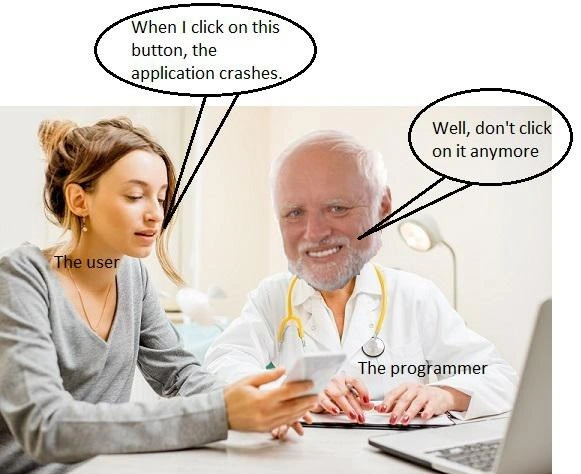
Imagine you’re playing your favorite video game, and every time your character opens a particular door, the entire game freezes and crashes. You go to the game’s maker for help, and their only advice is, “Well, just don’t open that door.” 🤨 See how silly that sounds? They’re not actually fixing the game at all! They’re basically telling you to avoid the part that’s broken. It’s funny in the meme because the programmer (dressed like a doctor) is giving the user advice that completely misses the point. Instead of curing the problem, he says to ignore it: “If clicking that button breaks the app, then just never click it.” That’s like if a doctor told you to stop doing anything that causes pain instead of treating your injury. We laugh because it’s obviously a ridiculous and lazy answer – it’s not how you’re supposed to fix things!

Level 2: The "Don’t Click" Fix

Let’s break down the joke in simpler terms. The image shows a user holding a smartphone and complaining to a programmer (dressed like a doctor) that “when I click this one button, the application crashes.” In real life, a crash means the app suddenly stops working and often closes unexpectedly – definitely not what we want! This is a classic software bug: an error or flaw in the program that causes it to behave badly (here, the bad behavior is a full crash).

Normally, when a user reports a bug like this, a programmer would go into debugging mode: they’d try to reproduce the crash, find out which part of the code is breaking, and then fix the error so it doesn’t happen anymore. Debugging/troubleshooting is basically detective work – the developer needs to figure out why clicking that button is causing a problem. Is it calling a function that doesn’t exist? Is it trying to load data that isn’t there? The developer would use tools like logs (messages the app writes about what it’s doing) or a debugger to step through the code and locate the issue.

However, in this joke, the programmer does something totally inappropriate (and funny in its absurdity): instead of investigating and fixing the bug, he just tells the user not to click that button. In other words, avoid the action that causes the crash. This is the equivalent of saying, “If the app breaks when you do that, just don’t do that!” It’s a lazy bug fix (in fact, it’s not a real fix at all). The user is essentially being told to live with the bug and change their behavior, rather than the programmer fixing the software’s behavior.

Why is this humorous to people in tech? Because it highlights a communication gap and a failure to meet stakeholder expectations in a ridiculous way. The user (who might be a client, customer, or anyone relying on the app) expects the expert – the programmer – to take their problem seriously and solve it. Telling the user “don’t click the button” is the opposite of good customer support or proper engineering. It reminds us of that old joke: “Doctor, it hurts when I move my arm like this.” “Then don’t move your arm like that.” The meme directly draws from this classic gag, but applies it to a software scenario. Here the programmer is like a doctor giving bad medical advice, which is funny because we trust doctors (and programmers) to solve issues, not just tell us to avoid them.

This kind of response is sometimes seen as a tongue-in-cheek joke among developers. It’s a form of frustration humor. Every programmer has encountered bugs that are puzzling or occur for only one user out of thousands. When a fix isn’t immediately obvious, the sarcastic thought might pop up: “Well, if it crashes the app, maybe we just won’t use that feature.” Internally, developers know that’s not an acceptable solution, but joking about it eases the stress for a moment. In practice, no serious developer would close a support ticket by literally instructing the user to avoid a legitimate feature – that would be a huge communication failure and very bad for user satisfaction. Yet, the fact that this meme scenario is recognizable means there’s a grain of truth: sometimes developers (under pressure or feeling lazy) do delay proper fixes and might quietly hope users just don’t stumble on the bug.

Let’s put some definitions in context:

  • Bug: A defect or error in the software code that causes it to behave unexpectedly or incorrectly. Here, the bug is so severe it crashes the whole application when triggered.
  • Crash: This is when the application stops working completely and exits or freezes. It’s one of the worst outcomes from a bug because the user’s work might be lost and the app cannot continue running.
  • Debugging: The process of finding and fixing bugs. If this were handled correctly, debugging would involve checking why clicking that button causes a crash and then changing the code to prevent it. Perhaps the programmer would discover, for example, that the button’s code tries to divide by zero or access something that isn’t set up, and they’d fix that mistake.
  • Workaround: A temporary solution or a way for users to avoid triggering the bug. Saying “don’t click the button” is a kind of workaround (a very unhelpful one). In professional settings, a developer might provide a real workaround like, “Until this is fixed, you can use Menu > Option B to do the same task instead of that button.” In our meme, the “workaround” is literally do nothing, which is why it’s funny.
  • Stakeholders/Clients: These terms refer to people who have a stake in the software – often the users or customers. They expect the software to work and their feedback (like bug reports) to be acted upon. The meme highlights a failure in handling stakeholder feedback properly. The client (user) is not being respected here; their issue is being brushed off.

So, the humor for a junior developer or someone new to this field lies in the ridiculous mismatch of expectations. The user did the right thing by reporting the problem. The programmer’s job is to fix the software bug. But instead, the programmer gives an answer that sounds like a joke: “Problem solved – just don’t use that problematic part!” It’s a bit of developer humor that pokes fun at situations where fixes are hard or when a developer might be tempted to take an easy way out. It teaches, by extreme example, that ignoring a bug is not a fix. In fact, this kind of response would likely make a user pretty upset (“Are you serious? That’s your solution?!”). Good communication and proper troubleshooting would mean acknowledging the bug, apologizing for the inconvenience, and working on an update to fix the crash. The meme exaggerates the wrong approach to remind us why that’s laughably not okay.

Level 3: The WONTFIX Cure

In this meme’s scene, a frustrated user reports a bug:

User: “When I click on this button, the application crashes.”
The programmer, playing doctor, responds:
Programmer: “Well, don’t click on it anymore.”

This humorous exchange spotlights a notorious anti-pattern in software maintenance: the lazy bug resolution. Instead of performing proper debugging (investigating why the crash happens) and delivering a fix, the developer prescribes avoidance. It’s essentially a WONTFIX remedy – in bug-tracker jargon, that means deciding not to fix the issue and often providing a workaround. Here the workaround is absurdly simple: eliminate the symptom by not invoking the buggy code path at all. The programmer’s advice is akin to marking the bug report as “Resolved: Won’t Fix – user instructed to avoid triggering it.” This approach utterly sidesteps any root cause analysis.

From a senior developer’s perspective, this scenario is a textbook example of what not to do. A crashing application is a serious bug – it could be an unhandled exception (like a NullPointerException or a failed assertion) whenever that button’s handler runs. A responsible dev would dive into stack traces, reproduce the error, and trace the fault in code (perhaps the button triggers a function that references something null or tries an invalid operation). By contrast, our meme’s programmer essentially says, “Let’s pretend that feature doesn’t exist.” It’s a form of symptom suppression: if the user never clicks the problematic button, the app will appear stable. After all, a program can’t crash if the buggy code never executes, right? 😏

This dark humor resonates with experienced engineers because it parodies real situations. Under tight deadlines or overwhelming debugging frustration, some teams have indeed shipped software with instructions like “Known Issue: app may crash if you do X; workaround: avoid doing X.” It highlights a communication gap and a failure in meeting stakeholder expectations. The user (stakeholder/client) expects the developer to heal the app, much like a patient expects a doctor to cure an ailment. Instead, the developer-doctor offers a quack solution. It’s software malpractice – a quick patch in the form of advice rather than a code fix. In a professional setting, telling a client “don’t use that feature” would come off as facetious or even negligent. Yet, in moments of exasperation, devs joke about these non-fixes as the simplest “solution.”

We also get an extra wink from the image: the programmer is depicted with a genial, knowing grin (the same expression as the “Hide the Pain Harold” meme face). That smile says it all – even he internally recognizes how ridiculous his guidance is. It’s the face of a battle-weary engineer who has perhaps seen one too many impossible bug reports. The humor cuts close to home because any senior developer can recall a scenario where a higher-up or teammate half-jokingly said, “Maybe we just tell them not to click that until next release.” It’s a cynical coping mechanism. Of course, we know the right answer is to fix the code, but the meme captures that gap between knowing best practices and sometimes feeling unable (or unwilling) to follow them in the moment.

From an architectural standpoint, advising “don’t click it” is equivalent to deprecating that UI element on the spot. If the developer were to implement this advice in code, it might look like a no-op function or a return statement at the top of the event handler, effectively disabling the button’s functionality:

// Quick hack: neutralize the crashy button
document.getElementById("crashButton").addEventListener('click', () => {
    return;  // do nothing on click to avoid the known crash
});

This snippet is the programmatic version of “don’t click it” – it ensures clicking the button does nothing at all, thereby avoiding the crash without actually solving whatever underlying problem caused the failure. The bug still exists in the code; we’ve just cordoned it off. This is akin to putting police tape around a hole in the ground instead of filling it. Experienced devs recognize this as technical debt: if you leave that hole unfilled (bug unfixed), someday someone will remove the tape or accidentally step in. In software terms, eventually another user or scenario will hit that same issue, especially if the communication of “do not use” isn’t passed along.

In summary, at the senior level, this meme is both a facepalm and a chuckle. It exaggerates a real temptation in software maintenance – to resolve a bug report by treating the user’s behavior, not the code, as the problem. It underscores the importance of true debugging & troubleshooting. We laugh because we’ve all known that one bug that was so pesky or low-priority that someone joked, “maybe we just tell them to avoid it.” The humor lands on the shared understanding that good engineering means finding real solutions, not just telling the user to work around our mistakes. It’s the perfect satire of a developer–user communication failure: a cure that’s worse than the disease (or rather, not a cure at all).

Description

This meme uses the 'Hide the Pain Harold' stock photo character, who is photoshopped into a doctor's uniform and labeled 'The programmer'. A young woman, labeled 'The user', is showing him her phone. The user says, 'When I click on this button, the application crashes.' The programmer, with Harold's iconic strained smile, replies, 'Well, don't click on it anymore.' This meme is a visual representation of the classic joke, 'Doctor, it hurts when I do this,' where the doctor replies, 'Then don't do that.' It humorously portrays a common frustration developers have with bug reports, and the cynical, dismissive response they sometimes wish they could give. It speaks to the feeling of being overwhelmed with bugs and resorting to suggesting the user simply avoid the problem area, which is relatable to any developer who has dealt with a particularly tricky or low-priority bug
Comments

7
Anonymous ★ Top Pick That's not a bug, it's a feature. The feature is to teach the user restraint
  1. Anonymous ★ Top Pick

    That's not a bug, it's a feature. The feature is to teach the user restraint

  2. Anonymous

    RCA complete: that button is now a Schrödinger feature flag - so long as nobody clicks it, uptime is 100% and the SLO dashboard stays green

  3. Anonymous

    After 20 years in this industry, I've learned that "Won't Fix" is just "Works As Designed" for bugs that survived three sprint plannings and a reorg

  4. Anonymous

    The classic 'works on my machine' defense has evolved: now we just tell users which features to avoid. It's not a bug, it's an undocumented user restriction. This perfectly captures the eternal tension between 'reproducible crash' and 'acceptable workaround' - where the cost of fixing a UI bug gets weighed against simply training users to navigate around it. Every senior engineer has been Harold at least once, smiling through the pain while mentally calculating whether this ticket is worth disrupting three layers of legacy code that nobody dares touch anymore

  5. Anonymous

    The ultimate CAP theorem concession: Prioritize button unavailability over consistency fixes

  6. Anonymous

    Enterprise reliability hack: convert the P0 into a product decision - hide the button behind a flag, close the Jira as “won’t fix,” and watch crash-free sessions hit 100% without touching a line of code

  7. Anonymous

    Classic P1 triage: rename the crashy button “Advanced,” hide it behind a 0% feature flag, and mark the incident mitigated

Use J and K for navigation