Skip to content
DevMeme
4313 of 7435
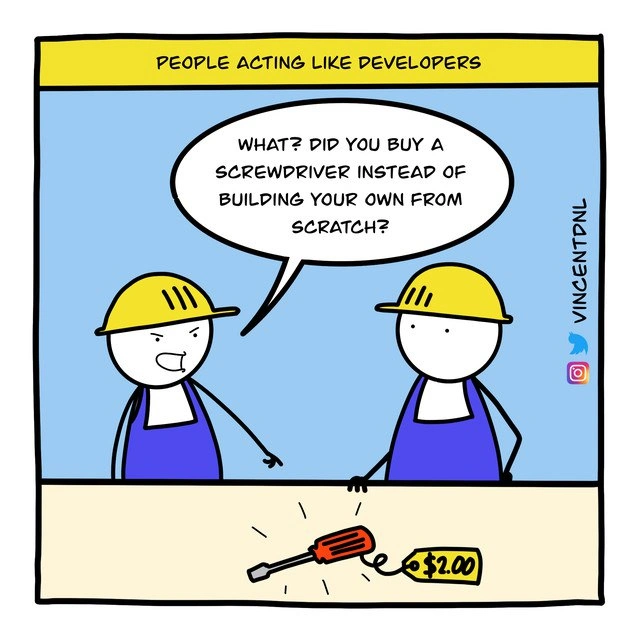
Dev mindset: shocked you bought a $2 screwdriver instead of coding one
Dependencies Post #4715, on Aug 1, 2022 in TG

Dev mindset: shocked you bought a $2 screwdriver instead of coding one

Why is this Dependencies meme funny?

Level 1: Don’t Reinvent the Wheel

Imagine you need a basic tool, like a pencil to write with. You could just grab a pencil from the store for a dollar. Now picture a friend gasping in disbelief because you didn’t chop down a tree and make your own pencil by hand. Sounds silly, right? Of course it does! It would take you ages to carve the wood and shape the graphite, while a store-bought pencil works instantly. This meme is joking about the same kind of silly idea, but with programmers: it’s making fun of people who try to make everything themselves instead of using an easy, cheap solution that’s already available. It’s funny because using a ready-made tool (like buying a $2 screwdriver) is so obviously the quick and sensible choice. The shocked construction worker in the comic acts like it’s wrong not to do the huge extra work. That upside-down reaction is the joke. In simple terms, the cartoon is saying: “Sometimes, programmers behave as if they must build a whole new tool from scratch even when a perfectly good one is right there on the shelf.” And just like you’d laugh at someone who insists on reinventing a pencil or a wheel, it’s pretty funny to see a developer do tons of unnecessary work when a $2 fix was right in front of them.

Level 2: Build vs Buy Dilemma

This cartoon uses construction workers to poke fun at developers’ habit of “reinventing the wheel.” One worker is shocked that the other simply bought a screwdriver instead of making one himself. In software terms, that’s like being surprised someone used an existing library or tool instead of coding their own from scratch. It highlights the Build vs. Buy decision developers face: do you build your own solution in-house or buy/borrow an existing one? Here, buying a $2 tool is equivalent to adding a dependency to your project instead of writing new code.

Let’s break down the concepts:

  • Dependency: In programming, a dependency is any external code or library your project relies on. For example, if you use a popular image-processing library to handle photos in your app, that library is a dependency. It’s code you didn’t write, but you include it to save time. Some developers hesitate to add dependencies, fearing they might introduce bugs or that they won’t have control over that code. In the meme, buying a screwdriver is like taking on a dependency (you didn’t forge the metal yourself, you’re trusting the store-bought tool).
  • Not-Invented-Here Syndrome: Often shortened to NIH, this is a mindset where people avoid using external solutions just because someone else made them. A developer with NIH syndrome might say, “I won’t use XYZ library because we didn’t build it internally.” They often prefer to create their own version, believing it will be better or just wanting to have full control. This can lead to ReinventingTheWheel – doing work that’s already been done well by others. It’s as redundant as reinventing a screwdriver that you could simply purchase.
  • Reinventing the Wheel: This is a common phrase meaning to create something from scratch that has already been invented. In coding, it refers to writing code for a solved problem instead of reusing existing solutions. For instance, if a beginner programmer writes their own sorting function or web server when reliable ones already exist, they’re reinventing the wheel. It’s usually seen as wasted effort unless you’re doing it as a learning exercise.
  • Overengineering: This means designing a solution that is far more complicated or ambitious than necessary. If a task could be solved with a simple script, but a team instead builds a whole framework, that’s overengineering. The meme’s scenario – building a simple screwdriver from scratch – is a perfect analogy for overengineering. It’s using far more effort than needed for a basic task.

Relatable example: Suppose you’re a new developer building a website and you need to add user login. You have two choices: use an existing authentication service (like a library or an API) or write your own login system from the ground up. The build vs buy dilemma kicks in here. Many juniors think, “I can write the login logic myself!” – and you can, but it’s tricky. You’d have to handle storing passwords securely, managing sessions, resetting passwords, etc. There are libraries that already handle these things (battle-tested for security). If you choose to build it yourself without a really good reason, you might spend weeks on something that an existing tool could do in minutes. That’s the software equivalent of spending days forging a screwdriver blade and handle in your garage instead of picking one up at the store.

Another everyday coding example is sorting a list of data. Every programming language has a built-in sort function or library. A junior dev might not know that and attempt to write their own sorting algorithm. For learning, that’s fine, but doing so in production code is usually unnecessary. For instance:

# Reinventing the wheel: custom sorting vs using built-in sort

numbers = [5, 2, 9, 1]

# Developer writes their own sorting (bubble sort as an example)
for i in range(len(numbers)):
    for j in range(len(numbers) - 1):
        if numbers[j] > numbers[j+1]:
            numbers[j], numbers[j+1] = numbers[j+1], numbers[j]  # swap

print("Custom sorted list:", numbers)

# Using the built-in sort (Python's TimSort under the hood, already optimized)
numbers = [5, 2, 9, 1]
numbers.sort()
print("Built-in sorted list:", numbers)

In the code above, the first part manually implements a simple sorting algorithm. The second part uses Python’s one-liner sort() function. The built-in is clearly easier and likely more efficient. Similarly, writing your own tool in software is almost always more work than using an existing one.

Why do developers sometimes choose to build from scratch then? There are a few reasons:

  • Learning and Fun: A newbie might reinvent something (like coding a game engine or a web server) as a learning exercise or for the challenge. They might not intend to outperform established tools, they just want to understand how it works under the hood.
  • Customization: Sometimes the available tools don’t do exactly what a developer needs. By building their own, they can tailor it to their specific use case. In the screwdriver analogy, maybe they think, “I need a very special screwdriver shape that no store sells, so I’ll make it.” In software, this is valid only if your needs truly are unique.
  • Avoiding Dependencies: Every added library is another thing that can break or become outdated. Some teams are cautious about relying on third-party code (what if the maintainer stops updating it, or a supply-chain vulnerability appears?). The infamous left-pad incident on npm, where a tiny utility library’s removal broke thousands of projects, is a lesson in dependency risk. This makes some developers say, “Let’s not depend on others, we’ll implement it ourselves so it’s under our control.” It’s a trade-off between convenience and control.
  • Company Culture: In some organizations, there’s pride in inventing things in-house. A company might discourage use of external code due to IP, licensing, or the “not invented here” culture. This can lead to multiple teams writing similar code from scratch in silos, which isn’t very efficient but happens more often than you’d think.

As a junior developer, it can be confusing. You might wonder, should I use the library, or impress everyone by coding it myself? The general professional advice is: don’t reinvent the wheel without a good reason. Established libraries and tools exist because many people collaborated to make them robust. Especially for critical things (like encryption, database engines, web frameworks), using tried-and-true solutions is safer. There’s even a common saying: “Don’t roll your own crypto” – meaning never try to write your own encryption algorithm, because it’s almost guaranteed to be weaker than the industry-standard ones.

The meme is relatable because every developer has faced (or witnessed) this dilemma. Maybe early in your career, you wrote a custom function for something, only to later discover a built-in function or package that does the same thing more reliably. It’s a facepalm moment 🤦‍♂️. Over time, you learn when it’s appropriate to build custom and when it’s smarter to rely on the rich ecosystem of tools out there. The two construction stick-figures make this lesson visual: one acts like the overzealous dev who can’t believe someone didn’t over-engineer a simple task. The humor comes from how exaggerated it is – a screwdriver is so simple and cheap that building one is obviously silly. It drives home the point: in software, as in construction, using the right ready-made tool usually beats making your own from scratch when you don’t have to.

Level 3: Reinventing The Screwdriver

Picture a developer who refuses to use anything they didn’t personally code. This meme nails that exact quirk. The cartoon shows two hard-hat workers—“People acting like developers”—and one is flabbergasted:

“WHAT? DID YOU BUY A SCREWDRIVER INSTEAD OF BUILDING YOUR OWN FROM SCRATCH?”

This absurd question satirizes the classic Not-Invented-Here Syndrome. In software, Not-Invented-Here (NIH) is the reflex to reject existing solutions (libraries, tools, services) and instead reinvent the wheel with in-house code. Here, a $2 screwdriver is a perfect, cheap solution (analogous to a readily available library). But the shocked worker represents that one engineer who’d rather spend weeks coding a screwdriver from raw metal 😅. It’s a pointed jab at overengineering and the build vs buy debates in tech.

In real projects, this mindset leads to overengineering: solving a simple problem in an overly complex way. Why use a well-tested library when you can pour man-months into writing your own bug-ridden version, right? Sarcasm intended! The humor hits home because experienced devs know the pain:

  • Teams reinventing their own logging frameworks instead of using log4j or logging because “ours will be better.”
  • A startup coding a custom payment system from scratch instead of integrating a proven API, only to discover the myriad of edge cases the hard way.
  • That colleague who insists on making a custom CSV parser even though one comes in the standard library, and then spending days chasing parsing bugs that the off-the-shelf tool solved years ago.

Behind the joke is a real trade-off. Building your own tool gives a sense of control and maybe fits your exact needs, but it costs a ton of developer time and can introduce glaring bugs. Using a dependency (a third-party library or service) is like buying that $2 screwdriver: cheap and quick, though you didn’t craft it yourself. The NotInventedHereSyndrome often stems from ego (“We can do better”), mistrust of external code (security or quality fears), or simply the fun of a DIY project. But as grizzled veterans know, maintaining that custom solution becomes a nightmare at 3 AM when it breaks and only you know how it works. Why wake up to fix a homebrew screwdriver when you could have just bought one that never fails? 🛠️

Let’s summarize the Build vs Buy decision with a touch of cynicism:

Approach Pros (😃) Cons (😩)
Build from scratch Full control, tailor-made solution,
Bragging rights for the team.
Huge time investment, likely to repeat known bugs, ongoing maintenance burden.
Use existing tool Immediate solution, well-tested by community,
frees you to focus elsewhere.
Not a perfect custom fit, reliant on external updates, “not invented here” pride hit.

In the meme, the construction worker’s shock is what makes it funny. He reacts as if buying a cheap ready-made tool is a bizarre, foolish move. That’s the inversion of reality that developers recognize: in tech forums and dev teams, you’ll actually find folks who scoff at using something off-the-shelf. Seasoned engineers chuckle (or groan) because they’ve seen this drama play out. The meme exaggerates it with a physical metaphor—literally coding your own screwdriver—to highlight just how ridiculous the habit can be. It’s a comedic reminder that sometimes spending $2 is smarter than sinking hours into coding your own screwdriver library. In other words: don’t overengineer a solution that already exists. Use the darn screwdriver!

Description

Single-panel cartoon with a yellow header that reads "PEOPLE ACTING LIKE DEVELOPERS." Two stick-figure construction workers in yellow hard-hats and blue overalls stand behind a beige workbench. The worker on the left, mouth agape, says in a speech bubble: "WHAT? DID YOU BUY A SCREWDRIVER INSTEAD OF BUILDING YOUR OWN FROM SCRATCH?" On the bench lies a red-handled screwdriver attached to a yellow price tag that says "$2.00." The artist’s handle "VINCENTDNL" and small Twitter/Instagram icons are on the right border. The comic satirizes the Not-Invented-Here mentality and build-vs-buy debates in software engineering, equating a simple $2 hardware purchase to re-implementing existing libraries or tools from scratch

Comments

10
Anonymous ★ Top Pick Why buy a $2 screwdriver when we can burn two quarters building a cloud-native ScrewdriverService, debate hex vs. Torx over three architecture reviews, deploy it on k8s, and still need a pager rotation because it occasionally cross-threads in prod?
  1. Anonymous ★ Top Pick

    Why buy a $2 screwdriver when we can burn two quarters building a cloud-native ScrewdriverService, debate hex vs. Torx over three architecture reviews, deploy it on k8s, and still need a pager rotation because it occasionally cross-threads in prod?

  2. Anonymous

    The irony is we'll spend 40 hours building a custom date picker to avoid a 2KB dependency, then wonder why our sprint velocity is measured in geological time scales

  3. Anonymous

    This perfectly captures the 'Not Invented Here' syndrome that plagues our industry - where we'll spend three sprints architecting a custom logging framework instead of using the battle-tested library that costs less than a coffee. The real kicker? That $2 screwdriver probably has better documentation, fewer edge cases, and won't need maintenance when you're on vacation. Sometimes the most senior move is recognizing that your time debugging a homegrown solution is worth more than the ego boost of building it yourself

  4. Anonymous

    Build vs buy: the $2 screwdriver lacked SSO and Prometheus, so we shipped Screwdriver-as-a-Service - 12 microservices, event-sourced torque, and a new on-call rotation that still strips screws

  5. Anonymous

    Buy the $2 screwdriver - it's the npm package with a million downloads; your from-scratch version? Straight to eternal on-call maintenance hell

  6. Anonymous

    We skipped the $2 screwdriver to avoid vendor lock‑in and now maintain Screwdriver Platform™ - three microservices, SOC 2 scope, an on‑call rotation, and still no P99 under a quarter‑turn

  7. @JoseAngelSanchez 3y

    Is this a JavaScrew dev?

  8. @amadare42 3y

    yes, but in real world not every screwdriver is monstrosity that designed to also be used as wrench, hammer and scissors. Purposely-made screwdriver that feels great in hand and applies to required screws perfectly could be much better tool.

    1. @RiedleroD 3y

      on the other hand, however: don't buy single eggs in plastic wrapping. There's so many packages for trivial things…

  9. @azizhakberdiev 3y

    He doesn't need a screw, he can find ready solution at ScrewOverflow

Use J and K for navigation